
Table of Contents
- When are tables taught in school?
- Understand before reciting
- How to read a multiplication chart
- The actual number of facts to memorize
- Tips and tricks, table by table
- Reviewing with boxes to avoid repeating everything
- How to prepare flashcards?
- A mind map to connect all the tips
- Games to practice without worksheets
- Keeping it fun along the way
- Frequently asked questions
To memorize multiplication tables, children must first understand what multiplying means, then rely on a few simple tricks: that leaves only a tiny handful of facts to truly memorize. Seven times eight… fifty-six? Fifty-four? For many children, multiplication tables feel like a mountain of one hundred facts to learn by heart. The good news is that this mountain is much smaller than it looks. Here is a step-by-step method, card games, and a short quiz to practice a few minutes every day.
When are tables taught in school?
The math curriculum for Cycle 2 (grades 1 to 3, ages 6–9), updated for 2025, specifies that learning multiplication tables is spread progressively across 2nd grade (CE1, ages 7–8). The first known facts serve as building blocks to construct others. Memorization may still be partial at the end of 2nd grade; it is strengthened during 3rd grade (CE2, ages 8–9).
The goal is to know the tables "both ways". It is not just about answering 9 × 6, but also finding the missing number in 7 × … = 42. By the end of 3rd grade (CE2), students should recall these equations automatically without recalculating every time. If your 2nd grader (CE1) still hesitates, don't worry: time is a natural part of learning.
Understand before reciting
Reciting "three times four twelve" without knowing what it represents is fragile: at the first memory lapse, your child has no way to figure out the answer. Start by showing what multiplication actually is. Using dried beans, counters, or building blocks, ask them to make "3 rows of 4". They count and see 12. Then rotate the rectangle: now it's 4 rows of 3, and still 12.
This discovery changes everything: every result learned counts twice. You can also offer everyday situations: "There are 4 plates with 3 cookies on each plate, how many cookies in total?" To extend this work with numbers, ideas from our article on mental math games for kids complement this practice wonderfully.
How to read a multiplication chart
A multiplication chart, or 1 to 10 grid, is read by crossing a row and a column. To find 4 × 6, follow the row for 4 to the column for 6: the answer, 24, lies at the intersection. The chart is a reference guide for checking answers, not a drill tool to recite. You can also ask your child to fill it in themselves, box by box, using the tips in this article. The sticky facts, like 6 × 8 or 7 × 8, then become the precise list of facts to review, and a fully completed grid shows at a glance what has been mastered.
The actual number of facts to memorize
A 1 to 10 grid contains 100 multiplication facts. But by building on what your child already knows, the number of facts to memorize melts away quickly. The chart below tracks this breakdown step by step: it is precise, and you can verify it on any grid.
Source: calculation made by Hepaly on the 1 to 10 multiplication grid
View chart data
| What the child already knows | Remaining results | Breakdown |
|---|---|---|
| Full grid (1 to 10) | 100 | starting point |
| 3 × 4 = 4 × 3 | 55 | each fact counts twice |
| + 1s and 10s tables | 36 | the easiest ones |
| + 2s and 5s tables | 21 | doubles and halves |
| + 9s table (finger trick) | 15 | finger trick |
| + squares (3 × 3… 8 × 8) | 10 | remember as "twins" |
| + ×4 = double the double | 6 | 6 results remaining |
The last six results are 3 × 6 = 18, 3 × 7 = 21, 3 × 8 = 24, 6 × 7 = 42, 6 × 8 = 48, and 7 × 8 = 56. These are the ones that deserve special practice.
Tricks, table by table
The 1s and 10s tables
Multiplying by 1 changes nothing, and multiplying by 10 adds a zero to the right of a whole number: 10 × 7 = 70. These two tables can be understood in a few minutes and build confidence.
The 2s table: doubles
Two times a number is simply its double. Kids often already know doubles from playing dice or counting fingers: 6 + 6 = 12, so 2 × 6 = 12.
The 5s table: half of 10
Five times a number is half of ten times that number: 5 × 8 = half of 80, which is 40. Another helpful benchmark: the minute hand on a clock moves forward by 5 minutes with every number, which links the 5s table to learning to tell time.
The 9s table: finger tricks
Place all ten fingers flat on the table. For 9 × 4, bend down the fourth finger starting from the left: you have 3 fingers before it (3 tens) and 6 fingers after it (6 ones), giving 36. This trick works from 9 × 1 to 9 × 10. For older kids, another strategy is to compute 10 times the number and then subtract the number once: 9 × 7 = 70 − 7 = 63.
The 4s table: doubling the double
For 4 × 7, double 7 (14), then double it again (28). This trick relies on the 2s table your child already knows.
Square numbers and the last six facts
Square numbers (3 × 3, 4 × 4… up to 8 × 8) are easy to remember as "twins." For the six remaining facts, teach your child to build them from a fact they already know: 6 × 7 is 5 × 7 + 7, so 35 + 7 = 42; 7 × 8 is 7 × 7 + 7, so 49 + 7 = 56. Rhymes like "5, 6, 7, 8: 56 is 7 × 8" also help many children.
Box review: stop repeating what's already mastered
Reviewing the whole 7s table every evening is tiring and doesn't focus on actual tricky spots. Try the box method instead: write each difficult multiplication problem on a flashcard with the answer on the back. Box 1 cards are reviewed every day, Box 2 cards every three days, and Box 3 cards once a week. A correct answer moves the card up a box; a mistake moves it back to Box 1, with zero fuss.
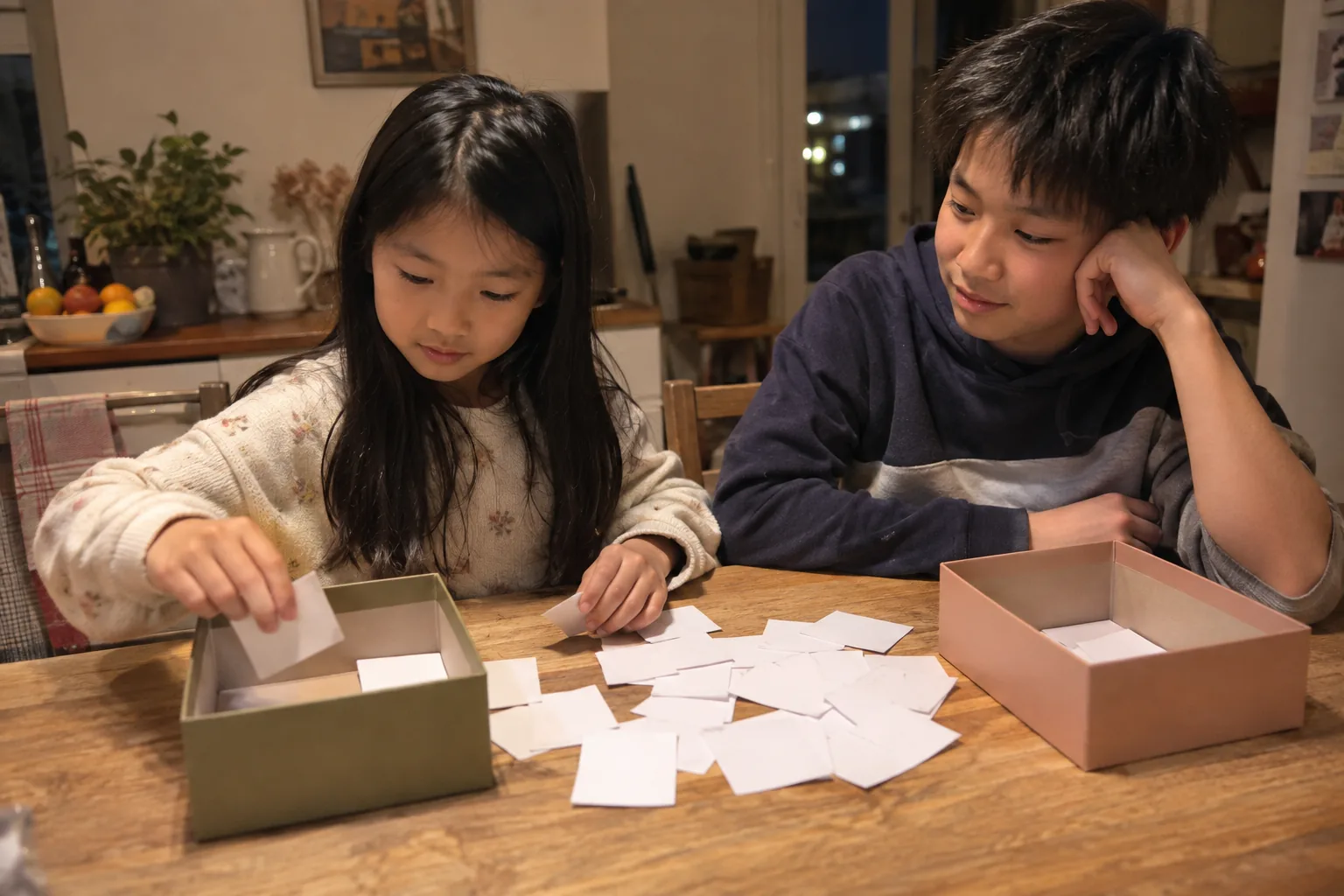
This spaced repetition concept avoids spending time on what is already learned. The content of the boxes changes based on observed answers; no timeline guarantees a box will become empty.
How to make multiplication flashcards that help explain an answer?
Write the problem on the front, then the result and a visual clue on the back. A card can be used to search, verify, and explain; it shouldn't become a mandatory speed drill. The following examples are sample materials whose calculations have been checked separately.
| Front | Possible clue on the back | Answer |
|---|---|---|
| 7 × 8 | 5 × 8 + 2 × 8 | 56 |
| 6 × 7 | 5 × 7 + 1 × 7 | 42 |
| 8 × 9 | 10 × 9 − 2 × 9 | 72 |
What should you do after a random guess?
Turn the card over and ask which hint your child would like to use. They can draw groups, use a familiar multiplication fact, or read the back. Then place the front side up again for another try, without requiring an immediate response. A single correct guess doesn't prove that the result will be remembered later.
How to choose the next cards?
Keep a few facts that are still tricky alongside others that are already mastered. Don't move a card up just because your child recited it after reading the back. Adjust the frequency based on what you observe; boxes organize review sessions, but they don't promise mastery within a set timeframe. If your child gets tired, reduce the set or stop. The interactive challenge in this guide offers another way to practice without replacing reasoning.
A mind map to connect all the tricks
A mind map lets you see all the tricks at a glance. On a large sheet of paper, write "Multiplication Tables" in the center, then draw one branch for each group: 1 and 10, 2 (doubles), 5 (half of 10), 9 (fingers), 4 (double the double), squares, and the six tricky facts: 3 × 6 = 18, 3 × 7 = 21, 3 × 8 = 24, 6 × 7 = 42, 6 × 8 = 48, and 7 × 8 = 56. On each branch, your child writes the trick in one sentence with an example: on the 5 branch, "5 × 8 is half of 80, which is 40." For younger kids, the adult writes and the child draws; older kids can write everything themselves. You can build the map over several weeks and hang it near their desk to check before review sessions.
Games to practice without worksheets
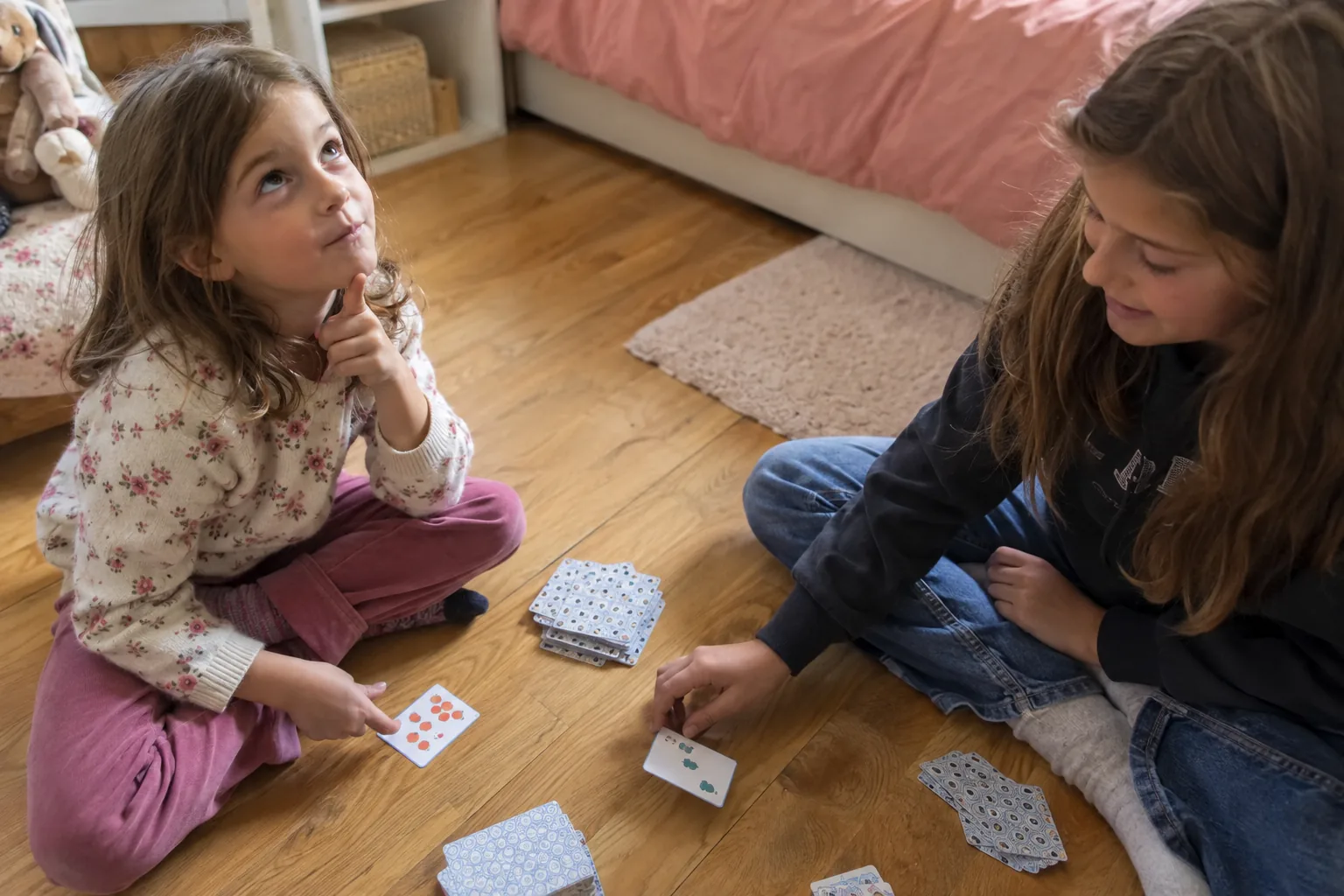
Multiplication tables stick really well through play, as long as games stay short. Here are a few ideas tested by families:
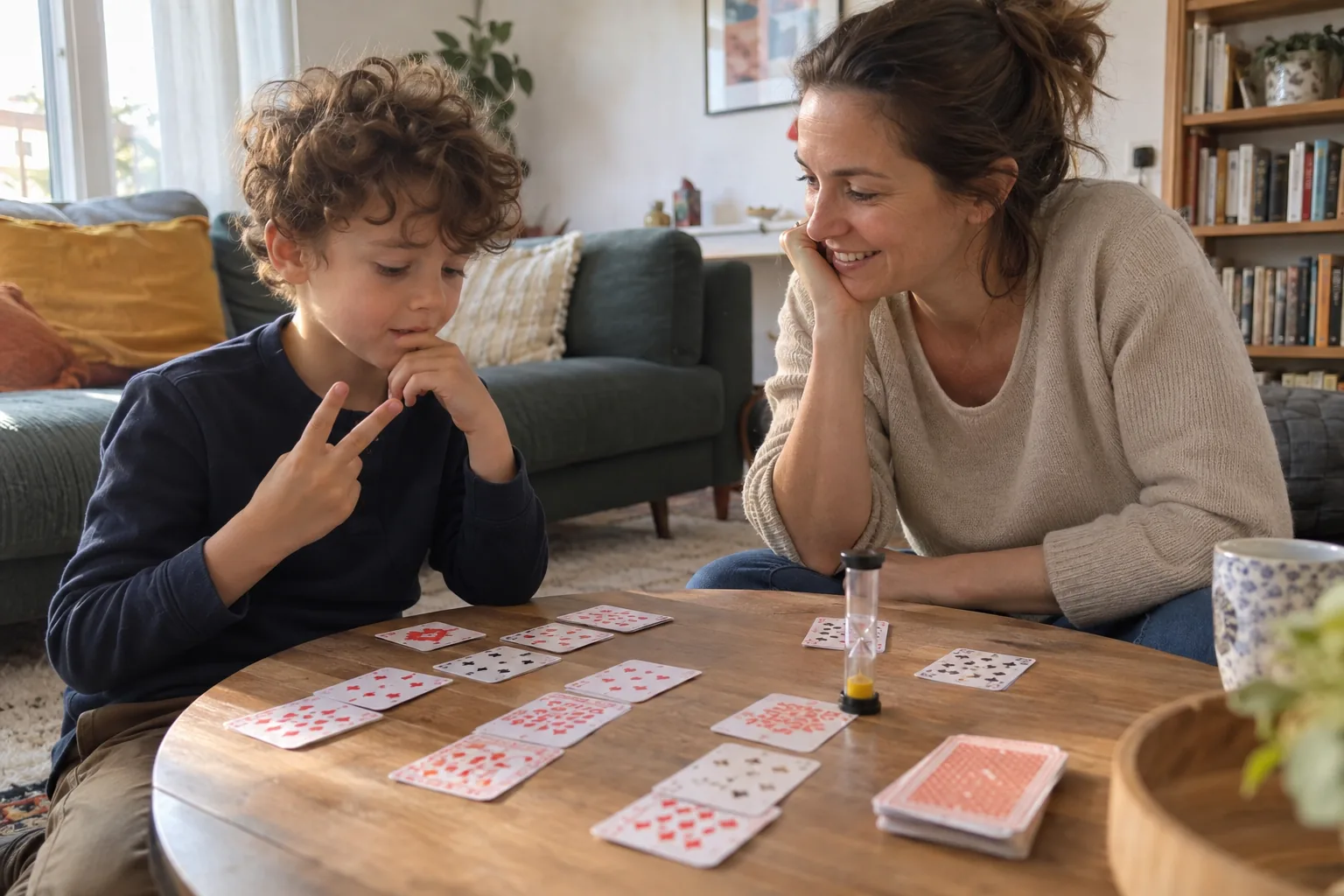
- Multiplication War: each player turns over two playing cards and multiplies them together; the highest product wins the cards. Remove face cards at first.
- Who am I?: "I am 42, who am I?" Your child answers 6 × 7 or 7 × 6. This is the "two-way" practice encouraged in schools. The idea is similar to riddles for kids.
- Table Dice: pick a table, roll a die, and multiply. With two dice, you can go up to 6 × 6.
- Staircase Counting: with every step up the stairs, call out the next result in the 3s table.

For quick practice on a screen, the little quiz below picks random multiplication problems from your chosen tables. It doesn't replace tabletop games, but it's a handy way to check your child's progress.
Keeping it fun along the way
Avoid comparing your child to a sibling or classmate. If you use a timer, make sure it's to beat their own personal best, never to make them feel defeated. When they find an answer, ask them how they worked it out: "Did you figure that out starting from 5 × 7? Great strategy!" Praising the approach builds enthusiasm for problem-solving rather than guessing. If your child likes working on memory in different ways, our memory games for kids offer more fun activities.
Finally, pick the right moment: not right after a long day at school or during a stressful moment. Our practical tips for helping with homework without doing it for them apply to multiplication tables too.
To vary grid reading without re-doing math calculations, try our Polybius square grid using coordinate reading. Explain the new rule beforehand: in this game, the row and column show a letter or digit, not the product of two numbers.
Equal groups connect multiplication and division while the questions remain different. The sharing-with-remainders activity shows what remains outside the groups and how to reconstruct the original collection.
Frequently asked questions
At what age do children learn multiplication tables?
In France, children start learning tables in 2nd grade (CE1, around age 7) and continue in 3rd grade (CE2), where memorization is consolidated. Students keep using and mastering them in later years.
Do children have to learn the tables in order from 1 to 10?
It isn't mandatory. Many teachers start with the easier 2s, 5s, and 10s tables, followed by the 4s, 3s, and 9s. It's best to follow your child's school sequence so they don't get confused.
My child always confuses 7 × 8 and 6 × 8, what can I do?
Put both cards in the daily review box and teach your child how to rebuild the result: 7 × 8 = 7 × 7 + 7 = 56. The phrase "5, 6, 7, 8: 56 is 7 × 8" also helps lock this fact in.
How long should practice sessions be each day?
Five to ten minutes are enough, ideally during a calm moment. It is much better to stop while it's still fun than to drag out a session that turns into a chore.
What is the simplest trick to memorize multiplication tables?
Start by understanding what multiplication means using rows of counters, then learn the easy tables: 1, 10, 2, and 5. Doubles (2 × 6 = 12) and half of 10 (5 × 8 = 40) are quickly remembered. The 9s table can then be calculated using fingers. After that, only a handful of facts remain: one flashcard per tricky fact is all it takes to master them.
How do you use your fingers for the 9s table?
Lay all ten fingers flat in front of you. For 9 × 4, bend down the fourth finger counting from the left: fingers to the left give the tens (3), and fingers to the right give the ones (6), making 36. This trick works from 9 × 1 to 9 × 10. Start by verifying it on a few familiar facts, then let your child try it on their own hands.
To go further
Preview before choosing
Les Grands Curieux · Ages 7–10
For children who are beginning to read instructions on their own and enjoy playing with words, numbers, and riddles. An adult can help with reading.