
Table of Contents
Pouring water from one pitcher to another, sorting buttons by color, tracing a letter with fingertips: activities inspired by Montessori education captivate children ages 3 to 6. Their secret lies less in specialized equipment and more in a mindset: a prepared environment, deliberate slow movements, and total freedom to repeat. The best news is that you don't need expensive materials to get started. Here are the core principles, fifteen DIY activities made with everyday objects, and how to introduce them to your child.
Key principles, at-home version
The pedagogy created by Italian physician Maria Montessori in the early 20th century relies on a few core principles. Children learn by interacting with concrete objects. They need an environment adapted to their size, where they can choose an activity, carry it out independently, and put it away. Repetition is part of learning: repeating the same pouring activity ten times is not boredom, it is concentration. And adults observe more than they intervene.
At home, you can take inspiration from it without turning your living room into a classroom: all you need is a low shelf, a few trays, and a little patience.
Setting up a Montessori corner
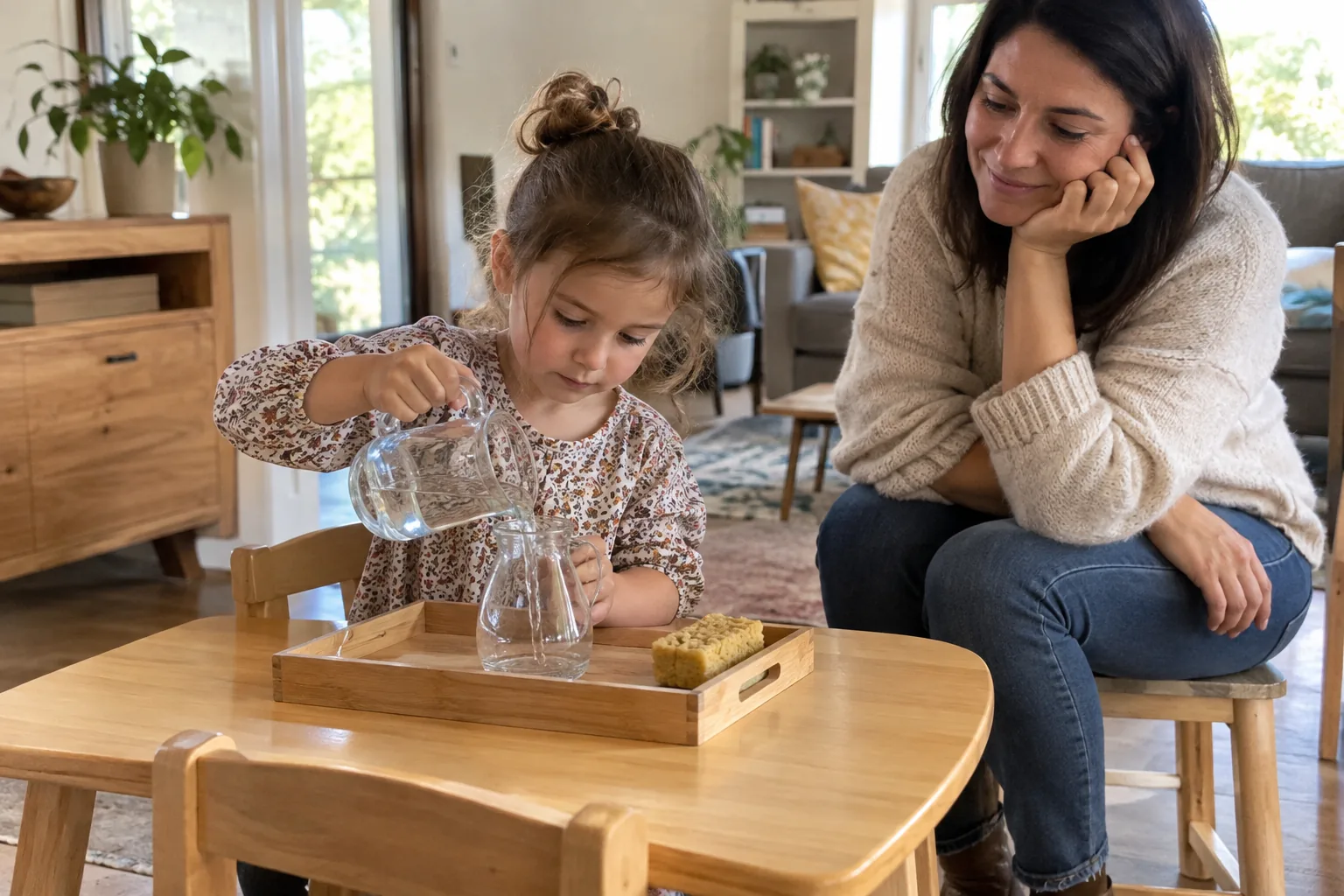
Choose a quiet spot with a child-height shelf. Place four to six activities on it, each on its own tray, complete and ready to use. The fewer activities there are, the more children focus. Everything should be easy to pick up, use, and put away independently: a small mat to define the workspace, along with a sponge and cloth nearby to clean up little accidents. Every two or three weeks, swap out activities that no longer hold their interest.
Fifteen activities using everyday household objects
These activities are categorized according to the four main areas developed between ages 3 and 6. All of them can be made with things you already have at home.
| Area | Activity | Materials |
|---|---|---|
| Practical life | Spoon-transferring seeds | Two bowls, one spoon, lentils |
| Practical life | Pouring water | Two small pitchers, a sponge |
| Practical life | Screwing and unscrewing lids | Jars and bottles with their lids |
| Practical life | Folding napkins | Cloth napkins marked with a line |
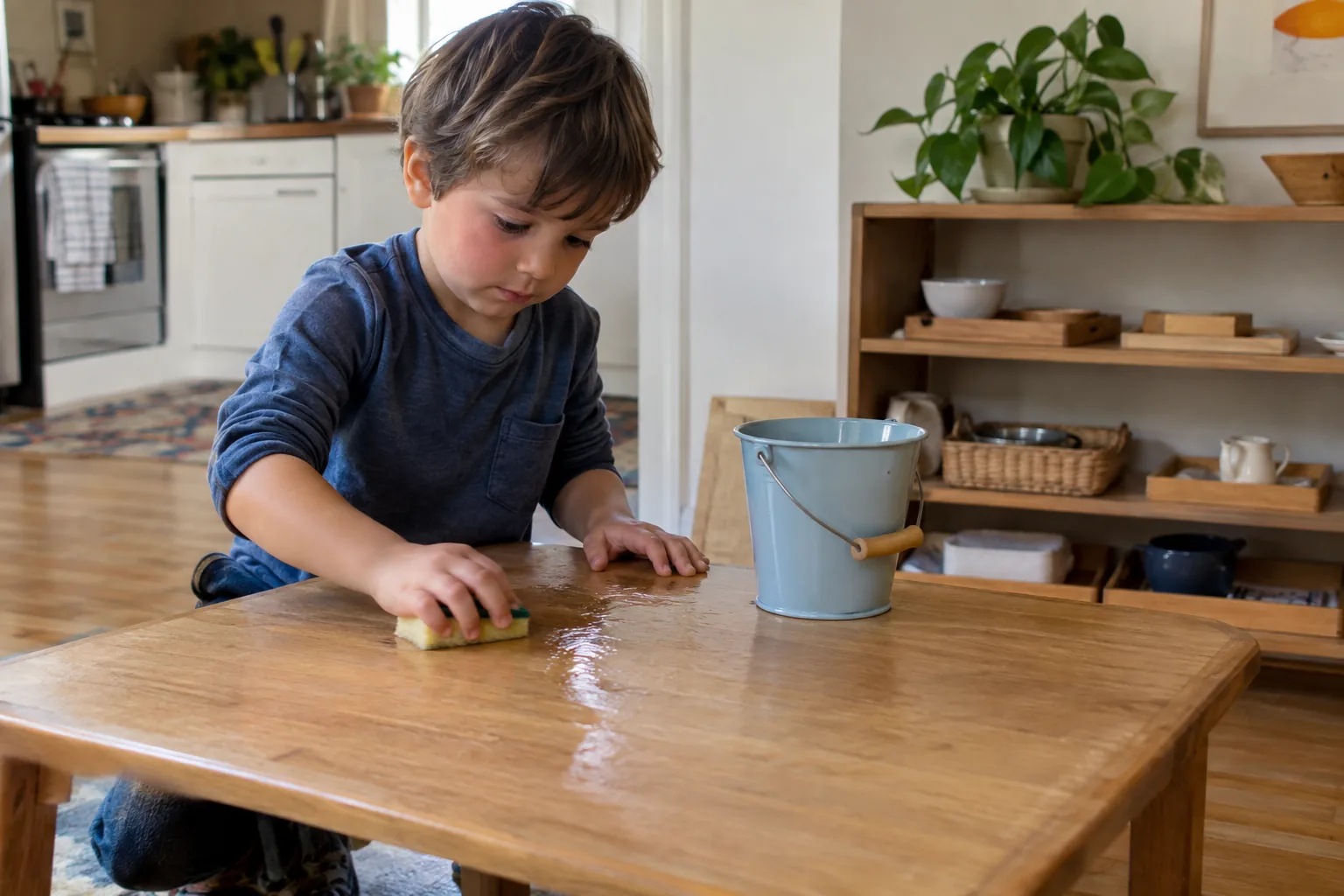
| Practical life | Wiping a table | Small sponge, bucket, cloth |
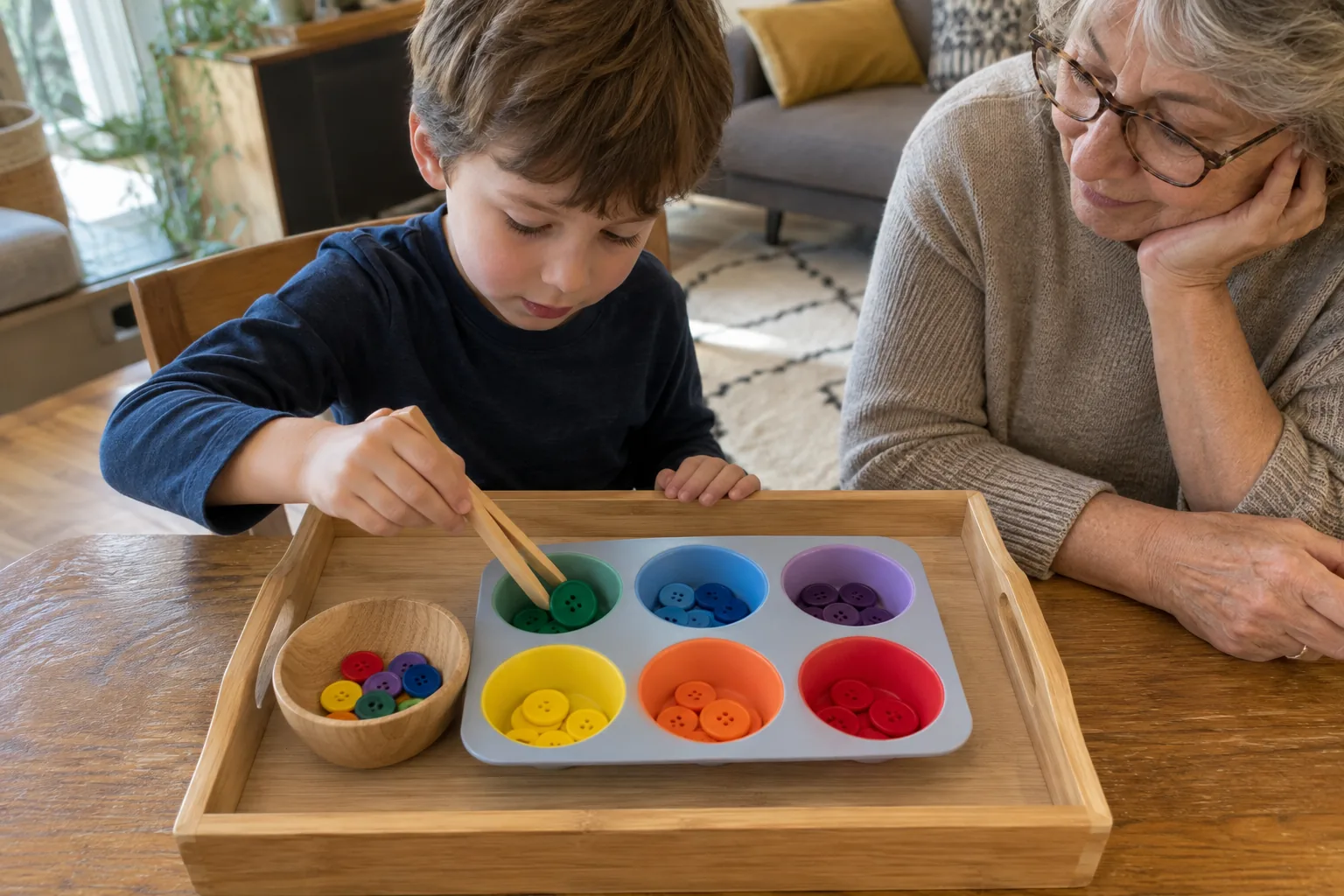
| Sensory | Sorting by color | Buttons, muffin tin, tongs |
| Sensory | Sound shakers | Opaque containers filled with rice, salt, pasta |
| Sensory | The mystery bag | A cloth bag and familiar objects |
| Sensory | From smallest to largest | Bottle caps, pebbles, or nesting boxes |
| Language | Sandpaper letters | Letters cut from sandpaper |
| Language | The sound basket | Small objects whose names begin with the same sound |
| Language | Real-life picture cards | Real objects, then matching photos |
| Mathematics | Number rods | Cardboard strips divided into 1 to 10 segments |
| Mathematics | Counters and numerals | Number cards from 1 to 10 and bottle caps |
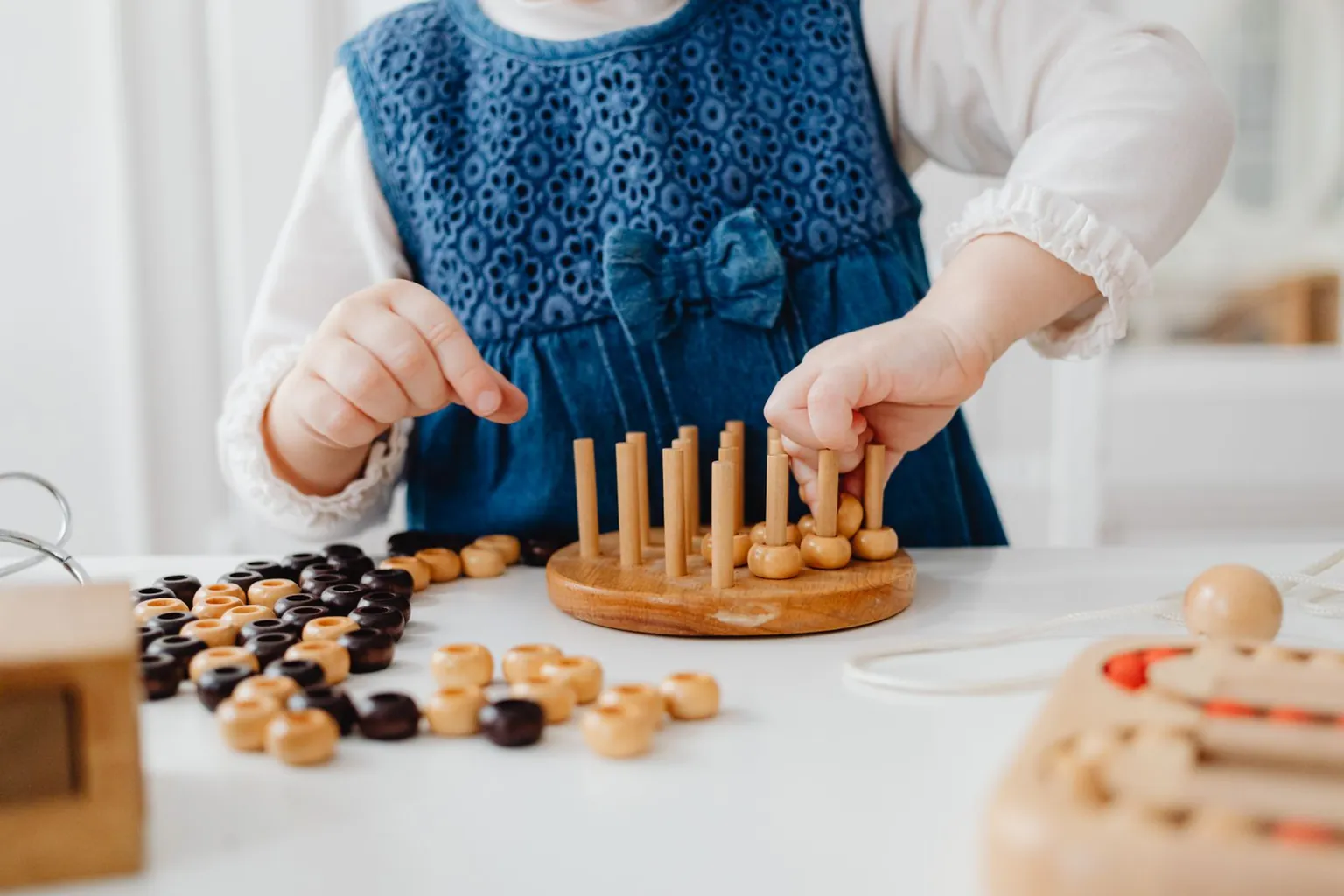
| Mathematics | Counting necklace | Beads and a shoelace |
Practical life activities are often children's favorites: they allow them to imitate adults and feel helpful. They also prepare children for real household responsibilities: our chart of chores by age offers ways to expand on them.
Presenting an activity
The presentation is the key moment. It always follows roughly the same sequence:
Invite
"I am going to show you something." The child chooses whether they want to watch.
Demonstrate slowly
Perform every movement in slow motion, without speaking during the movements. Children look at your hands, not your mouth.
Step back
Hand over the materials: "Your turn." Do not correct them while they are trying; simply observe.
Let them repeat
If they want to do it ten times, that is perfect. Repetition builds concentration.
Clean up together
The tray goes back to its spot, ready for next time. Putting things away is part of the activity.
The three-period lesson for learning a word
To learn a new word, such as the name of a fruit, shape, or letter, Maria Montessori adapted a method developed by physician Édouard Séguin: the three-period lesson. It is used with two or three objects at a time, never more.
If the child makes a mistake in the third period, do not correct them: simply return to the first period on another day. To enrich daily vocabulary, our article on expanding your child's vocabulary offers additional habits to try.
Safety note: small objects
Seeds, beads, and buttons are real hazards for children who still put objects in their mouths. Save these activities for children past that stage, always stay close by, and adjust object sizes for age. For younger children, choose larger items such as pom-poms, large jar caps, or balls.
What Montessori is not
Taking inspiration from Montessori does not mean letting children do whatever they want: freedom happens within a clear structure and simple rules. Nor does it mean buying every product sold under that name: what matters is the spirit, independence, focus, and respecting their pace. Our fine motor skill games fit seamlessly into this framework.
Frequently asked questions
At what age can you introduce Montessori activities?
The practical life and sensory activities described here are best suited for ages 3 to 6. Before age 3, opt for simpler activities and materials without small parts.
Do you need to buy official Montessori materials?
No. Most activities can be made with household objects: pitchers, bowls, tongs, buttons, cardboard, sandpaper. The environment and your presentation matter more than buying specific products.
How many activities should be kept on the shelf?
Four to six activities are plenty. Fewer options help children stay focused. Rotate them every two to three weeks based on their interests.
Is doing Montessori at home compatible with traditional schooling?
Yes. At-home activities build independence, concentration, and fine motor skills, which benefit children in any classroom. Just avoid rushing ahead of school academic lessons.
To go further
Preview before choosing
Les Petits Explorateurs · Ages 4–6
For preschool and early elementary children discovering shapes, numbers, and the fun of drawing lines. An adult reads the instructions.