
Table of Contents
Which outlines should you start with?
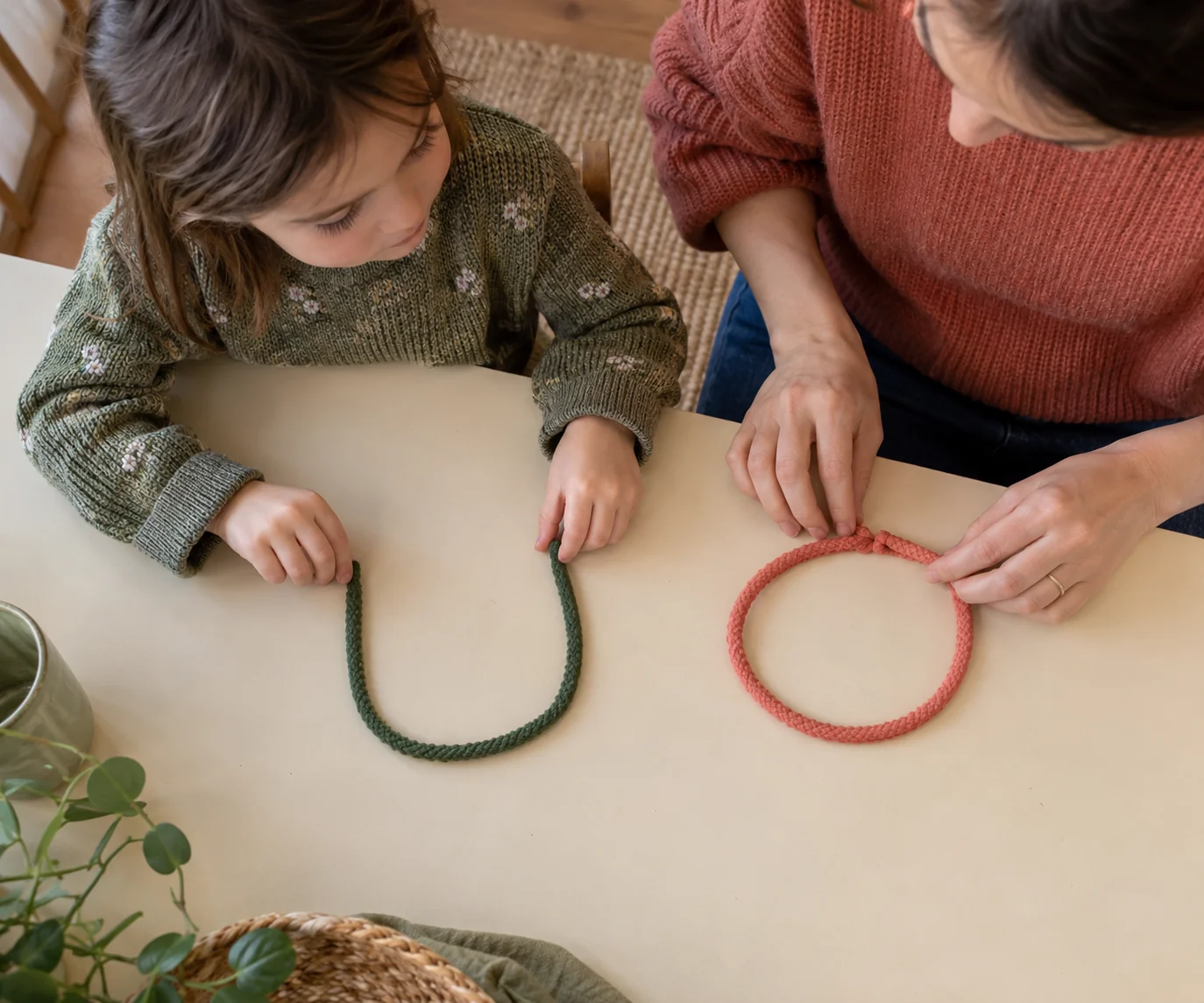
Choose a large circle and an open U-shaped curve. The lines should not cross or branch. A simple sheet makes one route easier to follow and keeps this question separate from finding a path through a maze full of choices.
The guide to children’s drawing covers a different topic. Here you are not asking for a neat circle or a recognizable picture. Children can point, explain aloud, or ask an adult to move a marker; a perfect pencil grip is not required to explore.
How do you follow the line without leaving it?
Place a finger on the outline and move slowly along it. On the circle, you can return to the start without jumping. On the U, your finger reaches an endpoint; getting to the other end would require crossing an area with no line.
Ask your child to show that gap rather than only saying “open.” A large uneven circle can still be closed if its outline is continuous. A nearly round shape may remain open. Its overall appearance is not enough to decide.
Classify simple outlines
Follow the line with your eyes. None of these four outlines crosses itself.
Outline 1: two separate ends, an open line.
Two separate ends: an open line.The line returns to its start: a closed line.Your classification matches.Follow the line again.Nothing you enter is stored or sent.
What changes when you join the ends?
Make a curve with a short, thick craft cord on the table, then bring its ends together. Your child sees a change in the same object. Keep the cord flat on the table with adult supervision; it is not for wrapping around a person.
Next, separate the ends again. The overall shape may look almost unchanged, although a gap has returned. The activity diagram uses an opening large enough to see on a small screen, so this does not become a test of visual sharpness.
How do you distinguish inside, outside, and on the line?
Start with one simple closed outline without crossings. Put a mark inside, then outside. A path drawn from one to the other crosses the outline. This is an observation about the diagram, not a claim that a real-world barrier cannot be crossed.
Add a third case: a mark placed on the line itself. It is not a mark lying entirely inside or entirely outside. The answer sheet distinguishes all three positions instead of forcing a two-choice answer when the picture shows the boundary.
Inside, outside, or on the boundary?
The boundary is the line itself. Point C lies on it, so it is neither inside nor outside.
A is inside.
This point is inside.This point is outside.This point is on the line.Your classification matches.Look at the point and the line.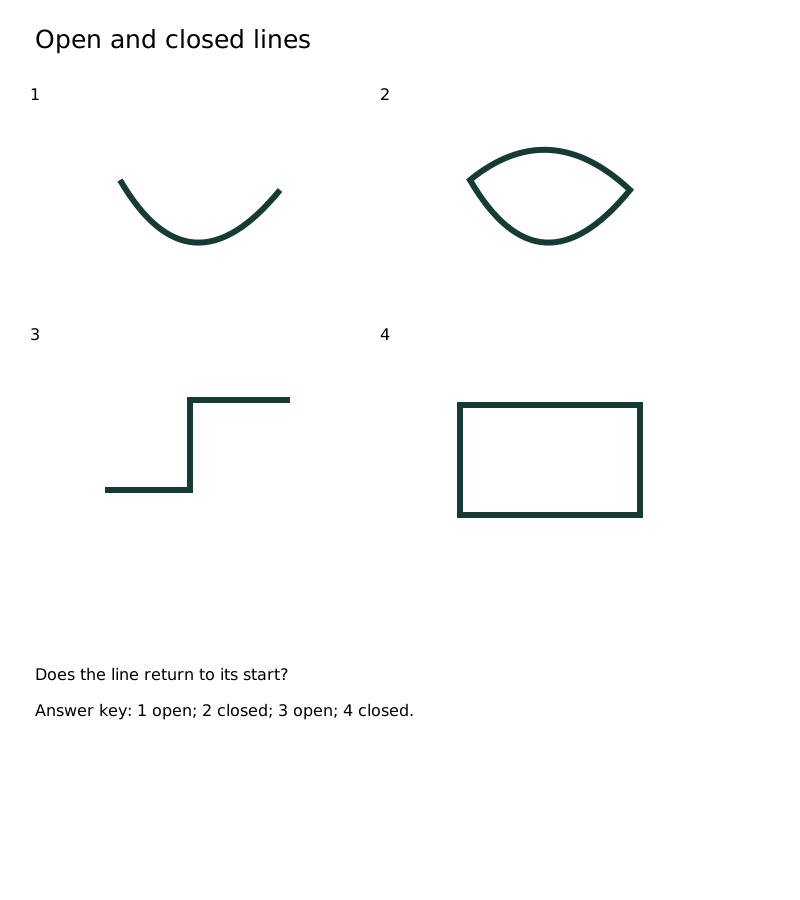
Nothing you enter is stored or sent.
What can you change when a child is unsure?
Return to the action: follow the line, stop at an endpoint, and point to the gap. Reduce the number of outlines rather than adding abstract explanations. An adult can draw a requested line while the child describes what it should do.
Folding to explore symmetry asks a different question about matching two halves. Mazes explore routes. These related activities offer a next step without treating every drawing activity as the same exercise.
Frequently asked questions
Must a closed line be round?
The outline can have corners or be uneven. In these simple examples, it needs to be continuous without a gap.
Does a small gap count?
Separated endpoints leave the line open. Use a clearly visible gap for this activity instead of a visual trick.
Do children need to write first?
Pointing, talking, and moving a tabletop cord let children explore without writing words or numbers.
Why avoid crossing lines?
Crossings add regions and route choices. Keep the outlines simple to focus on the first question.
Is a mark on the outline inside?
In this activity, “on the line” is a third position, separate from “entirely inside” and “entirely outside.”
Can the sheets be used without a screen?
Print the worksheet and its separate answers. An adult can also copy the large outlines onto plain paper.