

Table of Contents
- Who is this Morse code activity for?
- How can you read the Morse alphabet with your child?
- Why do letters and words need separators?
- How can you encode a first word without memorizing everything?
- How can you print the message without revealing the answer?
- What if the decoded result is not the word you expected?
- How can you change the game without making messages longer?
- What does the video show, and what matters for the paper activity?
- How can you continue with Hepaly workbooks?
- Frequently asked questions
Morse code uses a group of dots and dashes for each letter. On paper, put a space between letters and a slash between words. Start with a word your child knows and keep the alphabet key in sight. The message sheet and answer key come as separate files.
Your child can find one letter while you prepare the next. The game needs no lamp, app or memorization of the whole alphabet. A card and a readable key are enough to try it. The Hepaly team offers a symbol-matching activity on paper, rather than training in radio transmission.
Who is this Morse code activity for?
Offer decoding to a child who recognizes the letters in a short word, with support suited to what they can follow. Age suggests a starting point, not a required achievement level.
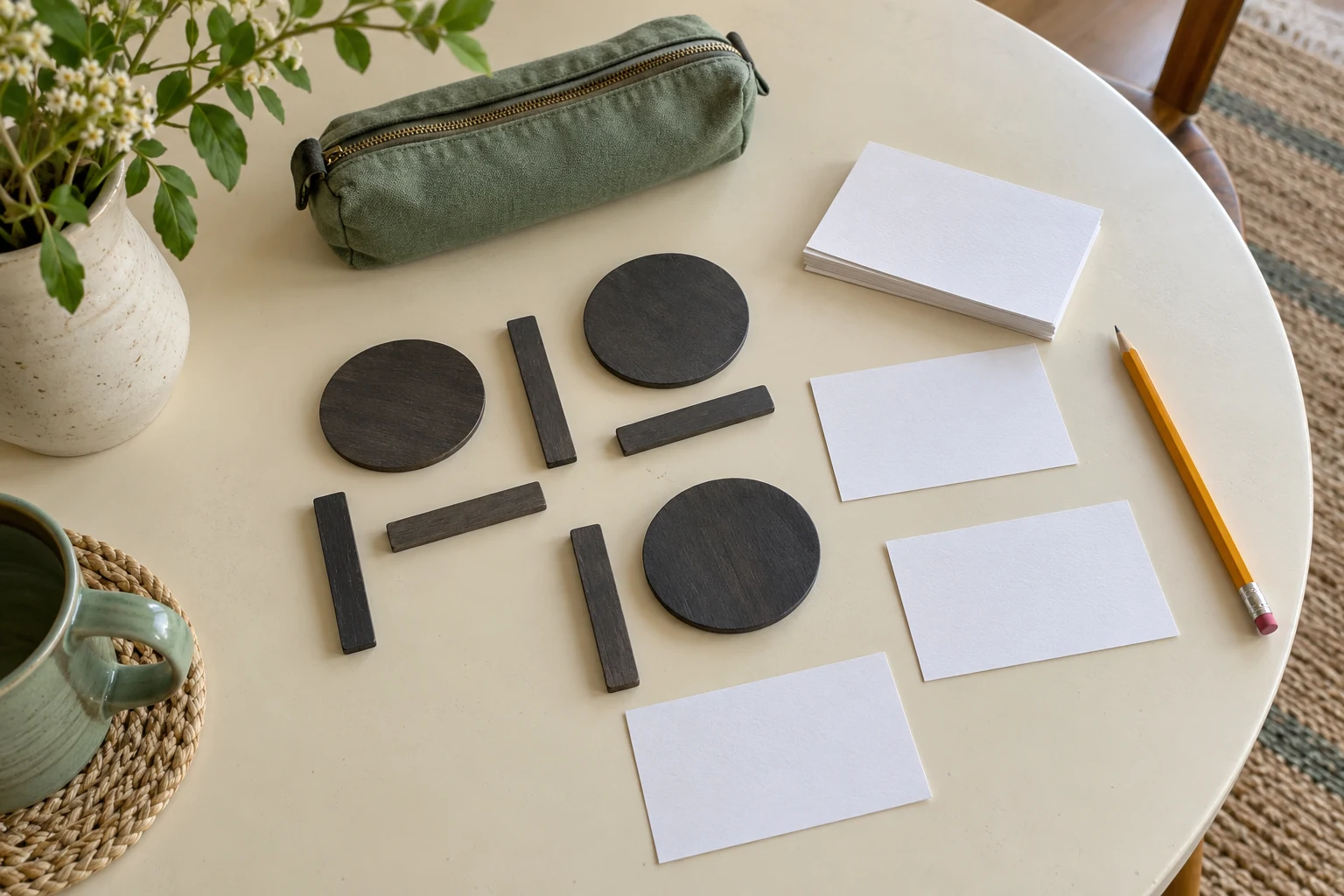
For ages 4–6, use just two large cards and match identical shapes: dot with dot, dash with dash. An adult can name the letter. There is no need to ask for a word to read or match the entire alphabet. If this sorting task is still difficult, our matching and logic games offer other starting points.
For children ages 7–10 who can read a familiar word, leave the alphabet visible. One child can point to a letter while another copies its group. The National Army Museum lists its own Morse activity for ages 7–11. That describes its worksheet, rather than setting a rule for every child.
| Starting point | First try | Possible support |
|---|---|---|
| Ages 4–6, still learning to match shapes | Match two identical cards | Name the symbols and focus on one group |
| Ages 7–10, able to read a familiar short word | Encode a word with the key visible | Show a first letter/code pair |
| The child encodes and checks independently | Swap a card with a partner | Check separators before swapping cards |
| Copying becomes tiring | Choose or point to prepared cards | Let an adult write without changing the rule |
How can you read the Morse alphabet with your child?
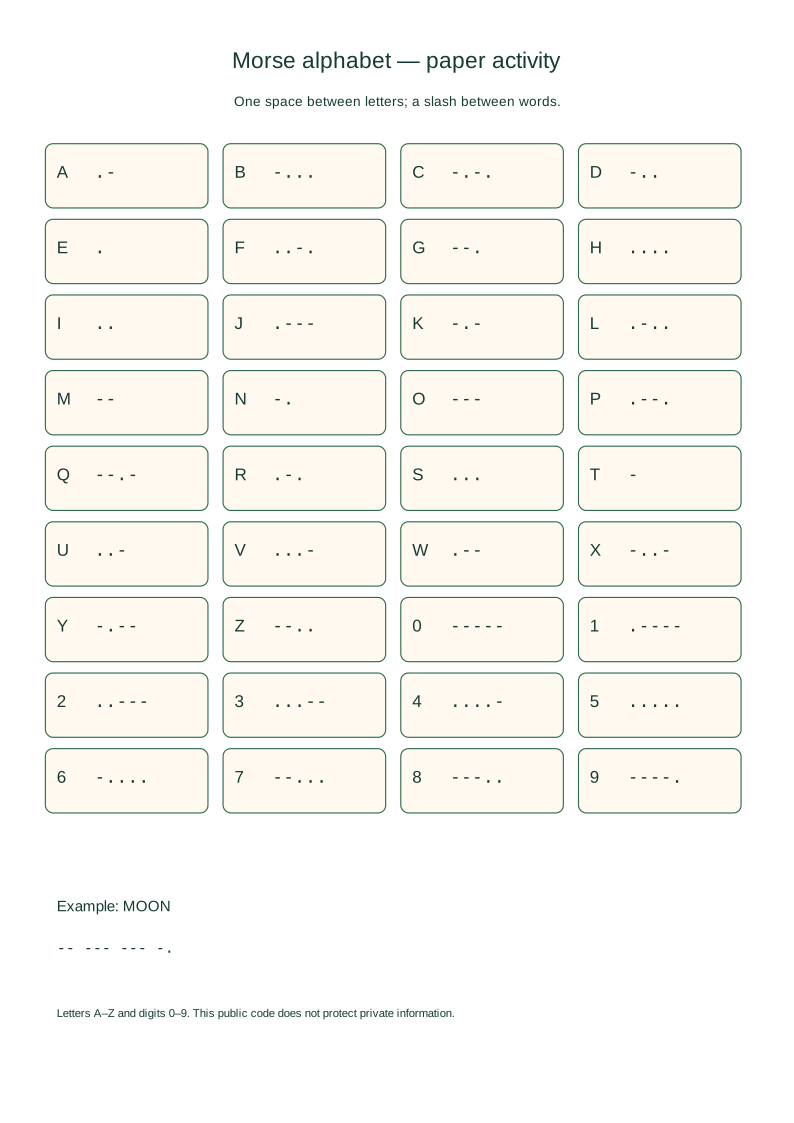
Find the letter in the key, then read its group from left to right. Dots and dashes cannot swap places: changing their order can produce another letter.
The alphabet shown uses the mappings in Recommendation ITU-R M.1677-1 for letters A–Z and digits 0–9. Our workshop supports only that character set. It does not silently remove an accent or change another letter. If your word contains an unsupported character, it asks you to choose a compatible word.
International Morse code also includes symbols left out of this first worksheet. Our selection keeps the key shorter; it is not the entire standard. To compare other games, our guide to coded messages for children explains shifted alphabets, numbers and other rules.
Morse workshop
Find a letter in the key
The A4 sheet includes letters A–Z and digits 0–9. Keep it visible throughout the game.
Why do letters and words need separators?
Separators identify the groups. Without them, the same sequence of dots can be read in different ways. The decoder should not invent the reading you intended.
This paper activity uses a space between letter groups and a slash between words. The slash is not a signal to transmit; it is a written marker for our game. A line break in the input is treated as a space, not as another letter.
The diagnostic below compares examples calculated from the same table. It shows the difference between one letter and several letters whose symbols have been joined. Keep the original word separate so you can check the intended grouping.
In actual transmission, the duration of signals and pauses serves this purpose. The ITU recommendation distinguishes gaps within a letter, between letters and between words. Our worksheets measure none of these timings and do not assess listening skills. They help children read and write groups on paper.
How can you encode a first word without memorizing everything?
Choose a word your child knows and look up one letter at a time. Keep the plain text visible on the first try. Hiding the solution immediately adds a difficulty that does not help explain the rule.
Our example word is MOON. The workshop calculates -- --- --- -. from the key. Point to one letter, find its group and leave a space before the next one. At the end, read the word back by going from the code to the letters.
Decode mode expects dots and dashes arranged in separate groups. If a group matches no character in the table, it reports an error instead of returning half a message. You can check that group without looking for a problem in every other letter.
A missing space cannot always be detected. Joined symbols can form another valid letter. A checker can verify a formal mapping, but it cannot know the word you meant to write. That is why reading back against the original text remains part of the game, even when the screen reports no error.
How can you print the message without revealing the answer?
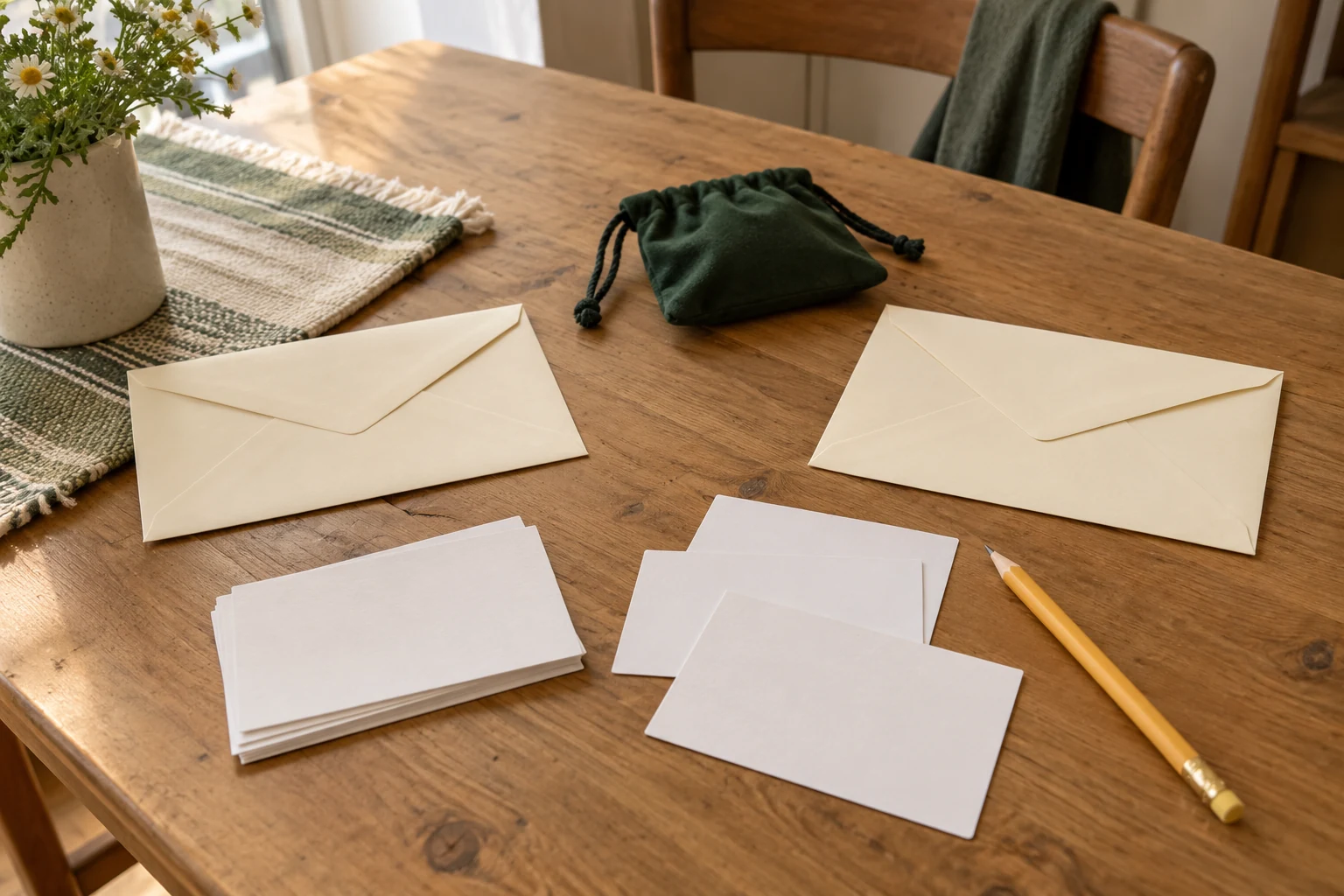
Download the message sheet and answer key using their separate buttons. Open both files before handing them out to check that each contains the intended part.
SVG keeps text and symbols in vector form. Open the file in a browser and print on A4 paper using the settings appropriate for your printer. The workshop cannot promise identical output on every device. If the preview cuts off part of the page, use fit-to-page and check that the groups remain readable.
For a two-player game, keep the key available to the person reading the message. The person who prepared the card can keep the answer. This is a game rule, not a race. If your child wants to check a letter before continuing, show that pair instead of revealing the whole answer.
The envelopes simply keep the documents separate. You do not need to hide a message somewhere hard to reach. Leave it on a table or hand it directly to its recipient. For a larger activity, plan the stages with our at-home treasure hunt guide and keep clues accessible.
What if the decoded result is not the word you expected?
Check the groups first, then the order of symbols within the relevant group. You may not need to redo the whole card. A separator or a symbol copied differently can explain the mismatch.
Look at the letter on the answer card and find its row in the alphabet. Compare the symbols in the same direction. If the written group produces another valid letter, the decoder has no reason to reject it. The original word lets you find the difference between the intended message and the one actually prepared.
Avoid framing this error as a lack of concentration. A child may have followed a hard-to-read key or copied a space the adult forgot. Review one group together, then let them decide whether to continue. For a different hands-on method, the printable Caesar wheel uses a shift key and a different diagnostic.
How can you change the game without making messages longer?
Change one form of support at a time: showing the word, providing its first letter or leaving the key visible. A longer text mostly adds groups to copy; it does not automatically make the activity more interesting.
Prepare two cards with the same word and ask your child to find the one with a changed group. Keep both answer cards so you can explain the difference. Another option is to swap roles: your child prepares a familiar word, then you decode it with the key left visible.
This activity focuses on matching symbols and checking a rule. It does not measure memory, reading ability or intelligence. A child who prefers cutting and sorting cards can take a different role from one who enjoys copying messages. Our activities for siblings of different ages help divide roles without giving everyone the same task.

What does the video show, and what matters for the paper activity?
The English video explains how Morse uses dots, dashes and pauses. It is background information for the adult preparing this game, rather than a requirement for the child's activity. Our paper worksheets need no radio equipment, lighting setup or listening practice.
Keep the transmission demonstration separate from our symbol-matching activity. The alphabet, written separators and answer key are enough for this game. You can watch the extra resource afterward or skip it, without adding screen time to your child's activity.
How can you continue with Hepaly workbooks?
Choose an activity that fits what you have observed, rather than assigning a level based only on the decoded message. Hepaly workbooks are 64-page PDFs to download and print. Their previews let you see the page types before choosing.
The Grands Curieux collection is designed for ages 7–10; Petits Explorateurs offers a different starting point for ages 4–6. All six paid workbooks and their previews are in French. The free worksheets in this guide also come in English and Spanish, but the workbooks sold in the store are not translated editions. See our guide to choosing a workbook by age if you are unsure.
Frequently asked questions
Do children need to learn the whole Morse alphabet before playing?
No. Keep the key visible and start with a familiar word. The first goal is to find the matching symbols and keep the separators.
Is Morse code suitable for ages 4–6?
Focus on matching large identical cards with an adult. Decoding a word requires other skills, and age alone does not guarantee them.
Why does the decoder reject my group?
It may not match any letter or digit in our table. Check the dots, dashes and spaces. A valid group can also produce a different letter from the one intended.
Can you use accented letters?
This workshop supports only letters A–Z and digits 0–9. It flags other characters instead of changing them. Choose a compatible word for this worksheet.
How can you keep the answer separate from the message?
Use the two separate SVG downloads and open them before playing. The message does not include the plain text; the person who prepared the card keeps the answer.
Can Morse code protect a personal secret?
The code is public and anyone with the key can read it. Use it for playful words, without passwords, addresses or private information.
To go further
- International Telecommunication Union — Recommendation ITU-R M.1677-1, international Morse code
- Cité des sciences et de l’industrie — Worksheet 10, decoding Morse, activity for ages 5–12
- National Army Museum — Morse Code Challenge, worksheet and answer key for ages 7–11
- Scouts — Inspector Morse code, an adult-supported activity