
Table of Contents
What rule should you agree on first?
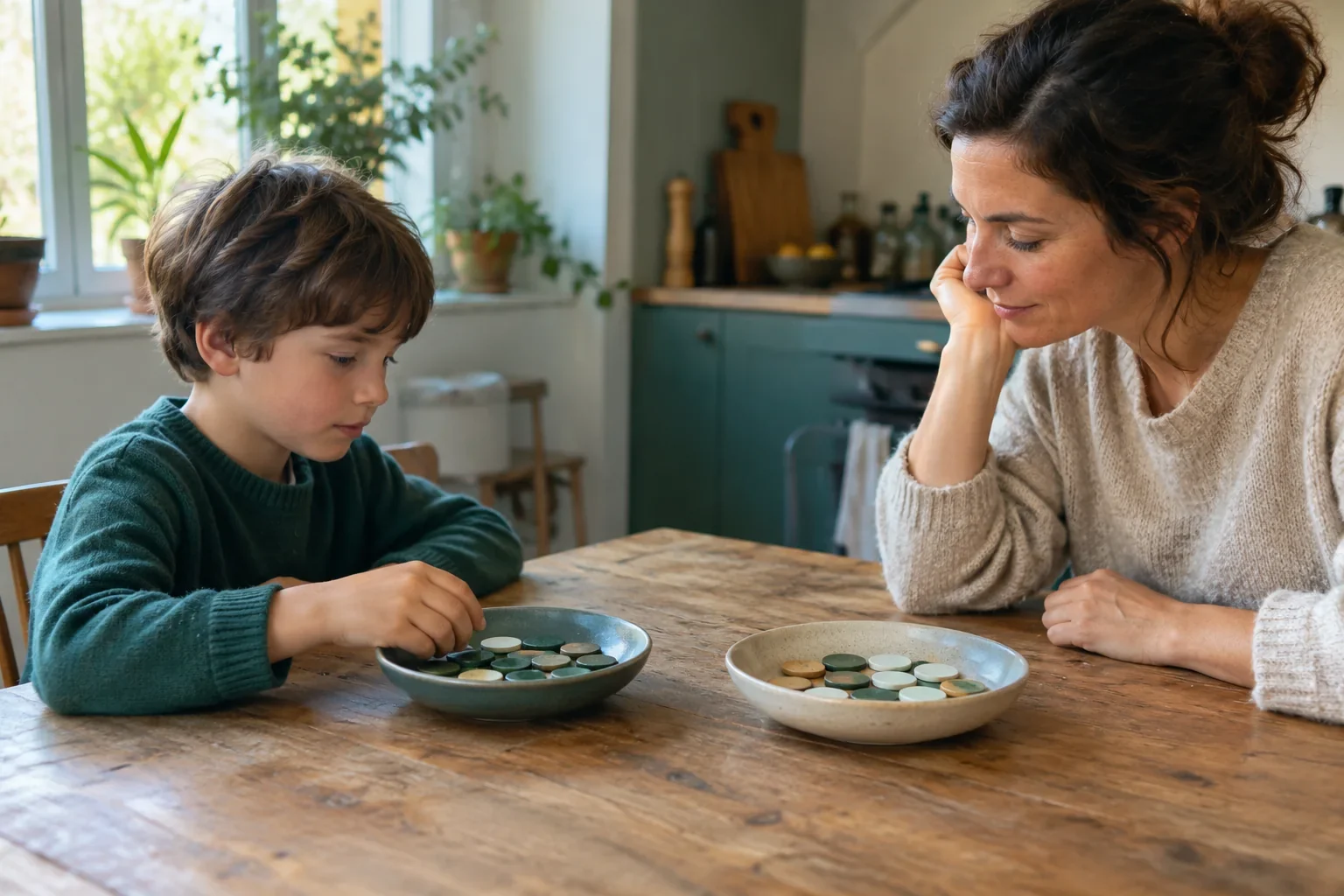
Choose matching objects and containers, and explain that the objects must stay whole. “The same number in every group” is the mathematical rule for this session. It is not a definition of fairness for every situation children encounter in everyday life.
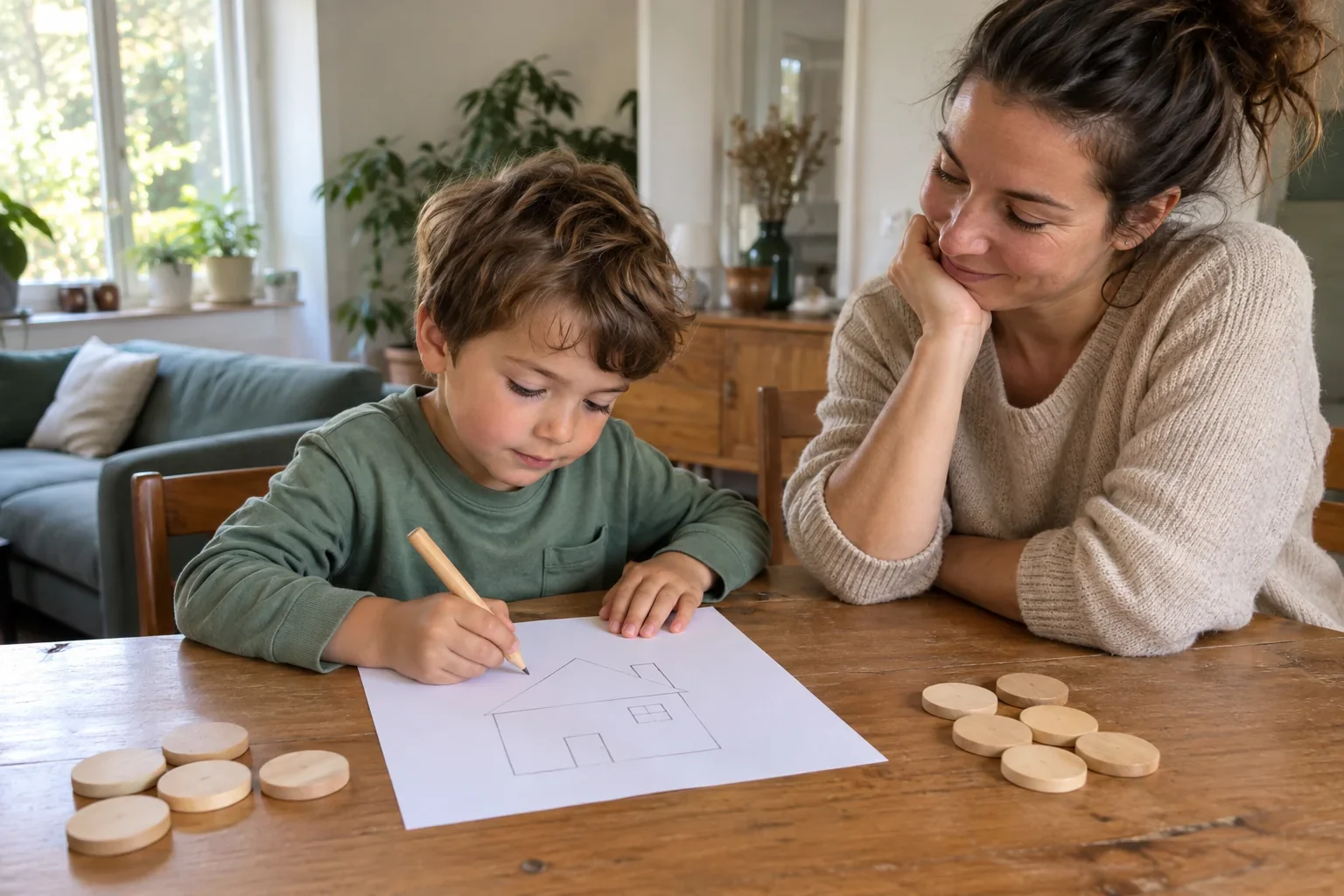
For a first sharing activity, use a few containers and a collection that is comfortable to count. Choose pieces large enough to handle safely. An adult stays alongside, observes, and helps keep the objects visible rather than answering every question immediately.
How do you distribute without losing track?
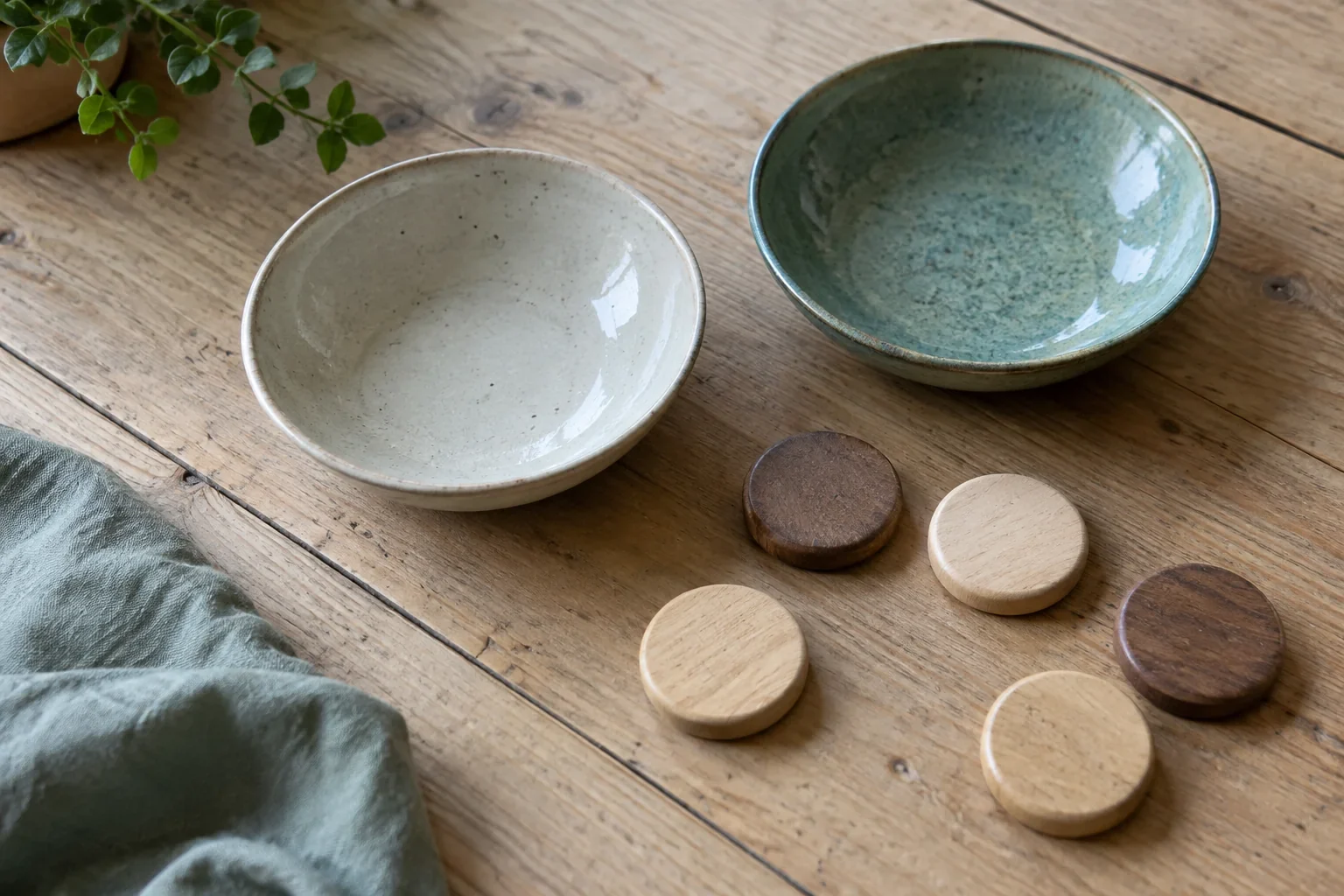
Put the collection in a central area and give one object to each container in the same order. Start another round only when enough objects remain to serve every group. Children can announce the round or move the pieces themselves, whichever is more useful.
When a complete round is no longer possible, place the remaining objects in a separate area. Do not hide them or quietly give them all to one group. Stopping the round creates a question to investigate, not an error that needs to disappear.
Distribute without losing the remainder
Whole objects: the remainder stays outside the groups. The simulation does not decide what you should do with it.
14 objects: 4 in each of 3 groups; remainder 2.
{n} objects: {q} in each of {g} groups; remainder {r}. Check: {g} × {q} + {r} = {n}.Nothing you enter is stored or sent.
How do you check the shares and remainder?
Line up the objects from each container and compare the shares one to one. A compact arrangement can look less full than a spread-out arrangement containing the same number. Then count the remainder in its separate area so that it stays part of the collection.
| Total | Groups | Per group | Remainder |
|---|---|---|---|
| 14 | 3 | 4 | 2 |
The calculator follows the same rule for your chosen numbers: the amount in each group and the remainder appear separately. Editing an entry clears the old result until you check again. Entries are not saved or sent anywhere.
What does the remainder mean in this activity?
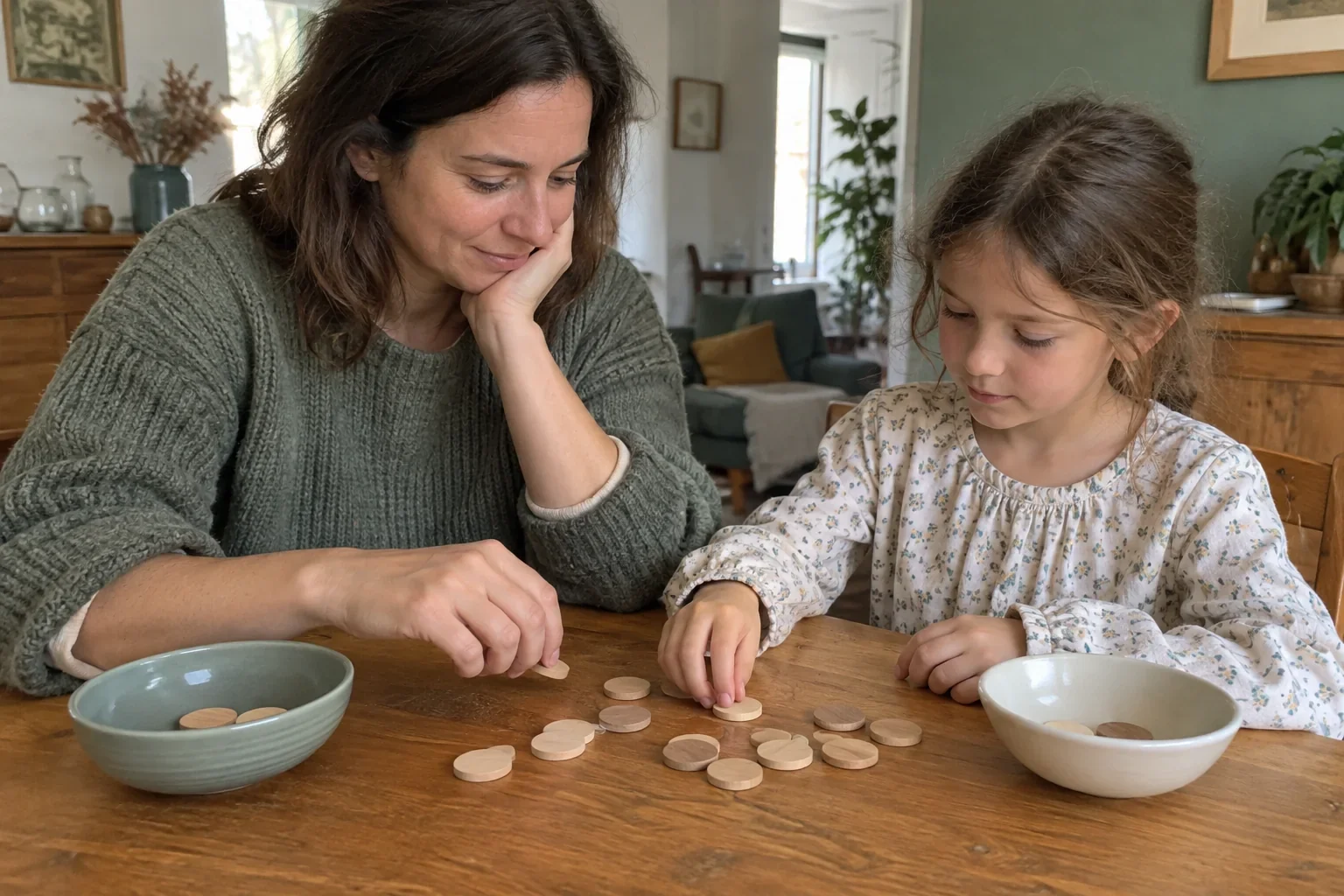
The remainder contains objects that are still present but are not enough to give one more whole object to every group. The French education ministry’s 2025 teaching resource includes hands-on sharing situations both with and without remainders.
Cutting objects would change the original rule. Exploring pieces of a cake or sheet of paper can be a separate activity about fractions. Keep the counters whole in this game so that the meaning of the remainder stays visible.
Groups or objects per group?
The question changes even with the same objects: fixing the number of groups is different from fixing each group’s size.
12 objects in 3 groups: 4 per group, remainder 0.
{n} objects in {p} groups: {q} per group, remainder {r}.{n} objects, {p} per group: {q} complete groups, remainder {r}.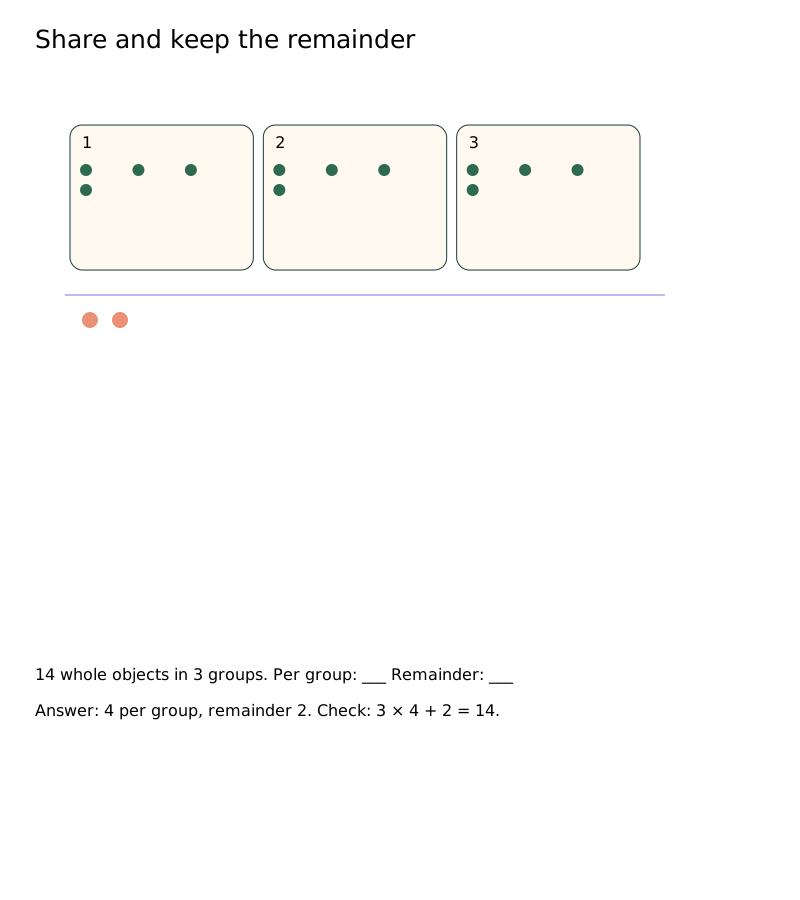
Nothing you enter is stored or sent.
Is the number of groups the size of each share?
The number of containers and the number of objects in each answer different questions. Ask “How many groups?” and then “How many in each group?” Children can point to the containers and their contents instead of having to write a division equation.
To check the total, bring together all the shares and the remainder. Mental math games can later help represent this reconstruction. The number 10 house explores another kind of split: two parts are not necessarily equal.
Frequently asked questions
Is the remainder an object that was forgotten?
It remains visible and belongs in the total. It was not distributed because another full round was no longer possible.
Can one group receive all the remainder?
That changes the rule of the same number of whole objects for each group. You can discuss another rule, but explain the change.
Must children write a division sign?
Objects, pictures, and words are enough to begin. Equations can follow when children understand what the groups represent.
What if there are fewer objects than groups?
With whole objects, no complete round is possible. Each group receives zero and the collection remains separate.
Should children answer quickly?
The activity is about organizing and checking a distribution. Allow time to move, compare, and count the objects again.
Does the answer sheet work without JavaScript?
The worksheet and static answer key remain available. Share objects on paper or in containers using the same rules.