
Table of Contents
- 1. Choose the whole before talking about parts
- 2. Check that the division is truly equal
- 3. Make sense of the two numbers
- 4. Explore fractions in the interactive lab
- 5. Compare without falling into the trap of the larger number
- 6. Discover why one half equals two quarters
- 7. Go beyond one whole and find fractions in everyday life
- 8. Check understanding without turning play into a test
- Frequently asked questions
"One eighth is bigger than one fourth, since eight is bigger than four." This line of reasoning makes sense: your child is applying what they know about whole numbers to fractions. To understand what changes, another explanation isn't always enough. A strip of paper, folded and then unfolded, makes the concept much clearer.
Here is a step-by-step path for 7–10-year-olds, which you can adapt to what your child is working on in school. Start by dividing and explaining, then move to writing. There's no need to complete everything in one session: keep the materials and pick up a question again the next day.
1. Choose the whole before talking about parts
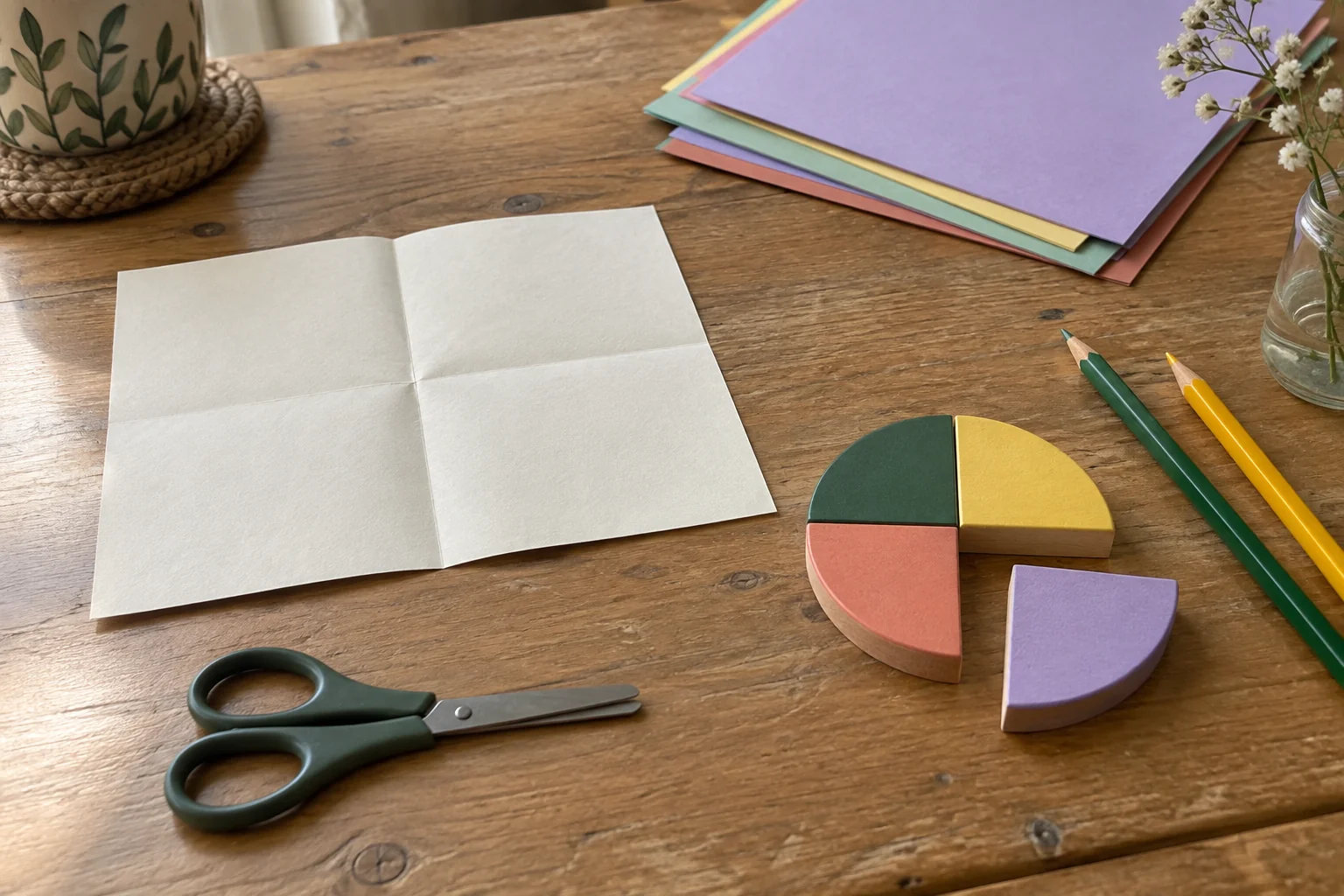
Place a rectangular piece of paper down and state: "Today, this whole sheet represents one." This whole is the unit. Fold it in half by carefully aligning the edges. Unfold it: each half represents one half of this sheet.
Next, prepare a small rectangle and a large rectangle. Fold each one in half. The two pieces obtained are indeed halves, but a half of the large rectangle takes up more space. The word "half" indicates a relationship to the whole; it does not give a single fixed size.
The question to keep handy
Ask regularly: "A quarter of what?" Of a sheet of paper, an hour, a meter? This precision prevents comparing objects without a common reference point. With drawings of different-sized cakes, you can't determine the quantities eaten just by looking at the fractions.
The Lumni guide on fractions helps review the vocabulary. At home, keep the habit of showing the whole unit before each hands-on activity.
2. Check that the division is truly equal
Draw two identical rectangles. Divide the first one into four strips of equal width. In the second, draw three very uneven lines. Color one section in each rectangle and ask: "Did we color a quarter in both drawings?"
No: counting four pieces is not enough. For this area breakdown, all four parts must have the same area. Evenly spaced strips make this easy to verify; in a different drawing, different shapes could also have the same area.
Let your child make a "fake quarter" and then explain the trap to you. You can play the role of the parent who is convinced that four pieces automatically make four quarters. They will need to explain what is missing from your reasoning.
3. Make sense of the two numbers
On a strip divided into four equal parts, color three parts. Say "three quarters," then write 3/4. The 4, the denominator, indicates how many equal parts the whole is divided into. The 3, the numerator, indicates how many of these parts are counted.
Practice going back and forth: you show a strip, your child writes the fraction; you write 2/4, they color two quarters. A recited answer can hide a doubt that a drawing reveals right away.
Counting parts without changing their name
Using four small identical pieces, rebuild the strip: one quarter, two quarters, three quarters, four quarters. You then have 4/4 = 1. Take away one piece: 3/4 remains, and 1/4 is missing to get back to the whole.
This step prepares children for simple calculations. Three quarters plus one quarter equals four quarters, not four eighths: you add pieces of the same size without changing their name. For other number games, our mental math activities offer a complementary approach.
4. Explore fractions in the interactive lab
In the lab below, first choose the number of equal parts from the menu, then move the slider for colored parts. Before each change, ask for a prediction: "If we divide the same whole into more pieces, will a single piece be larger or smaller?"
Try 1/2, 1/4, and 1/8 one after the other. Keep just one piece colored and observe its size. Start over with 1/4, 2/4, and 3/4: this time, the size of the pieces remains the same, only their quantity changes.
The goal isn't to move the slider quickly. Ask your child to describe a situation without naming the numbers shown: "I divided my rectangle into four equal parts and I took three." Then hide the fraction notation and reconstruct it together. Paper materials remain available to double-check what's shown on screen.
5. Compare without falling into the trap of the larger number
Start with two identical strips divided into eight parts. Three eighths are smaller than five eighths because there are fewer pieces of the same size. Your child can align the strips on the left and compare the colored lengths.
Then change the question: one half or one quarter? With the same unit, one half is larger. Dividing into more parts means smaller parts here. This observation applies to fractions where the numerator is one; it doesn't provide a complete rule for all comparisons.
When both numbers change
Between 2/3 and 3/4, looking only at 2 and 3, or only at 3 and 4, won't help you decide. Go back to drawings or look for a common division if your child is ready.
Don't turn every hesitation into a new rule to memorize. Three well-explained comparisons make a good stopping point. Logic riddles then provide another great space to justify answers without rushing through the curriculum.
6. Discover why one half equals two quarters
Take three strictly identical paper strips. Fold the first one in half and color one half. Fold the second into four parts and color two adjacent parts. Fold the third into eight parts and color four adjacent parts. Align their ends: the colored areas are the exact same length.
Write 1/2 = 2/4 = 4/8 underneath. Nothing was added to the colored quantity: we simply described the same quantity using smaller pieces. The Scientific Advisory Council for National Education highlights the benefit of connecting written fractions to concrete visual representations.
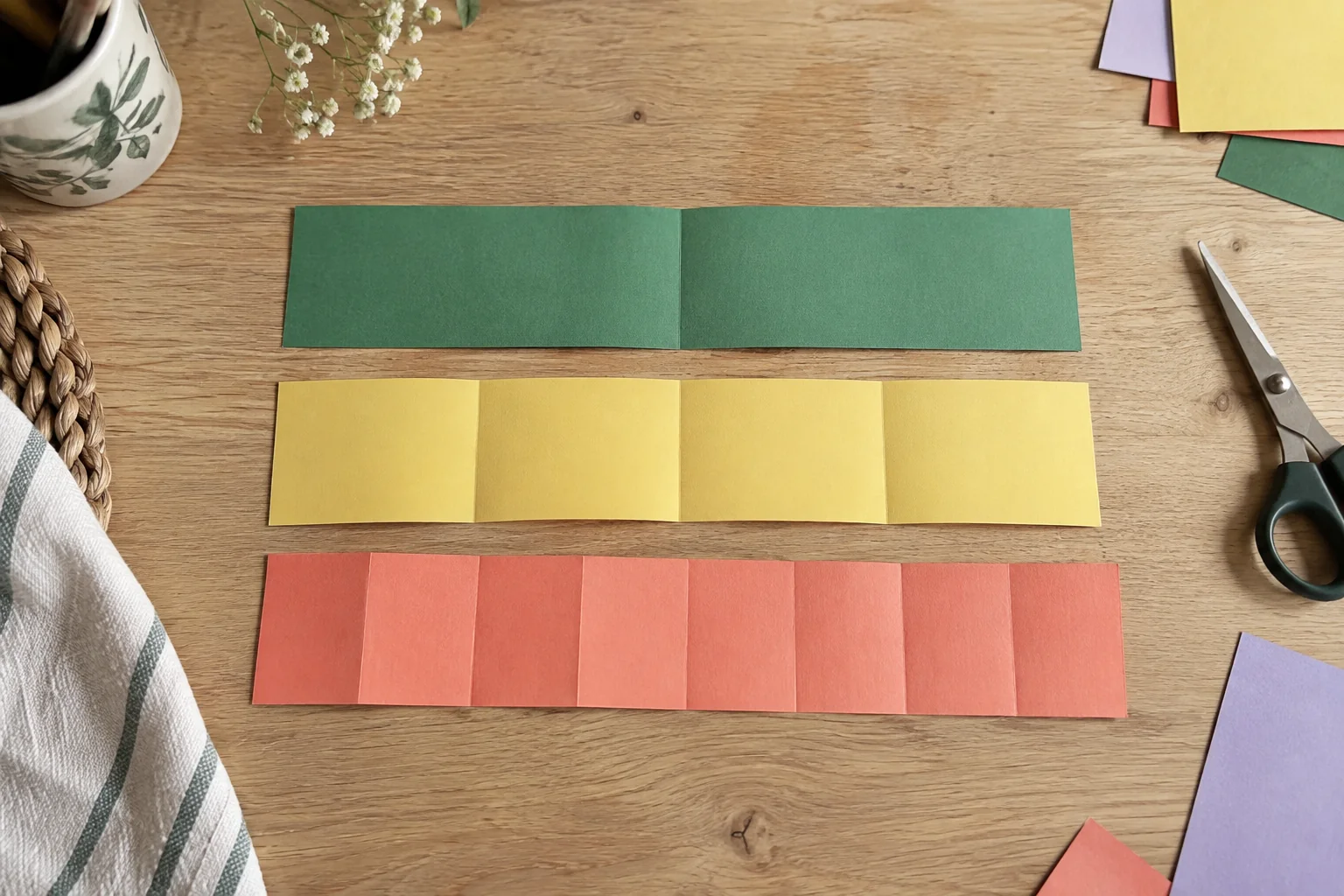
Next, try 3/4 = 6/8 by folding each quarter in half again. Your child can see why both numbers double together. Games built around multiplication tables can help calculate these doubles, but the hands-on activity explains their meaning.
7. Go beyond one whole and find fractions in everyday life
A fraction is not automatically smaller than one whole. Prepare two identical strips, each divided into four parts. Line up five quarters: four rebuild the first whole unit, and the fifth goes past it. Thus, 5/4 = 1 + 1/4.
Then mark these quarters along a number line, with 0 at the start and 1 after four intervals. The fifth interval leads to 5/4. Fractions are also numbers you place on a line, not just pieces you color in. The Réseau Canopé teaching guide on using fractions for measuring explores this concept further.
In daily life, look for one specific opportunity: sharing a ribbon equally, filling a measuring cup halfway, or spotting a quarter of an hour. For that last example, our guide on learning to tell time helps connect the clock face to the sixty minutes in an hour.
8. Check understanding without turning play into a test
Offer the quiz after the hands-on practice, leaving the paper strips within reach. Ask for an explanation before validating. A correct answer chosen by guessing tells you less than a mistake whose reasoning your child can explain.
If they still confuse the two numbers, review 3/4 with four physical pieces. If they think 1/8 is larger than 1/4, compare the whole strips before comparing their pieces. If they only succeed with the paper strips, keep using that support: the next try can start with a drawing.
To extend a calm quiet activity on paper, flip through a workbook together first and choose based on the pages that truly interest your child.
Frequently asked questions
At what age should we start learning fractions at home?
Around 7–10 years old, adapt to the concepts taught in school. You can start by dividing into halves or quarters without requiring all the vocabulary right away. Age is no substitute for observation: your child needs to be able to explain what the whole is and why the parts are equal.
Should we use pizzas to explain fractions?
It isn't mandatory. Identical rectangular strips are often easier to fold, overlap, and compare. A cake or pizza can serve as a familiar example, provided you specify its size and represent equal parts.
Why does my child add the denominators too?
They are likely treating the written fraction as two separate numbers. Go back to one quarter plus two quarters: you are counting three pieces that are still quarters. Then write 1/4 + 2/4 = 3/4 under the physical demonstration.
Do children need to know decimals before learning fractions?
No. The first concepts of halves, thirds, or quarters can be understood without decimal numbers. You can later connect certain fractions to decimals, according to their progress in school, without adding that difficulty during their initial discovery.