
Table of Contents
- 1. Show the three rules on a small grid
- 2. Choose numbers or shapes without changing the logic
- 3. Try the two grids, offering one hint at a time
- 4. Look for the cell that leaves the fewest possibilities
- 5. Help through a moment of stuckness without completing the grid for them
- 6. Check a solution and understand what still needs work
- 7. Set up playtime that stays fun and light
- 8. Watch the rule for classic sudoku in video
- Frequently asked questions
- What if the starting clues are the problem?
A first sudoku grid for kids can fit in a 4 × 4 layout: using numbers 1, 2, 3, and 4, each appearing only once in every row, column, and 2 × 2 box. Given numbers stay in place. There is no need to add numbers together or guess a value randomly: you look for the one that meets all three rules.
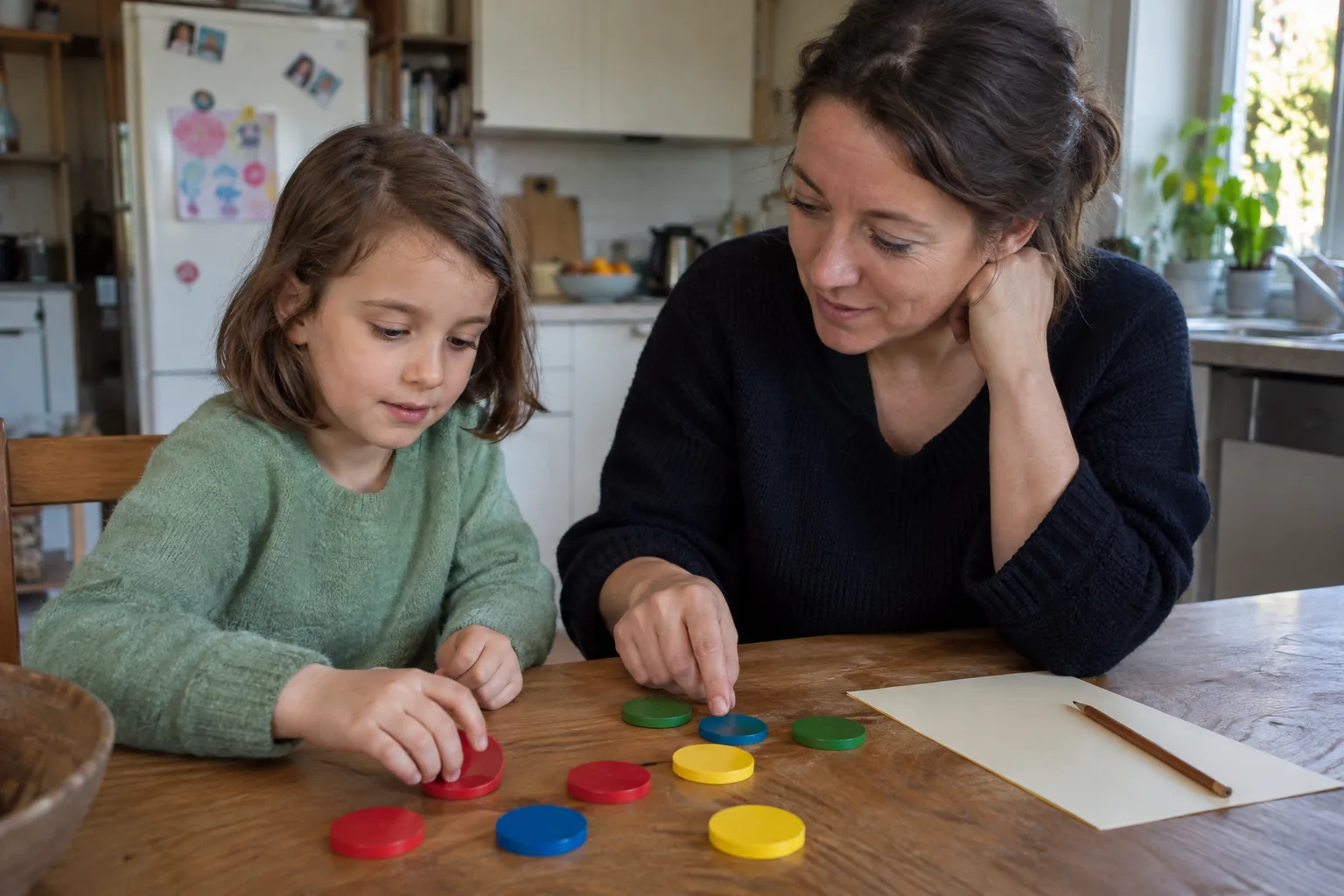
Here you will find two original grids, an activity method to complete them, and their solutions. What matters most is understanding one cell, then another. Finishing the whole grid, going fast, or succeeding without help is not required. Adults can read an instruction, offer a hint, or simply let the child try with a pencil and an eraser.
1. Show the three rules on a small grid
Draw sixteen cells, then outline the borders of the four boxes more strongly. Before searching for answers, ask the child to follow a row with their finger, then a column. They can then circle a small box. The word "cell" refers to one square space; the word "box" refers to a group of four spaces. Confusing them makes the rule unnecessarily complicated.
In a complete row, all four numbers appear with no repetitions. The same applies to a column and a box. Their order can change. So a row with "3, 1, 4, 2" follows the rule just as well as a row with "1, 2, 3, 4." Sudoku is not an exercise in putting numbers in counting order.
Explore together
Row, column, or box?
| 1 | 2 | 3 | 4 |
| 3 | 4 | 1 | 2 |
| 2 | 1 | 4 | 3 |
| 4 | 3 | 2 | 1 |
Select a zone to highlight its four cells.
Read the three reference areas
- First row: the four cells across the top.
- Second column: the four vertical cells in the second position.
- First box: the first two cells in the first two rows.
The interactive tool helps locate these areas. Have your child describe what is highlighted: "the first row," "the second column," "the top-left box." For a child learning these terms, taking time to distinguish them is an activity in itself. You can also try the games in our guide on learning spatial orientation on a map if position concepts need a bit more practice.
2. Choose numbers or shapes without changing the logic
Here, sudoku uses 1 through 4 simply as four distinct labels. No math calculations are involved. If numbers distract your child, prepare four easily distinguishable symbols instead, such as a circle, a square, a star, and a triangle. Each symbol must always replace the same number throughout the game. Do not switch the pairings midway through the grid.
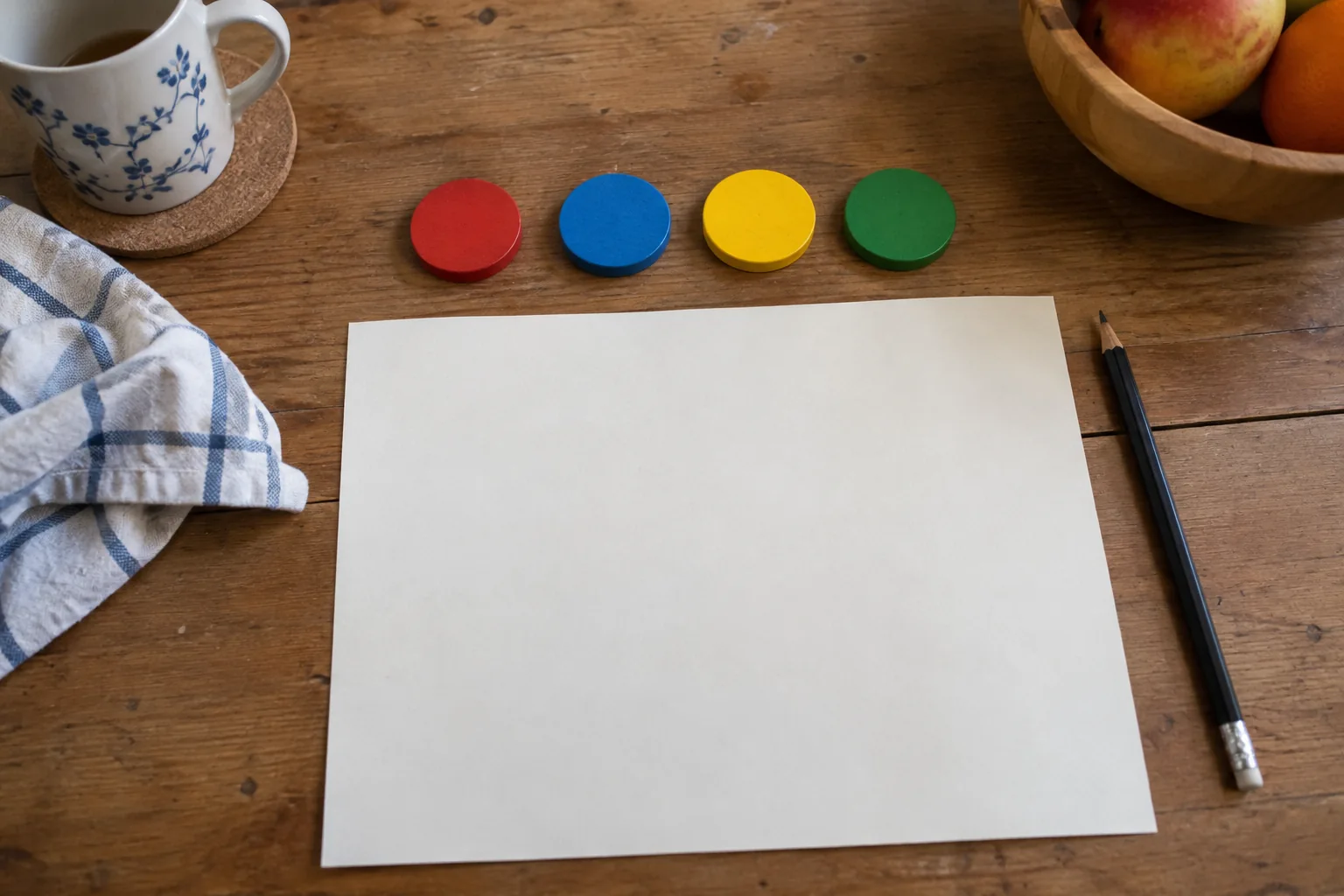
Tokens can make trial moves easier to adjust than writing and erasing numbers. They should feature a visual distinction other than color alone, as color by itself can be hard to differentiate. For a paper version, draw clearly distinct shapes. Keep small pieces out of reach of children who still put items in their mouth and supervise their use.
This adaptation does not turn a sudoku into a mental math exercise. The two activities can complement each other, but they ask different questions. Here, we eliminate possibilities based on rules. In a math calculation game, we look for the result of an operation. Explain this distinction if your child starts adding up the numbers in a row.
3. Try the two grids with step-by-step assistance
In the interactive workshop, initial values cannot be changed. Pick a number in an open cell, then use the check button whenever you wish. The message explains the current state without assigning a score to your child. You can erase a proposal, ask for a hint, or restart the same grid.
Explore together
Two original grids, two unique solutions
Select a grid. No entries are saved.
Grid 1
| 1 | 3 | 4 | |
| 3 | 4 | ||
| 1 | 4 | ||
| 4 | 2 | 1 |
The given numbers remain fixed. You can leave a cell blank.
| 1 | · | 3 | 4 |
| 3 | 4 | · | · |
| · | 1 | 4 | · |
| 4 | · | 2 | 1 |
Copy the given numbers, then solve on paper.
See solution for grid 1
| 1 | 2 | 3 | 4 |
| 3 | 4 | 1 | 2 |
| 2 | 1 | 4 | 3 |
| 4 | 3 | 2 | 1 |
Each row, column, and block contains 1, 2, 3, and 4 exactly once. Given numbers are preserved.
Grid 2
| 2 | 1 | ||
| 4 | 1 | 2 | |
| 3 | |||
| 3 | 2 |
The given numbers remain fixed. You can leave a cell blank.
| 2 | · | · | 1 |
| 4 | 1 | 2 | · |
| 3 | · | · | · |
| · | · | 3 | 2 |
Copy the given numbers, then solve on paper.
See solution for grid 2
| 2 | 3 | 4 | 1 |
| 4 | 1 | 2 | 3 |
| 3 | 2 | 1 | 4 |
| 1 | 4 | 3 | 2 |
Each row, column, and block contains 1, 2, 3, and 4 exactly once. Given numbers are preserved.
Both grids were created specifically for this guide and verified independently. Each has a single unique solution compatible with its starting values. This does not mean every child will experience their level of difficulty in the exact same way. The placement of clues, familiarity with the rules, and available help all play a role; the number of pre-filled cells alone is not enough to define a universal level.
To play on paper, copy the starting grid and keep the printed numbers darker than your attempts. The solution can be viewed in the designated panel. For a screen-free activity, hide that panel after preparing a copy: your child can ask to verify a box with you. You do not need to print an entire worksheet for a first trial.
If two children are playing together, give each their own grid or frame it as a collaborative task. One child can suggest a number while the other checks the three corresponding areas. Then swap roles. A race between a beginner and a child already familiar with the game risks hiding what each one truly needs; activities for siblings of different ages offer other ways to adjust a shared task.
4. Look for the cell with the fewest possibilities
An almost complete row is a great starting point. If it contains 1, 3, and 4, the missing number is 2. Before writing it down, double-check its column and block anyway. In a correct grid, all three checks will match. This habit establishes the full rule right from the first try, instead of limiting the exercise to filling row gaps.
When two values seem possible, cross-check the information. Imagine a row missing 2 and 4. If the cell's column already contains 4, that cell cannot take another 4—so 2 remains. Eliminated numbers are ruled out for a visible reason. You can write small possibilities on a paper copy, then cross out those excluded by the row, column, or block.
Do not select a number solely because it is missing from the block. It might already be present in the row or column. The full question is: "Does this value work in all three places?" Your child can point to the regions instead of giving an elaborate explanation. For other clue-based deduction games, logic riddles offer a complementary verbal format.
In our interactive grids, the hint button identifies a cell whose value is fixed by current constraints. It does not auto-complete the entire board. If a trial prevents the grid from being solved, it first prompts you to review it. A hint serves to restart reasoning, not to silently erase an incorrect answer.
5. Support a stuck moment without solving the grid for them
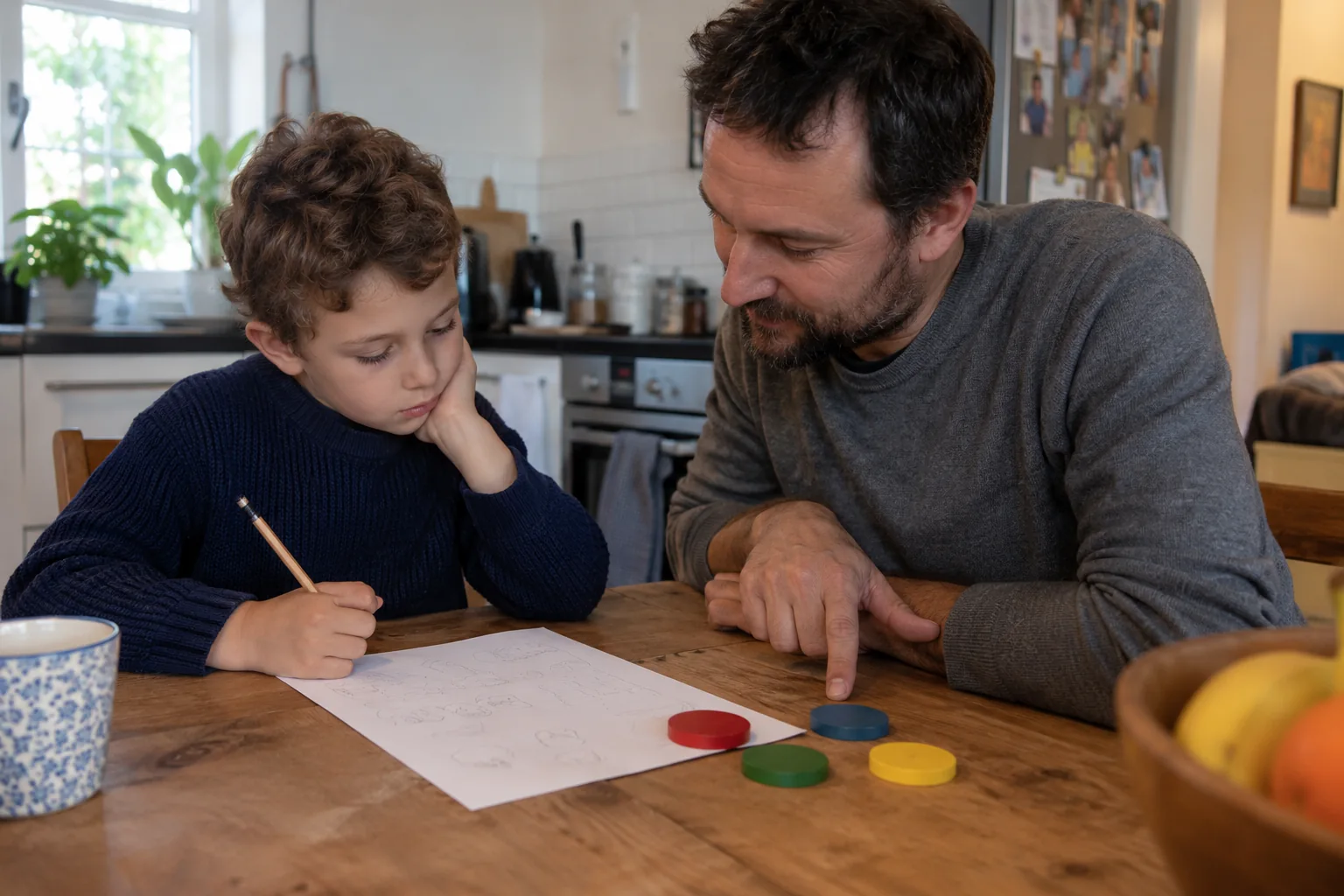
A child may understand the rule but lose track of all three zones simultaneously. In that case, suggest picking a single cell and checking its row, column, and block together. You can cover the rest of the sheet with a piece of paper, leaving only the necessary information visible. A short instruction remains easier to follow than a sequence of six corrections.
Explore together
Help tailored to the moment
He or she doesn't know where to look
Let's find an almost complete row. Which numbers do you already see?
He or she hesitates between two values
Let's check the column and the block. Is one of these numbers already there?
He or she gets frustrated or loses interest in searching
Would you prefer a hint, working on one together, or taking a break?
These suggestions support game play. They do not measure aptitude.
The guidance cards offer phrasing to try depending on what happens. First ask whether your child wants a hint, a joint attempt, or a break. If they ask you to complete a cell, you can do so while explaining the reason, then hand control back. Adults do not need to prove speed or turn every hesitation into a lesson.
If a repeated number appears, discuss the relevant rule: "There are two 3s in this column." Avoid judgments about focus or intelligence. An error can stem from a misread digit, a mixed-up cell, or a forgotten constraint. Figuring out together which situation occurred provides useful insights for next steps.
The guide on self-confidence helps encourage a specific attempt without requiring immediate success. For a child who gets angry, stopping the grid remains an option. You can resume another day with just one cell to find. Sudoku is not an IQ test, an assessment of academic difficulties, or a therapeutic method.
6. Check a solution and understand what needs review
Checking a completed grid isn't just counting the sixteen filled cells. Scan through all four rows: each must contain 1, 2, 3, and 4 exactly once. Do the same for the four columns, then the four blocks. Also confirm that the starting numbers stayed in place. A grid can look balanced yet contain a duplicate in a block.
The displayed solution serves as the reference for our two challenges. For another sudoku, compare it with its own solution and rules: a 6 × 6 or 9 × 9 grid does not have the same block layout. Do not automatically apply our four-small-square pattern everywhere. Here, the 4 × 4 format simply makes constraints visible on a compact surface.
Explore together
Three ideas to check
The quiz tests three concepts, with an explanation available for every answer. It can be done orally without aiming for a perfect score. If a question surprises you, refer back to the corresponding region in the demo widget. Reference points make sense when used to check an actual placement rather than reciting rules away from the grid.
7. Set up a playtime that stays enjoyable and light
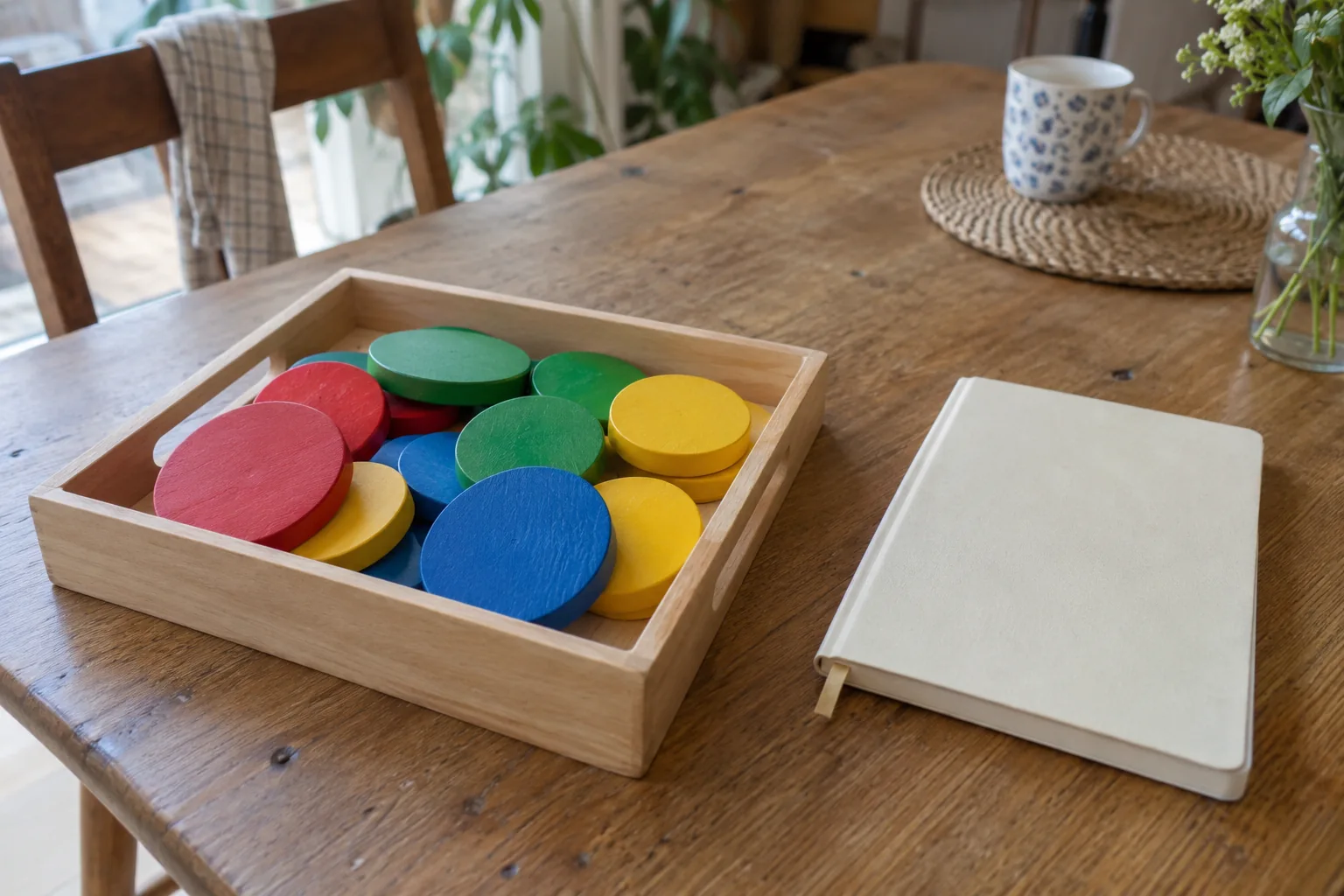
Prepare paper, a pencil, and an eraser, or tokens large enough to handle safely under supervision. Offer to look at a grid and work on a few cells. A session can stop before everything is filled. In this guide, there is no mandatory daily duration or time limit to achieve benefits.
Éduscol describes support resources for cycle 2 math (first through third grade equivalents in France) that combine hands-on manipulation, verbal explanations, and visual representations. At home, pointing to a zone, moving a token, and describing a choice can make rules more concrete. This pedagogical parallel does not imply that solving a particular sudoku will boost school grades: our grids are suggested games.
For a change of pace, try a tangram, which involves arranging shapes, or a maze, where you navigate a path. A child might prefer one over the others without it reflecting a higher or lower skill level. Choose based on available materials and the mood of the day.
8. Watch a video on the rules of traditional Sudoku
The video by Sudoku Academy explains traditional 9 × 9 Sudoku in French. Its rows contain nine digits and its blocks are 3 × 3. Our activity uses four digits and 2 × 2 blocks, but applies the same principle of no repetition across the three zones. Watch a segment together to make this comparison, without asking a beginner to move directly to a large grid.
What if the starting clues are the problem?
Check that the grid was copied correctly first. Two matching fixed numbers in a row, column, or box already contradict the rule before a child fills a cell. Do not add random clues to make a puzzle “easier,” because that can create a contradiction.
Conflicting clues
| 1 | 2 | 3 | 4 |
|---|---|---|---|
| 1 | 1 | · | · |
| · | · | · | · |
| · | · | · | · |
| · | · | · | · |
Number of solutions: 0
Exactly one solution
| 1 | 2 | 3 | 4 |
|---|---|---|---|
| 1 | · | 3 | 4 |
| 3 | 4 | 1 | 2 |
| 2 | 1 | 4 | 3 |
| 4 | 3 | 2 | 1 |
Number of solutions: 1
Multiple solutions
| 1 | 2 | 3 | 4 |
|---|---|---|---|
| · | · | · | · |
| · | · | · | · |
| · | · | · | · |
| · | · | · | · |
Number of solutions: 288
The examples distinguish a contradictory grid, a uniquely solvable grid, and a grid with multiple solutions. Their solution counts were calculated independently. Multiple solutions do not mean no solution exists; they mean the clues do not select one complete grid. Keep the clues fixed and check the source before asking children to restart all their reasoning.
Frequently asked questions
At what age can you introduce a 4 × 4 Sudoku?
When your child can distinguish four reference points and follow a simple rule with your help. Age alone doesn't determine the right time to start. You can explore a row with a younger child or present a full grid to a child who feels more comfortable, without any required milestone.
Do you need to know math to play?
No. The numbers are simply distinct markers; there is no addition or multiplication involved. Four shapes can replace them as long as each shape maintains the same match throughout the game.
Can you change the starting numbers?
No. They are part of the puzzle and remain fixed. You only make attempts in the empty cells. If you copy a grid, check its starting values before playing so you don't accidentally create a different puzzle.
Why does a number fit the row but not the grid?
Because it must also fit the column and the small block. A number missing from the row might already be present in one of these other two zones. Check all three conditions before keeping your try.
Do both grids have only one solution?
Yes, our checks confirm a single solution for each. The answer key remains available in the guide. This feature applies to these two original grids, not to every grid copied or drawn spontaneously on paper.