
Table of Contents
- Self-confidence vs. self-esteem: what do they mean?
- 1. Love unconditionally
- 2. Praise effort rather than talent
- 3. Offer challenges step by step
- 4. Let them try and make mistakes
- 5. Give them real responsibilities
- 6. Listen to their fears without brushing them off
- 7. Avoid comparisons
- 8. Keep track of successes
- Frequently asked questions
"I'll never get it right." "You do it." "I'm no good at this." Hearing these words can be painful for parents. Self-confidence cannot be ordered on demand, and no magic compliment will suddenly make it appear. It is built day by day through real experiences where a child tries, makes mistakes, tries again, and eventually succeeds under the watchful eye of adults who believe in them. Here are eight practical approaches to help them take steps forward, flashcards with "instead of... try this" suggestions, and a step-by-step challenge ladder to adapt to your child.
Self-confidence vs. self-esteem: what do they mean?
Self-esteem is the value a child places on themselves: "I am a good person, I am loved." Self-confidence is belief in their abilities: "I can try, I can succeed." Both are connected, and both are developed first at home. From age 5 (around kindergarten or 1st grade), school presents many new situations that test them: learning to read, making friends, being evaluated.
A confident child isn't a child who never doubts. They are a child who dares to try despite doubt, and who handles failure well enough to try again.
1. Love unconditionally
The foundation of everything is feeling loved for who you are, not for what you achieve. Tell your child often that you love them, spend one-on-one time with them, and show interest in what fascinates them. A child who knows they are loved even when they fail will take more risks to try.
2. Praise effort rather than talent
"You are so smart!" comes from good intentions, but this type of compliment can actually backfire: if success comes from talent, failure must mean you lack talent. Research in psychology, notably by Carol Dweck, shows that children praised for effort and strategies take on difficult challenges more readily. Replace "You're so good at this" with "You kept looking until you found the answer." Flip the cards below for more examples.
3. Offer challenges step by step
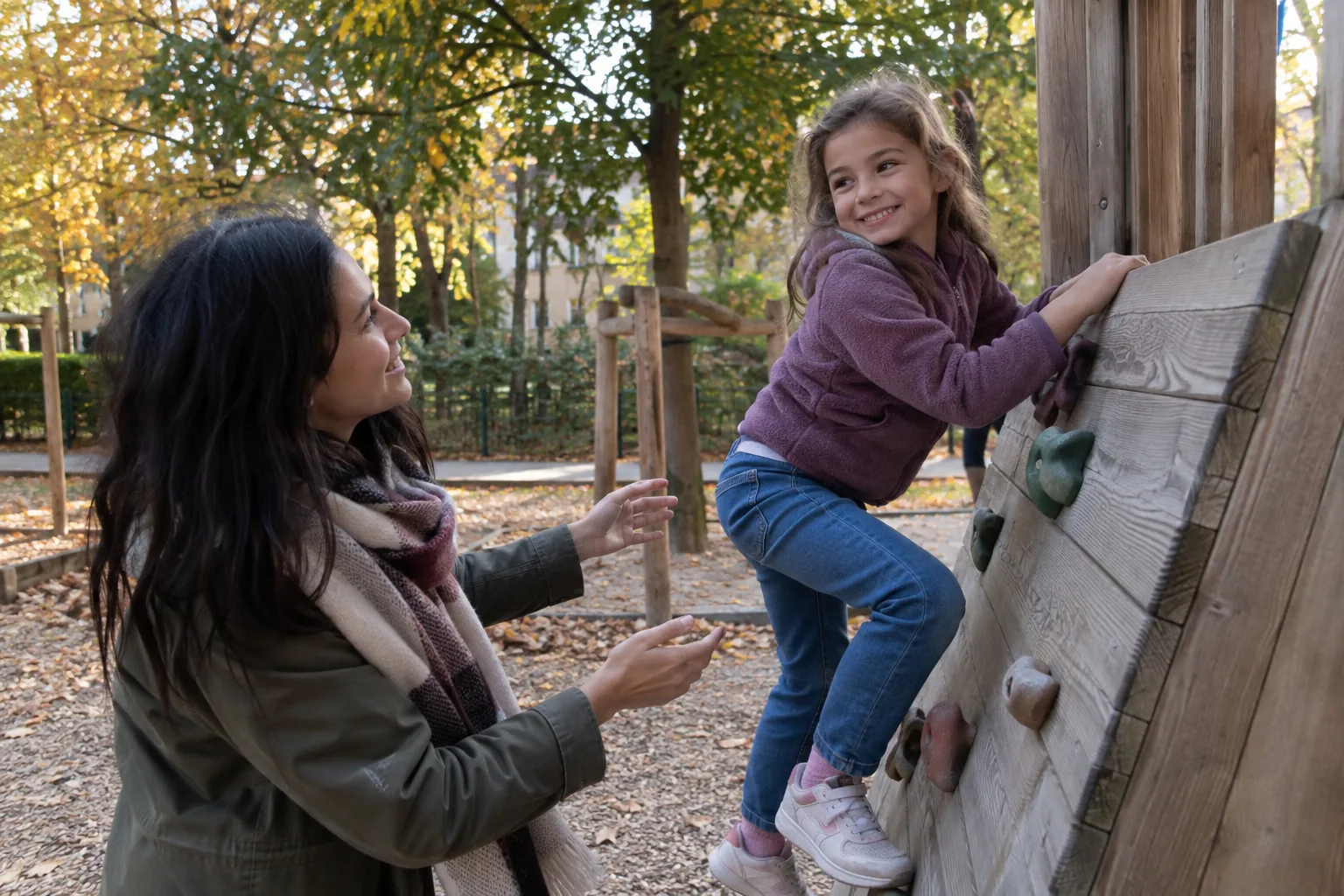
Confidence comes from successes... that required effort. A task that is too easy offers no growth, while one that is too hard causes frustration. The sweet spot is just above what the child can already do. For a shy or hesitant child, break the goal down into small steps, like rungs on a ladder.
This principle applies to everything: swimming without floaties, reading a full page alone, sleeping over at a friend's house. Celebrate every step reached, and let your child decide when they feel ready for the next one.
4. Let them try and make mistakes
When a child gets stuck, the instinct is to help right away. Wait a few extra seconds: often, they figure it out on their own. If they ask for help, provide the minimal amount needed—a hint rather than the complete answer. Mistakes aren't failures, but feedback: "What did you learn from making that mistake?" Our article on encouraging independence without leaving your child stranded during challenges explores this mindset further.

5. Give them real responsibilities
Setting the table, feeding the cat, choosing Sunday's dinner: meaningful responsibility sends the message "we rely on you." Adapt the task to their age, show them how to do it, and then trust them. Our chart of age-appropriate household chores provides practical ideas for ages 3 to 10.
6. Listen to their fears without brushing them off
"Come on, there's nothing to be scared of!" Although well-intentioned, this phrase implicitly tells a child that what they feel isn't valid. Instead, acknowledge the emotion: "You're nervous about not knowing what to say to your new teacher." Once validated, the fear feels smaller, and you can brainstorm solutions together. To learn more, check out our article on helping your child put words to their emotions.
7. Avoid comparisons
Comparisons with a brother, sister, or friend are hurtful, even when intended as encouragement. Instead, compare your child to themselves: "Remember back in September when you didn't know how to ride a bike without training wheels yet?" Seeing their own progress is one of the most powerful boosters of confidence.
8. Keep track of achievements
A pride notebook, a box where you slip a small paper for every achievement, photos of building creations: keeping track lets them look back at the path traveled on days of discouragement. Let your child choose what they want to put in it: these are their achievements, not yours.

Frequently asked questions
My child often says "I suck," what should I answer?
Avoid contradicting them outright ("No, you're awesome!"), as this rarely convinces them. Acknowledge the emotion, then ground them in facts: "You find this exercise hard. What have you already succeeded at? Where could we start?"
Are shyness and lack of confidence the same thing?
Not necessarily. A shy child can be very self-assured in areas they know: they simply need time to open up to others. Respect this pace while encouraging them with small social challenges.
Should you push a child who hesitates to try?
Pushing them abruptly often reinforces the fear. It is better to break the goal down into small steps and guide them through the first ones. A success, even a tiny one, makes them want to go further.
When should you be concerned?
If your child very frequently expresses that they are worth nothing, avoids all new things, or seems persistently sad, talk to your doctor or teacher. An outside perspective can help understand what is happening.
To go further
Preview before choosing
Les Grands Curieux · Ages 7–10
For children who are beginning to read instructions on their own and enjoy playing with words, numbers, and riddles. An adult can help with reading.