
Table of Contents
- 1. Start by telling the story, without taking out a pencil
- 2. Find five milestones to move the story forward
- 3. Listen to an example: the party under the apple tree
- 4. Make cards to choose your own adventure
- 5. Adapt your support between ages 4 and 10
- 6. Put the events back in order
- 7. Avoid corrections that stop imagination
- 8. Give a wrap-up to your shared time together
- Frequently asked questions
"Once upon a time, there was a dragon… and after that, I don't know." The idea is there, but what comes next won't arrive. To invent a story, a child doesn't necessarily need more characters or complicated words. Sometimes all they need is a very simple question: "What would this dragon like to do?"
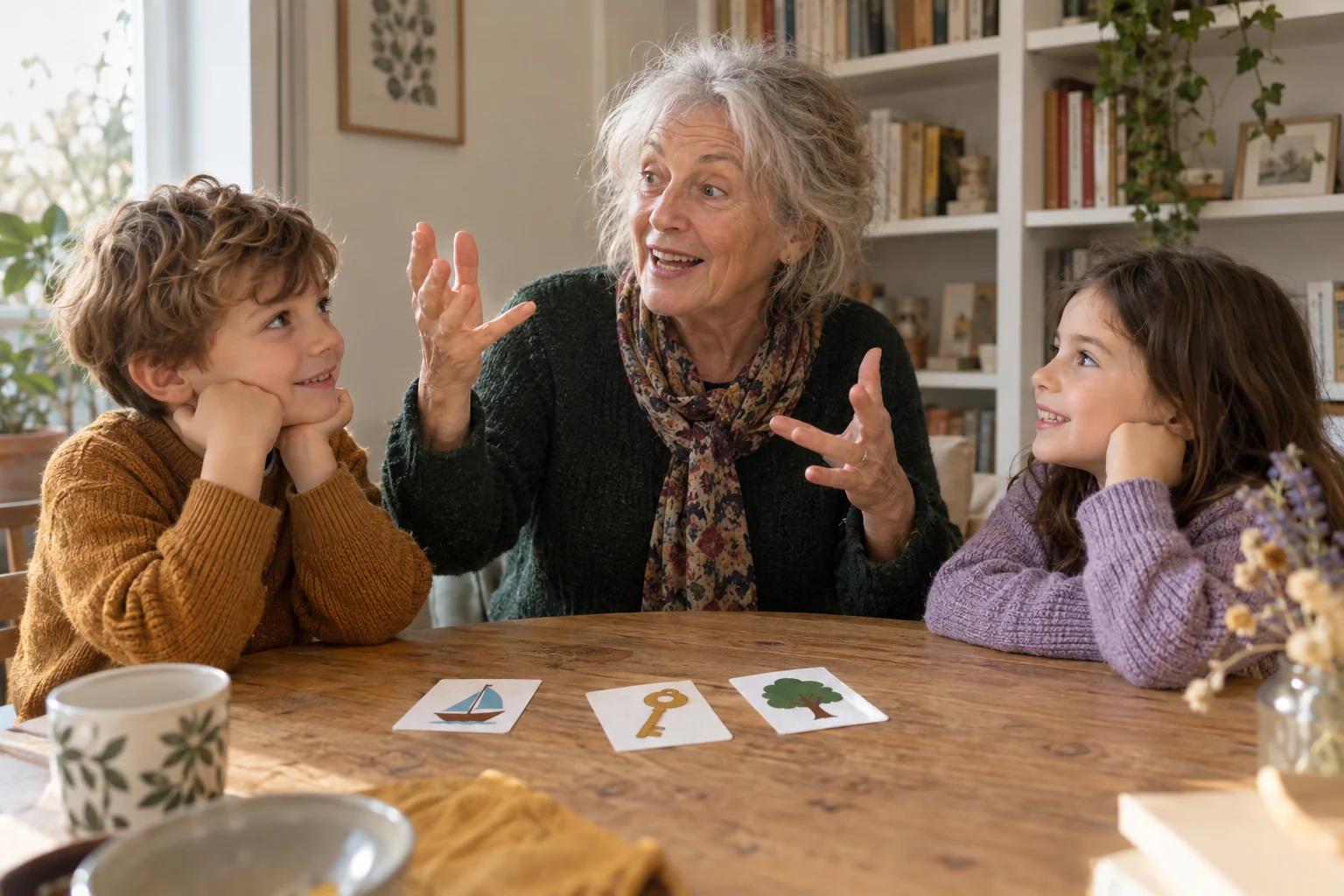
The adventure can start out loud, with a figurine or a few drawings. Between ages 4 and 10, you can offer simple structure and keep a light touch: your child chooses what happens, and you help them make their story easy to follow.
1. Start by telling the story, without taking out a pencil
Set up two figurines or show a picture you picked together. Suggest a opening sentence: "This morning, this character wanted to…" Then wait. The child might answer with a few words, a gesture, or act out a conversation. Repeat their suggestion to check that you understood, without trying to polish it right away.
At ages 4–6, an adventure told in three sentences is already a complete creation. At ages 7–10 as well, preparing out loud lets them test ideas before worrying about the page. You can say: "Let's tell it out loud first; then we'll decide if we want to write it down."
The French educational guidelines Éduscol benchmarks for French literacy specifically connect oral preparation with writing a short story. At home, these links can take a playful form. After a shared reading session, ask what the hero wanted, then invent another character with a different goal.
2. Find five milestones to move the story forward
A list of extraordinary things doesn't always make an adventure. "A dragon, a rocket, a castle" provides a setting; an intention sets the character in motion. Here are five prompts to offer without turning your chat into a quiz.
- Who? A character you can follow: a child, a mole, a robot.
- What do they want? Find an object, reach someone, prepare a surprise.
- What gets in their way? A blocked path, a missing object, a mistake.
- What do they try? An action, then possibly another one if the first one fails.
- What changes at the end? They succeed, find another solution, or give up for an understandable reason.
This framework is a helpful tool, not a mandatory formula for every story. The BnF pedagogical guides explore story ingredients and storytelling variations. Your story can remain everyday, funny, or tiny: finding a lost sock can be plenty.
3. Listen to an example: the party under the apple tree
Here is an original story to read aloud to show how these milestones connect.
Milo, the little fox with the green scarf, wanted to read a story to his friends under the apple tree. He had set up three cushions and placed his book on a crate. But the wind was turning the pages before he could finish reading them.
Milo put an apple on the book. The pages stayed still, but the apple hid the sentences. He tried holding the corners with both paws. This time he could read… until it was time to turn the page. Everything started fluttering again.
Luma, the firefly, noticed the laundry basket near the house. "What about clothespins?" she asked. Milo attached a clothespin to each outer edge of the book. When he turned a page, he gently moved one of the clothespins.
His friends arrived. The wind was still shaking the branches, but the story could finally begin. At the end, Milo closed his book and left an apple on each cushion: the snack had been waiting the whole time!
Simply ask: "What problem is Milo trying to solve?" Then look for his two attempts. The solution uses an object introduced earlier in the scene; it doesn't appear out of nowhere without explanation.
4. Make cards to choose your own adventure
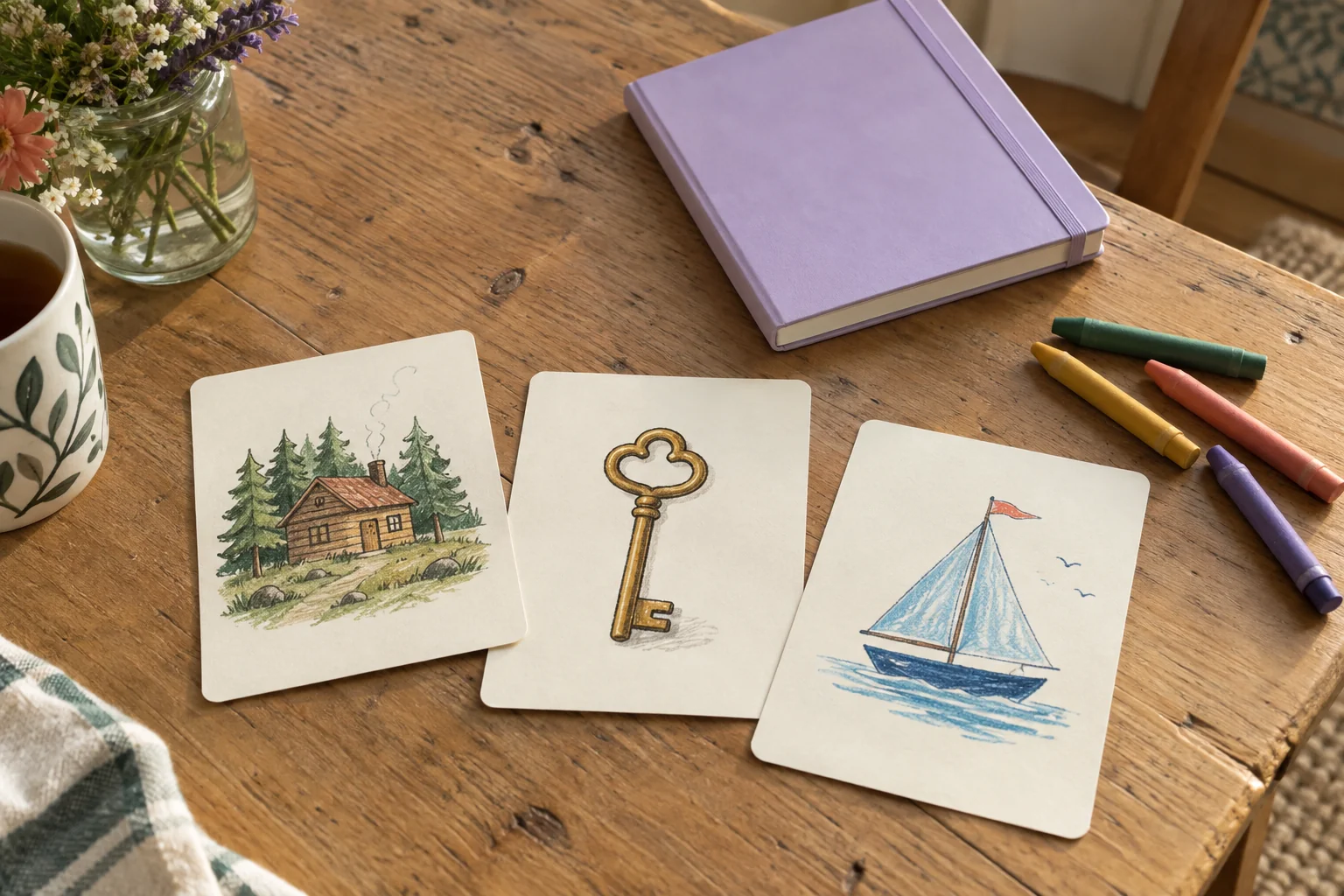
Take six small rectangles of paper and some colored pencils. Draw two characters, two places, and two objects: for example a turtle or an astronaut, a garden or a train station, a key or an umbrella. The drawings can be very simple; an adult can write their names.
The child picks one card from each category. Then ask what their character wants to do. The object can help, get in the way, or stay in the background.
- Lay the three chosen cards in front of you.
- Find a clear goal for the character.
- Invent an obstacle connected to that goal.
- Act out a try using the cards, then decide on the ending.
If the combination seems impossible, allow a card swap. The goal is to build a story that the child enjoys. To nurture this way of playing, also make room for free play at home, without requiring a completed story every time.
5. Adapt your support between ages 4 and 10
With 4-to-6-year-olds, stick to a main character, a problem, and a solution. You can offer two choices: "Is the door locked, or is the path flooded?" The child can invent a third option. Three drawings are then enough to recall the beginning, the problem, and the end.
Around ages 7–8, ask what happens after a first failed attempt. The child can dictate sentences, write a speech bubble, or add captions to pictures. Around ages 9–10, suggest a chosen challenge: telling the story from another character's point of view or giving a useful clue right from the start.
If you are writing down what they dictate, read it back regularly and ask if it matches their idea. This focus on content, formulation, and re-reading mirrors the dictation-to-an-adult approach outlined by Éduscol. Keep their choices of character and tone: you are their scribe, not their replacement.
6. Put the events back in order
A story can seem clear in the narrator's head while leaving the listener confused. Draw three or four key moments on separate sheets of paper. Mix them up, then work together to find the order that makes the adventure make sense.
In Milo's story, his friends can't listen peacefully until he finds a way to hold the pages down. Ask a specific question: "At this point, is the problem already solved?" Words like "first", "but", "then", and "finally" can help connect events.
The game below offers another adventure featuring Milo: a broken bridge on the way to the orchard. Put its four events back in order.
However, it isn't enough to simply add "and then" everywhere. Also ask why the character acts: he uses clothespins because the pages are blowing away. This relationship gives meaning to the sequence of events.
If a word is missing, offer two options and let them choose. Our games to enrich vocabulary offer other opportunities to discover new words; during storytelling, keep your focus on the story arc.
7. Avoid corrections that stop imagination
Replace overly broad requests like "Invent a nice story" with a small choice. Avoid piling on prompt after prompt. After asking a question, pause and embrace the silence; not every hesitation calls for a new suggestion.
Also avoid adding a "more interesting" twist yourself. A character simply returning home can suit the child completely. You can ask if their initial goal was reached, and then accept their conclusion.
If you keep a written version, keep the moments separate: first the story, then a short review. Correcting every mistake while inventing risks derailing the conversation. Spelling games can have their own place.
Finally, prefer specific feedback over a rating or comparison: "I understood why she goes back to get her bag." This comment describes what works. It leaves more room for a next try than comparing it to a sibling's story.
8. Give an ending to the shared moment
When the story makes sense, suggest giving it a title. Your child can choose the funniest phrase, draw a cover, or simply tell it to you one last time. Ask before reading it to someone else: some stories are best enjoyed in the privacy of playtime.
Another session can change just one element: the setting, the object, or the ending. You can abandon one version and start a new one.
To support their desire to try again, notice a personal decision: "You came up with how she crosses over." Our article on self-confidence offers other ways to comment on attempts without demanding a high performance.
Frequently asked questions
My child doesn't know how to write yet: can they invent a story?
Yes. They can tell it out loud, play with action figures, or put drawings in order. You can write down a few sentences as they dictate, then read them back. An oral story remains a full creation in its own right.
What should I do if they use a familiar character or story?
Welcome that starting point and suggest changing one element: the character's goal, the setting, or the obstacle. They may also want to retell the known story faithfully. In that case, present that moment as a fun way to retell it.
Does there always need to be a moral at the end?
No. The ending can solve a problem, reveal a surprise, or show a change. Ask what happens to the character's initial wish; there is no need to add a lesson every time.
How can I help a child who says they have no imagination?
Avoid turning it into a label. Offer a choice between two characters, start with a first sentence, or use an everyday event while changing one detail. If they aren't in the mood, stop there and try another day, without setting length goals.