
Table of Contents
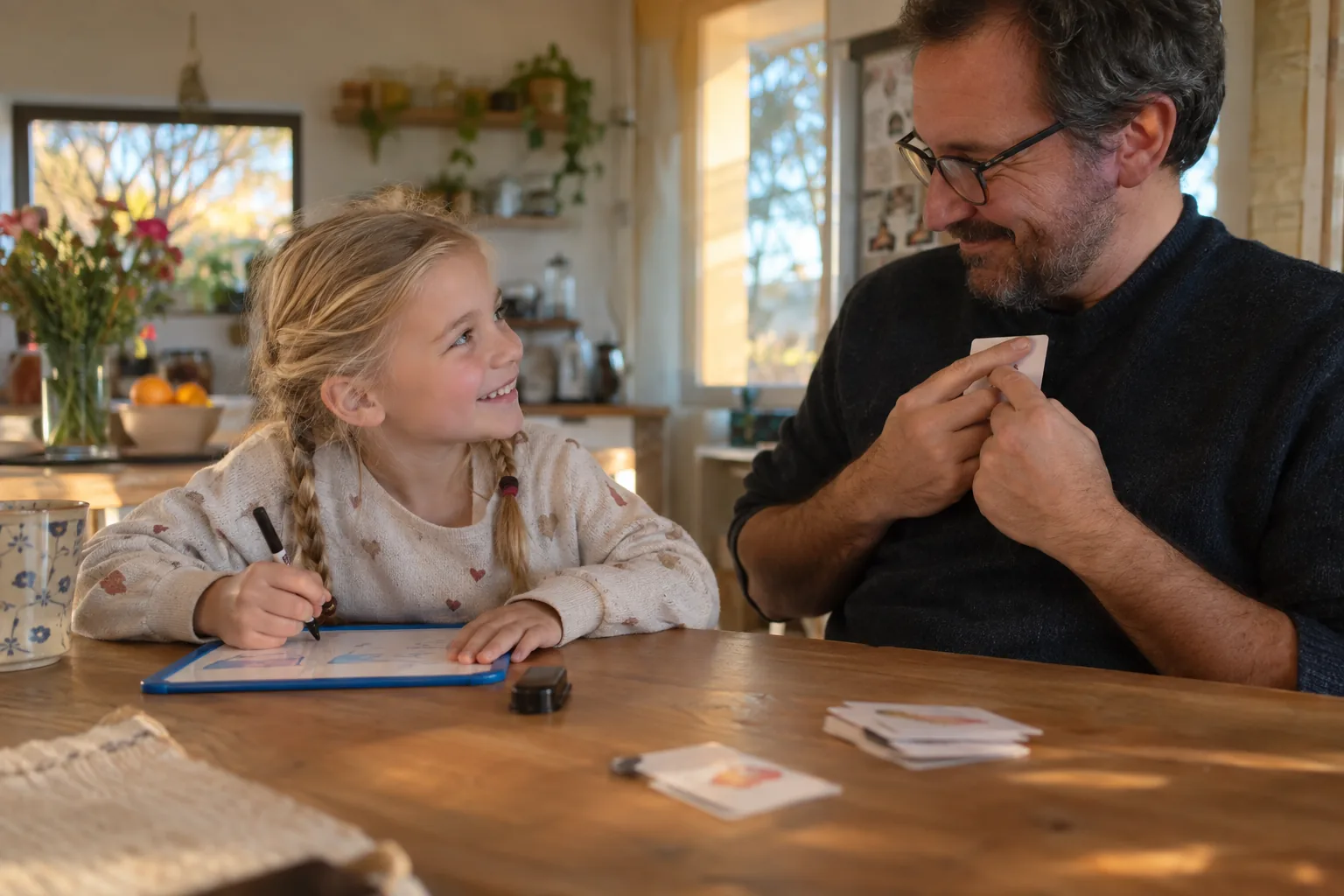
“Because,” “friend,” “said”… Some words are not spelled exactly as they sound. In English, one sound can have different spellings: the long “a” appears in play, rain, and cake. Remembering a spelling therefore takes more than listening: children also notice letter patterns and word families. The good news is that these skills grow with a simple routine and short, playful practice. Here is how to help children in early elementary school practice spelling without tears.
How we remember the spelling of a word
When children first write words, they often use the sounds they hear. In English, a child might write “sed” for said or “frend” for friend. These attempts can show careful listening, while also revealing which letter patterns need practice. Reading, spelling and checking the actual written word help children connect sounds with conventional spellings.
The official French guide "To Teach Reading and Writing in 2nd Grade (CE1)" highlights the essential role of copying and dictation in memorizing spelling. But copying must be done cleverly: copying a word ten times letter by letter, checking the model for every single letter, hardly engages memory. Conversely, observing the word, covering it, and then writing it from memory forces the brain to retain it.
The five-step method
For every word to learn, offer this short routine. It takes less than a minute per word and quickly becomes second nature.
- I read the whole word aloud and notice the tricky part, such as the “ai” in rain.
- I spell the word letter by letter while looking at the model.
- I cover the word and try to "see" it in my mind with eyes closed.
- I write the word from memory.
- I check against the model, letter by letter, and correct it if needed.
The flash copy tool below applies this exact principle: the word appears for a few seconds, disappears, and your child writes it from memory. You can select the display time depending on their level.
Grouping words to memorize them better
Isolated words are easily forgotten; words organized into family groups are retained much better. Two types of categories help immensely.
Word families help children recognize shared spellings: play, player, and playful keep the same base. Other families, such as sign and signal, reveal a sound that is silent in one word. These clues do not explain every spelling, so check unfamiliar examples together. Finding a word’s relatives can become a game. For more ideas, see our guide to building your child’s vocabulary.
Grouping by spelling patterns helps children compare words that share a sound or a tricky letter. Make a small chart on the fridge and add examples together over several weeks.
| Spelling pattern | Examples | How to remember it |
|---|---|---|
| ay | play, day, stay | often found at the end of a word |
| ai | rain, train, paint | rain → rainy; paint → painting |
| a…e | cake, game, name | name → named; game → games |
Six games to practice without even realizing it
- The mystery word: replace two letters with blanks (“f _ ie _ d” for friend) and invite your child to fill them in.
- Hangman with hints: with each wrong guess, give a clue about the word's meaning instead of drawing part of the gallows.
- Reverse dictation: your child dictates three words to you... and you intentionally sneak in a mistake for them to spot.
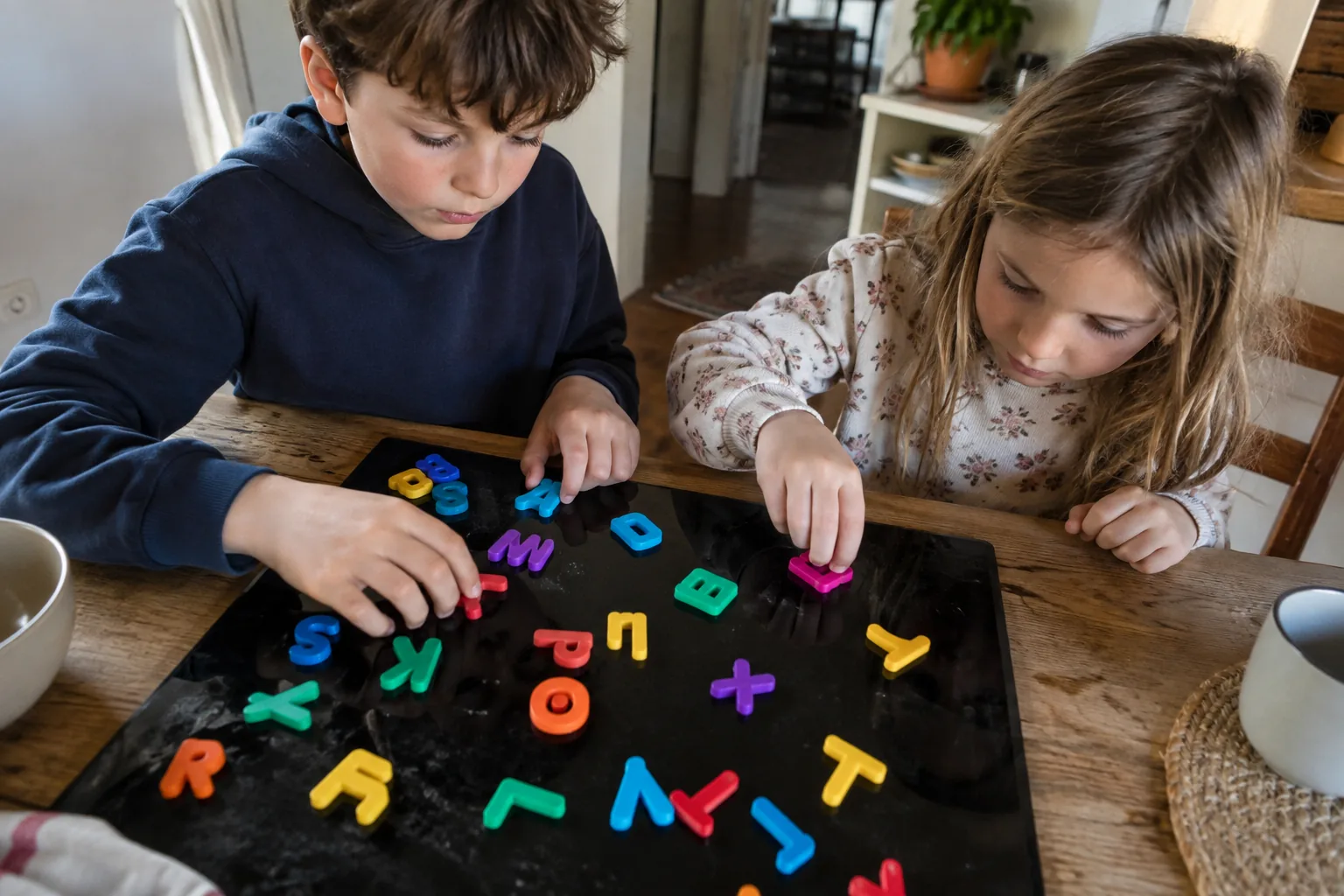
- Magnetic letters: mix up the letters of a word on the fridge or a metal tray; your child has to put it back together.
- Word hunt: inside a book or magazine, search for the words from this week's list.
- Word of the day: a word written on a sticky note, stuck in an unexpected spot; in the evening, write it from memory.
Preparing a dictation stress-free over four days
The weekly dictation is best prepared across several short ten-minute sessions rather than one full hour the night before. Here is a simple plan to adapt to the list provided by the teacher:
Day 1: Discover
Read the list together, explain unknown words, spot tricky parts, and underline them in color.
Day 2: Memorize
Apply the five-step method to the hardest words, followed by a quick flash copy exercise.
Day 3: Practice
Do a fill-in-the-blank dictation: you write sentences leaving blanks, and your child fills them in.
Day 4: Check
Dictate a few short sentences, then review them together, exploring the reasoning behind each mistake.
Mistakes are clues
Different mistakes need different kinds of practice. A sound-based spelling such as “sed” for said suggests that the child heard the word but has not yet remembered its written form: flash-copy practice may help. Leaving out a sound, as in “sip” for slip, calls for slow listening and reading. A grammar error such as “two boat” needs a different conversation about singular and plural forms.
Notice successes as well as mistakes: “You remembered the apostrophe in don’t!” Confidence helps children feel willing to try. Our tips for supporting homework without doing it for your child build on this approach.
Frequently asked questions
How many words should be learned per day?
Three to five new words a day are generally enough in 2nd and 3rd grade (CE1–CE2 equivalent). It is far better to truly memorize a few words than to skim through a long list.
Should a child be made to write a word ten times?
This is not the most effective method. Copying while looking back at the model for every single letter does very little to build memory. It is much better to look closely at the word, cover it, write it from memory, and then check.
My child writes “the way it sounds,” is that normal?
Yes, it is a normal step in the early stages of learning. They are relying on sounds, which is a great foundation. Memorization games and word families will then help them remember the exact spelling.
What should I do if dictations trigger tears?
Reduce the amount, break preparation down over several days, and celebrate progress. If significant difficulties persist despite regular practice, talk to the teacher, who can observe how things go in class.
To go further
Preview before choosing
Les Grands Curieux · Ages 7–10
For children who are beginning to read instructions on their own and enjoy playing with words, numbers, and riddles. An adult can help with reading.