
Table of Contents
- What can you prepare without turning home into a laboratory?
- How do you keep a genuine prediction before testing?
- Why can a heavy object still float?
- What should you compare when shape changes?
- What can you record when the result is hard to classify?
- How can you finish with a useful conclusion?
- Frequently asked questions
To find out whether an object sinks or floats, make a prediction and gently place it in water with an adult beside your child. Watch its position without holding it. Size and mass alone do not settle every case. Keep uncertain observations in your record too.
What can you prepare without turning home into a laboratory?
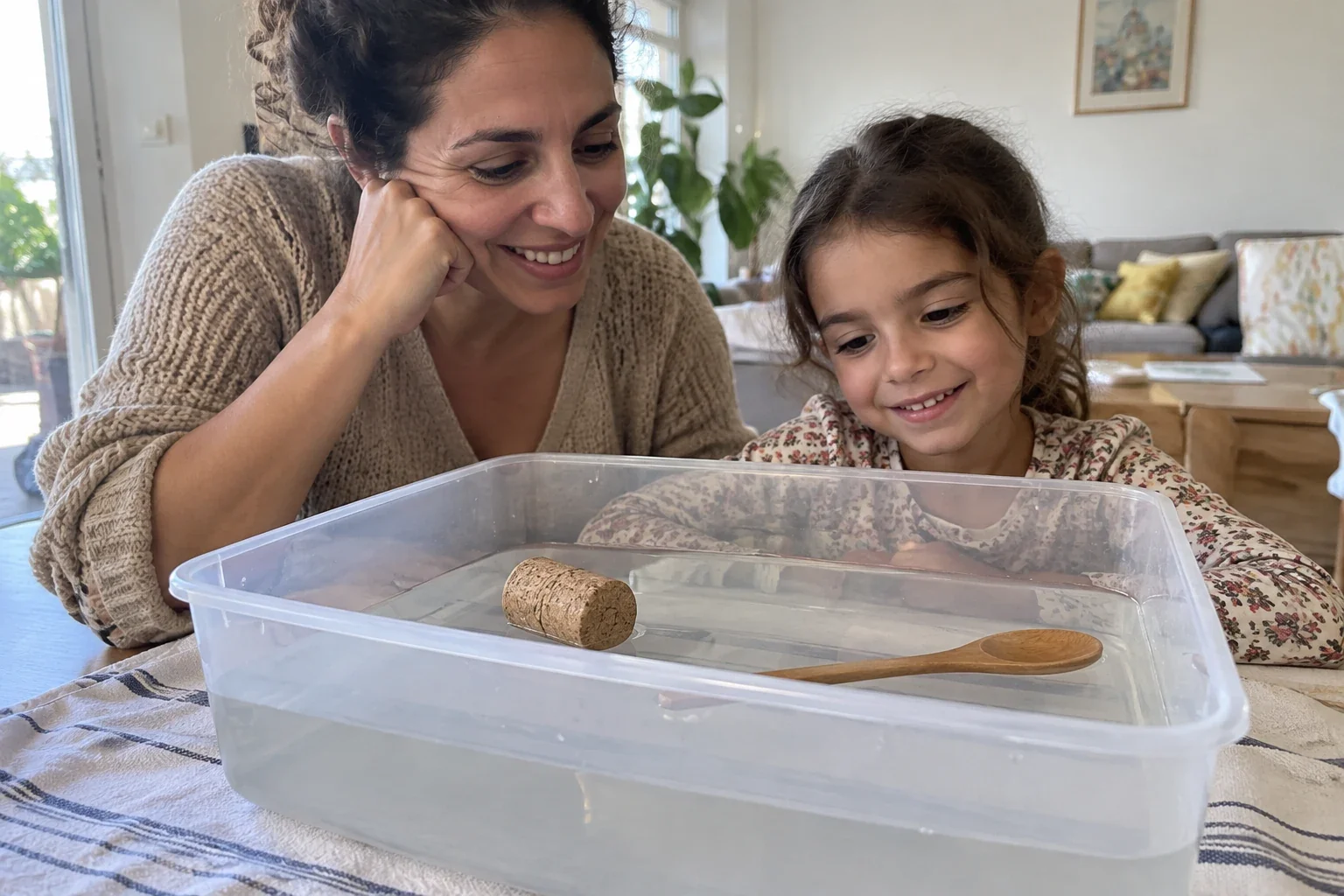
Choose a low, stable container, room-temperature water, a towel, and a few washable objects too large to swallow. A wooden spoon, a metal tablespoon, and an intact plastic box give you objects to describe. Leave out batteries, electrical devices, glass, and sharp pieces.
An adult stays beside the child throughout, handles the water, and empties the container afterwards. Wipe spills straight away. Experiment water is not for drinking. Reduce the selection if your child still mouths objects: this activity is not independent water play.
| Variation | Suggested action | Possible record | |---|---|---| | Ages 4–6, supervised | Observe one object at a time | Point and dictate a sentence | | Ages 7–10, supervised | Compare two documented tests | Write prediction and observation |
These ages describe variations, not levels children must pass. Fondation La main à la pâte also introduces floating and sinking as an observation investigation before moving towards more abstract explanations.
How do you keep a genuine prediction before testing?
Ask “Where do you think this object will end up?” before placing it in water. Accept “I am not sure.” Record that answer without correcting it afterwards: changing an idea belongs in the investigation. Then lower the object gently, take your hand away, and watch what happens.
Remove each object before the next and let the water settle. The journal below separates your prediction from your observation. It does not know the exact material or your test conditions, so it cannot supply an automatic physical answer key. A different result invites an explanation rather than a grade for your child.
My journal: before and after
Observations recorded: {n}. Possible comparisons: {p}. Matching predictions: {m}. These counts do not grade your child.Choose a prediction before testing and an observation afterwards.
No answers are stored or sent. Explanations remain readable without JavaScript.
Why can a heavy object still float?
Mass alone cannot sort every object. Water pushes upwards; shape and the volume displacing water also matter. NOAA describes these principles in its boat-building resource. Its challenge for older students is not a requirement for this first family investigation.
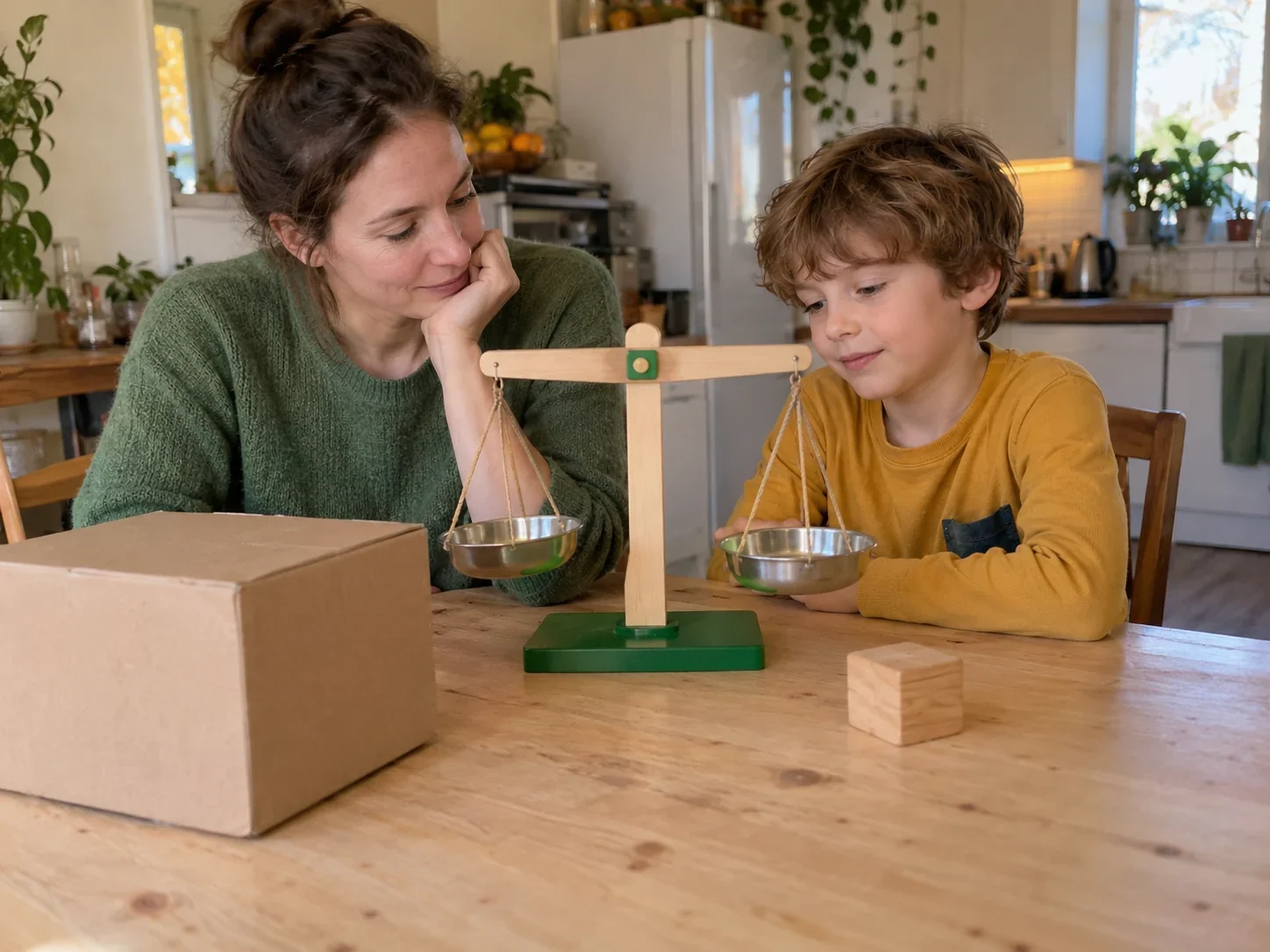
To compare two masses, use a balance scale instead. To investigate floating, observe the whole object in water: a small metal spoon may sink while a bulkier hollow object stays at the surface. That observation does not measure their masses. Do not replace testing with “small means light means floating”.
What should you compare when shape changes?
Keep the same material and describe what you change. An intact tray and a compact piece do not have the same construction. However, a hollow shape that takes in water may stop behaving as it did initially. Do not promise that every modelling clay can become a floating boat: formulations and setups vary.
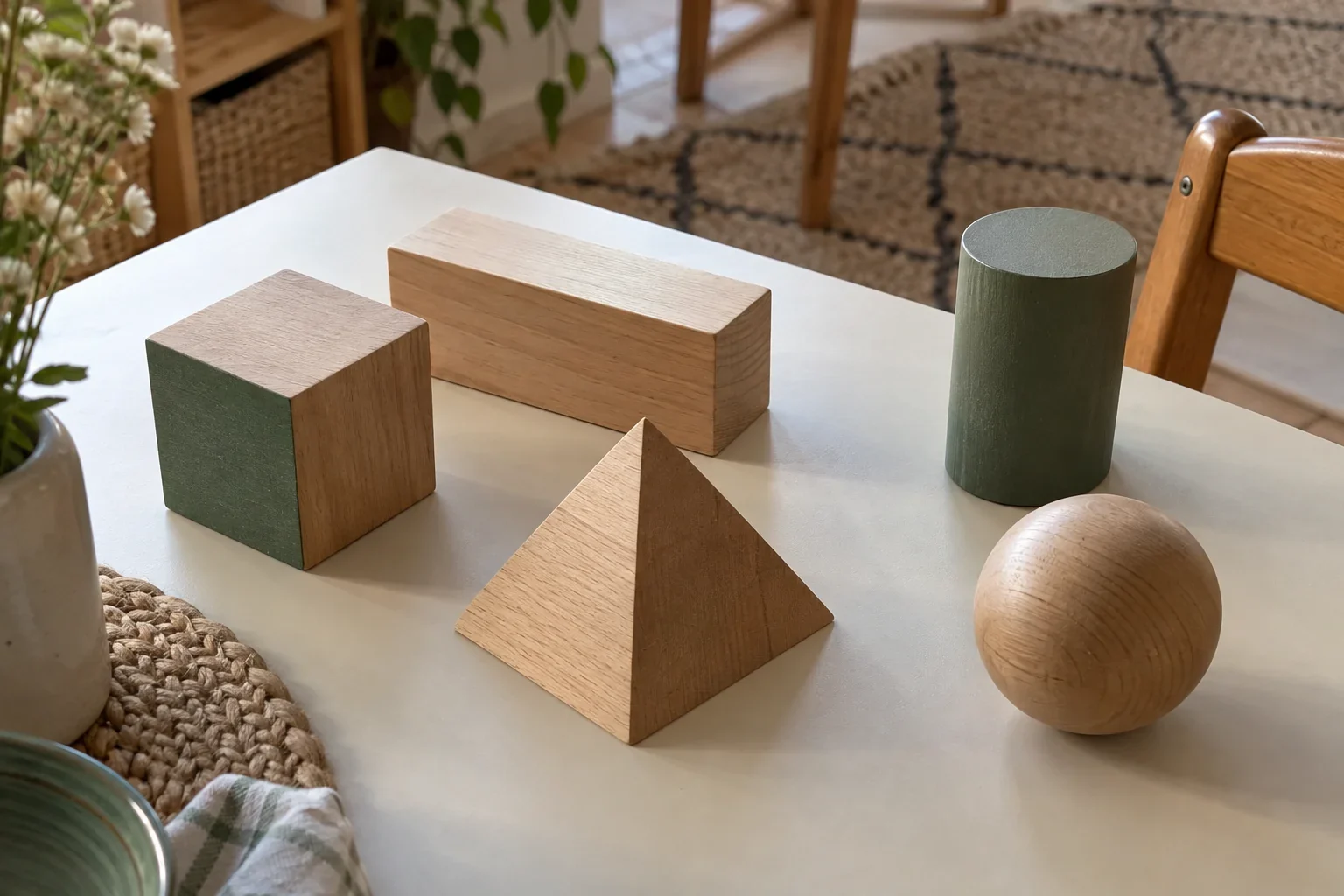
With older children, separate the geometric name from construction using the solid-shapes guide. Two objects that look cubical can be solid or hollow. The quiz below concerns conclusions you can draw rather than a universal list of floating objects.
Which conclusion is justified?
Justified conclusion.Read the explanation before deciding.No answers are stored or sent. Explanations remain readable without JavaScript.
What can you record when the result is hard to classify?
Write what you see: “part of it sticks out”, “it touches the bottom”, or “its position changes”. A floating object can be partly submerged. Science Learning Hub highlights that the category requires more than a quick look at the top of the water.
Repeat under comparable conditions if the container was too shallow or a hand was still supporting the object. Keep the first observation in your journal. If the water level changes after adding an object, that alone does not demonstrate evaporation: our water-cycle guide deals with a different observation.
How can you finish with a useful conclusion?
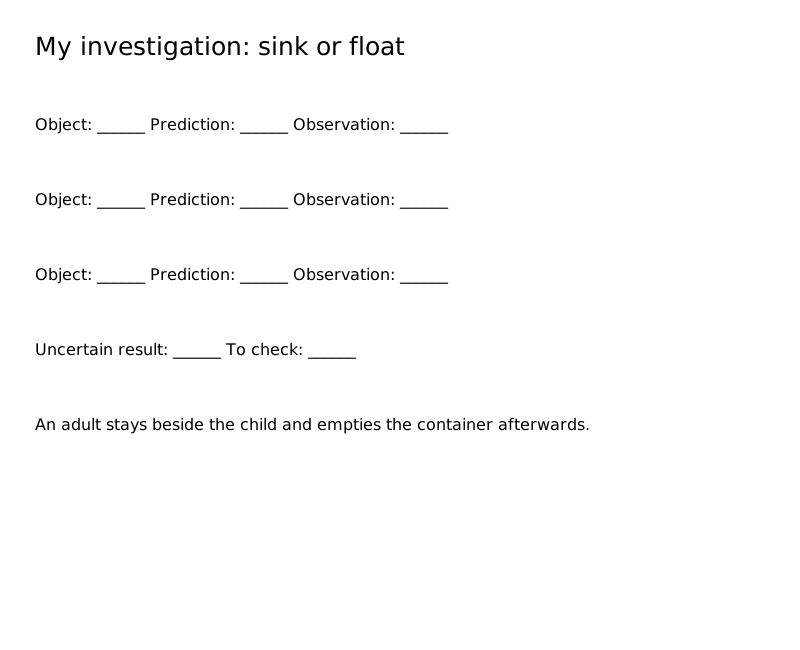
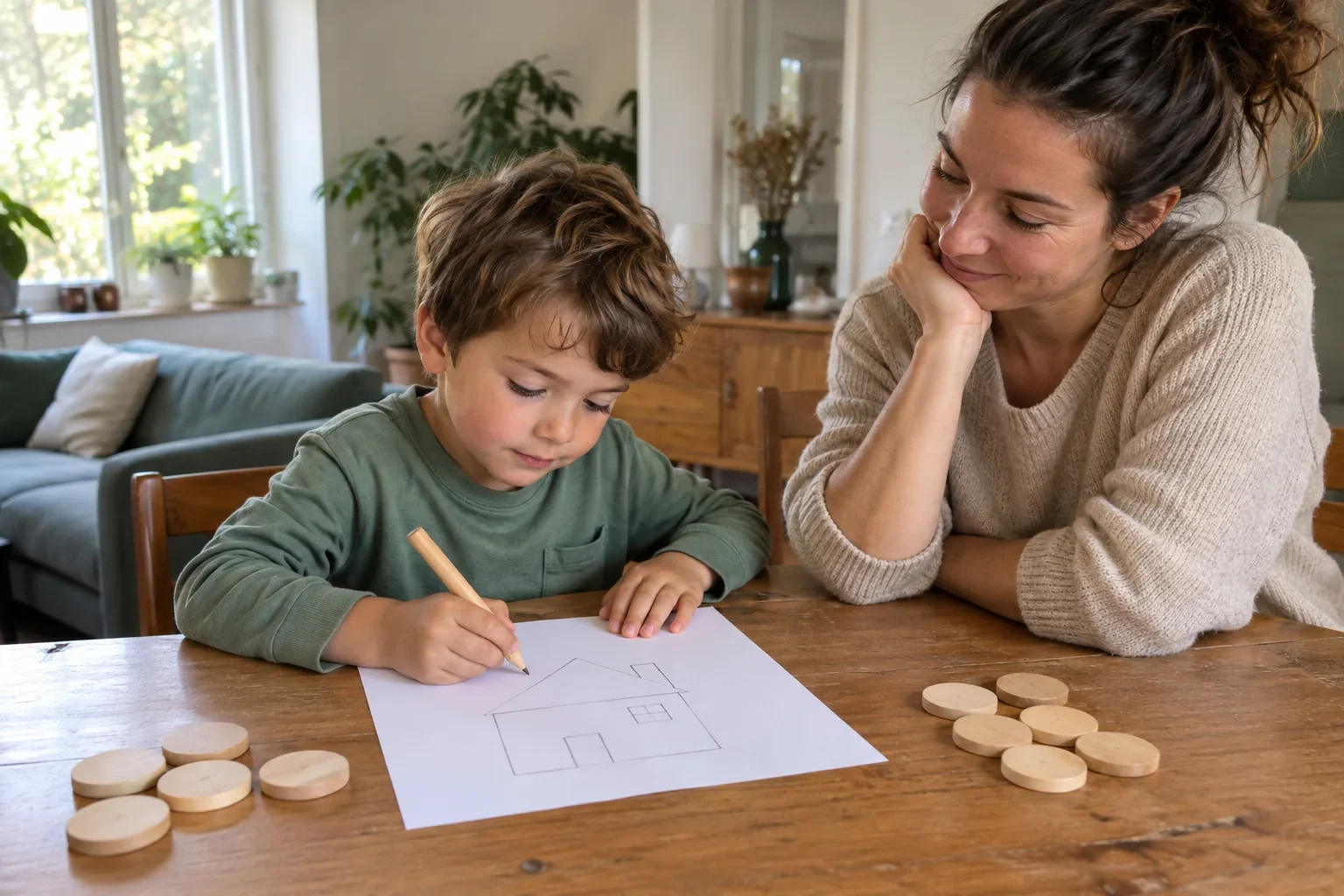
Choose one example and complete: “I thought…, I saw…, I would like to check…”. The activity’s downloadable sheet leaves room for uncertainty. It does not turn an illustration into evidence or ask children to succeed at every test.
You can then return to the free activities or browse Hepaly workbooks on the site. The commercial PDFs are in French; distinguish them from this page’s free sheet. For your next sink-or-float investigation, return to one precise question instead of making an ever-longer list of objects.
Frequently asked questions
Should you fill the container completely?
No. An adult chooses an amount suited to the container and objects, stays beside the child, and empties it afterwards.
Must a floating object be entirely above water?
Part of it can remain submerged. Describe its position without pushing or holding it.
Does all modelling clay sink?
Composition and shape can vary. Record what your product does rather than imposing another experiment’s result.
Can you record “not sure”?
That answer preserves real uncertainty. Add what you observe and what would need checking.
Does a balance predict whether something floats?
It compares masses. That result alone cannot predict how every object will behave in water.
Does the journal store your answers?
Choices stay in the open page, without transmission or automatic storage. Keep a printed copy if you wish.