
Table of Contents
- Which game to choose based on what your child already knows?
- How to read row and column without mixing them up?
- Why does this grid have six rows instead of five?
- How to encode a word and verify the result?
- How to decode a message without guessing the whole word?
- What hint to give when row and column are reversed?
- How to print a worksheet without revealing the answer key?
- Does a Polybius square protect a real secret?
- How to extend the activity without repeating the same page?
- Frequently asked questions
The Hepaly team offers a coordinate-reading activity here, not a method to secure real secret messages. You will find a shared grid for the tools, six guided attempts, and eight worksheets with separate answer keys. Keep the chart in full view: no need to memorize the alphabet. The fun comes from linking a coordinate pair to a square, then watching the hidden word appear.
Which game to choose based on what your child already knows?
Pick an activity based on familiar visual benchmarks rather than age targets. Your child simply needs to identify grid squares and read the two numbers of a coordinate pair; you can read the letters together. Successfully completing a worksheet is an enjoyable achievement, not a test of school performance.
| Starting point | Suggested activity | Materials and guidance |
|---|---|---|
| Around ages 4–6 (pre-readers) | A 2x2 grid featuring four simple pictures | Paper, pencil, and an adult naming the positions out loud |
| Around ages 7–10 (knows letter names and sounds) | A short word inside our 6-row grid | Grid in plain view, repeatedly modeling the "row first, then column" rule |
| For children who are already comfortable with coordinates | A short phrase and a fresh worksheet with no worked example | Worksheet, scratch paper, and answer key kept separate |
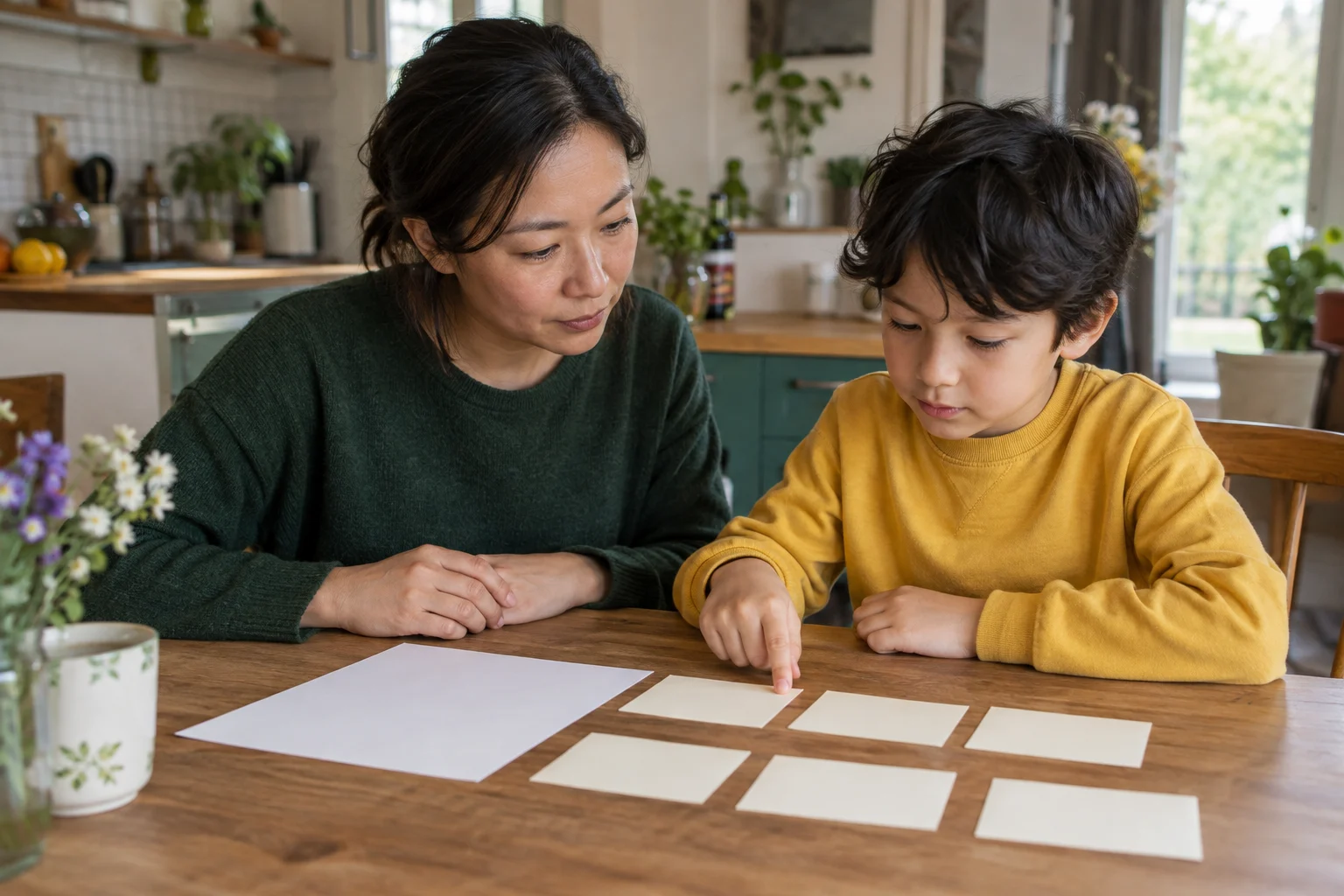
The small picture grid is a gentle starter warm-up, separate from the tool generator ciphers. For instance, place a moon and a star on top, and a tree and a house on the bottom. Ask your child to point to "bottom left" without turning this activity into a reading drill. Our alphabet learning games offer another fun entry point if working with letters feels overwhelming right now.
This guide is meant for shared activities, family games, or index hunts. Anyone looking to secure real digital messages will need a different tool: our chart is public, fixed, and intentionally easy to reverse-engineer. If tracking grid squares causes fatigue or frustration, enlarge the grid size, focus on a single letter, or switch to a different game.
How to read row and column without mixing them up?
The first digit indicates the horizontal row; the second indicates the vertical column. Place a finger on the row number on the left side, move along that line, and stop directly under the column number. The letter sits right at their intersection.
| Row / column | 1 | 2 | 3 | 4 | 5 | 6 |
|---|---|---|---|---|---|---|
| 1 | A | B | C | D | E | F |
| 2 | G | H | I | J | K | L |
| 3 | M | N | O | P | Q | R |
| 4 | S | T | U | V | W | X |
| 5 | Y | Z | 0 | 1 | 2 | 3 |
| 6 | 4 | 5 | 6 | 7 | 8 | 9 |
Calculated examples with this grid: D → 14; S → 41; MILO → 31 23 26 33.
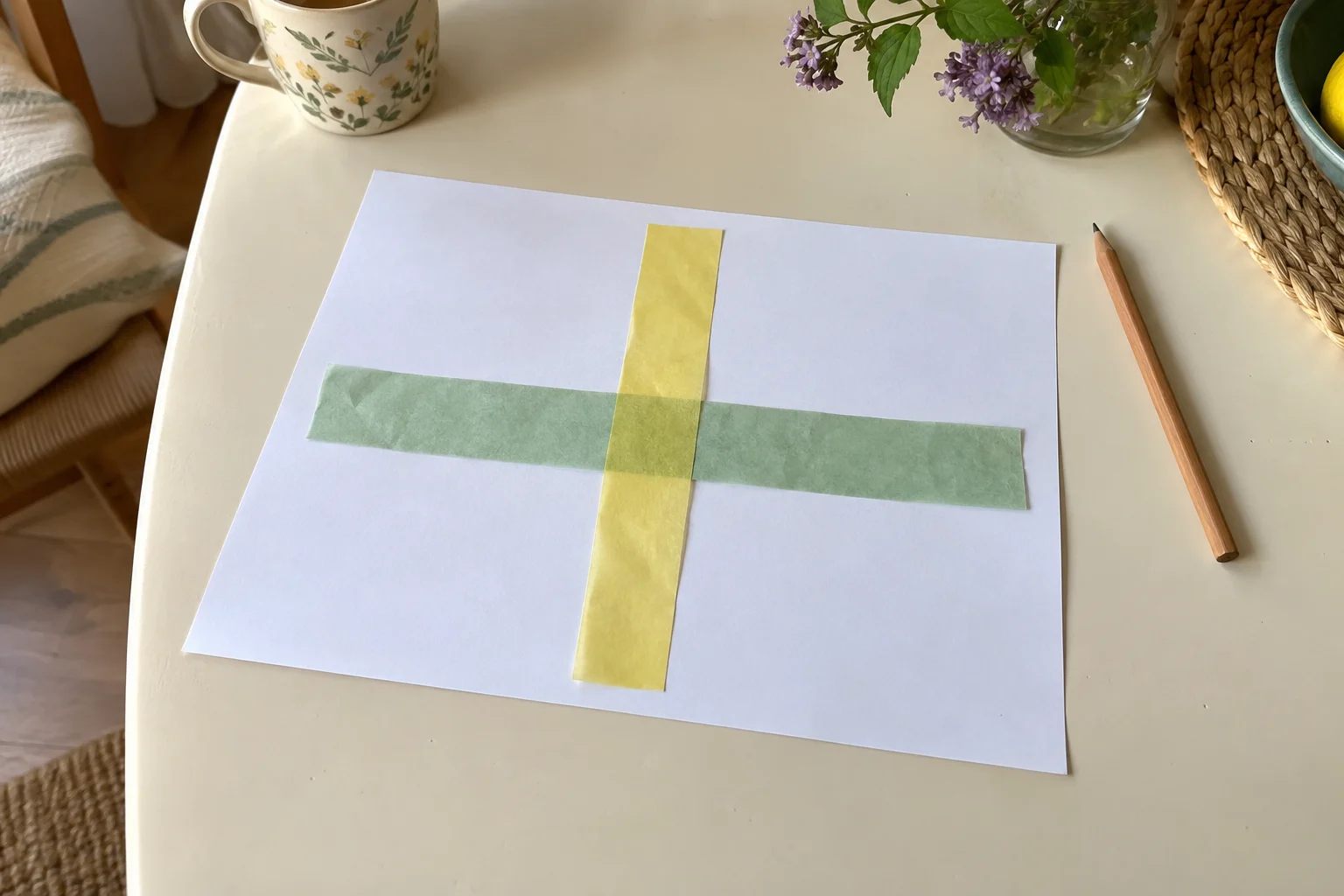
Take two strips of paper in different colors. One strip follows the row; the other goes down from the column. Their intersection makes the target cell clearly visible. Then remove just one strip and let your child find the path again. Keeping the visual aid is not cheating: it helps them understand what each number represents.
A coordinate is not a multiplication problem. In a multiplication chart, crossing two numbers gives you their product; here, it pinpoints a symbol. You can compare this to reading our guide on multiplication tables, making sure to highlight the change in rules.
Why does this grid have six rows instead of five?
Our version keeps each letter from A to Z in its own cell, then adds the ten digits. The total cell count and all letter-number matches are script-verified: six rows crossed with six columns provide 36 spaces, filled with no duplicates.
A common five-row version combines I and J into a single cell. Other alphabets and arrangements also exist. Back in 2005, the Petit-Bazar educational sheet from the University of Geneva featured a 36-cell grid, so we did not invent this format. Our track adds alignment cues and printable worksheets with separate answer keys.
Antoine Houlou-Garcia's video shows a different setup and explains how modern adaptations differ from the ancient Greek system. Watch it to understand the historical background, then return to our grid for the activities on this page. The same number pair will stand for a different letter if the chart changes.
How do you encode a word and check your result?
Write down a familiar word, locate each symbol in the table, and write down its two coordinates. Separate each pair with a space. If you enter multiple words, our tool adds a slash between them so you can see where each word ends.
Hepaly Workshop · working together
Which message would you like to encode or read?
Letters A through Z, numbers, and spaces. Accents are removed, Œ becomes OE, and Æ becomes AE. Punctuation is not accepted. No actual secrets.
Without JavaScript, look up each symbol in the table. Example: MILO becomes 31 23 26 33.
The converter accepts Latin letters, digits, and spaces. It turns all text to uppercase, strips accents, and expands ligatures like Œ and Æ. To keep the rules clear, punctuation is rejected: if you wish to continue, swap hyphens or apostrophes for spaces. This formatting change is displayed right above your result; decoded text will not restore original accents.
Start with our mascot's name, MILO, or a word like LUNE. Your child can pick a letter, give you its coordinates, and then check how you read them. Swapping roles lets each person verify the other's steps. Checking a shared grid together keeps the focus off memorizing the alphabet.
Read the result once more before hiding the message. A missing letter can make a strange word that looks like a deliberate riddle. Double-check the written message itself, not just what you meant to say. The same idea applies to other secret codes for kids that use different matching rules.
How do you decode a message without guessing the whole word?
Read each pair on its own, find its cell, and write down the symbol before moving to the next. The slash divides words. Our tool rejects numbers outside the grid, incomplete pairs, and misplaced dividers: invalid messages are not fixed by guessing.
A piece of scratch paper can have two lines: the number pairs on top, and the decoded letters right below them. Align each letter directly with its pair. If the word makes no sense, you can review a specific spot without erasing all your work. Make sure both of you are looking at the exact same grid.
Numbers in the original message have their own cells too. This means the digit zero gets its own coordinate pair; it does not mean an absent letter. Within any pair, both position digits range from one to six. Keep this distinction in mind when explaining why a zero inside a coordinate pair is invalid, while a zero in the text can be encoded.

What tip can you give if the row and column get swapped?
First point out the row to follow, then let your child look for the column. If they still need help, point to the starting mark on the left side of the grid. The complete answer stays available in every challenge, but it does not pop up automatically after a single try.
Hepaly Workshop · working together
Which letter is hidden in each pair?
Choose a letter for each pair. Hints and answers remain accessible without JavaScript.
Swapping coordinates doesn't always show an obvious mistake. When both numbers are the same, switching them points to the exact same cell, so a single test like that won't prove they followed the rule. Our challenges include pairs where the two digits are different. The feedback then explains what changed instead of just showing a red warning.
Ask "which number did you look at first?" instead of "why did you make a mistake?". Children can often trace their path even if they struggle to explain it in words. If they find the right row but lose track of the column, keep a ruler or a paper strip in place. You can also pause the activity after one clearly explained pair.
How do you print a worksheet without showing the answer key?
Choose short words or simple sentences, then select a worksheet version. Two separate files are provided: the activity worksheet and its answer key. The file name, level, and version number help you match them without accidentally printing answers on the back.
Hepaly Workshop · working together
Which worksheet and answer key should you choose?
All files, with or without JavaScript
- Words, version 1: worksheet · answer key
- Words, version 2: worksheet · answer key
- Words, version 3: worksheet · answer key
- Words, version 4: worksheet · answer key
- Sentences, version 1: worksheet · answer key
- Sentences, version 2: worksheet · answer key
- Sentences, version 3: worksheet · answer key
- Sentences, version 4: worksheet · answer key
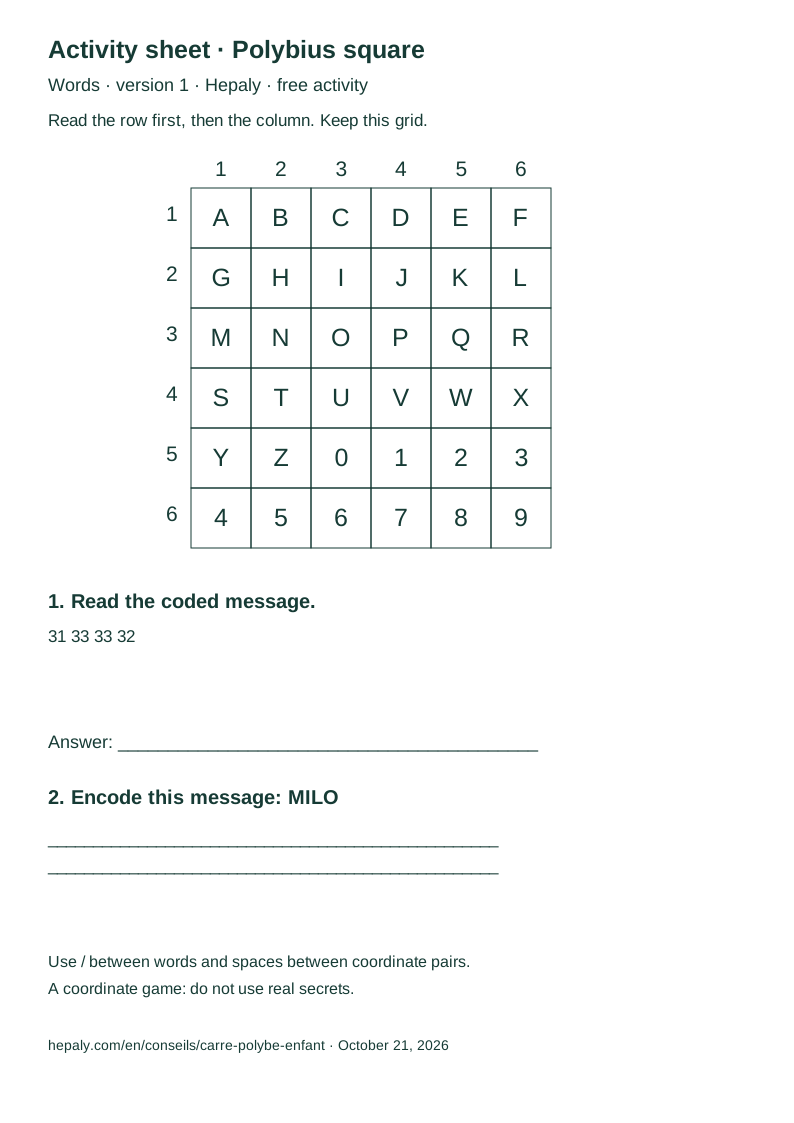
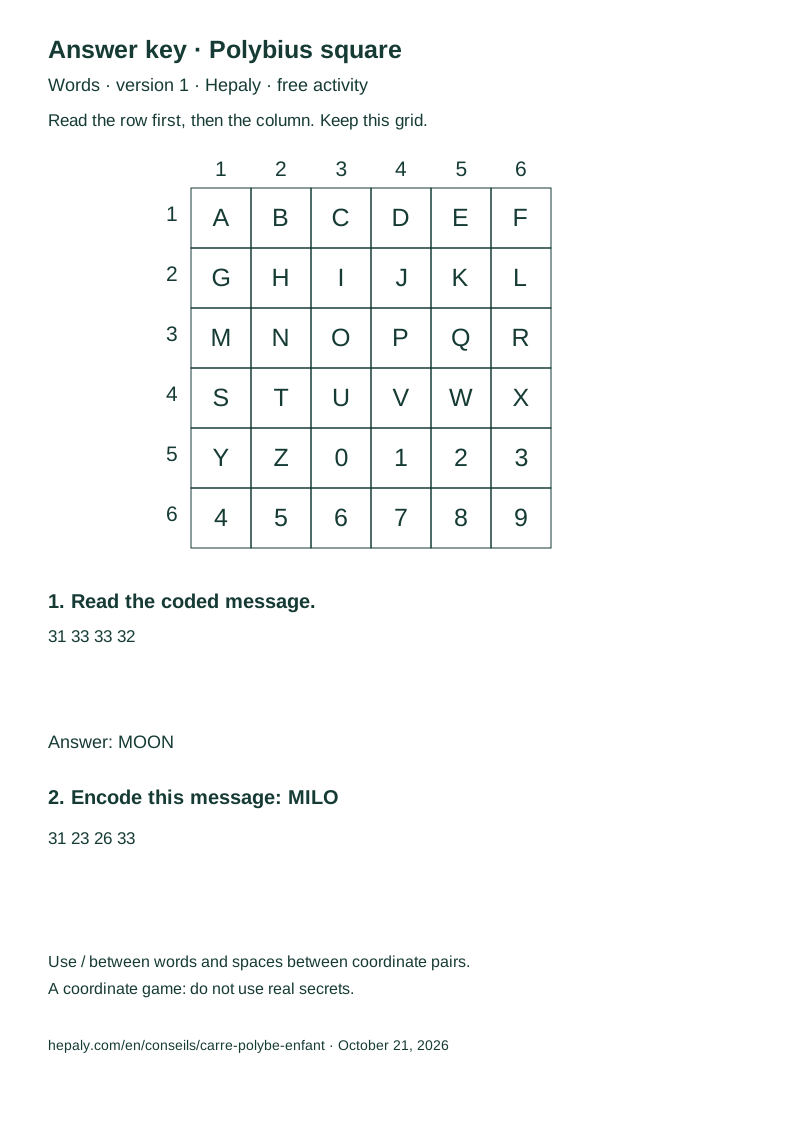
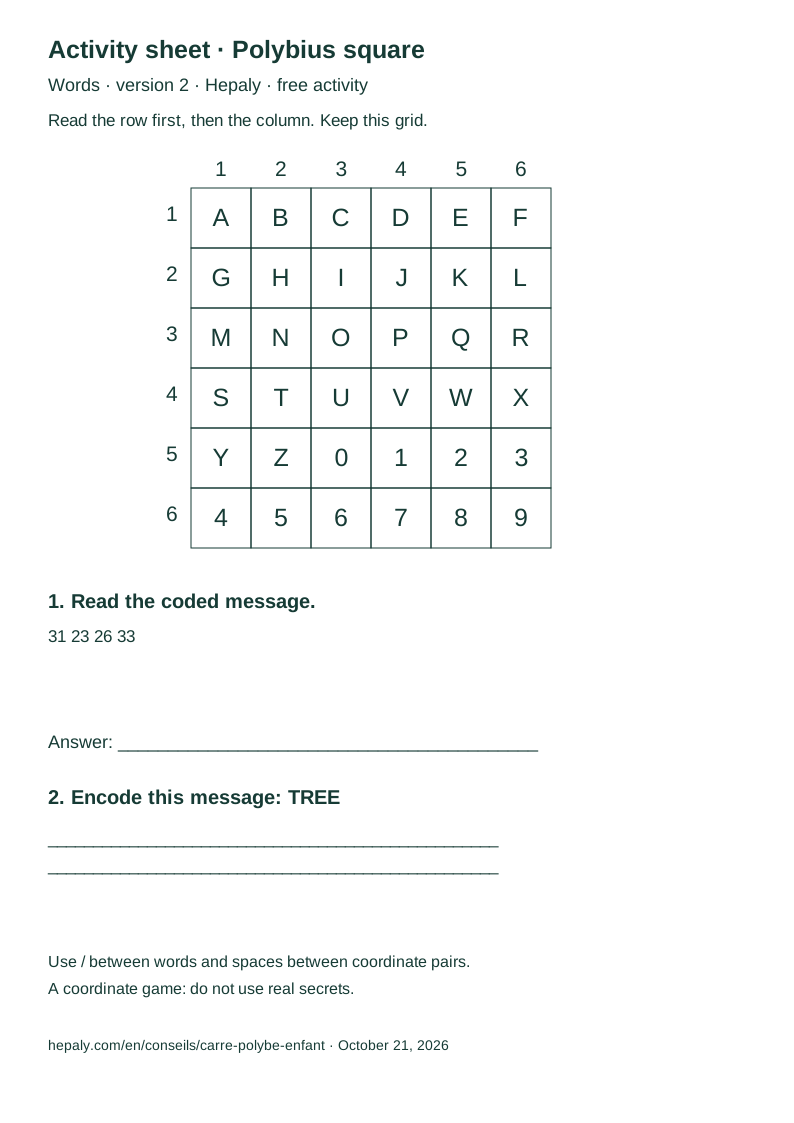
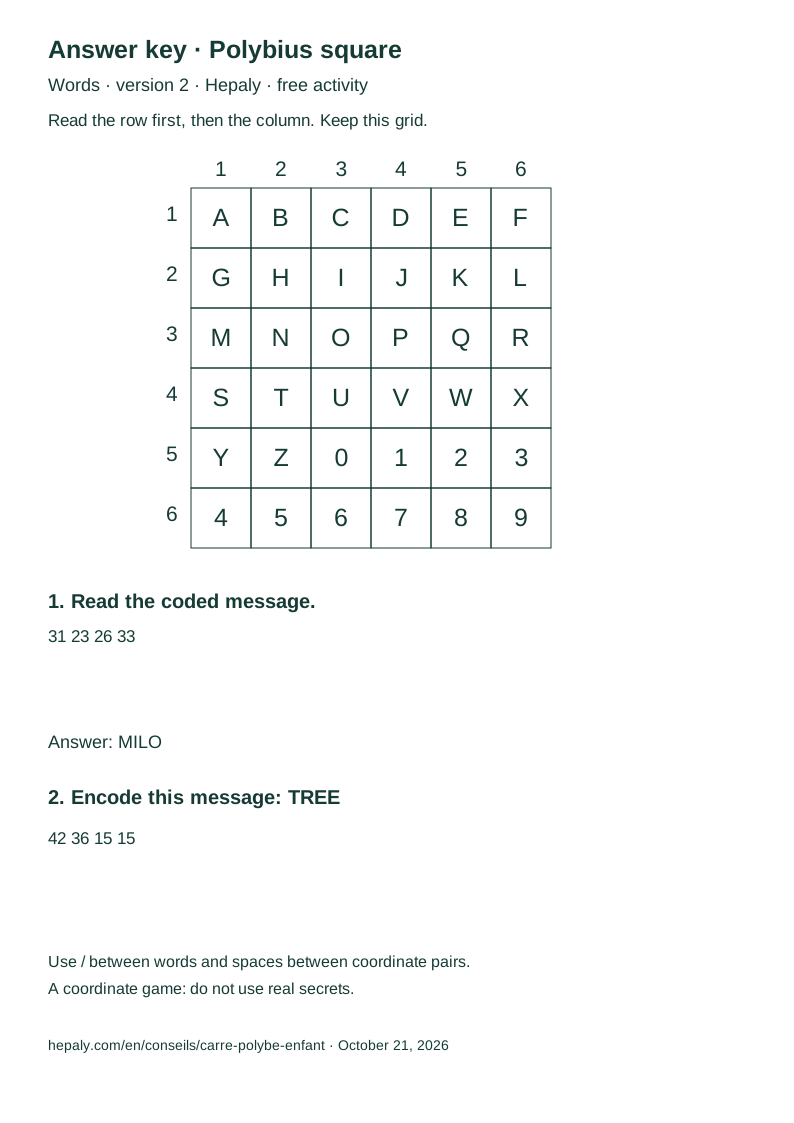
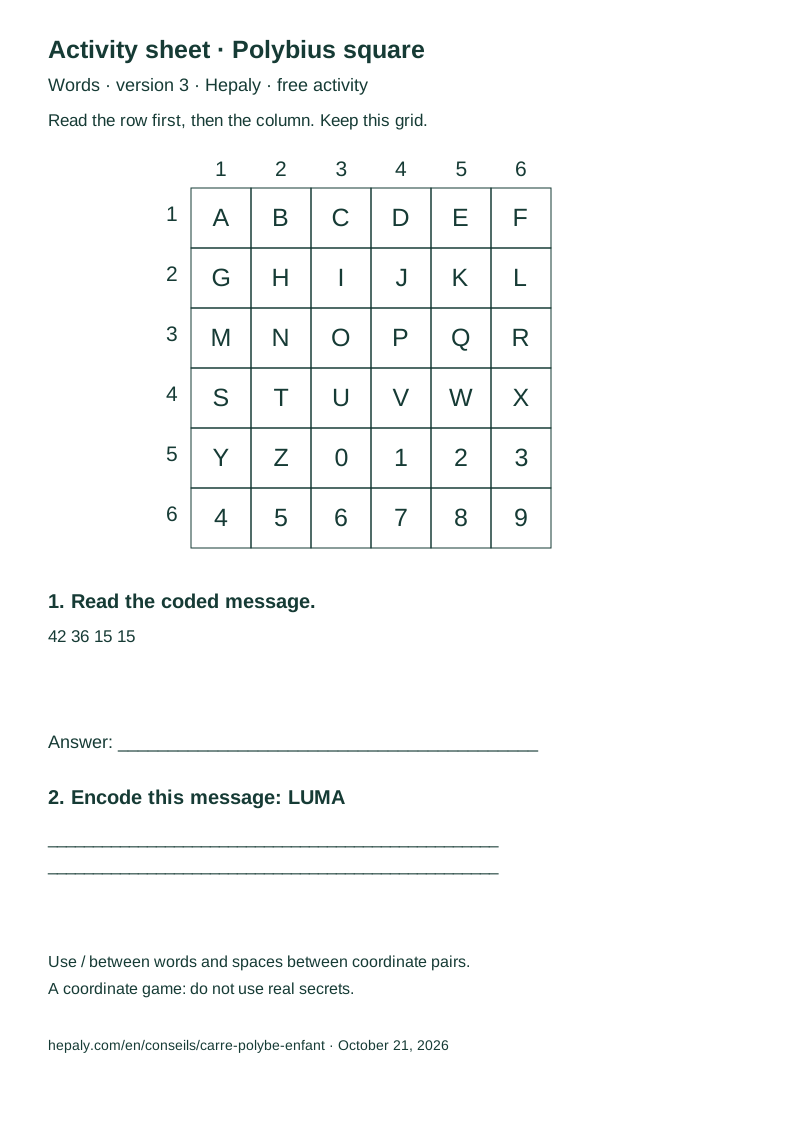
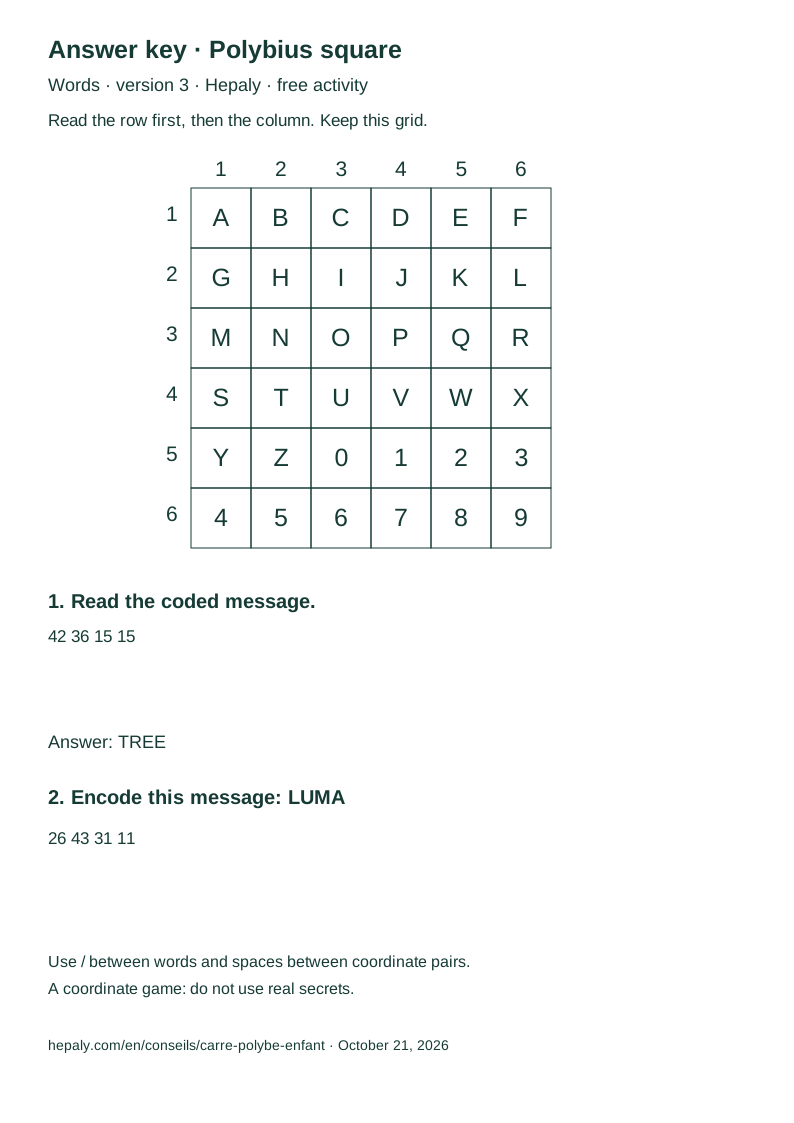
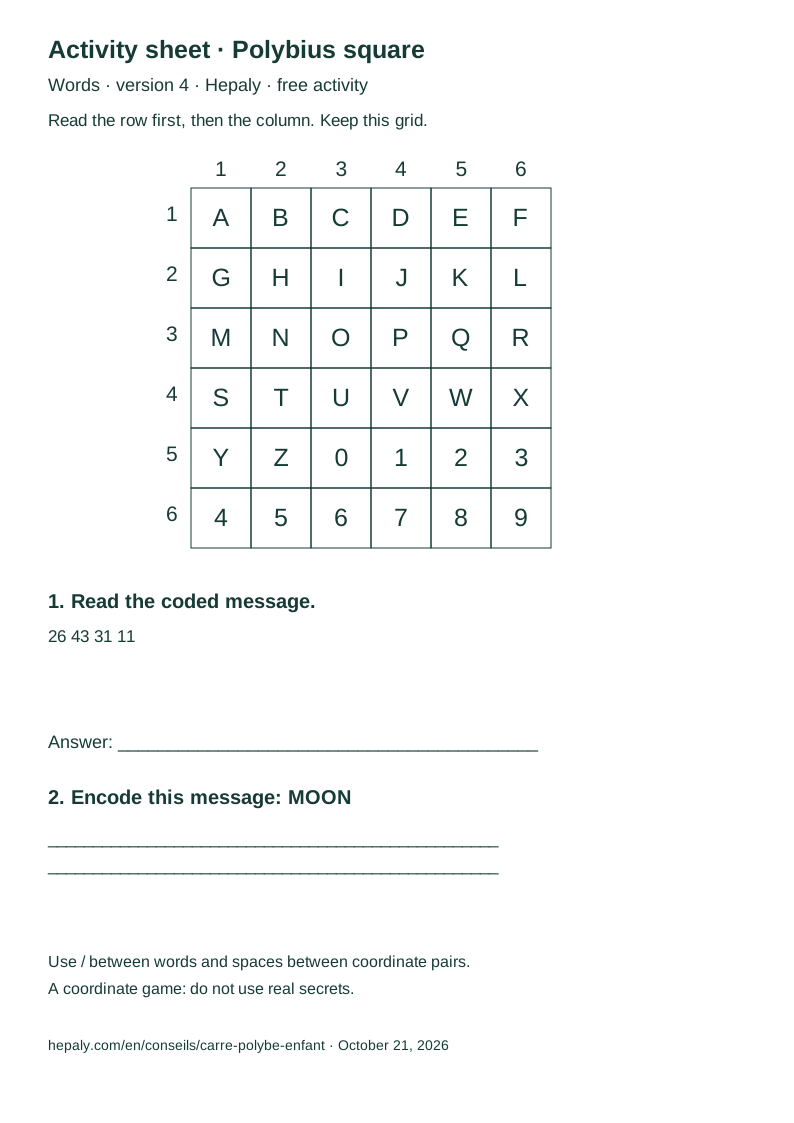
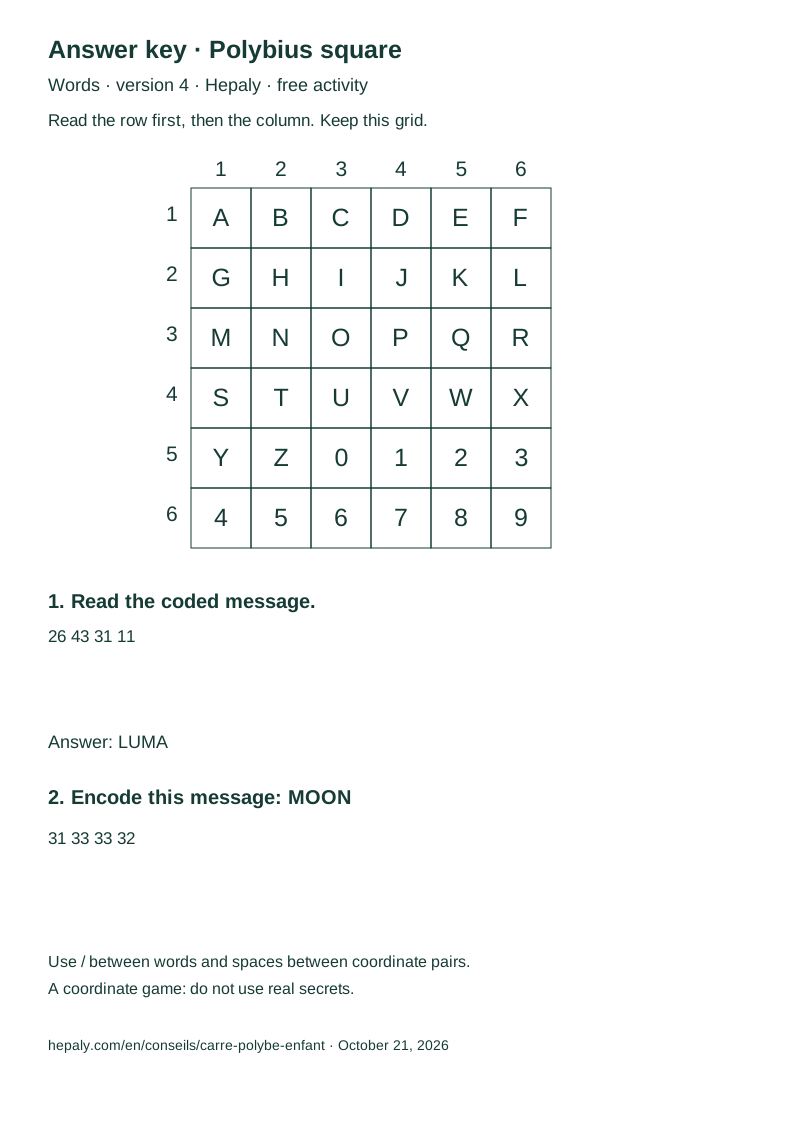
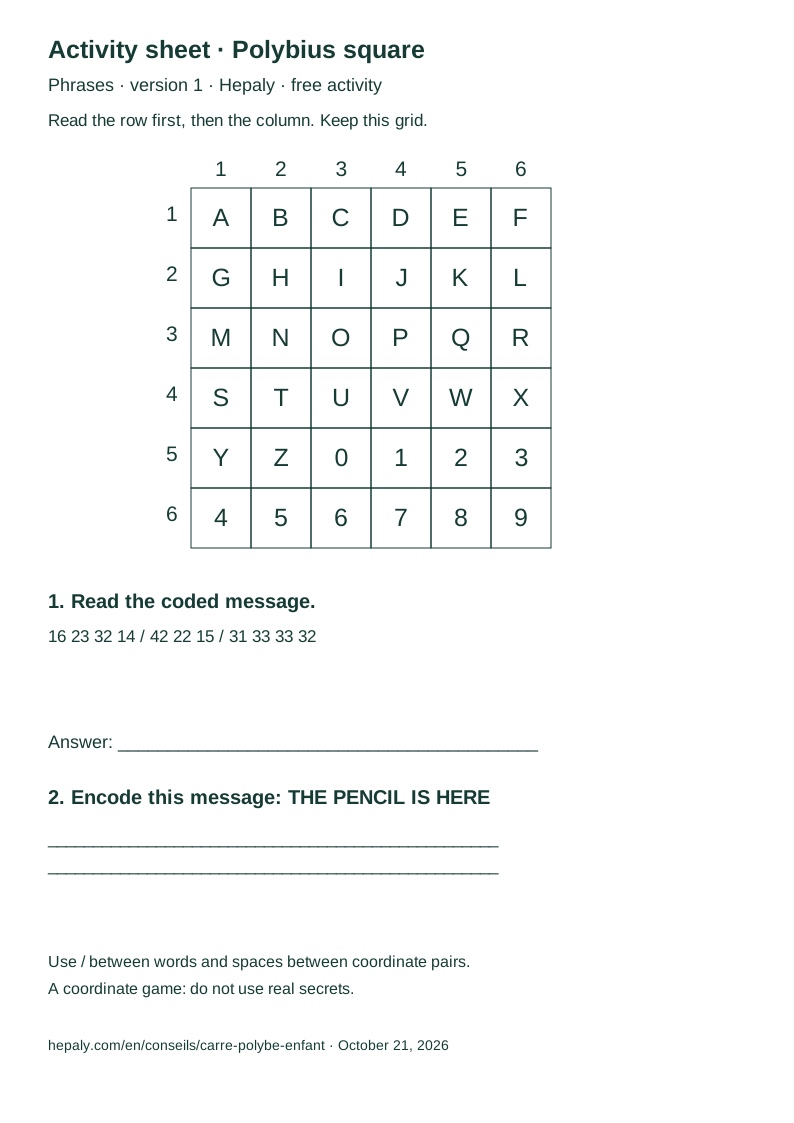
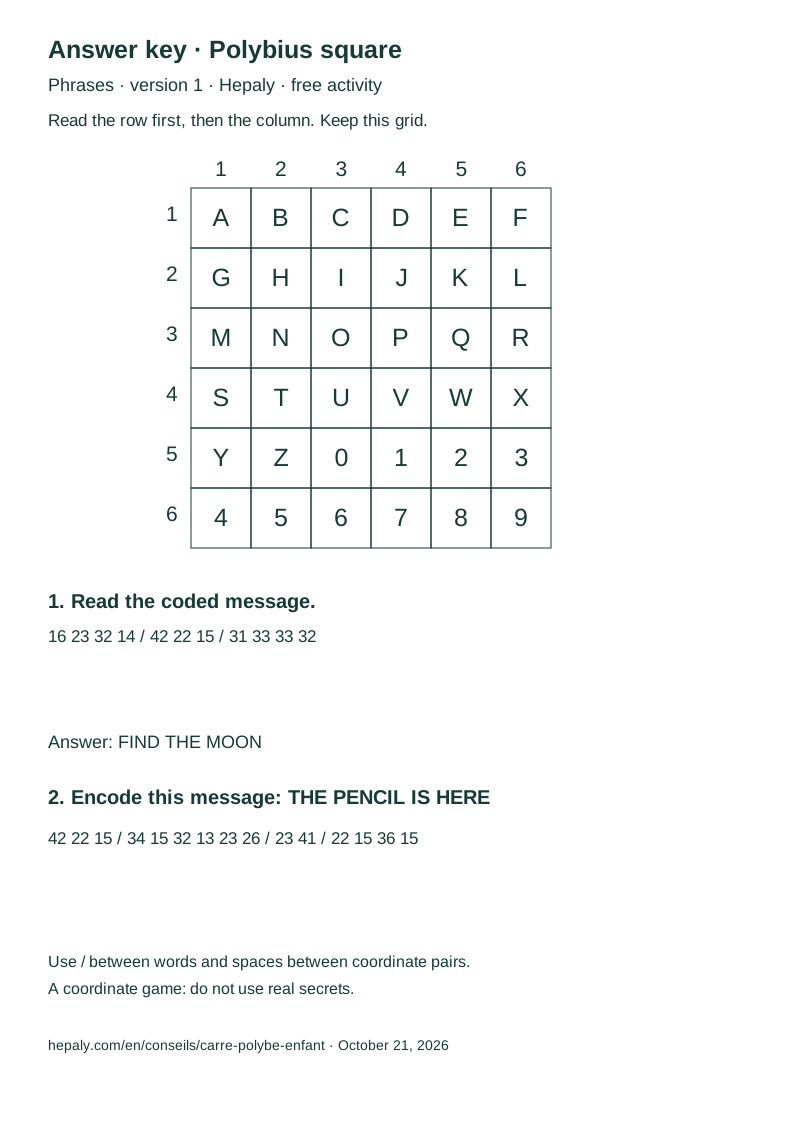
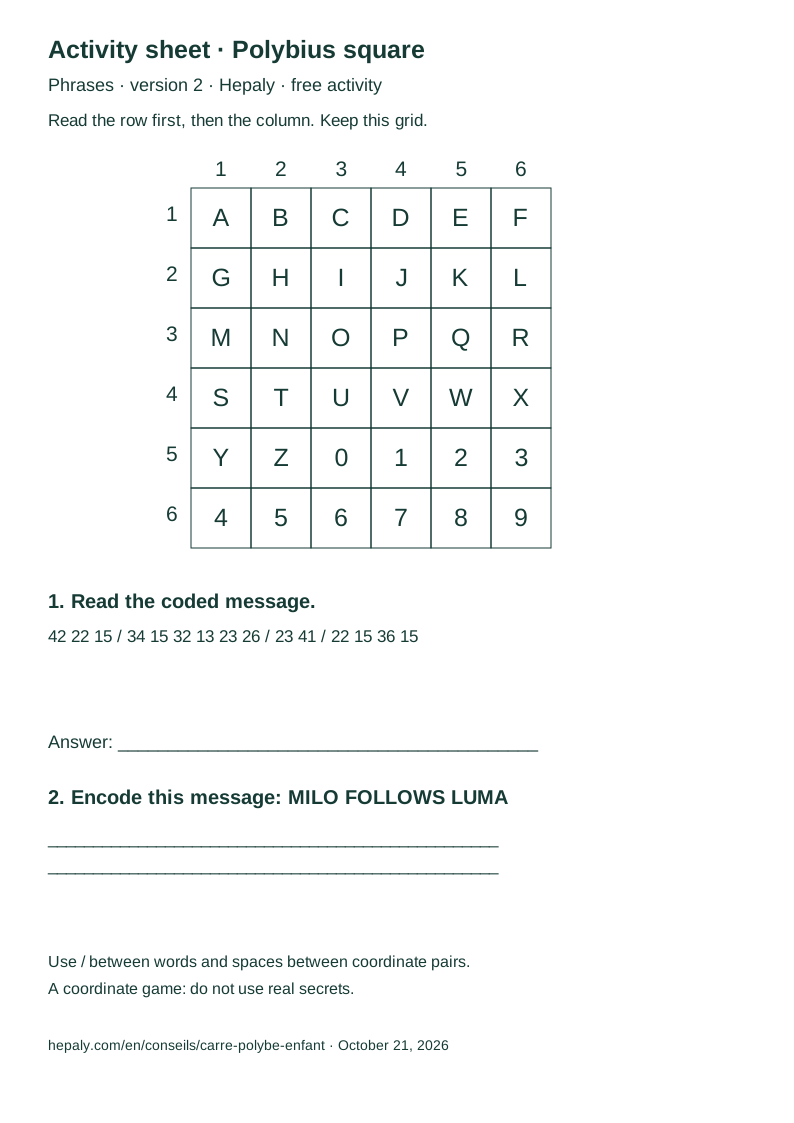
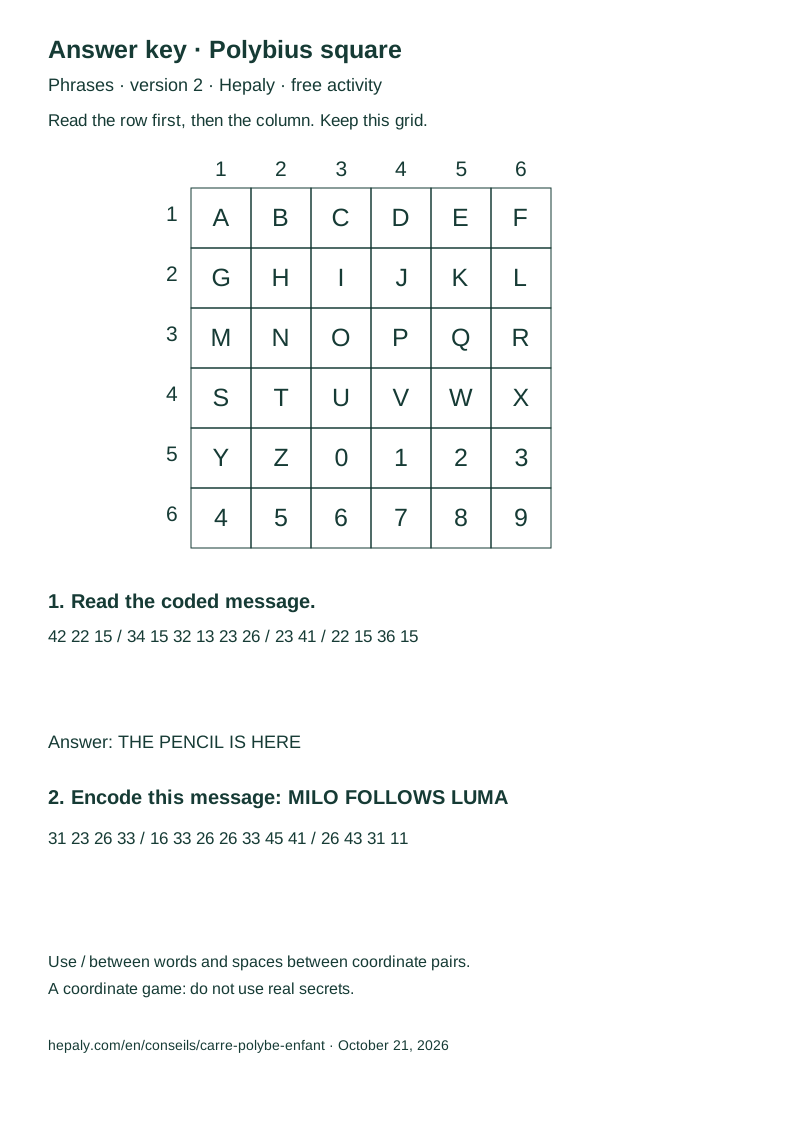
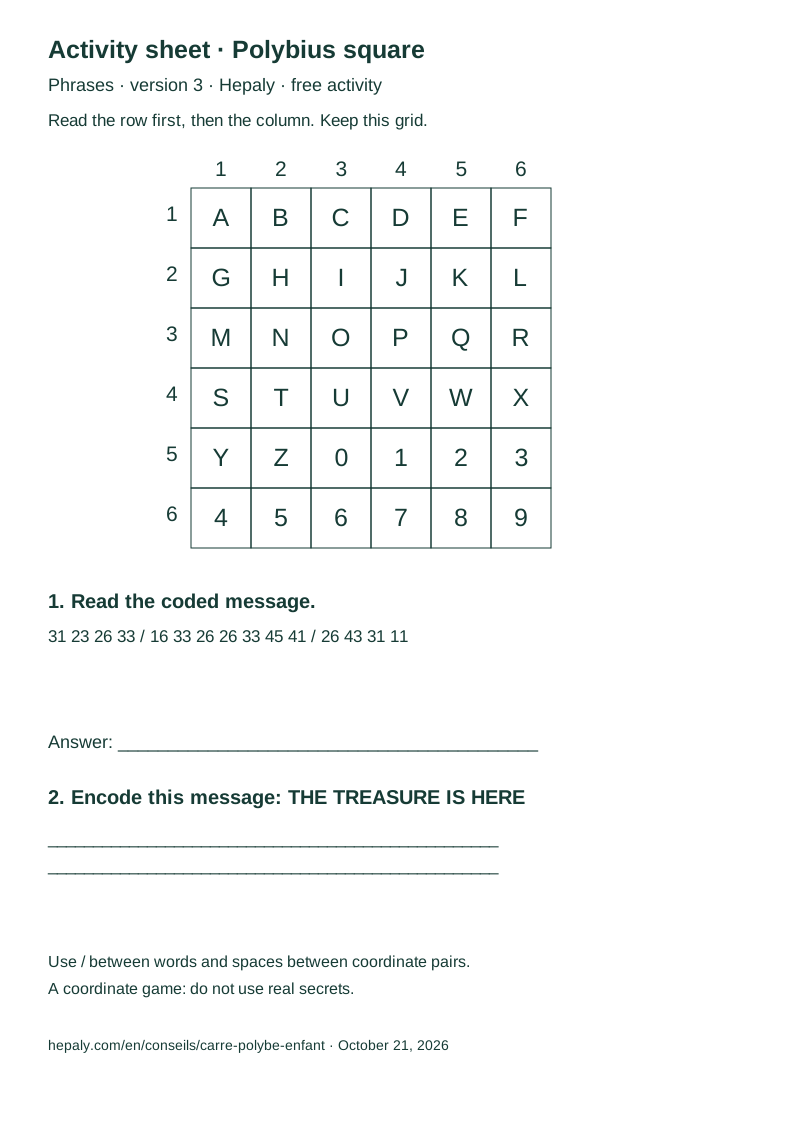
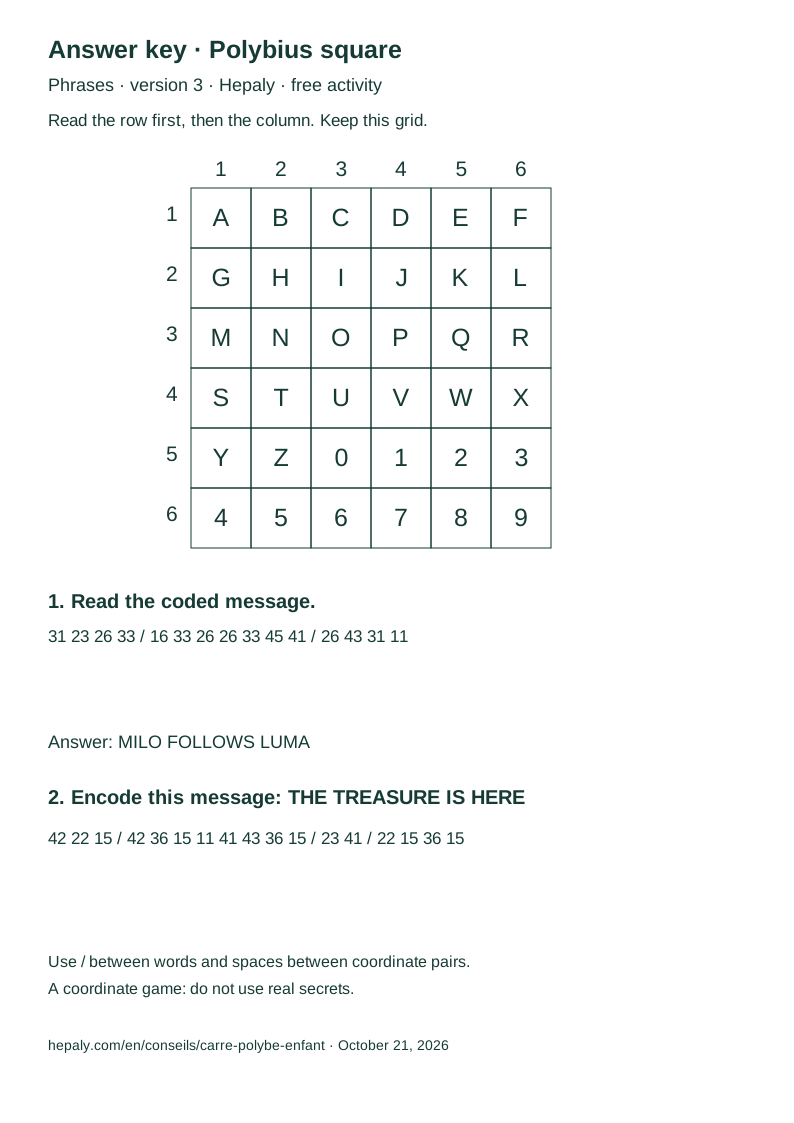
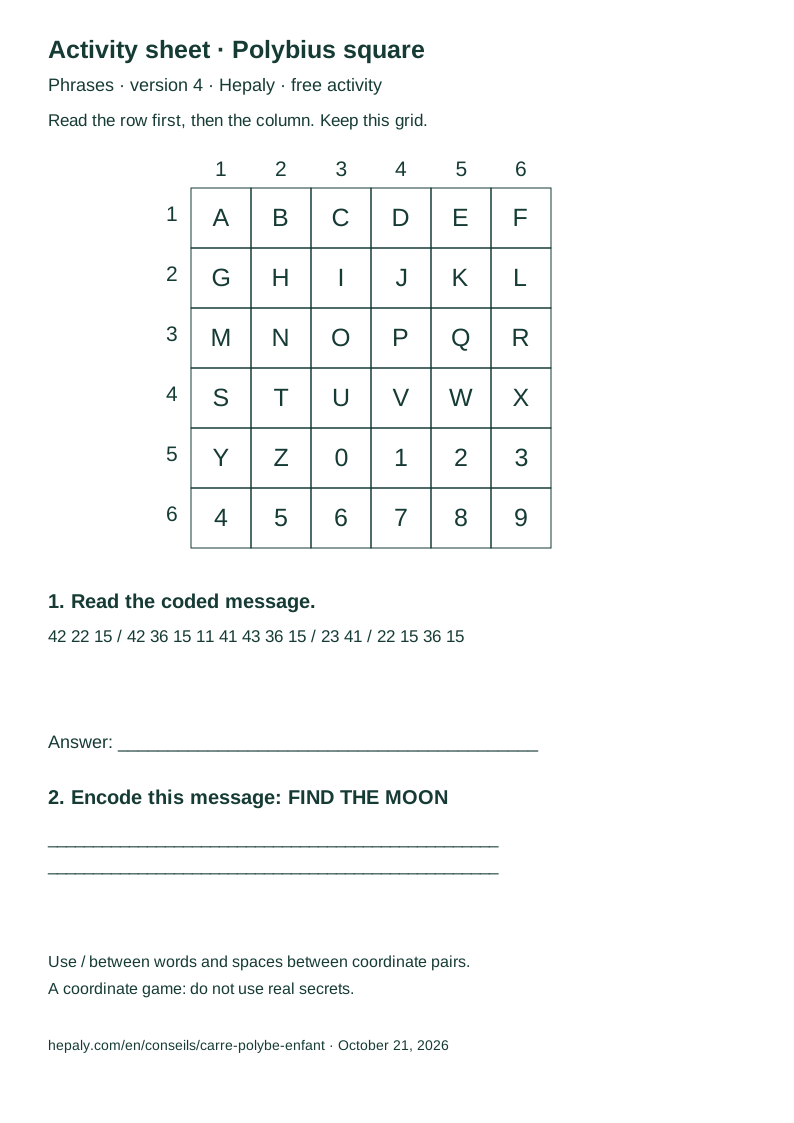
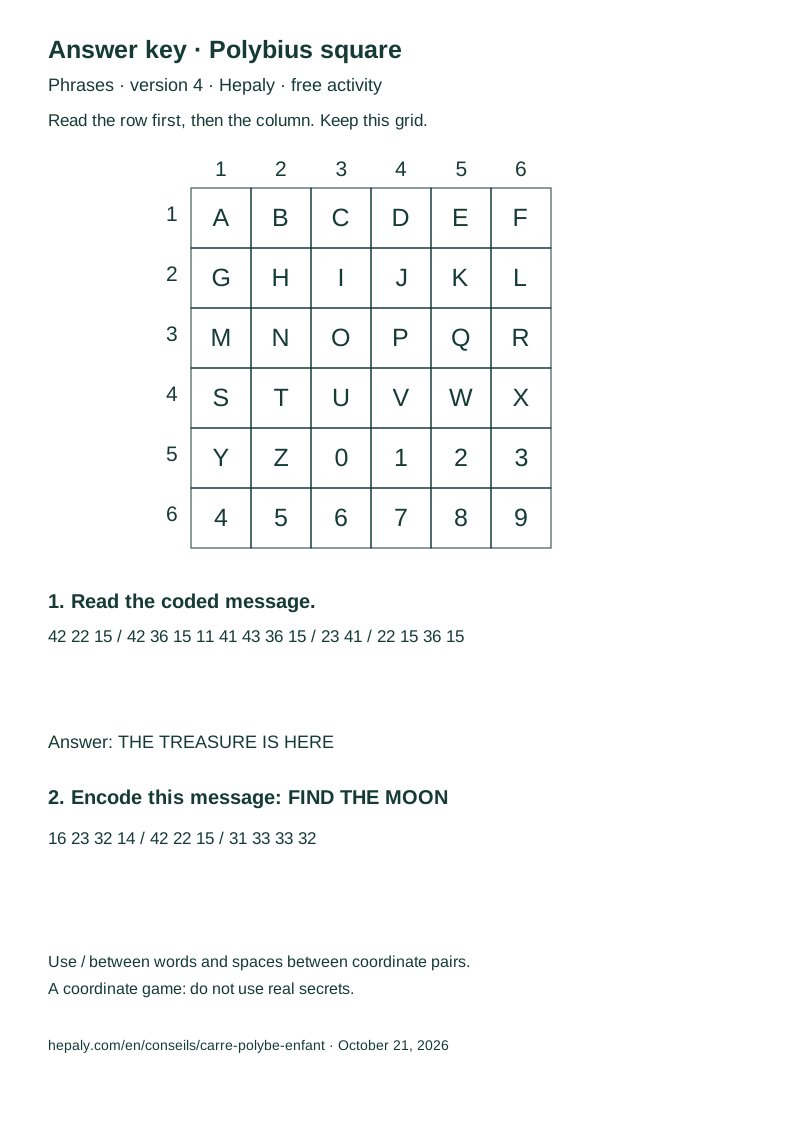
Open the downloaded SVG file in your browser to print it. Check the preview on an A4 page. None of the files collect any personal information.
SVGs are vector documents in A4 format. Download the sheet first, open it in your browser, then use its print command, with a 100% scale or "fit to page" depending on your printer. Check the print preview: the entire grid and the instructions must fit on one page. Black and white printing retains the numbers and cell borders.
Each sheet contains the same grid, a message to read, and a message to code. The examples are fictional and prepared by Hepaly; no first names or personal information are requested. Without JavaScript, the eight pairs of files remain accessible. You can also copy the table and a single word by hand.
Does the Polybius square protect a real secret?
A public Polybius square is an easy substitution game to reconstruct, not a protection for confidential data. Do not enter any password, full name, address, or private message into it. Use the proposed fictional examples or an ordinary word without high stakes.
Our converter works within the page and does not transmit its content. It stores neither history nor progress after reloading. This lack of recording does not make the code secure: anyone who sees the chart can read the message. Even a scrambled alphabet does not transform this family activity into a modern encryption solution.
Check your benchmarks with the short quiz. It can be used to discuss the rule after the game, without an enforced score and without comparing children. The explanations remain readable when JavaScript is disabled.
Hepaly Workshop · working together
Which benchmarks did you remember?
How can you extend the activity without repeating the same page?
Suggest that the child prepare a single clue for another person, then check the answer with them. Keep the same grid throughout the game. Changing the chart midway without notice would cause an otherwise correct search to fail.
To vary the activity, move on next to logic riddles with clues: you no longer just apply a match, you eliminate possibilities. If you are setting up a small treasure hunt, choose accessible hiding spots and set its boundaries before starting. No clue should require going outside alone or handling a heat source.
Éduscol presents the cycle 2 curriculum applicable in 2026–2027 (around ages 6–8); this does not mean that the Polybius square is an officially mandated exercise. This page is a family proposal for spatial orientation and language. Your observation of the child, discussions with their teacher, and their own interests guide any adjustments, without promises of progress within a given timeframe.
Frequently asked questions
What is a Polybius square for children?
It is a grid where each letter is replaced by its row number and then its column number. Our adaptation contains A through Z and the numbers 0 through 9. It is used to play with a message, without protecting a real secret.
Should you read the row or the column first?
In all our tools and worksheets, read the row first, then the column. Other variations exist: always check the convention and the chart before mixing two resources.
Why are I and J separated here?
Our grid has six rows and six columns, so there are enough cells for both letters and the ten digits. A common grid with five rows combines I and J; its coordinates are not interchangeable with ours.
What should I do if the decoder rejects my message?
Check the pairs: each digit must range from one to six. Separate pairs with a space and words with a slash. Remove slashes at the beginning or end and any characters that are not part of the code.
Can you use the worksheets without JavaScript?
The eight worksheets and their eight answer keys can be downloaded via ordinary links. The grid, examples, and detailed answers remain readable. Only the converter and instant feedback require JavaScript.
How old do you need to be to try?
The 4–6 and 7–10 age markers help guide your choice of activity, without defining a rigid age for success. Before moving to letters, play with four drawings. Then, keep the grid visible and start with a short word.