
Table of Contents
- How do you show the repeating block?
- What to adjust if the child only focuses on color?
- How to find the next shape without guessing randomly?
- How to create a printable worksheet with its answer key?
- Can you keep the same rule while swapping objects?
- Why accept a different pattern continuation sometimes?
- How to wrap up the activity stress-free?
- Frequently asked questions
- How can you show that two rules are still possible?
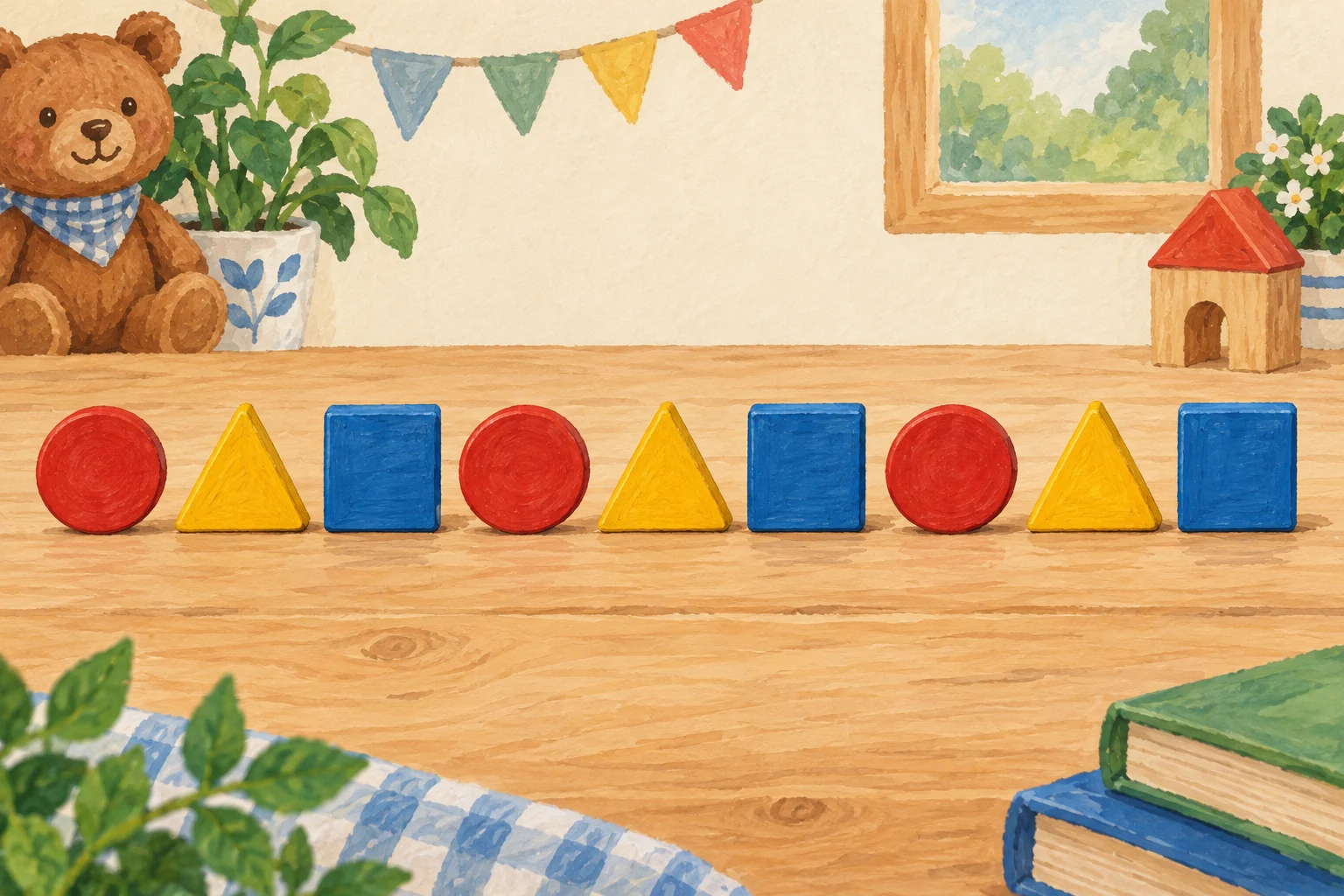
To start a logic pattern with a child, pick a small block, repeat it, and ask them to explain the rule before finding what comes next. For example: circle, circle, square; circle, circle, square. If we state that this exact block always repeats, the next shape is a circle. Without a stated rule, other continuations can be logical too: the explanation matters as much as the answer.
You will find four original workshops, a free printable worksheet to set up, and its answer key. No timer, no grading, and no mandatory target age. You can read instructions aloud, move large objects around, or discuss the patterns orally. Exploring a single sequence thoroughly is enough to get started; completing a full page is entirely optional.
How do you show the repeating block?
Place two circles then a square, and repeat this group. Leave a small gap between groups during initial exploration. Your child might say "two circles, one square" or point to each piece with a finger. The common word "circle" is fine in everyday conversation; adults can also introduce "disk" for solid shapes. The primary goal remains spotting what repeats.
In the demonstration tool, the letters A and B are simply a quick shorthand for adults. A always refers to the same shape throughout an example; B designates a different one. Thus, AAB stands for two identical shapes followed by a different shape. This is not an alphabet reading lesson to learn nor a secret code to memorize. You can play without ever pronouncing the letters.
Explore together
Spotting the block and its return
The letters track identical shapes, without serving as a reading instruction for the child.
AB block: circle, square
- circle
- square
- circle
- square
- circle
- square
Rule: repeat this block identically. Its length is 2 positions.
AAB block: circle, circle, square
- circle
- circle
- square
- circle
- circle
- square
- circle
- circle
- square
Rule: repeat this block identically. Its length is 3 positions.
ABC block: circle, square, triangle
- circle
- square
- triangle
- circle
- square
- triangle
- circle
- square
- triangle
Rule: repeat this block identically. Its length is 3 positions.
AABB block: circle, circle, square, square
- circle
- circle
- square
- square
- circle
- circle
- square
- square
- circle
- circle
- square
- square
Rule: repeat this block identically. Its length is 4 positions.
Next, compare two structures: circle-square repeating, then circle-circle-square repeating. Using the same shapes does not result in the same rule. Ask "Where does your small group start over?" rather than "Don't you see what to do?". For other clue-based discovery activities, our logic riddles for children offer a complementary format.
What to adjust if the child only focuses on color?
Using distinct shapes and their names lets children play without relying solely on red or blue. Prepare paper circles and squares, or two types of objects that are large enough and easy to tell apart. A pattern can be recognized by shape even when all pieces share the same color. Avoid changing shape, size, and orientation all at once during the first discovery phase.
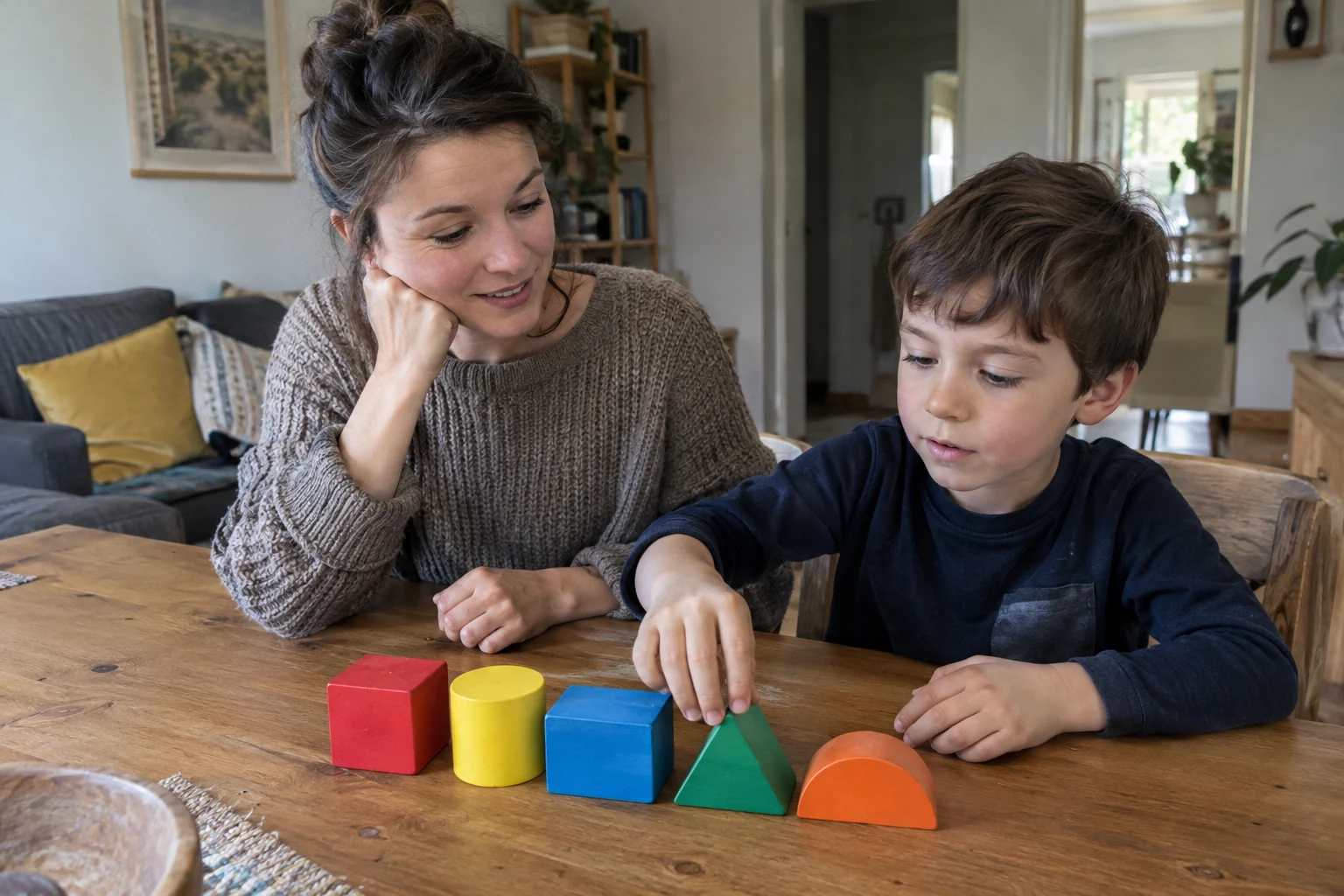
If using physical objects, select age-appropriate materials and supervise play. Keep small beads, coins, and loose parts out of reach of young children who put objects in their mouths. Paper cards or large building blocks can safely replace small items. Our guide on activities for siblings of different ages helps share an activity idea without forcing everyone to use the same materials.
A child can explain the rule with a gesture, a few words, or by placing the next piece down. Avoid asking for a perfectly phrased sentence and a new logical challenge at the same time. You can rephrase after their attempt: "You put down the same group again." This observation describes an action without assigning a general grade or academic evaluation.
How to find the next shape without guessing randomly?
In the second workshop, the rule is stated before each challenge. Read through the block again, follow the shapes already shown, then see where the repetition breaks. Choose an answer and run the check. The feedback explains the placement of the expected shape. You can ask for the answer directly, move to the next challenge, or restart the set.
Explore together
Six pattern challenges and their stated rule
Follow the stated rule. The explanation remains available even if no choice is made.
Challenge 1
Repeated block: circle, square.
- circle
- square
- circle
- square
- circle
- square
- circle
Which shape comes next?
See explained answer
Position 8 corresponds to spot 2 of the announced block: square.
Challenge 2
Repeated block: circle, circle, square.
- circle
- circle
- square
- circle
- circle
- square
- circle
- circle
Which shape comes next?
See explained answer
Position 9 corresponds to spot 3 of the announced block: square.
Challenge 3
Repeated block: circle, square, triangle.
- circle
- square
- triangle
- circle
- square
- triangle
- circle
- square
Which shape comes next?
See explained answer
Position 9 corresponds to spot 3 of the announced block: triangle.
Challenge 4
Repeated block: circle, circle, square, square.
- circle
- circle
- square
- square
- circle
- circle
- square
- square
- circle
- circle
Which shape comes next?
See explained answer
Position 11 corresponds to spot 3 of the announced block: square.
Challenge 5
Repeated block: circle, circle, square.
- circle
- circle
- square
- circle
- circle
- square
- circle
Which shape comes next?
See explained answer
Position 8 corresponds to spot 2 of the announced block: circle.
Challenge 6
Repeated block: circle, square, triangle.
- circle
- square
- triangle
- circle
- square
- triangle
- circle
- square
- triangle
- circle
Which shape comes next?
See explained answer
Position 11 corresponds to spot 2 of the announced block: square.
If an answer differs from the answer key, go back to the instructions: “In this game, we chose to repeat this pattern block. Where were we?” The child may have followed another idea, lost their spot, or confused two shapes. These situations do not mean they “have no logic.” Have them walk you through their path before offering help.
A pattern to extend does not work like a 4 × 4 sudoku. Sudoku imposes several simultaneous constraints; here, a repetition rule determines positions. You may prefer this more linear format without presenting it as a mandatory step before another game. The guided trials on this page do not constitute an evaluation of the child's abilities.
How to create a printable worksheet with its answer key?
Choose a block, a length, and a version in the setup tool. The rule is printed on the sheet: it remains available when the child fills in the empty spaces. The first few repetitions are shown in full, then a few positions are hidden. The words “disk”, “square”, and “triangle” remain readable in black and white; no color printer is required.
Explore together
Prepare a worksheet and its answer key
The rule will be printed. Changing the version number alters the hidden squares without changing the announced block.
Read the worksheet answer key
Example to copy without JavaScript
Rule: repeat disk, disk, square.
disk · disk · square · disk · disk · square · ? · disk · square · disk · ? · square
Example answer key
Positions 7 and 11 are disks. The group of three positions is repeated identically.
No account or first name requested. Only the settings for this sheet are used during the visit.
The print button opens your browser options. You can also save the worksheet as an SVG file to reopen and print it later. The answer key can be displayed or kept separate during the search. Check the preview before printing: margins and scale depend on your browser and printer. The worksheet requires no name or registration.
Start with a few spaces and keep the page to pick up later if needed. An eraser, an approximate drawing, or a spoken answer work fine. To vary paper-based activities, the free maze generator offers another type of constraint: following a path rather than repeating a pattern block. The two games can exist side by side without confusion.
Can we keep the rule while changing the objects?
Yes. Take the “disk, disk, square” group and replace each disk with a card featuring a leaf, and each square with a card featuring a house. The “two identical, one different” structure stays the same. Agree on this matching system before starting; otherwise, you will be changing the rule too. You can draw the two cards yourself, without copying a sheet bought elsewhere.
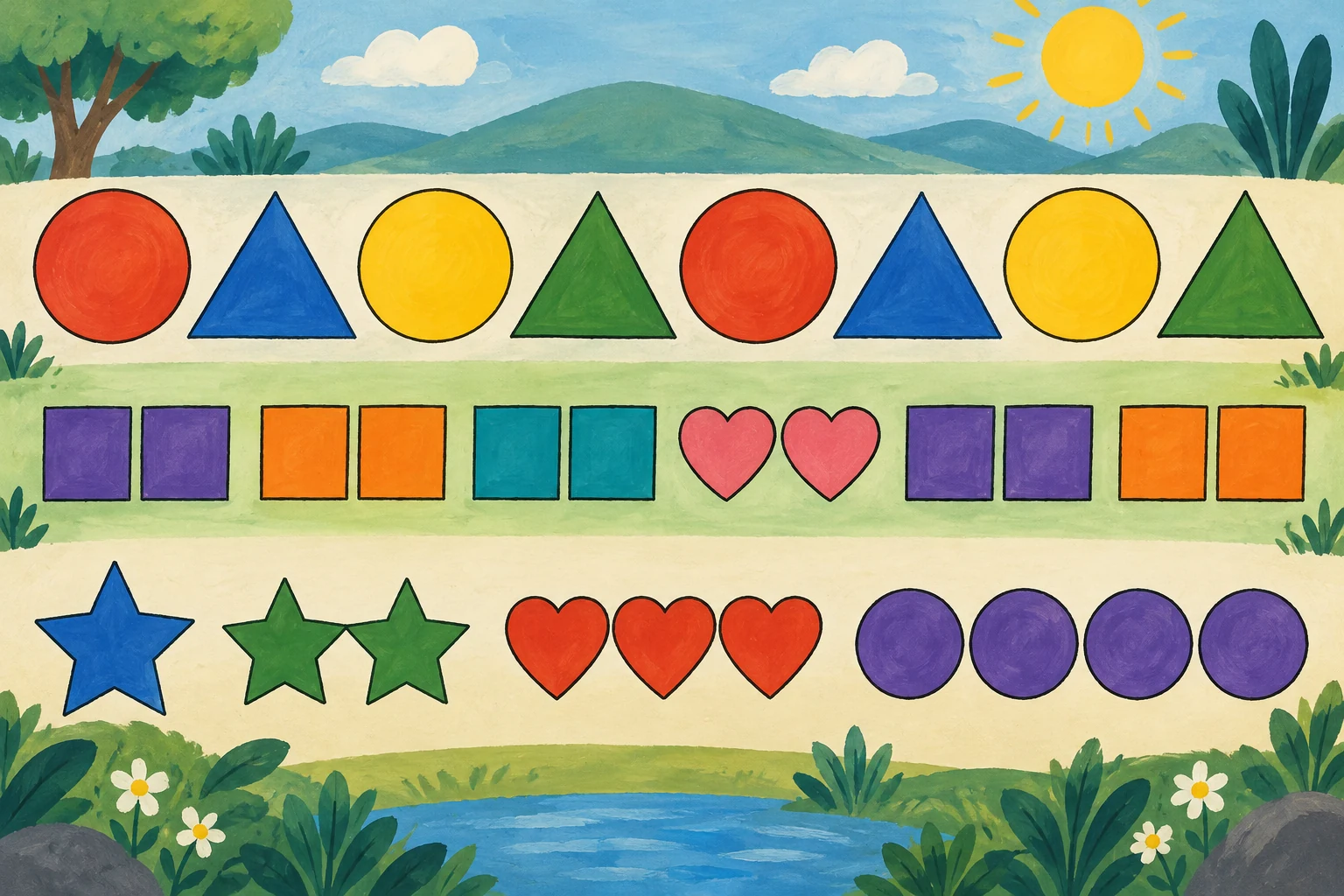
Another variation is to use gentle sounds or simple gestures. The child can choose two light taps on the table and an open hand, then repeat this pattern. Announce what changes and what stays the same. If a format does not suit them, stick to cards or physical objects; no sound or motor exercise is mandatory.
The tangram also encourages talking about shapes, but it asks to build a silhouette rather than extend a sequence. Avoid turning all games into the same activity. A session can simply end by creating a pattern for the adult to try and recreate, explaining what they understood in turn.
Why accept a different continuation sometimes?
A given starting sequence does not always reveal its full rule. After “disk, square, disk”, one person might choose an alternating pattern; another might introduce a three-element block that repeats. The fourth shape then differs without anyone necessarily having reasoned incorrectly. To ensure a definite answer key, our challenges specify the block and ask to repeat it identically.
The official French Cycle 1 curriculum (preschool, approx. ages 3–6), effective from the start of the 2025 school year, emphasizes explaining extension rules. It asks to accept coherent proposals when students justify them. This detail applies to the specific task presented, not an obligation to validate any answer to a precise prompt. The curriculum age benchmarks are not a prediction of individual success.
Explore together
Three questions to clarify instructions
The CSEN (French Scientific Advisory Council for Education) also presents patterns as tools to observe, vary, and abstract regularities. Its publications express caution regarding the scope of research results. Therefore, we promise no score increases in math nor measured memory improvement through our workshops. They are original opportunities to play and explain a rule.
How to end the game without pressure?
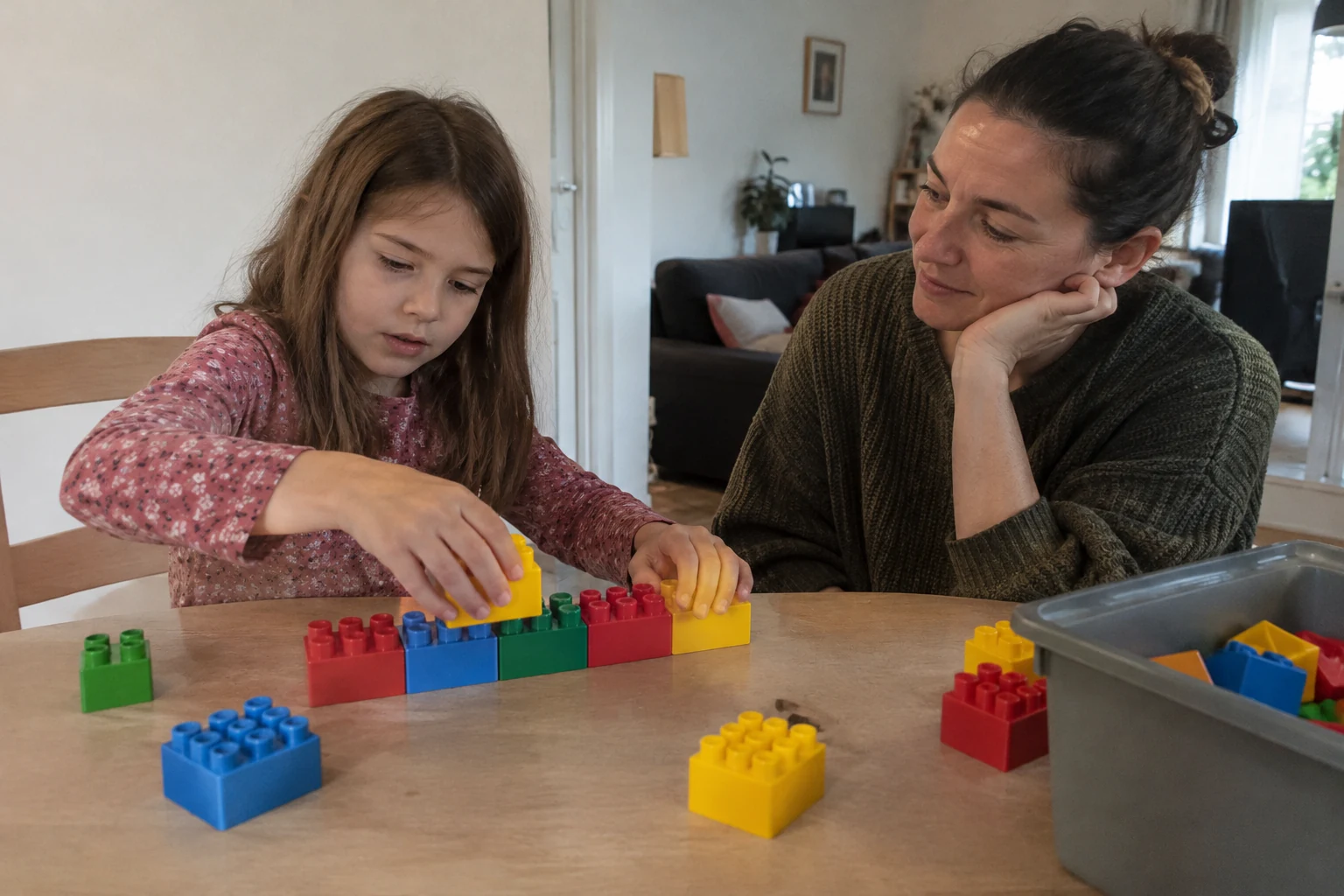
You can offer three options: keep a sequence the child likes, let them create a challenge for you, or put the materials away. Ask what they would like to keep for next time. If they get tired or frustrated, taking a break is a perfectly valid choice. This guide recommends no mandatory daily duration nor a specific number of sheets to complete.
Léa Tralala's video shows other pattern activities using weather vocabulary. It presents an external commercial resource; our activities and worksheet generator are independent, original, and free. You do not need to buy this resource to follow this guide. Focus especially on the differences between completing a sequence and recognizing its structure.
How can you show that two rules are still possible?
A short list does not always force one continuation. The table uses the same beginning with two stated rules: repeat a short block, or repeat a longer block that starts the same way. Their next shapes can differ without contradicting the shapes already displayed.
| Stated repeating unit | Shared start | Next element |
|---|---|---|
| AB | A B A B | A |
| ABABC | A B A B | C |
If the instructions state the first block, use that rule to check the answer. If the task asks children to invent a rule, let them explain it and produce several more terms. A proposal must fit the whole beginning, not just its final shape. Then change one term to look for a counterexample. This is about organization; counting a collection asks a different question.
Frequently asked questions
At what age should you introduce logical sequences?
Adapt the instructions to what the child already observes and explains, using large objects or drawings. School curricula provide developmental milestones; they do not set a rigid age by which every child must succeed at our games.
Does a logical sequence always have only one right answer?
No, a starting sequence can allow several coherent rules. In our challenges with answer keys, the block to repeat is specified. The expected answer comes from this explicit instruction; a different rule can be discussed separately.
Is it necessary to know the letters A and B?
No. Letters are shortcuts for adults to compare structures. The child can name the shapes, point to objects, or explain “two same, one different.” Writing them down formally is not needed to play here.
Is the worksheet available without signing up?
Yes. The setup tool generates a worksheet and its answer key right in your browser, without requiring an account, name, or email address. Without JavaScript, a complete sample to copy and its solution remain available on the page.
What should you do if the child refuses to continue?
Suggest looking at a single position together, having them give you a challenge, or stopping. Hesitation or a unexpected answer does not measure intelligence. These workshops are shared games, not tests or therapy.
To go further
- Éduscol — Acquiring early mathematical tools in Cycle 1 (preschool), June 2026
- Official curriculum — Organized patterns, pages 13–15, effective fall 2025
- CSEN — Patterns, a source of mathematical discovery in preschool and primary school, Note 10
- CSEN — Key strategies to foster a love of math using patterns