
Table of Contents
- 1. Start with objects you can turn around
- 2. Distinguish the 3D solid from the shape of its faces
- 3. Pair a gesture with every word
- 4. Compare cubes, rectangular prisms, and pyramids
- 5. Understand hidden lines in a drawing
- 6. Explore rounded shapes as well
- 7. Build and guess without naming
- 8. Check with three questions, then go back to the objects
- Frequently asked questions
- Can one print identify the whole solid?
- Does “geometric solid” mean a solid-filled object?
"It's a square!" says your child while pointing at a die. Their answer contains an accurate observation: they are looking at a square face. Yet the whole die has a different 3D shape. To explain the difference, turning the object around in their hands works much better than multiplying definitions.
Exploring geometric solids means learning to observe an object from several angles, describe it, and recognize what a drawing does not show directly. Here is a path for ages 4–10, from free building to counting faces, edges, and vertices for the first time.
1. Start with objects you can turn around
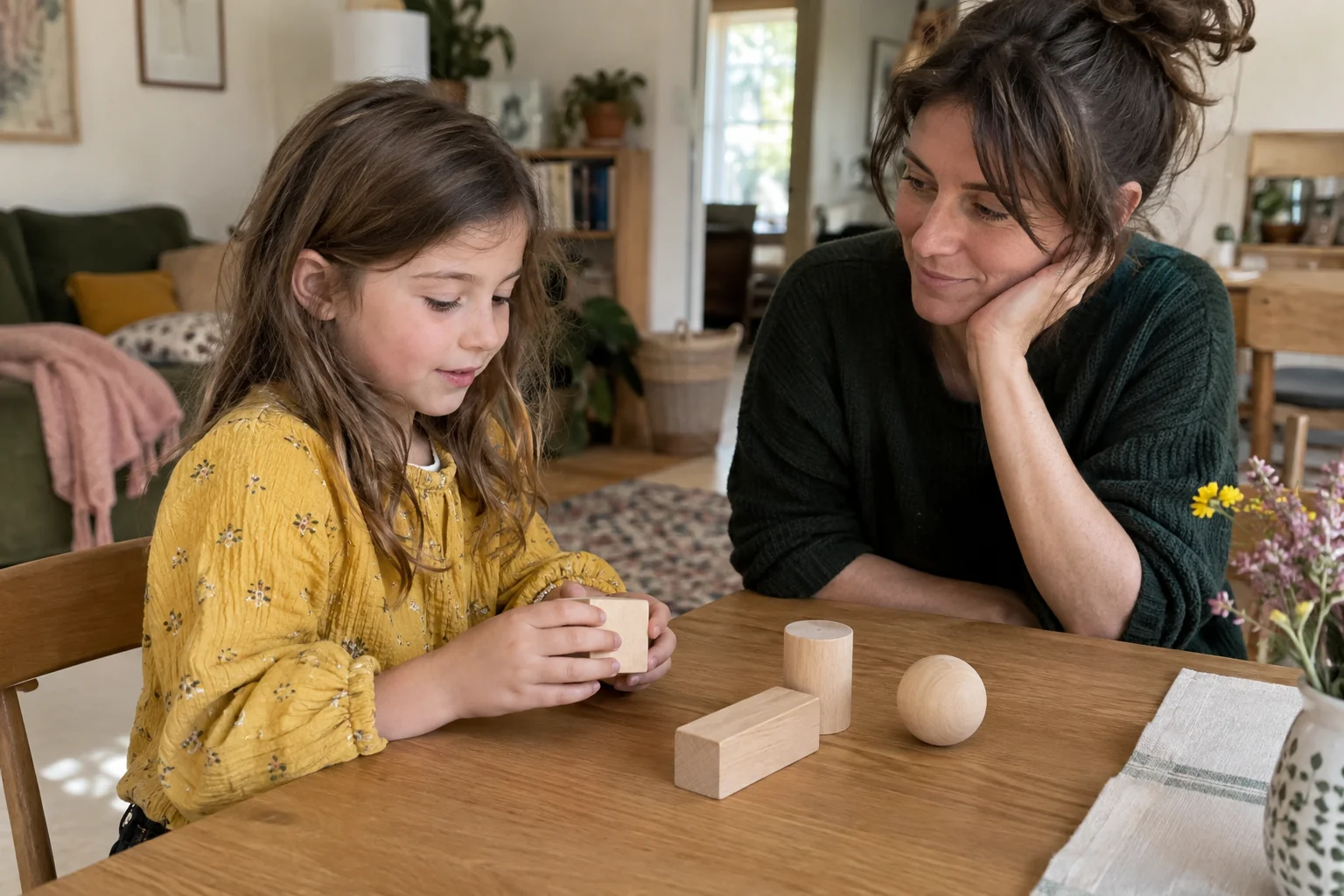
Gather a rectangular box, a wooden cube block, a ball, and a smooth cylindrical object without sharp edges. Add a toy pyramid if you have one. Choose pieces large enough to handle easily.
First, let your child create families of objects. They can group them by color, material, or shape. Ask for their criterion, then suggest a different sorting rule. Two blocks of different colors can belong to the same geometric family.
With 4 to 6-year-olds (pre-K to Kindergarten), simple prompts like "find a box that looks like this one" or "turn the object over to see underneath" are enough. Around 7 to 10 years old (1st to 5th grade), ask for a geometric property to justify their choice. These are not rigid rules tied to exact ages.
Real-world objects are only approximate representations of mathematical solids: a die might have rounded corners, a box might have flap seams. Don't make them confusing counterexamples. Simply point out which ideal shape we recognize despite those details.
2. Distinguish the 3D solid from the shape of its faces
Place the cube block on a piece of paper. Trace the outline of the face touching the paper, then lift the block. The resulting drawing represents a square; the block represents a cube. The square is a 2D flat shape, while the cube is a 3D solid taking up space.
Try it again with the box. Its footprint might be a rectangle, but the whole box is not a rectangle. Rest it on a different face: the traced outline might change dimensions without changing the nature of the object itself.
Describing precisely what you point to
Instead of correcting with "no, that's not a square," answer: "You recognized the shape of that face! What is the name of the whole object?" If they don't know the name yet, simply give it without stopping the activity.
Save the traced shapes for a session on symmetry with 2D shapes. This extends the activity while reinforcing the difference between a drawn shape and the 3D object used to produce it.
3. Pair a gesture with every word
On a cube, place your palm on a face, trace an edge with your finger, then touch a vertex. A face is a flat polygonal surface; an edge is the segment shared by two faces; a vertex is a point where edges meet.
These terms describe polyhedrons here: 3D solids bounded by flat polygonal faces. Cubes, rectangular prisms, and pyramids are common examples.
Counting without missing or double-counting
Stick a small piece of paper or painter's tape on each face as you count it. For vertices, use removable markers or dots of playdough. Turn the object over and check underneath to ensure nothing was missed. For edges, a strip of colored tape works great as a marker.
The French Éduscol resource on misconceptions about vertices notes confusion between a vertex and the highest point. Turn the cube upside down: its bottom vertices are still vertices. A vertex does not have to be at the top.
4. Compare cubes, rectangular prisms, and pyramids
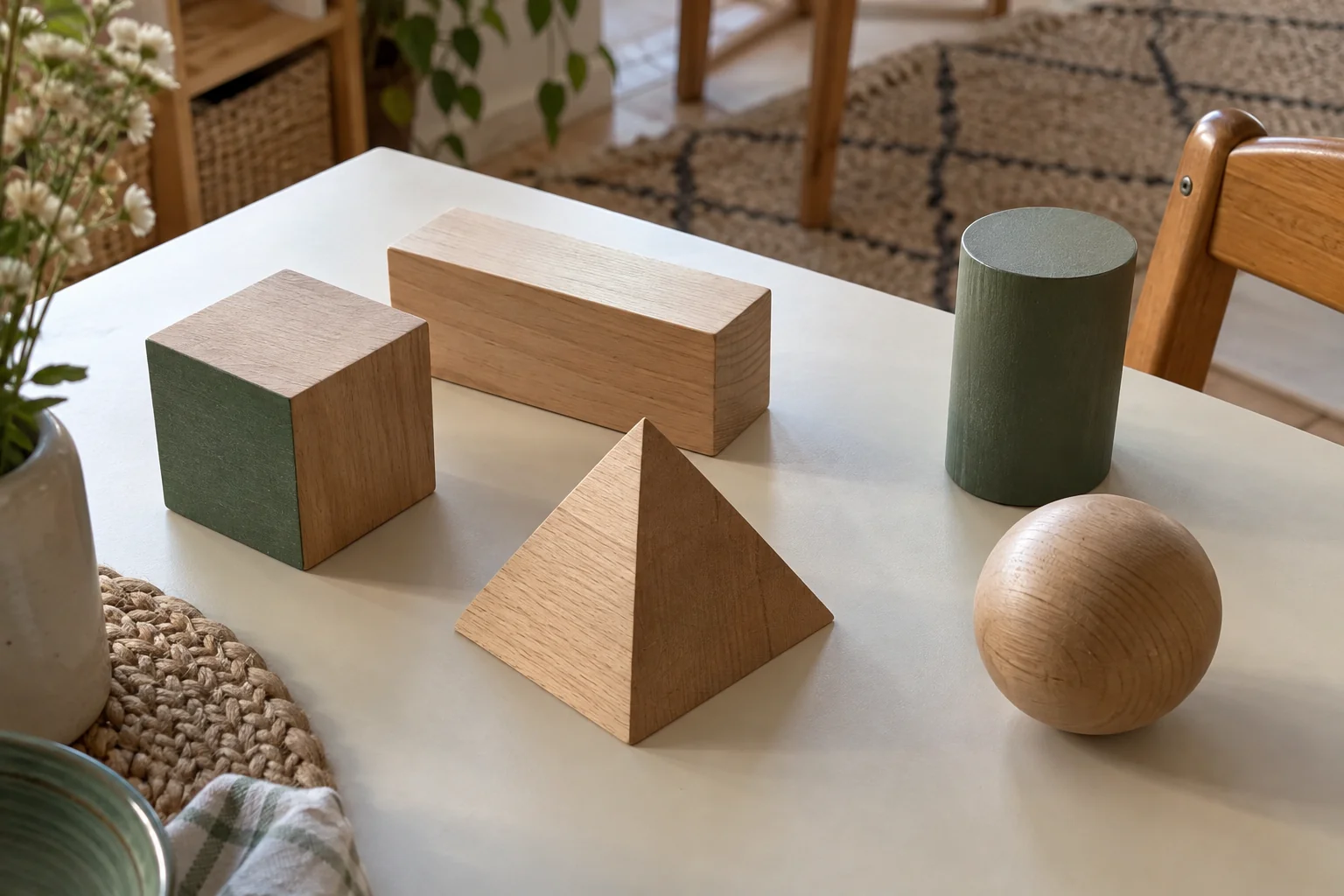
A cube has 6 square faces, 12 edges, and 8 vertices. A rectangular prism has 6 rectangular faces, 12 edges, and 8 vertices. A cube is a special type of rectangular prism: its faces are squares, which are themselves special rectangles.
A square-based pyramid has 5 faces, 8 edges, and 5 vertices. Count 1 square face at the base and 4 triangular side faces. For edges, count the 4 along the square base plus the 4 going up to the top apex.
These counts apply to a square-based pyramid. A pyramid with a triangular base has different counts. The French Éduscol guide to solids provides reference properties and diagrams.
In the interactive explorer, choose a solid then examine its faces, edges, and vertices. Ask for a guess before checking the totals. Keep a real object on hand to verify.
5. Understand hidden lines in a drawing
A cube drawn in perspective sometimes appears to have slanted faces. However, its real faces are perfect squares. The drawing represents a 3D object on a flat sheet of paper, so the visible shapes cannot be read like six squares laid flat side by side.
Dashed lines represent hidden edges behind the solid. They do not indicate a hole or a missing piece. Place a box in front of you and ask your child to point out an edge they know is there, even if they cannot see it from where they are sitting.
Then switch sides around the table. The edge becomes visible; it didn't magically appear on the object. Changing point of view ties directly into our activities for learning to read maps and spatial grid layouts.
If your child counts only the visible vertices on a drawing, go back to a physical solid. Avoid asking them to guess drawing conventions they haven't learned yet.
6. Explore rounded shapes as well
Spheres, cylinders, and cones are not polyhedrons: their outer surfaces are not made entirely of flat polygons. In this guide, we limit the formal counting of faces and edges to polyhedrons. This avoids mixing up different technical terminology conventions about curved surfaces.
A sphere strictly refers to the ideal outer surface, while a solid ball includes the volume inside. With a young child, playing with a ball mainly serves to observe a round shape from all directions. There is no need to enforce technical mathematical distinctions right away.
Place a cylinder on its flat circular base, then lay it on its side. Depending on its orientation and the surface, it can slide or roll. A cone on its side rolls in a curved path. Avoid rigid classifications like strictly "rolls" vs. "doesn't roll."
Instead, ask: "In this position, what happens when you push it gently?" Describing the result of an experiment is far more accurate than applying a general rule based on a single movement.
7. Build and guess without naming
Set up a secret guessing game with three geometric solids. Your child chooses one secretly and gives a clue describing its shape. "It's yellow" works for your specific toy collection, but doesn't describe a geometric property. "All my faces are square" allows identifying the cube regardless of color.
The French Éduscol classroom examples for fifth grade include describing objects and finding the odd one out. Adjust the number of objects and the vocabulary without turning the game into a lesson to memorize.
To build models, assemble sturdy paper drinking straws with balls of playdough (with supervision). Straws represent edges, while playdough balls represent vertices. This skeleton frame has no faces: imagine where paper panels would be attached to close it off.
In a shared activity between siblings of different ages, the younger child can pick the model while the older child explains how to build it. Other creative games can then reuse these constructions.
8. Check with three questions, then go back to the objects
This mini-quiz checks understanding of solid properties and the distinction between 2D shapes and 3D solids. Let your child handle physical models before answering. Above all, ask which clue helped them decide.
Confusing a face with a vertex calls for physical touch gestures. Forgetting hidden parts calls for turning the box around. Forgetting a geometric term simply requires reminding them gently. Different mistakes require different types of support.
Finally, keep a small collection of 3D objects easily accessible. When an unusual household container arrives, look together to see which mathematical shape it resembles. Your child will be able to describe their observations even if you don't immediately know the exact name of the solid.
Can one print identify the whole solid?
A print describes the part placed against the paper. It does not automatically show all the object’s faces. A cube and a rectangular prism with one square face can leave the same square outline when those chosen faces have matching dimensions.
| Solid | Possible face print | What this does not prove |
|---|---|---|
| Cube | Square | That every solid with this print is a cube |
| A rectangular prism with a square base, taller than wide | Square, when the base touches the paper | Its height or the shape of all its other faces |
Ask what further observation could help: turn the object, inspect another face, or compare its dimensions. Keep the first print as a clue rather than a certain identification. The objects can also be used in a mass comparison, but a geometric name does not predict their mass. Material and construction matter too.
A solid’s shape does not tell you which object is heavier. The mass-comparison activity asks that separate question using a suitable instrument.
Does “geometric solid” mean a solid-filled object?
A geometric solid describes a three-dimensional shape; an object with that shape can be solid-filled, hollow, or made from several materials. An empty cubical box and a wooden cube therefore do not share their entire construction. The name “cube” tells you neither their mass nor their buoyancy.
| What your child describes | Example | Information still unknown |
|---|---|---|
| Outside shape | A box appears cubical | Wall thickness and interior contents |
| Visible material | A surface looks metallic | Construction and possible hollow space |
| Position in water | Part sticks out at the surface | Exact mass and another object’s behaviour |
To extend the activity without mixing concepts, our sink-or-float investigation lets you record observations. Keep the geometry session dry first. Do not immerse play blocks that are unsuitable for water, or electrical or fragile objects.
With older children, describe one difference at a time: the same outside shape with different construction, or the same material with a changed shape. A photograph does not always show the inside. Saying “we do not know yet” avoids assigning one test result to every cube.
Frequently asked questions
What is the difference between a square and a cube?
A square is a 2D flat shape with four equal sides and four right angles. A cube is a 3D solid with six square faces. Tracing the outline of a cube's face on paper helps distinguish between a flat face and the entire solid object.
Is a cube also a rectangular prism?
Yes. A rectangular prism has six rectangular faces, and a square is a special kind of rectangle. A cube therefore belongs to this family. To compare appearances, use a cube alongside a rectangular prism whose three dimensions are not all equal.
Do all pyramids have five faces?
No. The total number of faces depends on the base. A square-based pyramid has 1 base and 4 triangular side faces, making 5 faces in total. A pyramid with a triangular base (a tetrahedron) has 4 faces in total.
Do kids need to learn all the names as early as preschool?
Start by manipulating, sorting, and describing with simple, everyday words. You can name the solids you come across without requiring a complete list. Short activities repeated with different objects let you see what your child recognizes beyond a memorized model.