
Table of Contents
- School expectations from 1st to 3rd grade
- Step 1: the short hour hand all by itself
- Step 2: half hours and quarter hours
- Step 3: counting minutes by 5s
- Step 4: saying the time naturally at home
- How to read exact minutes?
- Step 5: morning, afternoon, and military/24-hour time
- Time vocabulary at a glance
- Bringing time concepts into daily life
- Three games to learn telling time without worksheets
- The most common mistakes
- Frequently asked questions
- Is reading a time the same as measuring elapsed time?
To learn to tell time, children start with the hour hand alone, then add the minute hand for half hours and quarter hours, and finally count minutes by 5s. In elementary school, full hours are worked on in 1st grade (CP, ages 6–7), half hours and quarters in 2nd grade (CE1, ages 7–8), and exact minutes in 3rd grade (CE2, ages 8–9). "What time is it?" The question comes up constantly throughout the day, yet reading an analog clock requires coordinating many concepts: two hands measuring different things, numbers changing meaning depending on the hand, and everyday expressions like "quarter to"... No wonder this skill takes years to master! By taking it step by step and bringing time into daily routines, your child can succeed without getting discouraged. Here is a 5-step method tailored to classroom expectations, along with an interactive clock for practice.
School expectations from 1st to 3rd grade
The Cycle 2 math curriculum clearly breaks down the progression. Knowing where the class is helps you avoid skipping steps and discouraging your child.
| Grade level | What the student learns | Example |
|---|---|---|
| CP (1st grade, age 6–7) | Reading and placing on-the-hour times, connecting an hour to a familiar activity | “It is 8 o’clock, we are leaving for school.” |
| CE1 (2nd grade, age 7–8) | Afternoon hours, half hours, and quarter hours; 1 hr = 60 min | “A quarter past two” is also 2:15 p.m. (14:15). |
| CE2 (3rd grade, age 8–9) | Reading and setting hours and minutes, calculating durations | “Twenty to four,” “3:42 p.m.” |
Step 1: the hour hand, all by itself
The first difficulty comes from having two hands. At first, forget the big hand. With a cardboard clock, or by covering the minute hand with your finger, show that the hour hand tells a lot on its own: “It's pointing at the 4: it's 4 o'clock. It's between the 4 and the 5: it's a little past 4 o'clock.” This approximate reading is precious: your child realizes that time flows continuously and that they can already use it.
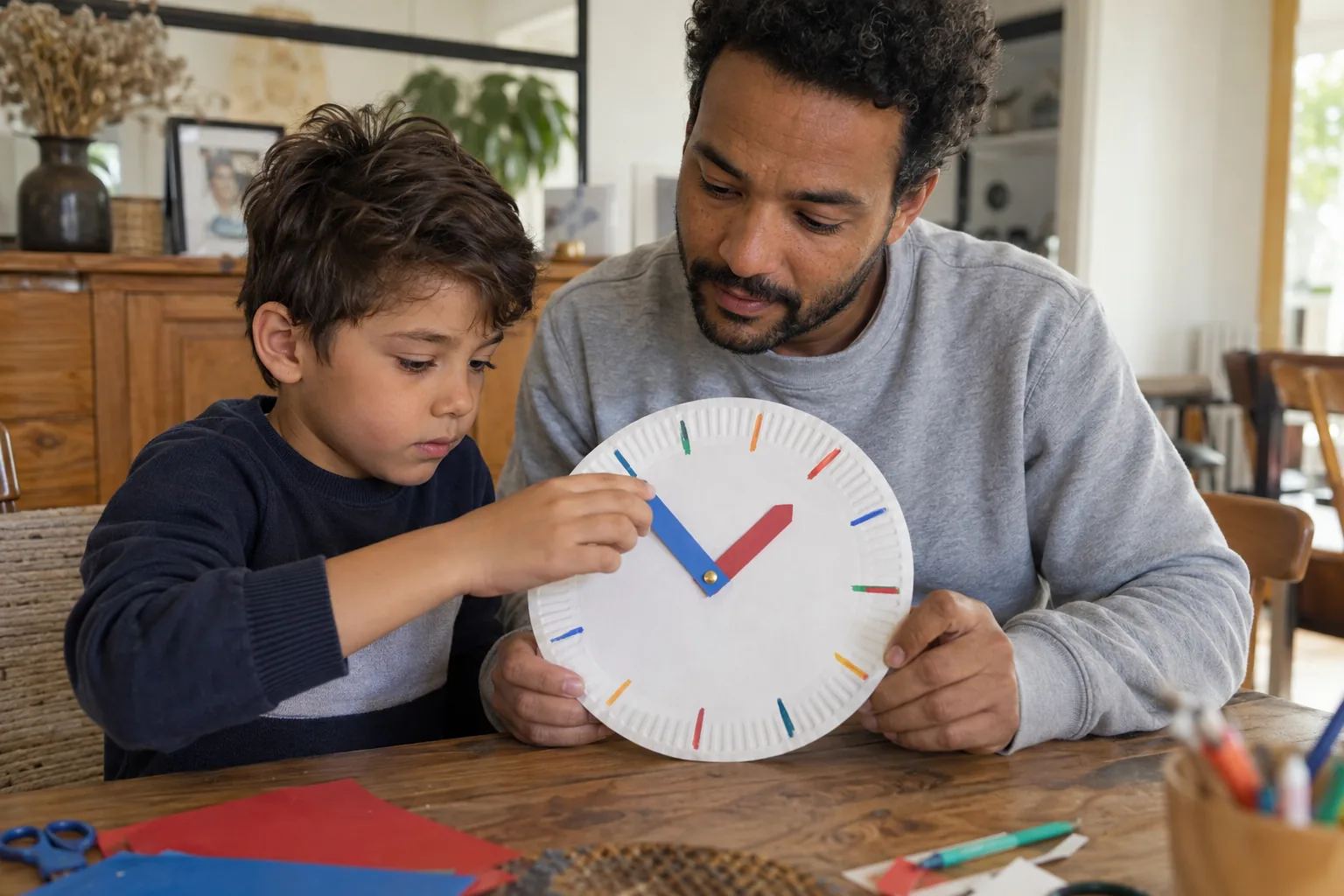
Making their own clock makes this step hands-on. A paper plate, two cardboard strips of different colors and lengths, and a split pin: your child writes the numbers from 1 to 12 and turns the hands themselves. Give the short hand the color you'll use for hours and the long hand the color for minutes, and keep those colors consistent in all your games.
Step 2: the half hour and quarter hours
Once the short hand is well understood, bring the big hand into play with just four positions: straight up (“o'clock”), to the right (“quarter past”), straight down (“half past”), and to the left (“quarter to”). The clock face turns into a pie cut into four equal 15-minute slices. That is actually how schools introduce it in 2nd grade (CE1), linking it to fractions.
Source: Cycle 2 math curriculum (1 hr = 60 min; 1 half hour = 30 min; 1 quarter hour = 15 min)
View chart data
| Part of the clock face | Minutes | We say… |
|---|---|---|
| 1st quarter | 15 | “quarter past” |
| 2nd quarter | 15 | “half past” at 30 min |
| 3rd quarter | 15 | “quarter to” at 45 min |
| 4th quarter | 15 | “o’clock”, the next hour |
A simple game works really well: you say “half past,” and your child places the long hand; then switch roles. Take the opportunity to show that the short hand moves forward a bit too when it's “4:30”: it sits halfway between the 4 and the 5.
Step 3: counting minutes by 5s
When reading minutes, the big hand doesn't “read” the number it points to: on the 3, it indicates 15 minutes. The easiest way is to count by 5s around the clock face with a finger: 5, 10, 15, 20… up to 60. This is great practice for the 5 times table, which we detail in our article on multiplication tables.
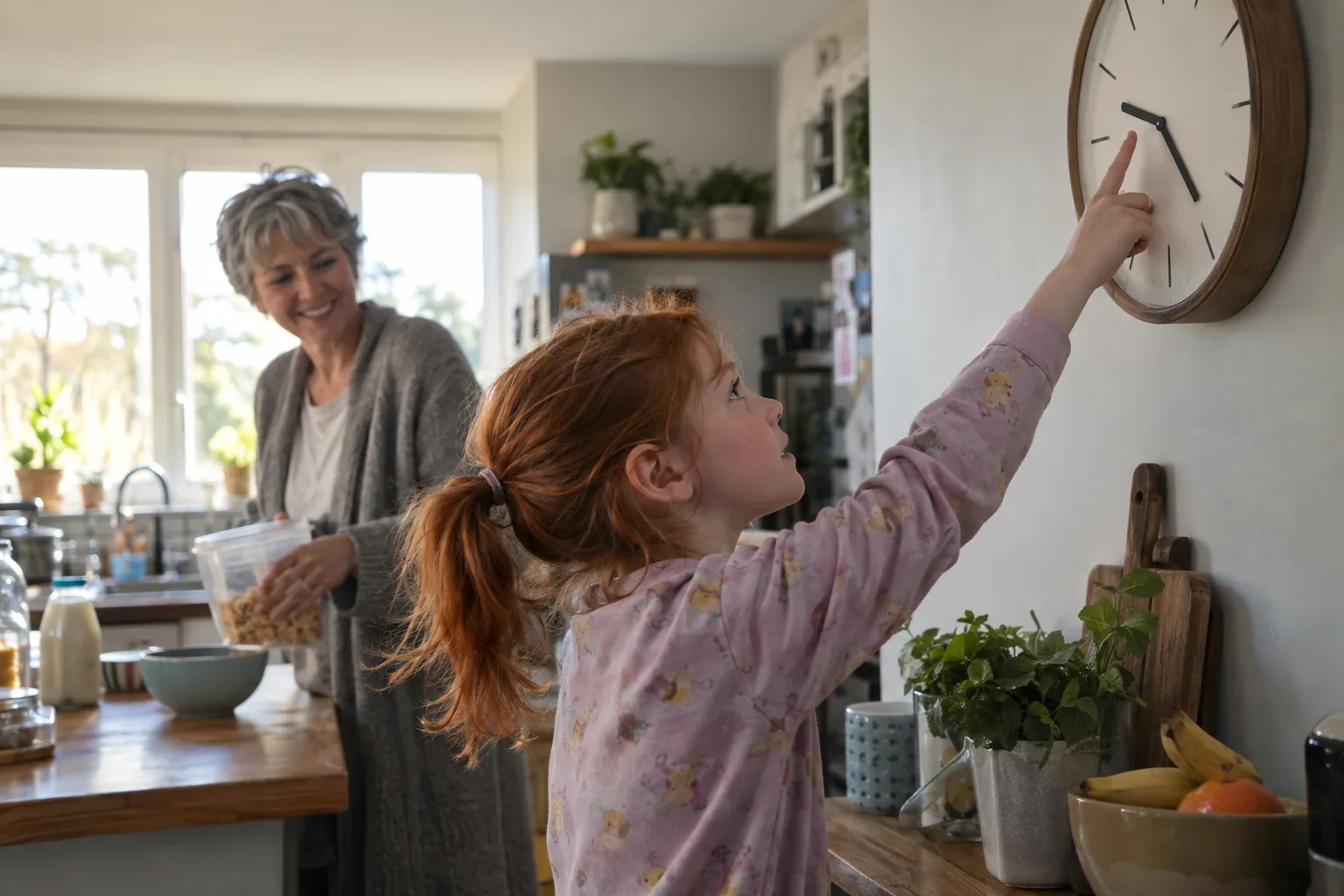
Many clocks designed for kids display the minute numbers in small print outside the dial: this is helpful support at first, which you can later cover with stickers once your child feels confident.
Step 4: telling time naturally
Out loud, people rarely say “eight forty-five”: they say “a quarter to nine.” Both ways are correct, and your child should gradually learn both. Explain that “to” or “minus” means looking ahead to the upcoming hour: at 8:40, there are 20 minutes left before 9 o'clock, so it is “twenty to nine.” Use the interactive clock below to see how the phrase changes with every click.
Then try the challenge: the clock prompts a time spelled out in words, and your child positions the hands using the buttons. Let them explore: making mistakes is part of learning.
How do you move from multiples of five to exact minutes?
One small tick mark equals one minute. When the long hand leaves the 8, it goes past forty minutes: the first tick mark after it is 41, followed by 42, 43, and 44. The “+ 1 min” button on our clock lets you track each step; “− 1 min” helps you backtrack after hesitation. The five-minute buttons are still available to jump quickly across the clock face.
Start by reading the nearest multiple of five, then count the remaining small tick marks. Next, ask your child to explain their reasoning before checking the digital clock. In the official Cycle 2 math curriculum, 2nd grade (CE1) focuses on full hours, half hours, and quarter hours; in 3rd grade (CE2), practical examples of reading and placing hands include exact minutes. These school benchmarks are helpful guidelines, not a way to rank children.
| Starting point | Action | Result and explanation |
|---|---|---|
| 7:59 a.m. | Add one minute | 8:00: the long hand reaches the 12 and the short hand reaches the 8. |
| 2:42 p.m. (14:42) | Subtract two minutes | 2:40 p.m. (14:40): two small tick marks backward, right to the 8. |
| 11:59 p.m. (23:59) | Add one minute | 12:00 a.m. (0:00): it is midnight, the start of a new day. |
Watch the short hand too: it glides between two numbers as the minutes tick by. At 7:59, it's almost on the 8, not right on the 7. If reading both hands feels overwhelming, go back to a single step and try again later. The examples and their answers can be read easily without using the tool.
Step 5: morning, afternoon, and the 24-hour day
Final step: a day has 24 hours, and the short hand travels around the clock face twice. “Three o'clock in the afternoon” and “15:00” mean the exact same time. Many school clocks print numbers from 13 to 24 along the outer rim; if yours doesn't have them, pencil them onto your cardboard clock.
Connect these times to your child's daily schedule: snack time around 4:30 p.m., dinner around 7:00 p.m., bedtime shortly after (our sleep guidelines by age can help establish it). The times shown on a router, oven, or smartphone then become everyday opportunities to practice.
Time vocabulary at a glance
Each phrase matches a position of the hands. The table lists the most common ones:
| Time | What we say | Where the hands are |
|---|---|---|
| 8:15 | “Quarter past eight” | Short hand just past the 8, long hand on the 3 |
| 8:30 | “Half past eight” | Short hand halfway between 8 and 9, long hand on the 6 |
| 8:40 | “Twenty to nine” | Short hand almost on the 9, long hand on the 8 |
| 8:45 | “Quarter to nine” | Short hand almost on the 9, long hand on the 9 |
| 12:00 p.m. | “Noon” | Both hands on the 12 |
| 12:00 a.m. or 24:00 | “Midnight” | Both hands on the 12 |
“Quarter past” adds 15 minutes to the hour that just started, “half past” adds 30 minutes, and “quarter to” or “minus” points to the upcoming hour: at 8:40, there are twenty minutes left until 9 o'clock. Noon and midnight both have both hands meeting at the 12: the light of day or dark of night makes the difference. To practice, ask your child to express lunchtime using both ways: “12 o'clock” and “noon.”
Bringing time reading into everyday life
Telling time shouldn't feel like a standalone lesson: it's a practical skill for everyday family life. Here are a few habits that offer practice without feeling like work:
- Announce key parts of the day with the time: “We're leaving for the park at 3:30, can you let me know when it's time?”
- Ask “How much longer?”: if it's 4:10 and the cake comes out at 4:30, how many minutes are left?
- Entrust them with tracking durations: pasta cooking time, game turn time, or when indoor playtime is over.
- Weave time check-ins into your morning schedule, which we cover in detail in our article on a stress-free morning routine.
Three games to learn telling time without worksheets
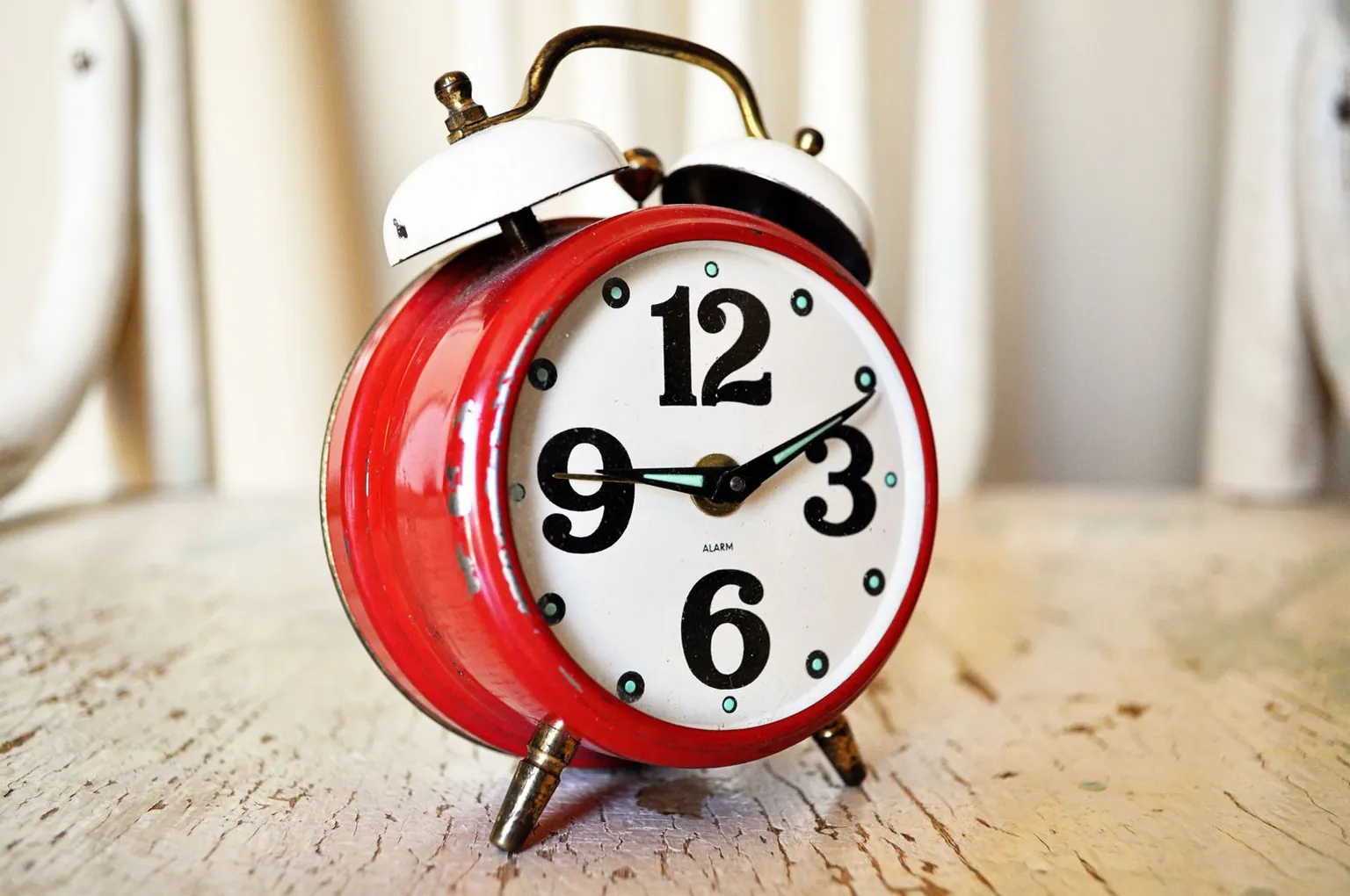
These games need only paper and a cardboard clock. Clock memory matches two kinds of cards: a drawn clock on one and a time written in words, such as “half past four,” on the other. Your child turns over two cards and looks for pairs. Clock bingo works in a similar way: an adult calls out a time and the child covers the matching clock on their board. You can also play Simon Says: “Put the long hand on the 6,” or “Your short hand is between the 2 and the 3.” A quick memory game before dinner makes a pleasant change from worksheets. To explore durations, such as “twenty minutes left,” try our mental math games.
The most common mistakes
- Mix up the hands: Keep both colors and repeat, "The short hand for the hour, the long hand for the minutes."
- Read the number the minute hand points to ("It's 4:03"): Go back to counting by 5s.
- Get the hour wrong when using "till" or "to": At 7:45, the hour hand is almost on the 8, and people say "quarter to 8" (or 7:45).
- Forget that the hour hand moves: At 4:50, it is no longer right on the 4, but almost on the 5.
Is reading a time the same as measuring elapsed time?
Reading a clock answers “When?” Finding a duration answers “How much time passed?” Two correct clock readings are not enough if a child subtracts the minute numbers without accounting for crossing into the next hour.
| Step | Minutes elapsed |
|---|---|
| 09:50 → 10:00 | 10 |
| 10:00 → 10:15 | 15 |
| Total | 25 |
Draw a line with both times and mark the whole hour between them. Count the minutes to that point, then the minutes from there to the finish, and combine the intervals. This example stays within one day without crossing midnight. For weekdays and months, use the printable calendar activity. The CP, CE1, and CE2 references in this guide describe French primary-school stages, not universal grade expectations.
Calendar days and clock minutes are different units. To compare dates without calculating elapsed hours, use the monthly calendar and inclusive-date counter.
Frequently asked questions
At what age can a child tell time?
Learning starts in 1st grade (CP, age 6–7) with full hours, continues in 2nd grade (CE1, age 7–8) with half hours and quarter hours, and wraps up in 3rd grade (CE2, age 8–9) with minutes. By around age 8, most children can tell time, though they may still hesitate over expressions like "twenty to" or "quarter to".
Should you use an analog watch or a digital watch?
Both have their place. A digital watch lets children read digits, but only an analog clock shows time passing and quarter hours visually. For learning, an easy-to-read analog clock or watch remains the most useful tool.
Should you say "15:00" or "3 o'clock in the afternoon"?
Both are correct, and French schools teach both formats. At home, use both naturally and link them together: "It's 3 o'clock in the afternoon, which means 15:00."
My child always gets the two clock hands mixed up: what should I do?
Go back to using just the hour hand for a while, then use two different colors for the hands on your cardboard clock. A simple rule helps too: "The big hand goes all the way around in one hour."
How do you teach time to a child who cannot read yet?
Start with concrete landmarks in their day: waking up, snack time, leaving for school. A clock with colored stickers instead of numbers helps show where the hours are without needing to read digits. Say the time out loud by linking it to an activity, like "It's snack time, the big hand is on the 12." Reading the numbers will come later in school.
What is the difference between "quarter past" and "quarter to"?
In French clock terms, "et quart" (quarter past) adds 15 minutes to the hour that just started: 8:15 is spoken as "huit heures et quart", with the minute hand on the 3. "Moins le quart" (quarter to) announces the upcoming hour: 8:45 is spoken as "neuf heures moins le quart", with the minute hand on the 9. To remember the difference, say together: 3 means "quarter past", 9 means "quarter to".
When should you start teaching time?
You can start in preschool using the hour hand and whole hours, linking the clock to daily routines. In elementary school, learning progresses in stages: whole hours in 1st grade (CP), half hours and quarter hours in 2nd grade (CE1), then minutes in 3rd grade (CE2). So there is no need to master everything before starting 1st grade.
To go further
Preview before choosing
Les Grands Curieux · Ages 7–10
For children who are beginning to read instructions on their own and enjoy playing with words, numbers, and riddles. An adult can help with reading.