

Table of Contents
7:40 AM. Pants aren't on, the bowl of cereal is half full, one shoe has vanished, and tempers are rising. In many households, morning is the most stressful time of day. It isn't a lack of good intentions: children don't experience time the way adults do, and carrying out a dozen tasks in a row without getting distracted takes a huge effort on their part. A good routine won't work miracles, but it will significantly reduce friction. Here is how to build one, complete with a checklist chart and a visual timer you can start using tomorrow morning.
Why mornings get stuck
Young children live in the present. "Hurry up, we're going to be late" doesn't mean much to them: they can't tell time yet, and the concept of being late twenty minutes from now remains abstract. On top of that, mornings are full of transitions—moments when they have to stop one activity to start another: getting out of bed, leaving their toys, putting away a drawing to put on shoes. Every transition is an opportunity to slow down or resist.
Routines help children know exactly what to do and in what order. They also build a sense of confidence: kids feel capable because they know what comes next.
Everything starts the night before
Morning prep starts partly the evening before, when things are calm. Three small habits save precious time: choosing tomorrow's clothes and placing them on a chair, putting the backpack by the door, and setting the breakfast table. Let your child choose between two outfits suitable for the weather: they will be much more cooperative in the morning if they made the decision the night before.

A fixed sequence, shown in pictures
The brain thrives on regular sequences. If the order changes every day, your child needs guidance at every step. If it stays the same, they eventually follow it on their own. Choose a sequence that fits your family, then display it using picture cues for children who don't read yet.
Making the chart together makes all the difference: your child draws or cuts out the pictures, pastes them in order, and feels ownership over it. A magnet they move from step to step, or a clothespin, makes their progress visible.
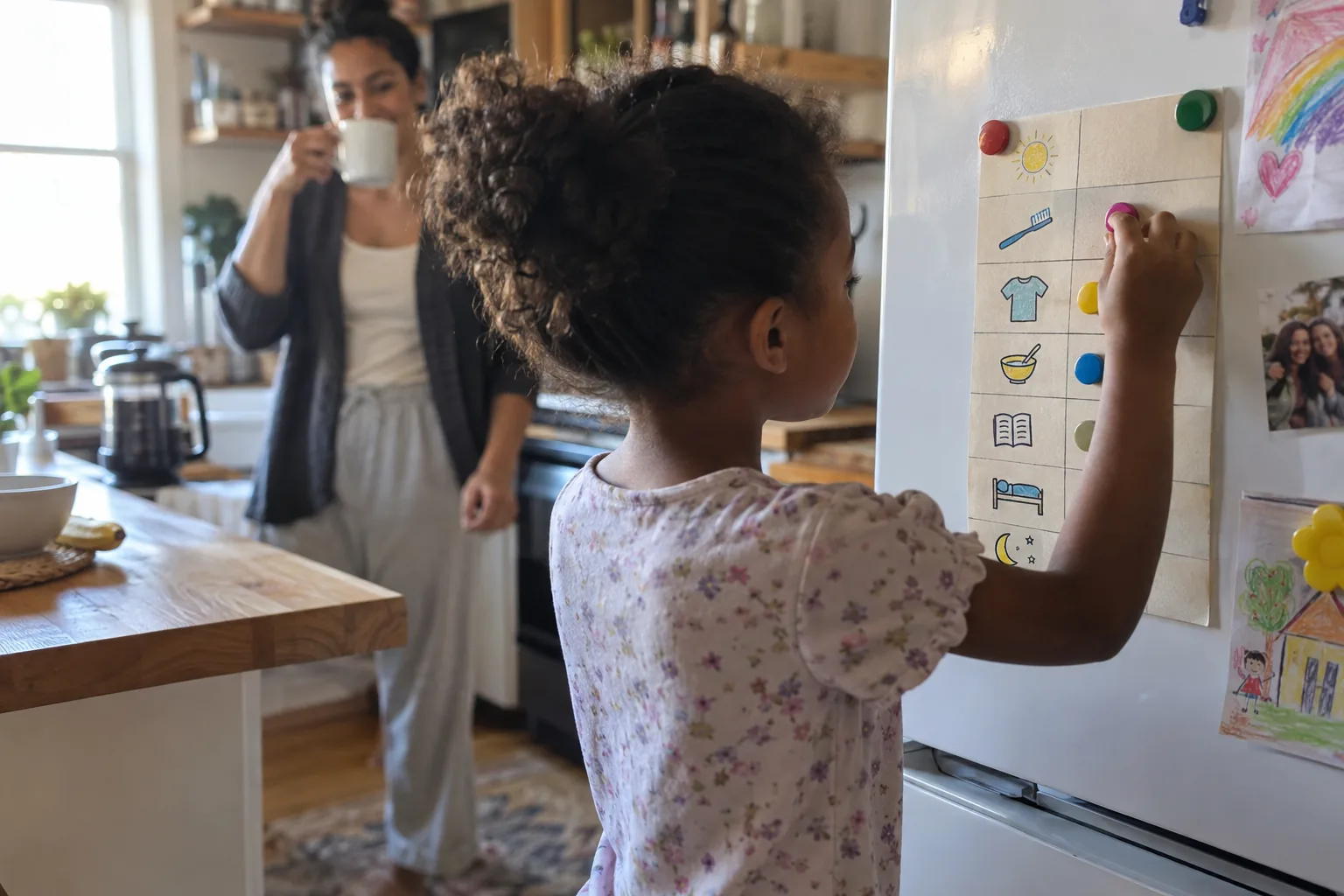
The checklist chart
For children who read, or to test the idea before making a physical chart, this checklist can be checked with a tap and resets the next day. It stays saved on your device.
Making time visible
For a child who can't tell time yet, a visual timer makes much more sense than a clock: the shrinking slice of color clearly shows how much time is left. Use it for tasks that tend to drag out: "You have five minutes to get dressed, keep an eye on the color." For teeth, the French Union for Oral Health recommends brushing twice a day for two minutes: a two-minute timer is perfect for this.
Frame it as a fun challenge against the clock, never against a sibling. The goal isn't to win, but to be ready together. Step by step, your child will also learn how to tell time: our article on learning to tell time offers a 5-step method.
Fewer words, more actions
In the morning, long explanations get lost. A single, short instruction given right next to your child—rather than yelled from another room—is much more likely to work. When they get distracted, point them back to the chart: "What comes next?" The chart is in charge, not you, which helps prevent power struggles.
Offering limited choices works wonders too: "Do you want to put on your shoes before or after your coat?", "Would you like an apple or a banana?" Your child feels in control, and the routine keeps moving forward.

Planning a buffer
A routine scheduled down to the minute will always run off track: a lost shoe, a spilled glass, an urgent need for a hug. Allow a ten-minute buffer. If your child is slow in the morning, waking them up slightly earlier is far better than constantly rushing them. And hold onto a moment of warmth when waking up, before the rush begins: a few minutes of cuddling often makes a child much more cooperative afterwards.
All of this relies on getting enough sleep: a tired child will drag their feet even more in the morning. Our article on how many hours of sleep kids need helps you set the right bedtime.
When things stall anyway
Some mornings, nothing goes right: fatigue, worry about a special day, or a need for attention. Instead of raising the pressure, try to address the underlying cause: "You look worried this morning, is something happening at school?" Simply putting words to an emotion is sometimes enough to move past a blockage. Then in the evening, review things calmly together: what got stuck, and what could we tweak?
A routine shows the order of actions; a calendar locates a date in the month. The calendar-reading activity for children helps choose the right format rather than mixing those two references.
Frequently asked questions
What time should I wake my child up in the morning?
Add up the time needed for every step, add a ten-minute safety buffer, and ensure the bedtime allows for enough total sleep: between 9 and 12 hours for ages 6–12, according to international guidelines.
My child takes forever to get dressed, what should I do?
Pick out clothes the night before, choose items that are easy to put on, use the visual timer, and stay nearby without doing it for them. Praise every bit of progress, no matter how small.
Are screens in the morning a good idea?
They hold children's attention and make transitions much harder. It's best to save them for later in the day if you choose to use them, keeping the morning focused strictly on the routine.
Should you reward a successful routine?
The satisfaction of checking off their board along with a sincere compliment is usually enough. If you decide to offer a small reward at first, keep it simple and shared—like playing a game together on Saturday—and then gradually phase it out.
To go further
Preview before choosing
Les Petits Explorateurs · Ages 4–6
For preschool and early elementary children discovering shapes, numbers, and the fun of drawing lines. An adult reads the instructions.