

Table of Contents
Which calendar should you start with?
Choose one month with large cells and clear weekday headings. Keep decorations away from the numbers. An adult can read the weekday names while a child finds a cell with a finger or movable marker. Independent reading is not a prerequisite for exploring the grid.
First, locate the month title and its year. Two sheets showing the same month name do not necessarily put dates beneath the same weekdays. Our calendar lets you choose both the month and year, then print the matching version for the activity.
Is the first column always Monday?
Read the headings instead of inferring a weekday from its position on the page. Some calendars start on Monday and others on Sunday. Changing the layout moves columns but does not change the weekday that belongs to a particular date.
The activity can display both layouts of the same month. Find one date before and after changing the first weekday, then read its heading again. The number has moved on the page, while the complete date remains the same.
Read the same month in two layouts
| Mon | Tue | Wed | Thu | Fri | Sat | Sun |
|---|---|---|---|---|---|---|
| 1 | ||||||
| 2 | 3 | 4 | 5 | 6 | 7 | 8 |
| 9 | 10 | 11 | 12 | 13 | 14 | 15 |
| 16 | 17 | 18 | 19 | 20 | 21 | 22 |
| 23 | 24 | 25 | 26 | 27 | 28 | 29 |
| 30 |
Only dates in the selected month are numbered. No school-break or holiday data is added.
November 2026.
Calendar shown: {month} {year}.MonTueWedThuFriSatSunOutside this month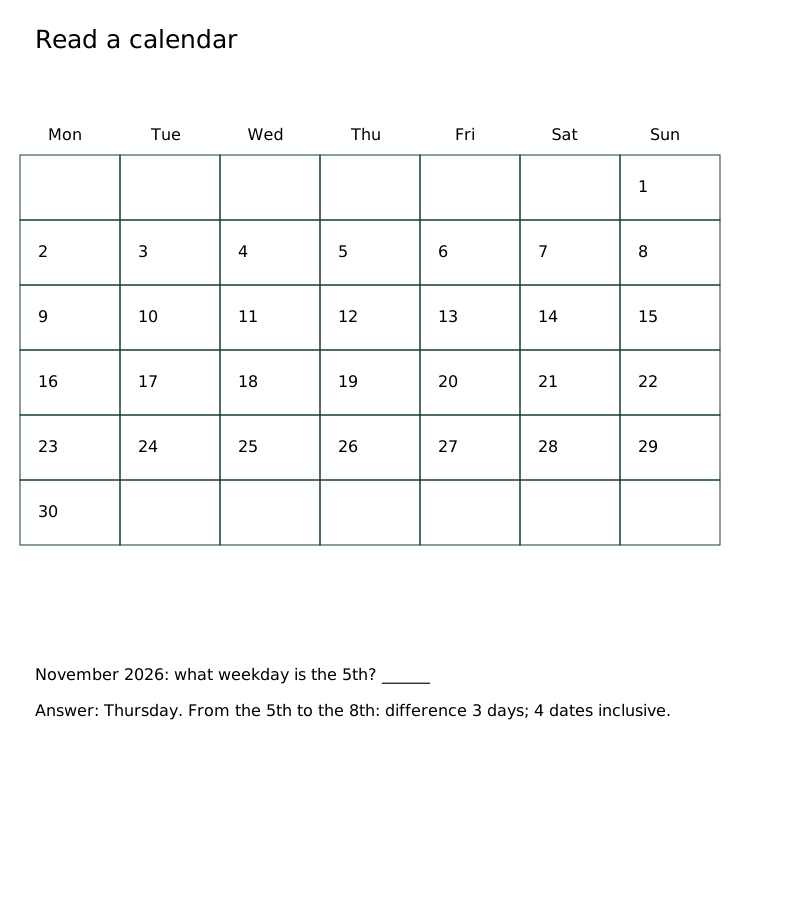
Nothing you enter is stored or sent.
How do you find the weekday for a date?
Locate the number in a cell belonging to the selected month, then follow that column up to its weekday heading. Check the month title and year before saying the complete date. This is about reading columns, not only reciting weekdays in order.
Checked example: November 5, 2026, is a Thursday. The 8th is a Sunday.
The two-way table activity explores how a row and column meet. On a calendar, the date number still matters: “the second cell” is not a reliable way to identify a date when the layout changes.

What do unnumbered cells mean?
A blank cell before the first date is not “day zero.” It positions the month’s dates beneath the correct weekday headings. After the final date, the remaining cells in our grid stay blank too; they do not become additional dates in the same month.
Other calendars may print dates from the previous or following month in those spaces. Check their color or key. The Hepaly sheet numbers only dates belonging to the selected month, with that convention stated so that the months are not mixed together.
Are you counting dates or days that pass?
Agree on the question before counting. The difference between two dates counts the moves from one date to the next. An inclusive count also includes the starting date. The two answers can differ without either one being a mistake.
| Question | Answer |
|---|---|
| From the 5th to the 8th: elapsed days | 3 |
| Dates from the 5th through the 8th, inclusive | 4 |
The second activity labels both interpretations. It counts civil calendar days, not an exact number of hours between appointments. For clock hands and minutes, continue with the guide to reading the time, which addresses a different measurement.
Elapsed days or inclusive dates?
Gregorian calendar days. The calculation uses dates without turning a daylight-saving change into elapsed hours.
Difference: 3 calendar days. Including both start and end: 4 dates.
Difference: {days} calendar days. Including both start and end: {inclusive} dates.The end date must be on or after the start date.Nothing you enter is stored or sent.
How can you use the sheet day to day?
Choose one simple event your child already knows and find it together. A removable marker can highlight the date without covering its number. The activity does not automatically add school breaks or public holidays; those depend on location and are outside what this calendar calculates.
The free calendar is available in the page’s language. Hepaly’s commercial activity books remain in French, as their product pages explain. For the sequence of everyday actions, the morning routine guide is more suitable than a monthly grid.

Frequently asked questions
Must children memorize the months first?
Read the title together and work with one month. Finding a date does not require reciting every month of the year.
Why does February have different lengths?
The Gregorian calendar adds a day to February in leap years. The activity calculates this from the selected year.
Should you fill an empty cell?
On this sheet, cells outside the month remain blank. They are not day zero or extra dates in the current month.
Does changing the first weekday change a date?
The columns change position, but the weekday belonging to a date stays the same.
Does the calendar know our school breaks?
It adds no school or personal information. Check with your school before adding those details yourself.
Can you print without using the interactive tool?
A static sheet and answer key remain available. The tool lets you choose another month, year, or layout.