
Table of Contents
- What do you need for a first comparison?
- What should you check before adding objects?
- How do you move from a prediction to an observation?
- Why swap the objects between the pans?
- Is a larger object always heavier?
- What if the pans remain level?
- Frequently asked questions
- Can a balance also predict which objects float?
What do you need for a first comparison?
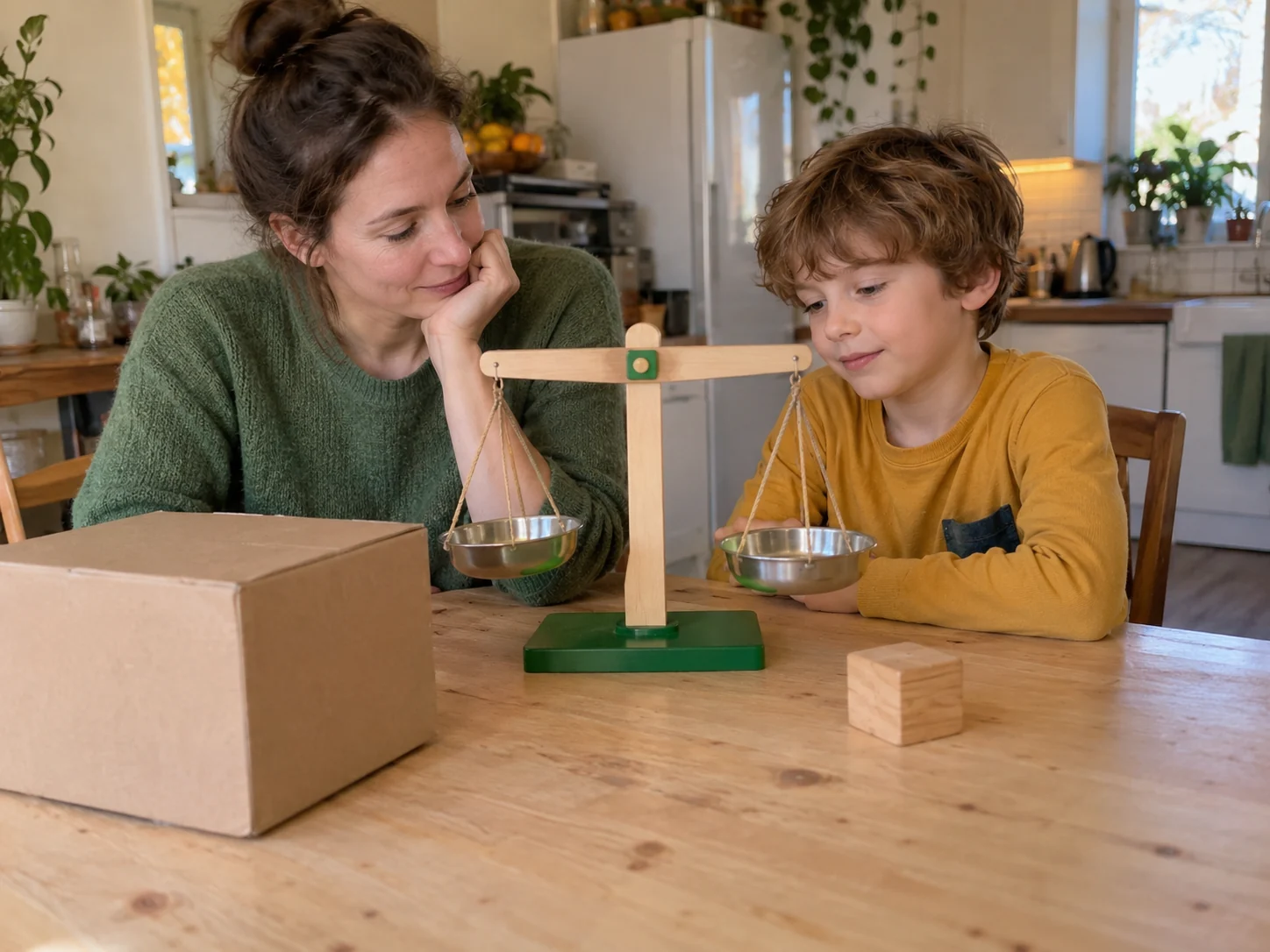
Use a stable educational balance and objects your child can handle comfortably. An empty carton and a wooden block offer different shapes to examine without assuming their weights. Avoid fragile, sharp, or small objects that could be swallowed.
Keep the activity short and stay alongside your child. A younger child can describe one comparison aloud; a more confident child can record the result and explain a prediction. These are activity options, not an age-based test or a promised milestone.
What should you check before adding objects?
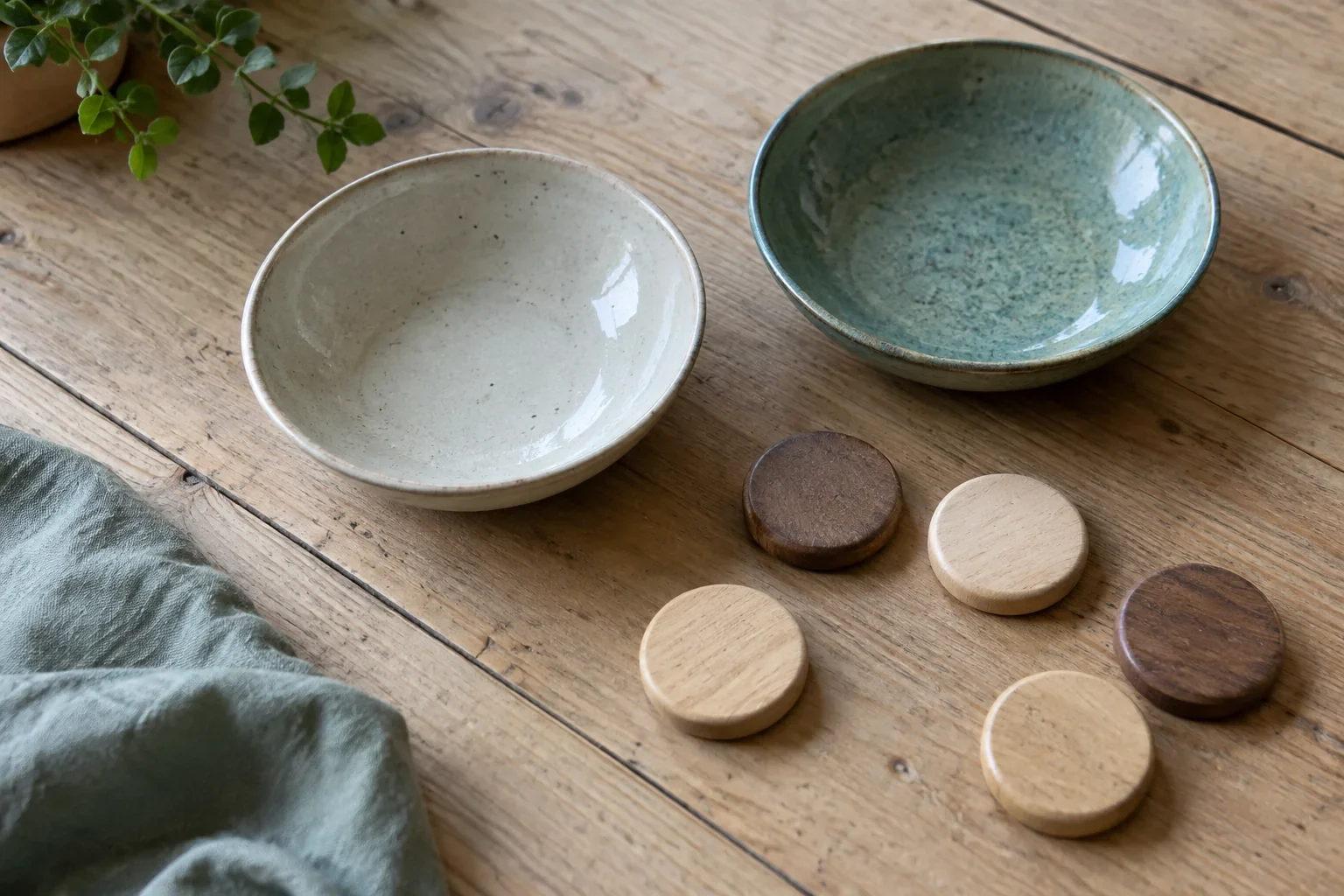
Put the balance on a stable surface with both pans empty. Check it according to the maker’s instructions. If the empty pans do not take their expected position, you cannot attribute a later tilt entirely to the objects you add.
Keep hands clear of the pans while observing. A pan resting on the table, an object leaning on the support, or a finger holding a cord can interfere with the comparison. If the movement is obstructed, stop and check the setup.
How do you move from a prediction to an observation?
Ask, “Which side do you think will go down?” Listen to the explanation before placing one object on each pan. On a correctly used equal-arm balance, the side that moves down carries the greater mass.
Name both objects in your conclusion: “The block is heavier than this box.” Heavier describes a comparison, not an absolute property that holds against every possible object. Record the prediction separately from the observation so that changing your mind is part of the activity.
Predict, compare, swap
Simulation: numbers are fictional units, not measured grams.
Side B moves down.
Side A moves down.Side B moves down.The simulated masses are equal.Your prediction matches the simulation.The simulation gives another result; you can revise your prediction.Nothing you enter is stored or sent.
Why swap the objects between the pans?
Swapping helps check whether the result follows the object rather than a problem with the setup. Remove both objects, check the empty position, and exchange their places. If the block was heavier, its new side should now move down.
If the observations conflict, keep both rather than choosing one at random. Check for contact with the support and whether the pans can move freely. The record sheet allows an “inspect and repeat” outcome: an uncertain comparison should stay uncertain.
Is a larger object always heavier?
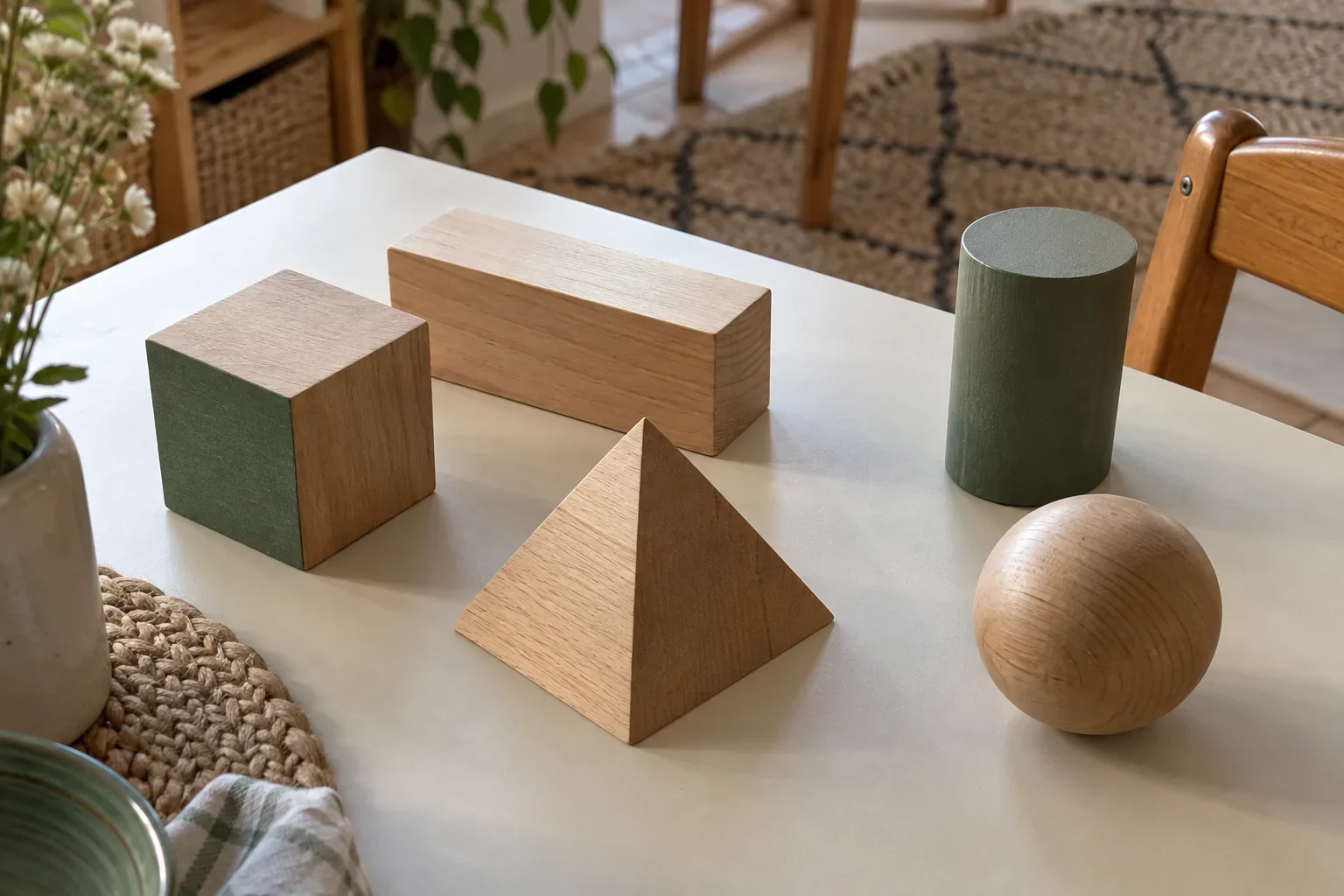
Size alone does not tell you mass. La main à la pâte’s activity has children check estimates using comparison instruments. Do not assign invented real weights to the objects shown in an illustration.
Our simulator uses imaginary units to explain the direction of the tilt. They are not grams or measurements of your own objects. For another attribute, use the guide to length and rulers: different questions require different measurements.
Check a real observation
Try your real balance, then select the lower side before and after swapping objects. This tool checks only whether your two observations agree.
First A, then B after swapping: the result follows the same object.
The observations agree after swapping; also check the empty balance.Inspect and repeat: check for obstructions and the empty position.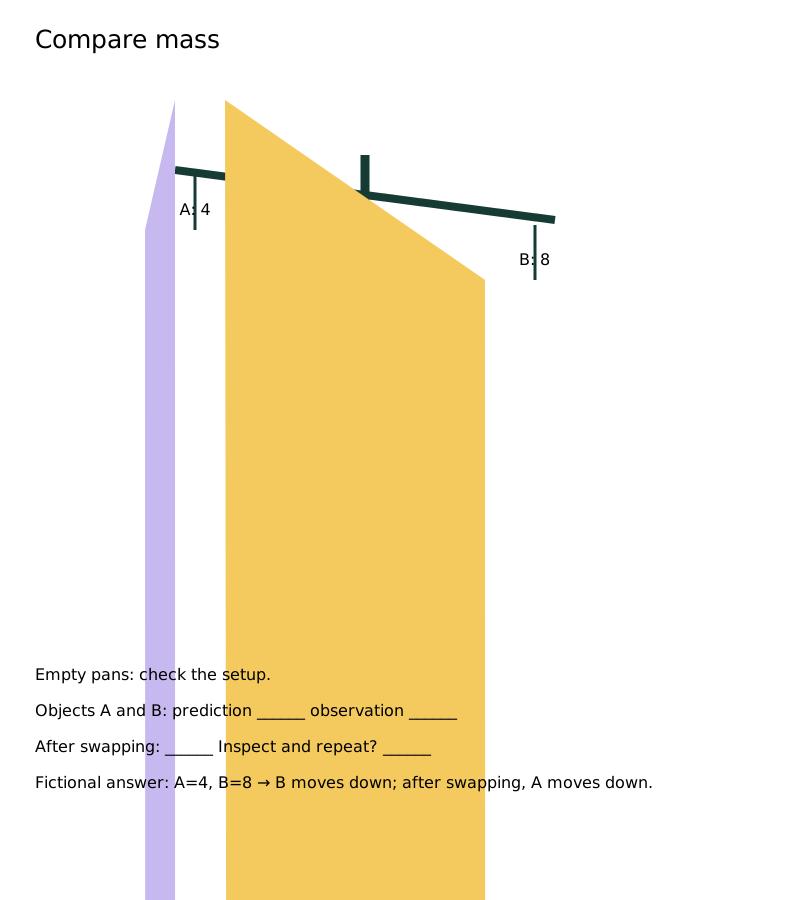
Nothing you enter is stored or sent.
What if the pans remain level?
You can say the balance shows no difference under these conditions. Its sensitivity limits what it can distinguish. Do not conclude that the objects are identical: an observed equal mass does not mean the same shape or material.
To continue, compare three-dimensional shapes or choose another adult-guided experiment. Keep one question at a time. The record sheet, simulator, and paper activities let you return to the comparison without requiring speed or a score.
Can a balance also predict which objects float?
A balance compares masses; a container of water shows an object’s behaviour in water. These are not two ways to measure the same thing. If a bulkier object floats while a small spoon sinks, the observation does not automatically contradict the balance: you were asking different questions.
| Question | Useful setup | Permitted conclusion |
|---|---|---|
| Which object has more mass? | Free-moving balance, checked empty | A comparison between these objects |
| Where does this object stay in water? | Suitable container, unsupported object | Its observed position in this test |
| Does it happen again? | Another documented comparison | The repeated result, not a universal rule |
The new sink-or-float activity keeps prediction separate from observation. Do the two experiments at different times: dry the objects and keep water away from the balance. Then ask your child to name the instrument that answers each question.
You can write “A lowers the pan” and “A stays at the surface” without turning those sentences into a density calculation. NOAA explains that construction and displaced volume influence buoyancy; a photograph of an object does not reveal its measured mass or density.
Frequently asked questions
Do children need to know grams first?
Comparing two masses can come before measuring them in grams. Begin with heavier, lighter, and an observed equal mass.
Should you push a pan to help?
Keep hands clear while observing. Pushing adds an outside action, so the movement no longer comes only from the objects.
Does the simulator weigh real objects?
It compares the numbers entered in imaginary units. It has no sensor and does not measure objects in your home.
Why check the empty balance?
The empty position provides a reference. If it is wrong, check the instructions and setup before comparing objects.
Does equal mass mean identical objects?
Objects can differ in shape or material while having masses that the balance cannot distinguish.
Must children complete the whole sheet?
One discussed comparison may be enough for a session. Keep the other rows for another time if your child wants to continue.