
Table of Contents
- What is a double-entry table used for?
- What benchmarks and materials should you prepare?
- How do you cross a row and a column?
- What if only one property is taken into account?
- How to print a worksheet and keep the answer key separate?
- How to play without relying solely on colors?
- What changes when you swap the headers?
- How to extend the game with a 7- to 10-year-old child?
- When to simplify, take a break, or choose something else?
- What key points should you remember before putting the table away?
- How is a sorting table different from splitting ten?
- Frequently asked questions
The blue disc is in the discs column, but it is not in the correct row. This small misalignment provides a good question to investigate together: what information is still missing? The Hepaly team offers a guided sorting activity here, with movable cards, keyboard tools, and printable worksheets. No timer determines whether the child understood.
What is a double-entry table used for?
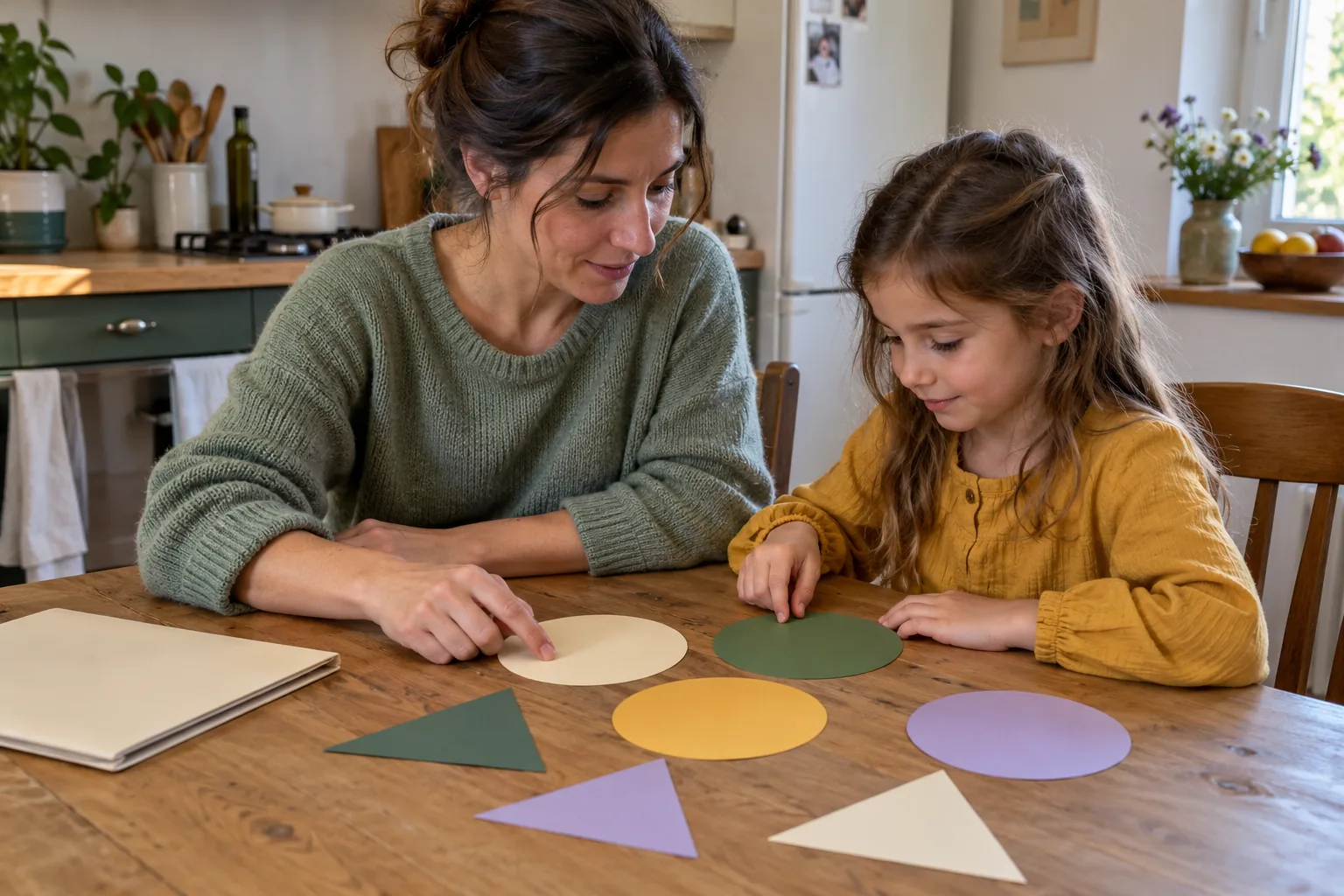
It allows you to organize or find information at the intersection of two categories. In our first model, a row indicates a color and a column indicates a shape. The shared cell therefore contains a shape of that color: a blue disc, a yellow square, or a green triangle.
This does not work like a sudoku puzzle. Here, we are not looking for a solution based on uniqueness constraints: the headers directly give the rule for each cell. In logic patterns, we look instead at how a sequence continues. Name this difference so that the child does not apply a rule belonging to a different game.
The 1st grade (CP) mathematics curriculum explicitly includes building and completing a double-entry table. In preschool, sorting and manipulating shapes provide helpful support. Aligning with the curriculum does not turn this into a test to pass at a specific age.
What benchmarks and materials should you prepare?
First, make sure your child can distinguish the chosen properties without a table. Offer to put similar shapes together, then find a color or a pattern. If they mainly focus on the names of objects, reduce the variety and name the cards with them.
| Observed benchmarks | Suggested session | Materials and guidance |
|---|---|---|
| Around ages 4–6, properties still new | Two shapes and two colors, one cell shown | Large sheet, wide cards, available adult |
| Spatial placement already understood, regardless of age | Three shapes and three colors or patterns | Visible table and movable cards |
| Around ages 7–10, looking for another challenge | Swapped headers then reading an everyday table | Two versions of the same table and oral explanation |
A sheet of paper and scrap paper are enough. Draw the shapes freehand if you do not want to print. Cards should be distinguishable without needing to be perfectly cut out. Keep small pieces out of reach of children who put things in their mouths, and leave cutting to the adult when it is difficult.
A first session can be limited to pointing out one cell and searching for another. Stop when attention wanders; filling out the entire page is not required. Logic riddles for kids offer another form of search if the grid does not look appealing.
How do you cross a row and a column?
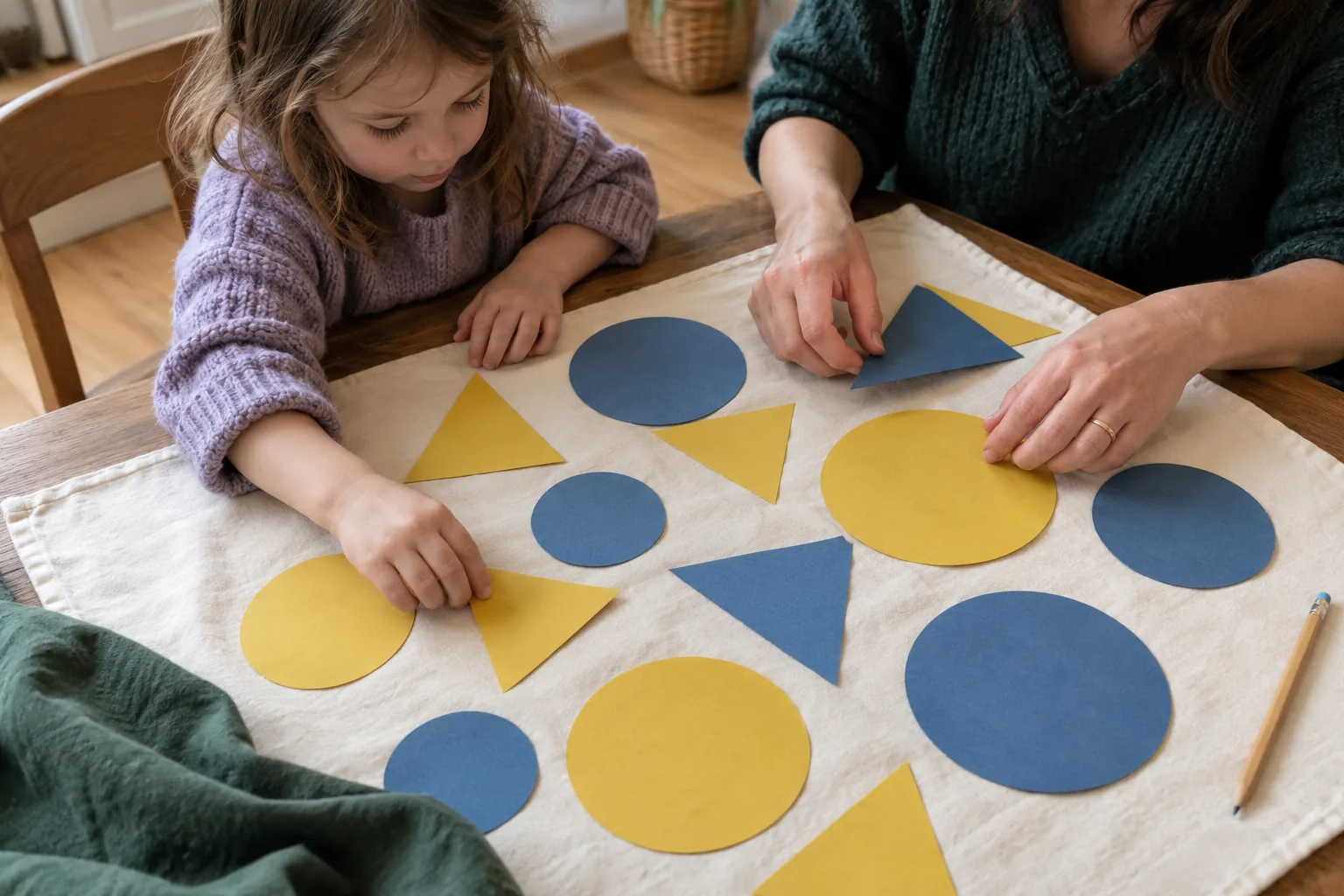
Follow a header to its row or column, then find where it meets the other. You can start from the left or the top: it is the same cell as long as you keep both criteria. Saying "blue and disc" allows you to check both pieces of information.
On paper, point to a header without placing your finger on the answer. Let the child follow the direction, then ask what the other header adds. A paper cover can isolate a row if the rest of the table draws too much focus. Remove this helper when it is no longer needed.
In the workshop, a card is requested. Choose the size and type of markers, then select its cell with the keyboard or by clicking. Feedback indicates the properties of the chosen cell; an incorrect answer triggers no alarm or loss of points. You can request another card without erasing any personal trace: no attempts are saved.
Hepaly Workshop · intersect and explain
Which cell holds the requested card?
Two properties are announced. Look for their intersection; no answer is saved.
Model to explain without JavaScript
| Color / shape | Circle | Square |
|---|---|---|
| Blue | Blue circle | Blue square |
| Yellow | Yellow circle | Yellow square |
Show the two headers for the yellow square. If the shape is correct but the color is wrong, re-read the color row.
The Polybius square also uses a grid, but its code requires an order between two digits. Our classification does not encode any message. It simply combines two properties; the labels, rather than position alone, tell you what each direction represents.
What if only one property is taken into account?
Go back over what is correct and what is missing separately. A yellow triangle placed in the yellow row has the right color; you still need to check the triangle column. This phrasing describes an action to repeat, without blaming the error on a lack of attention or effort.
The following activity contains a card that does not match its box's headers. Look for it, then explain the forgotten property. The other cards stay in place: you can compare neighboring squares and rebuild the rule. The answer key names what should occupy the square, rather than just saying "wrong".
Hepaly Workshop · intersect and explain
Which card does not match its two headers?
A card has been replaced by another. Find the incorrect space and name the forgotten criterion.
Model to explain without JavaScript
| Color / shape | Circle | Square |
|---|---|---|
| Blue | Blue circle | Blue square |
| Yellow | Yellow circle | Yellow square |
Show the two headers for the yellow square. If the shape is correct but the color is wrong, re-read the color row.
On paper, replace the yellow square with a yellow circle: its color fits, but its shape no longer matches the column.
If your child places a card over a header, the boundary between the instructions and the grid to complete might not be clear yet. Point out the answer area using a large empty box. Keep the first placed card as a model and go back to fewer boxes if necessary.
If guessing takes over, avoid guiding your child's hand to the solution. Instead, ask them to choose between two very different cards. They can also watch you play a round while you explain your choices, and then decide if they want to try again.
How to print a worksheet and keep the answer key separate?
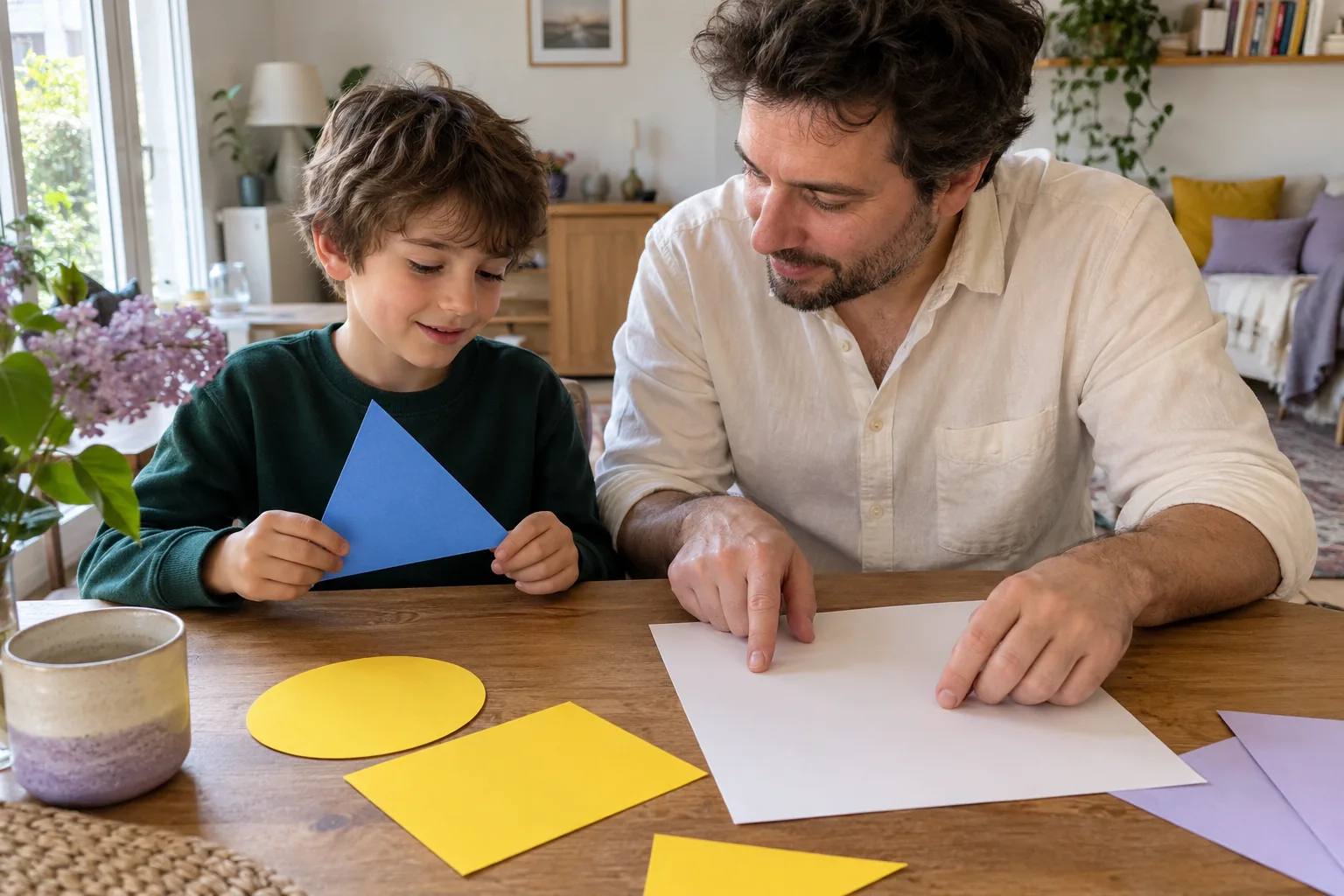
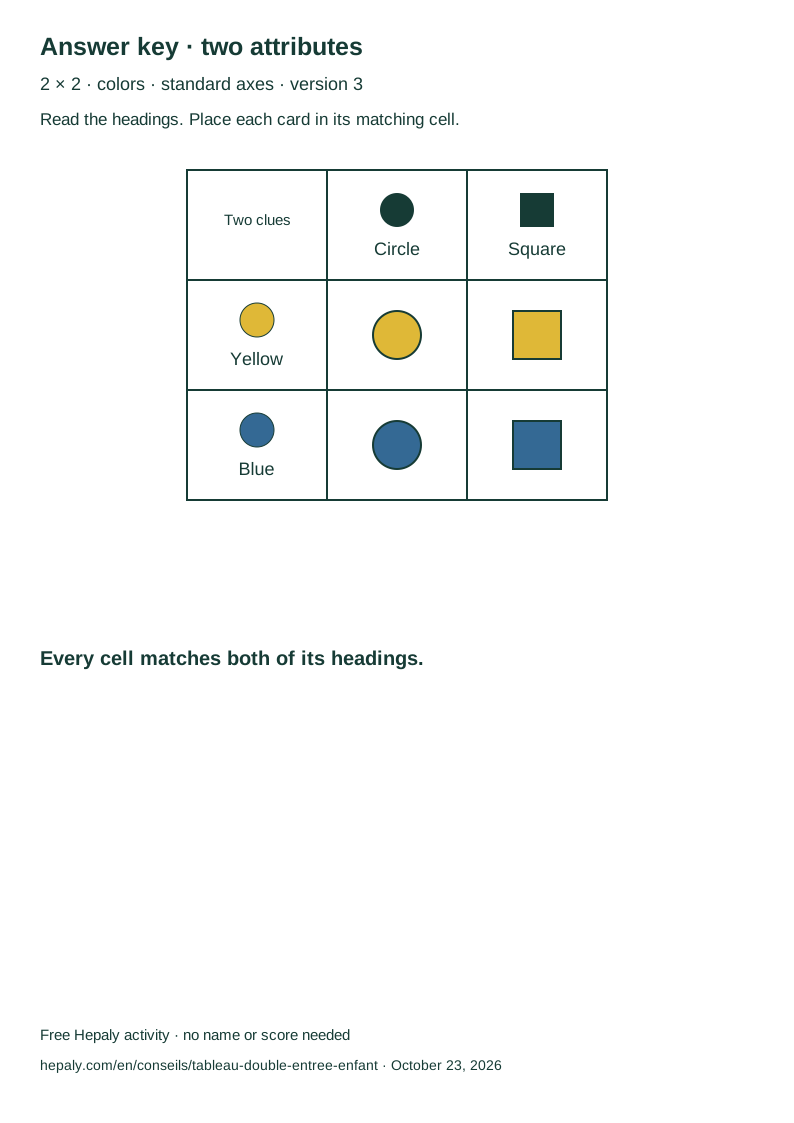
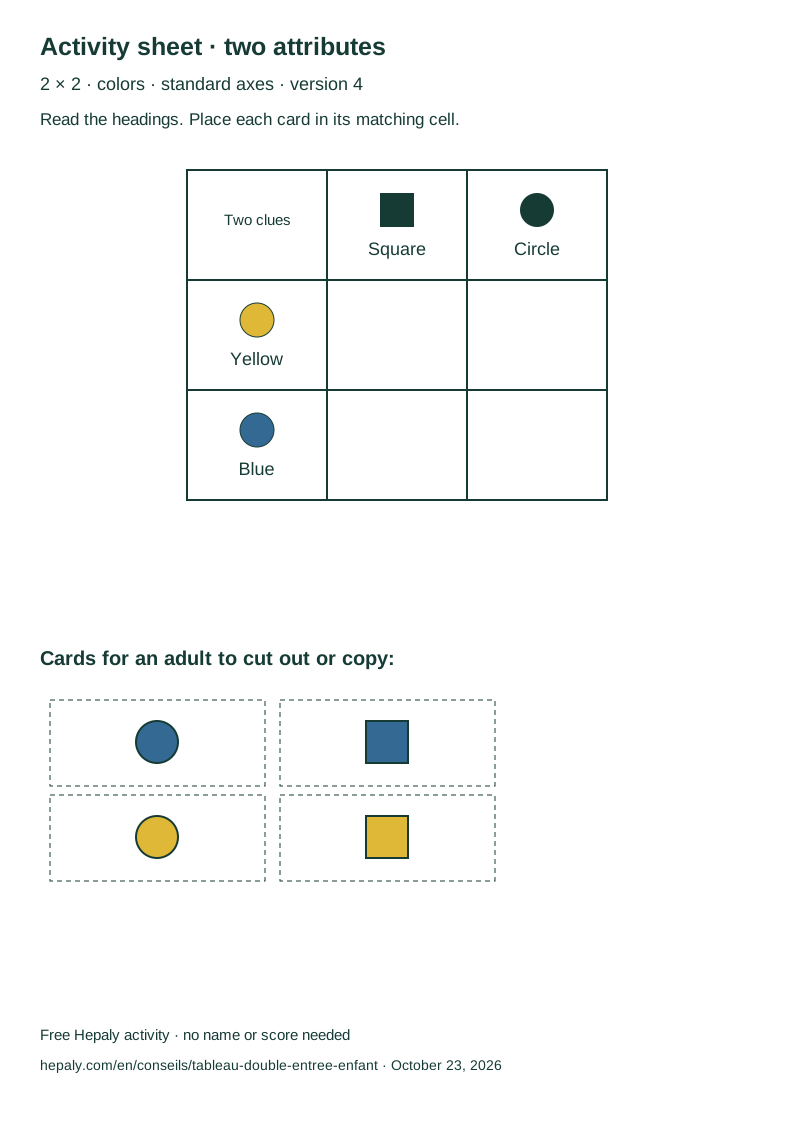
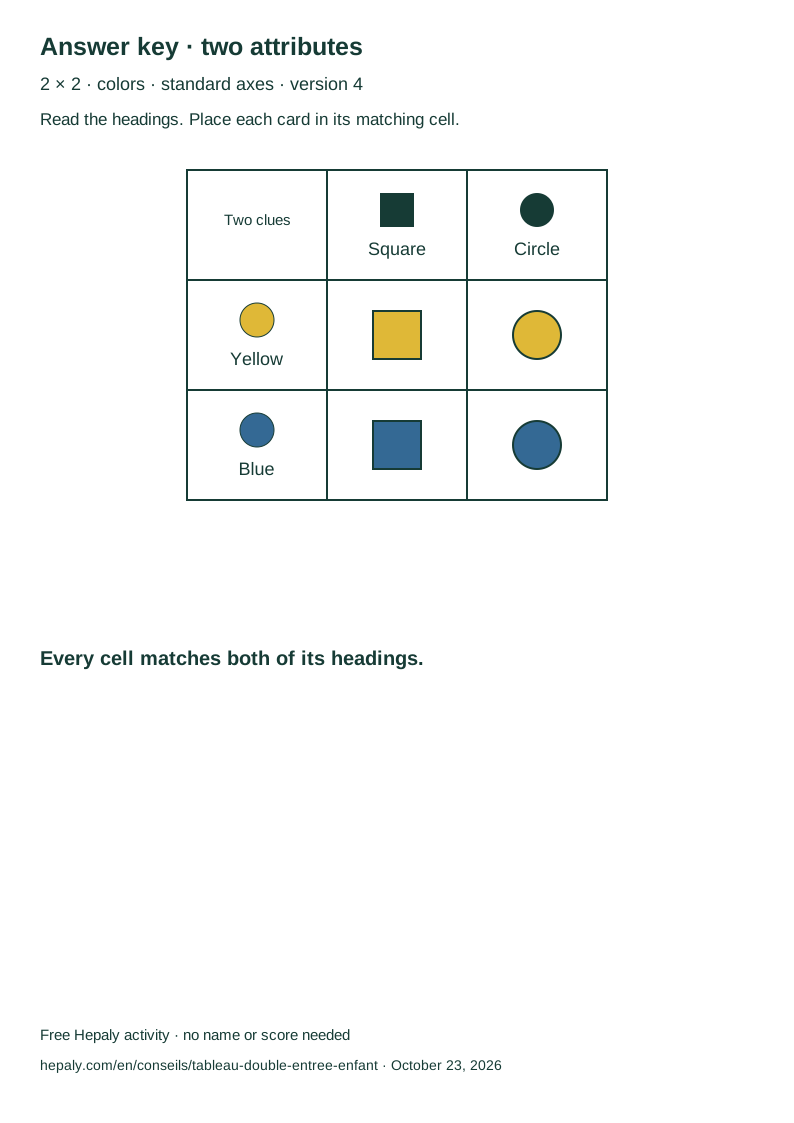
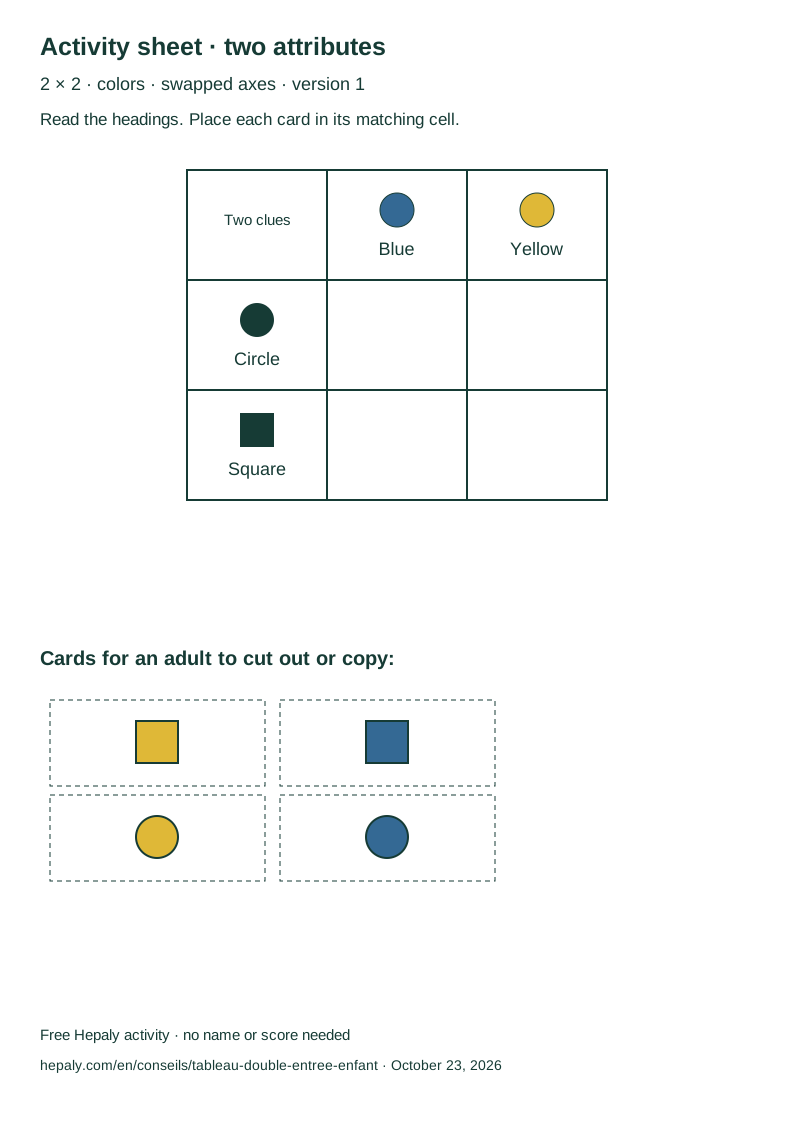
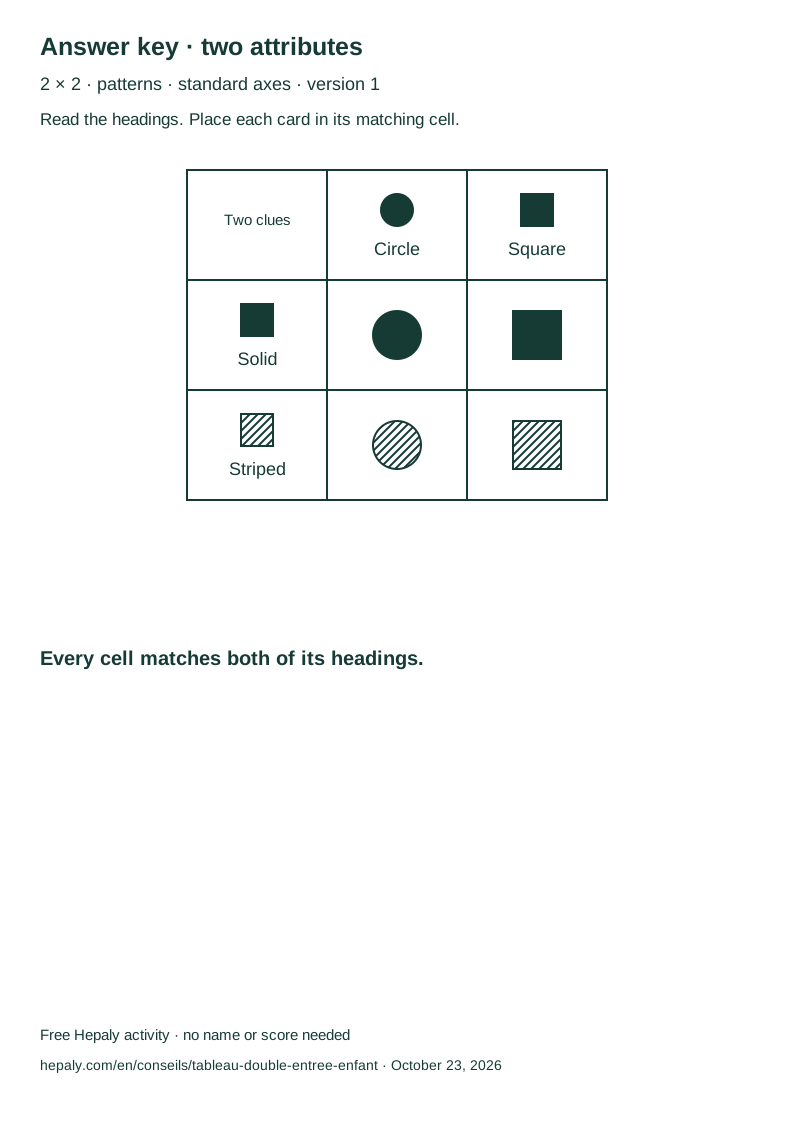
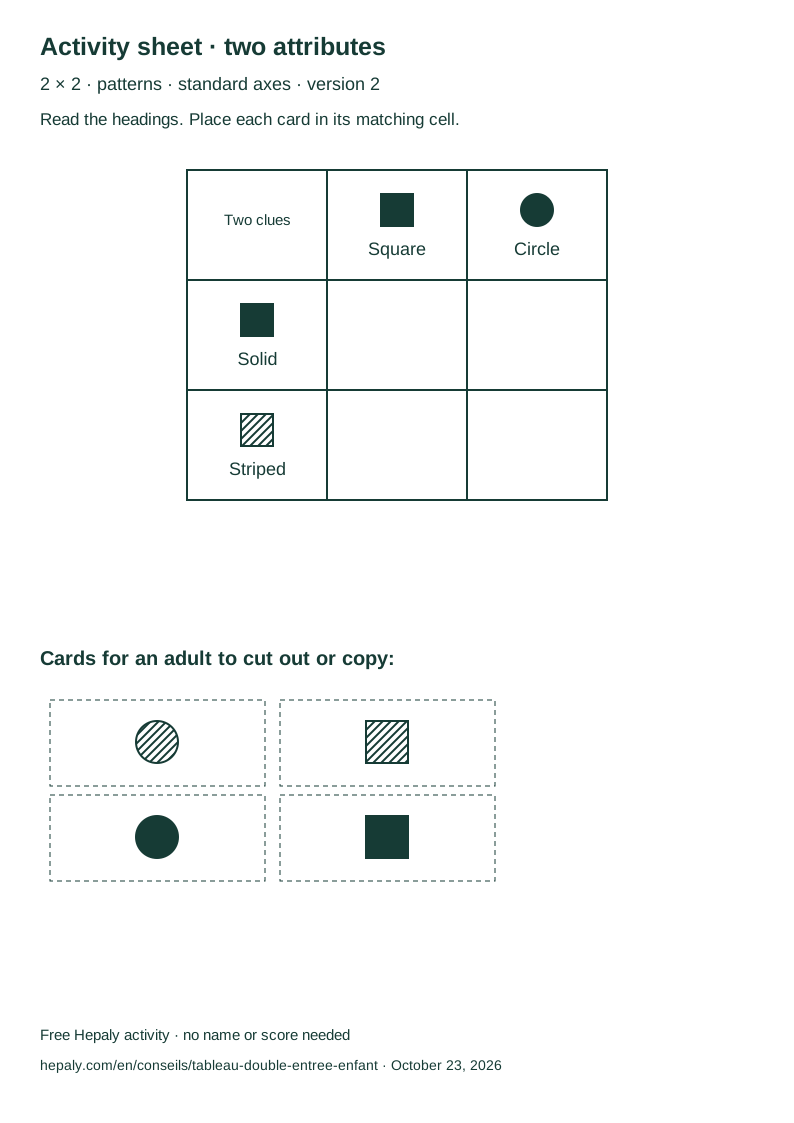
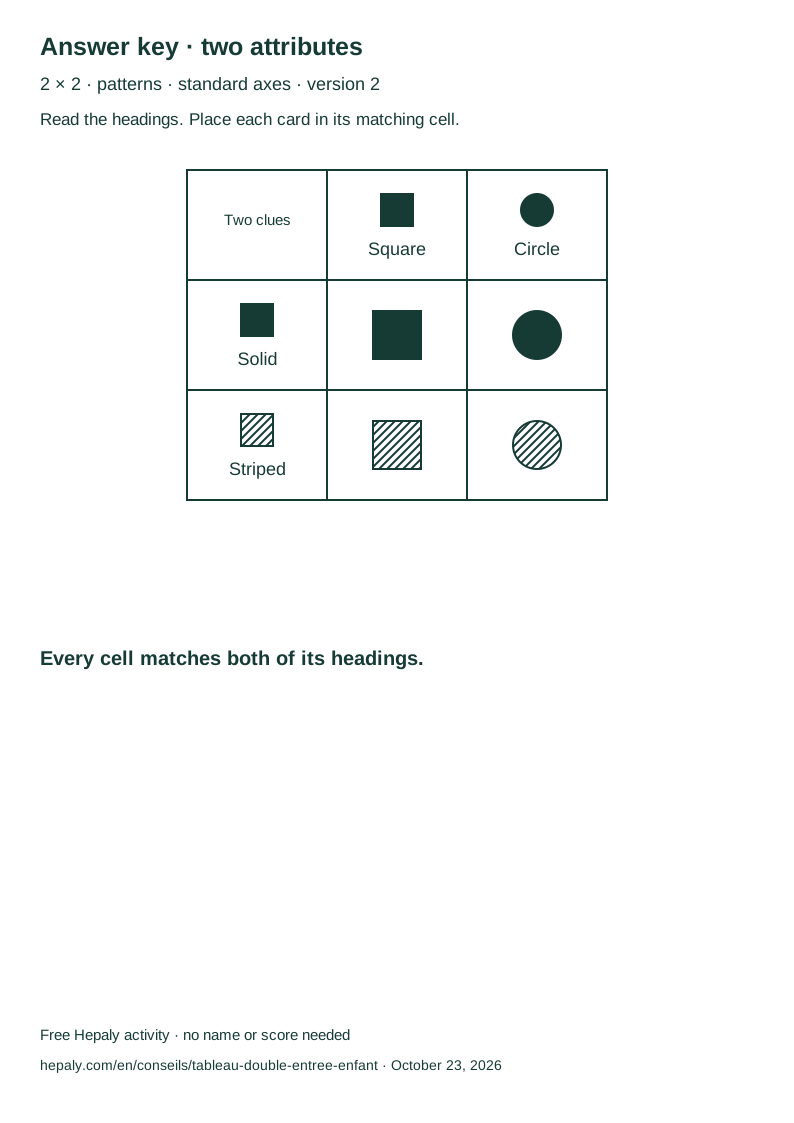
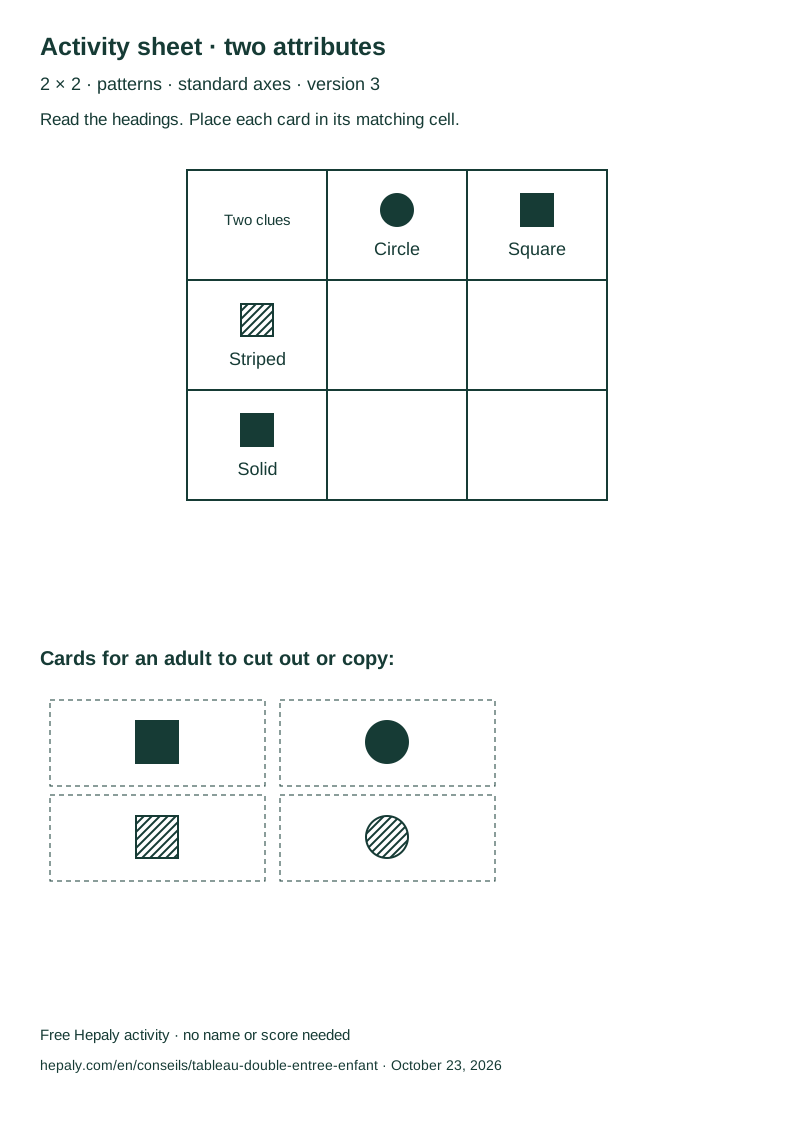
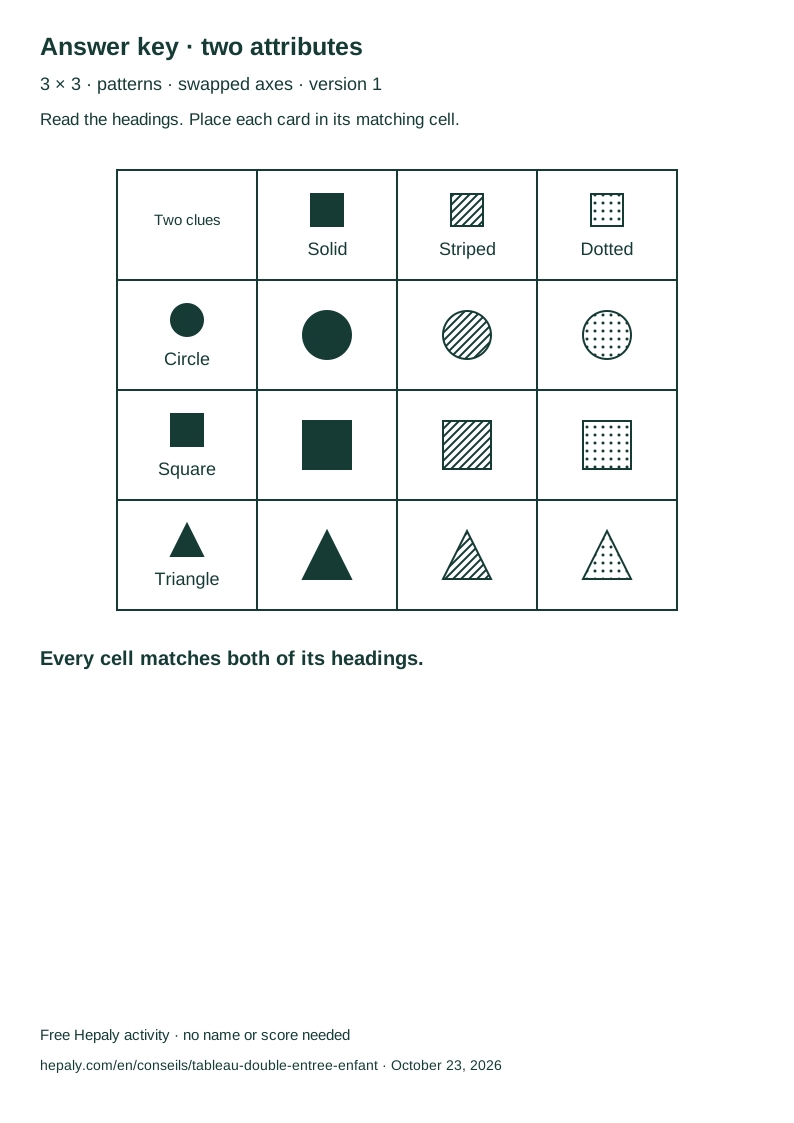
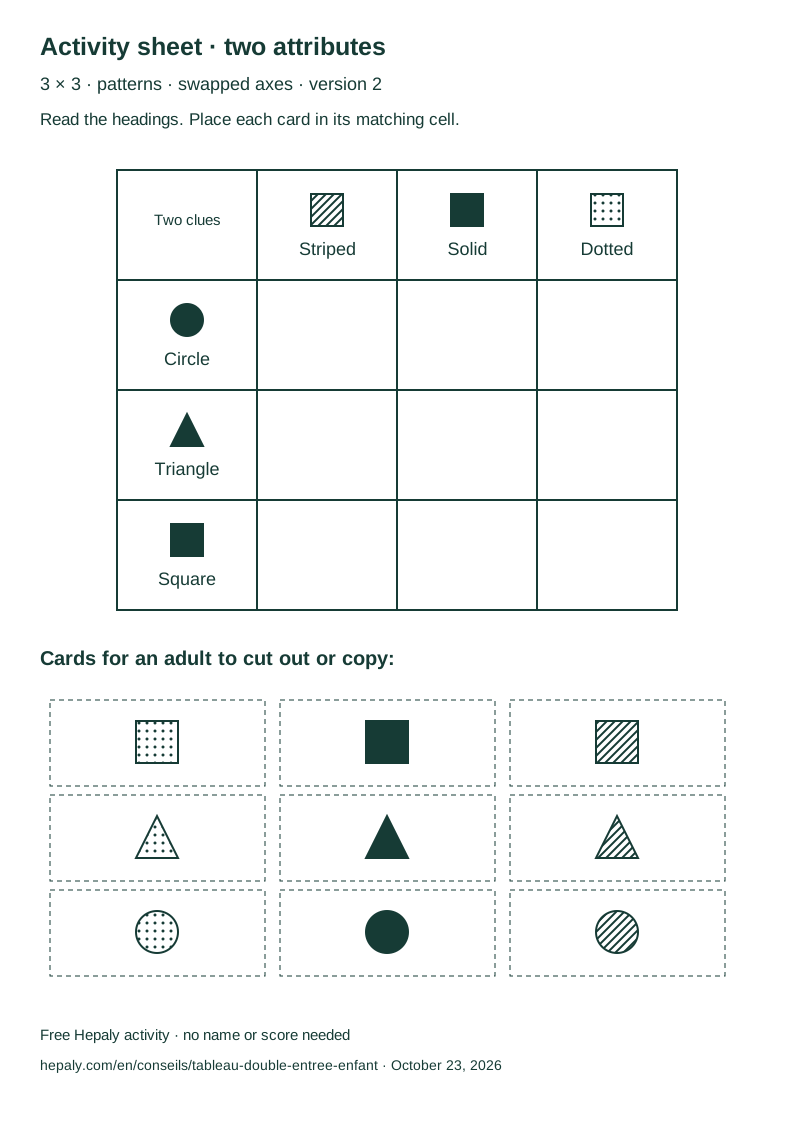
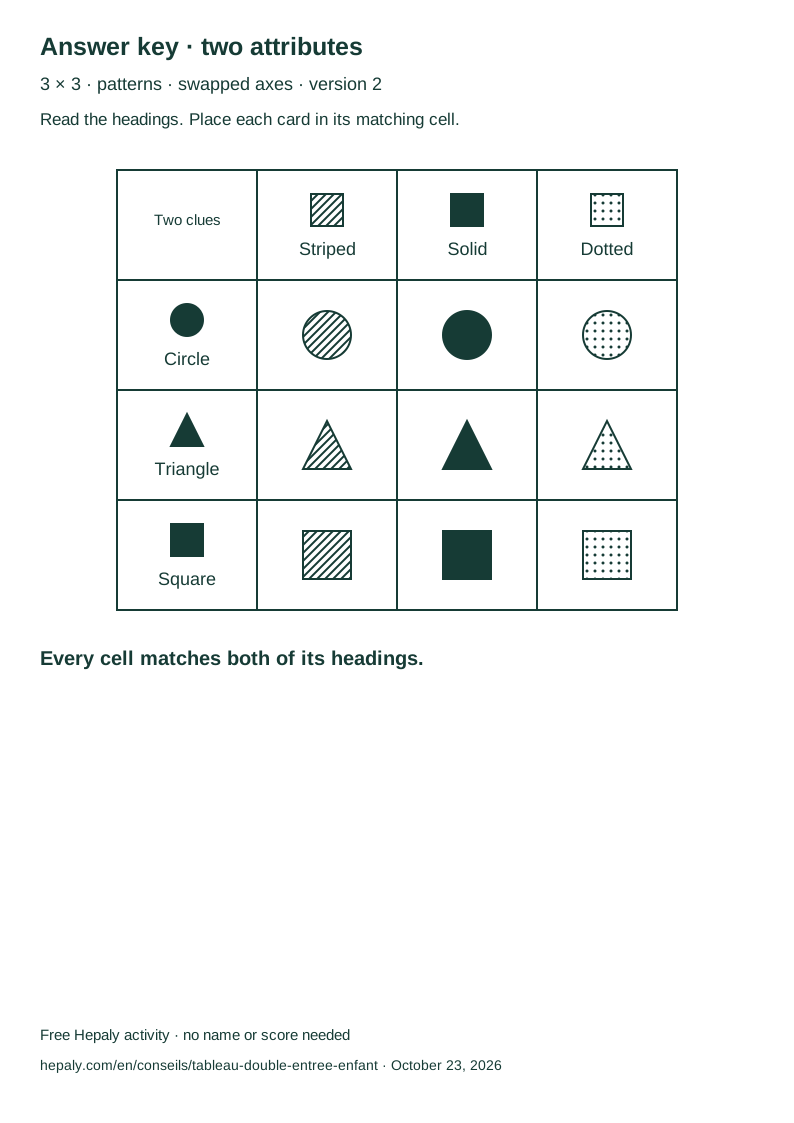
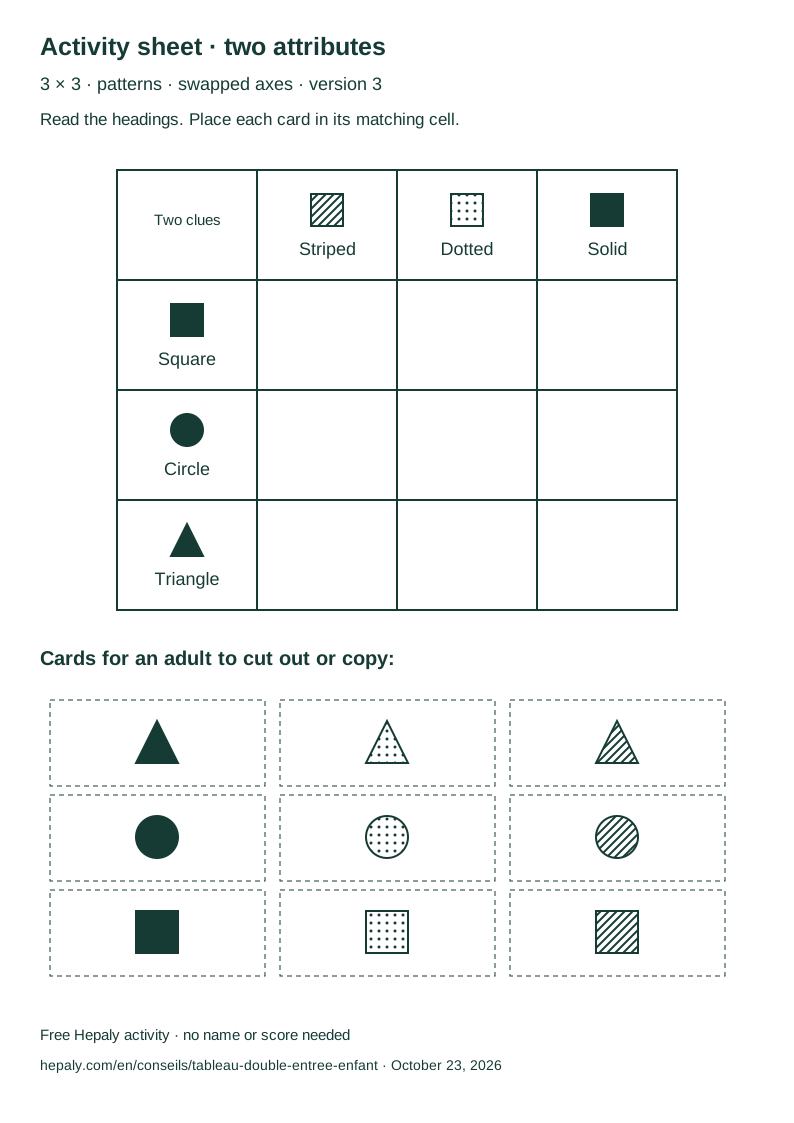
Choose the same settings for both the worksheet and its answer key: size, properties, axis directions, and version. Each link generates a standalone SVG file to open and print in your web browser. The answer key has a distinct title and is not included in the child's file.
The worksheet preview shows an empty grid and the cards to sort. You can cut them out to start, or ask your child to draw the shapes with a pencil if they feel confident with fine motor skills. The activity shouldn't turn into an unintended scissor workout; an adult can prepare the pieces before the session.
Hepaly Workshop · intersect and explain
Which worksheet would you like to prepare?
All files, with or without JavaScript
- 2 × 2, colors, standard axes, version 1: worksheet · answer key
- 2 × 2, colors, standard axes, version 2: worksheet · answer key
- 2 × 2, colors, standard axes, version 3: worksheet · answer key
- 2 × 2, colors, standard axes, version 4: worksheet · answer key
- 2 × 2, colors, inverted axes, version 1: worksheet · answer key
- 2 × 2, colors, inverted axes, version 2: worksheet · answer key
- 2 × 2, colors, inverted axes, version 3: worksheet · answer key
- 2 × 2, colors, inverted axes, version 4: worksheet · answer key
- 2 × 2, patterns, standard axes, version 1: worksheet · answer key
- 2 × 2, patterns, standard axes, version 2: worksheet · answer key
- 2 × 2, patterns, standard axes, version 3: worksheet · answer key
- 2 × 2, patterns, standard axes, version 4: worksheet · answer key
- 2 × 2, patterns, inverted axes, version 1: worksheet · answer key
- 2 × 2, patterns, inverted axes, version 2: worksheet · answer key
- 2 × 2, patterns, inverted axes, version 3: worksheet · answer key
- 2 × 2, patterns, inverted axes, version 4: worksheet · answer key
- 3 × 3, colors, standard axes, version 1: worksheet · answer key
- 3 × 3, colors, standard axes, version 2: worksheet · answer key
- 3 × 3, colors, standard axes, version 3: worksheet · answer key
- 3 × 3, colors, standard axes, version 4: worksheet · answer key
- 3 × 3, colors, inverted axes, version 1: worksheet · answer key
- 3 × 3, colors, inverted axes, version 2: worksheet · answer key
- 3 × 3, colors, inverted axes, version 3: worksheet · answer key
- 3 × 3, colors, inverted axes, version 4: worksheet · answer key
- 3 × 3, patterns, standard axes, version 1: worksheet · answer key
- 3 × 3, patterns, standard axes, version 2: worksheet · answer key
- 3 × 3, patterns, standard axes, version 3: worksheet · answer key
- 3 × 3, patterns, standard axes, version 4: worksheet · answer key
- 3 × 3, patterns, inverted axes, version 1: worksheet · answer key
- 3 × 3, patterns, inverted axes, version 2: worksheet · answer key
- 3 × 3, patterns, inverted axes, version 3: worksheet · answer key
- 3 × 3, patterns, inverted axes, version 4: worksheet · answer key
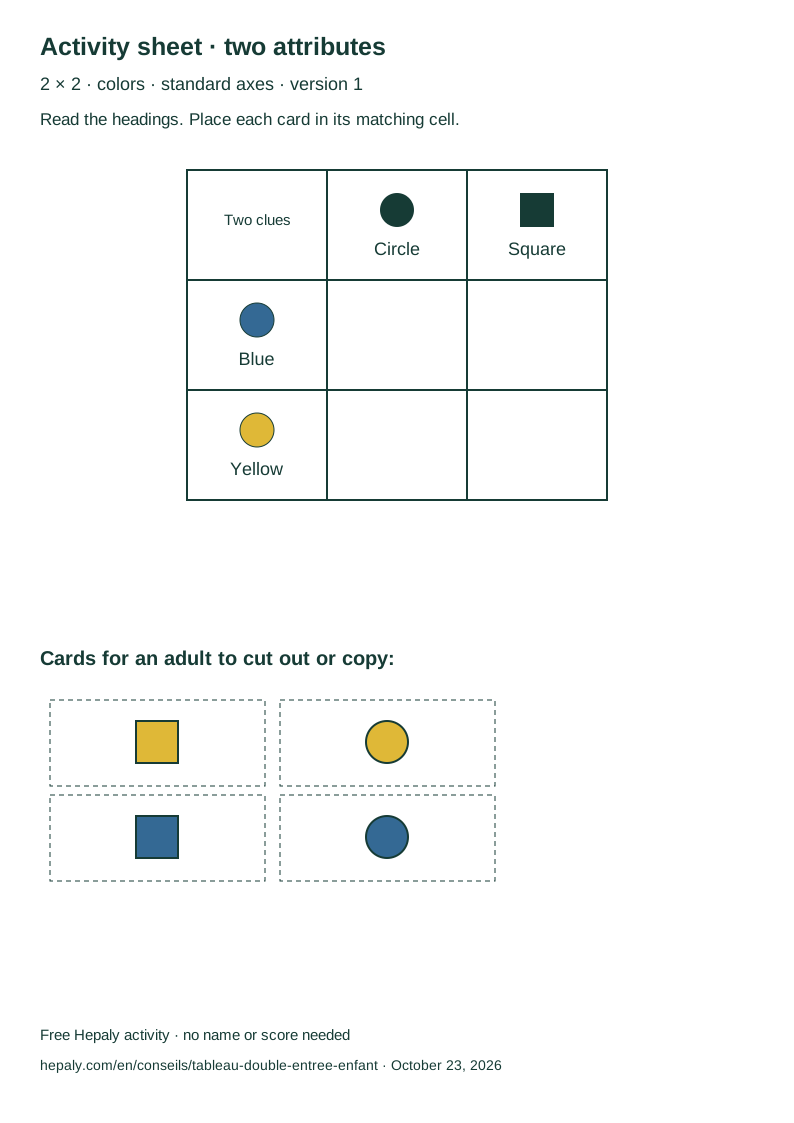
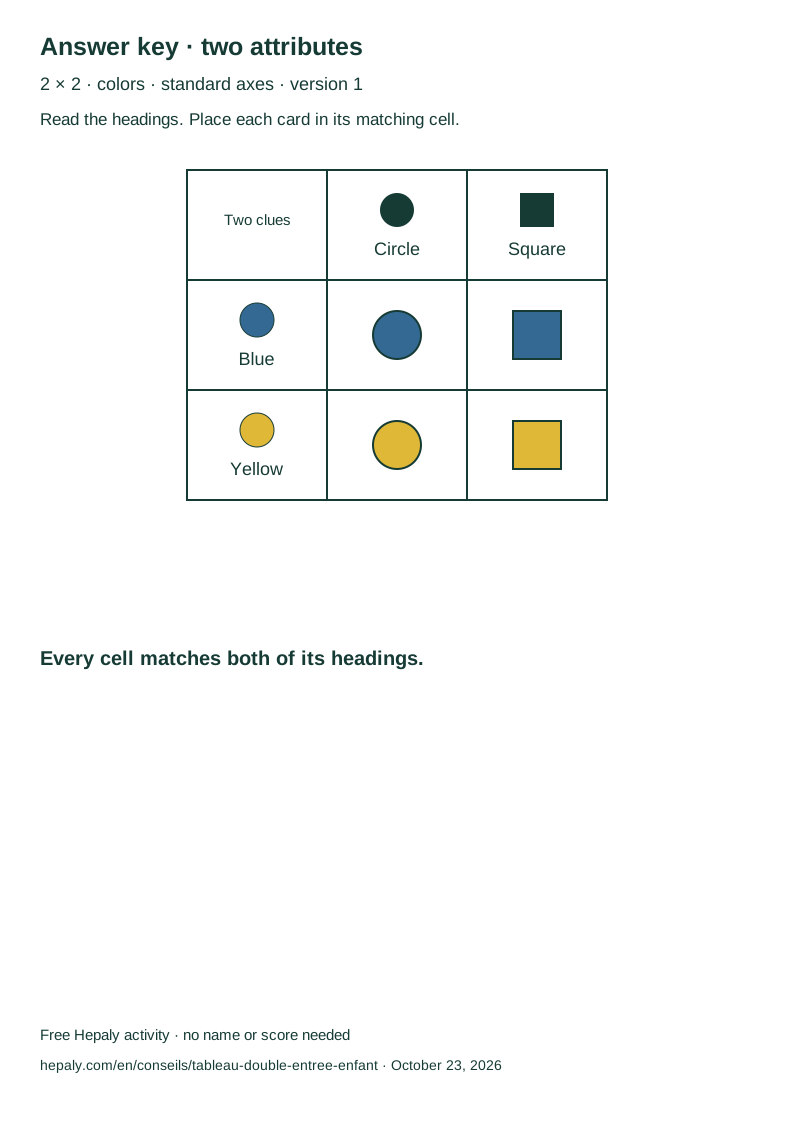
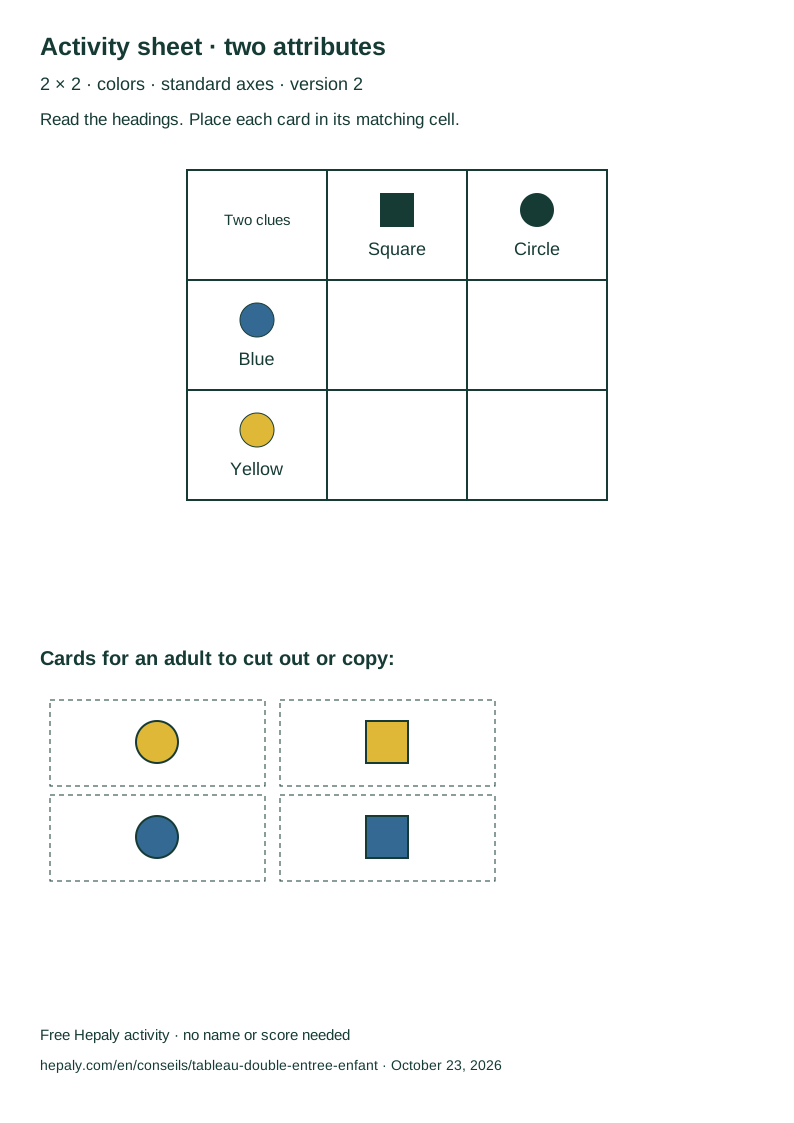
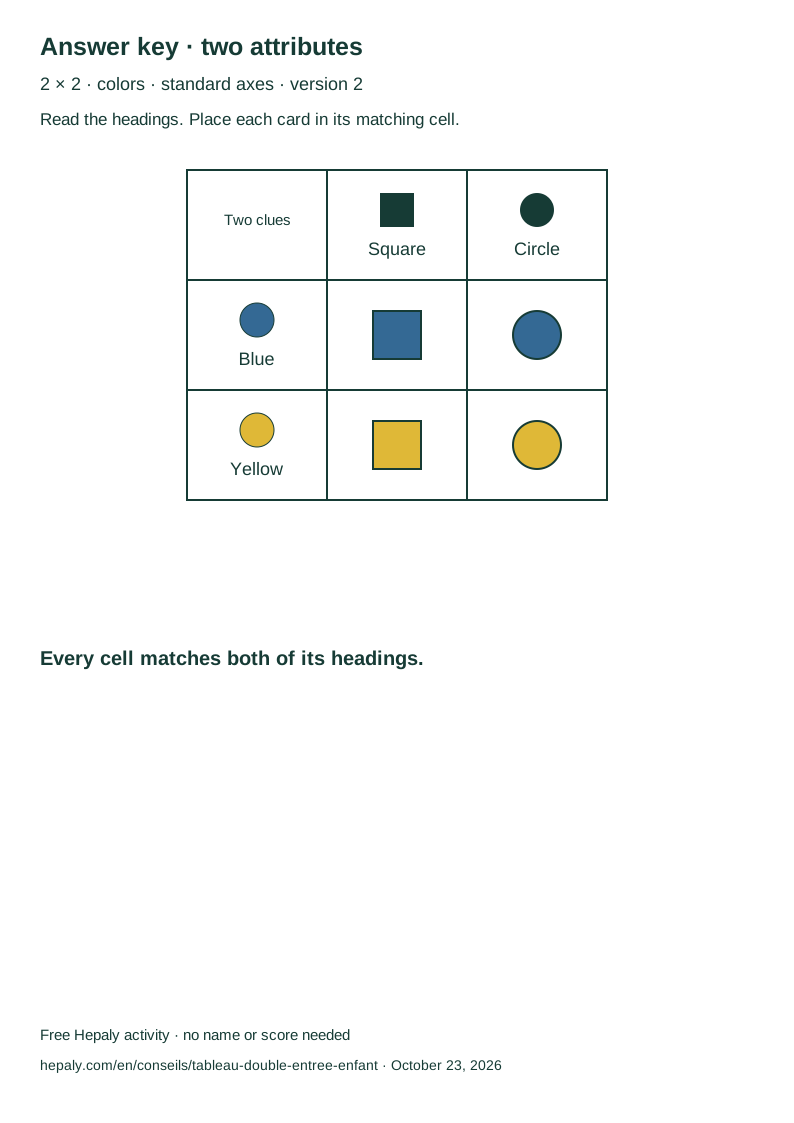
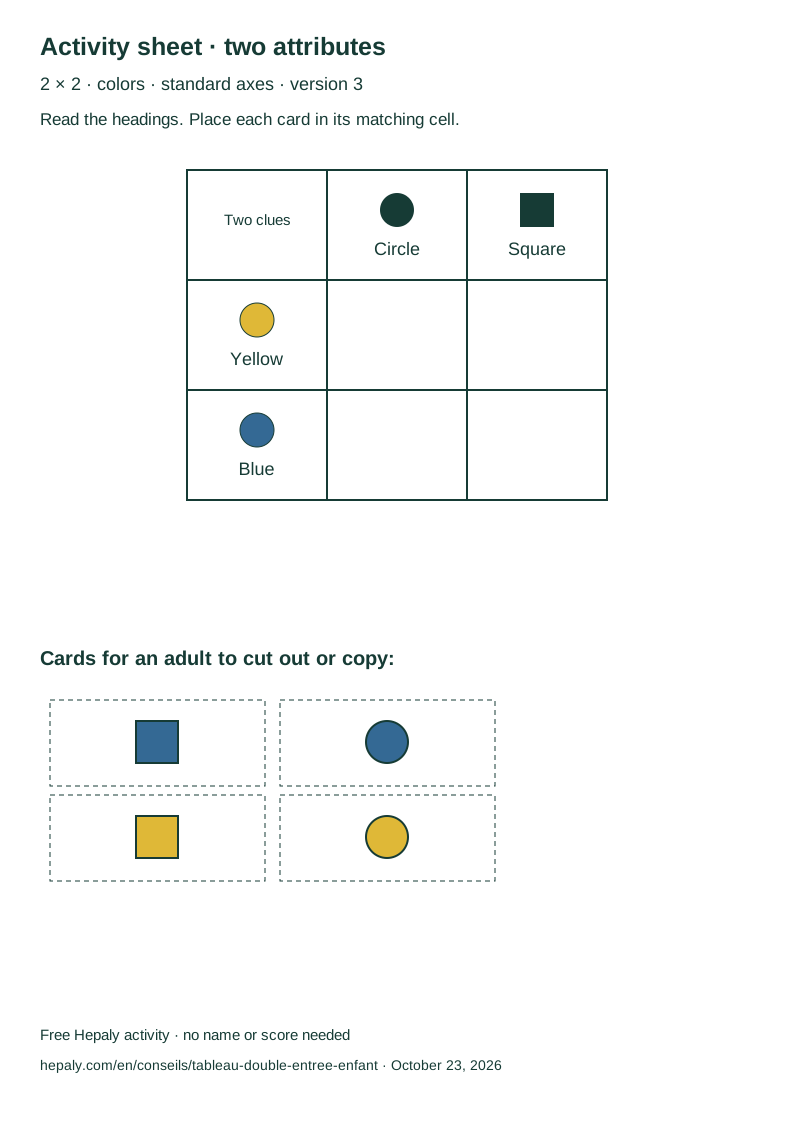
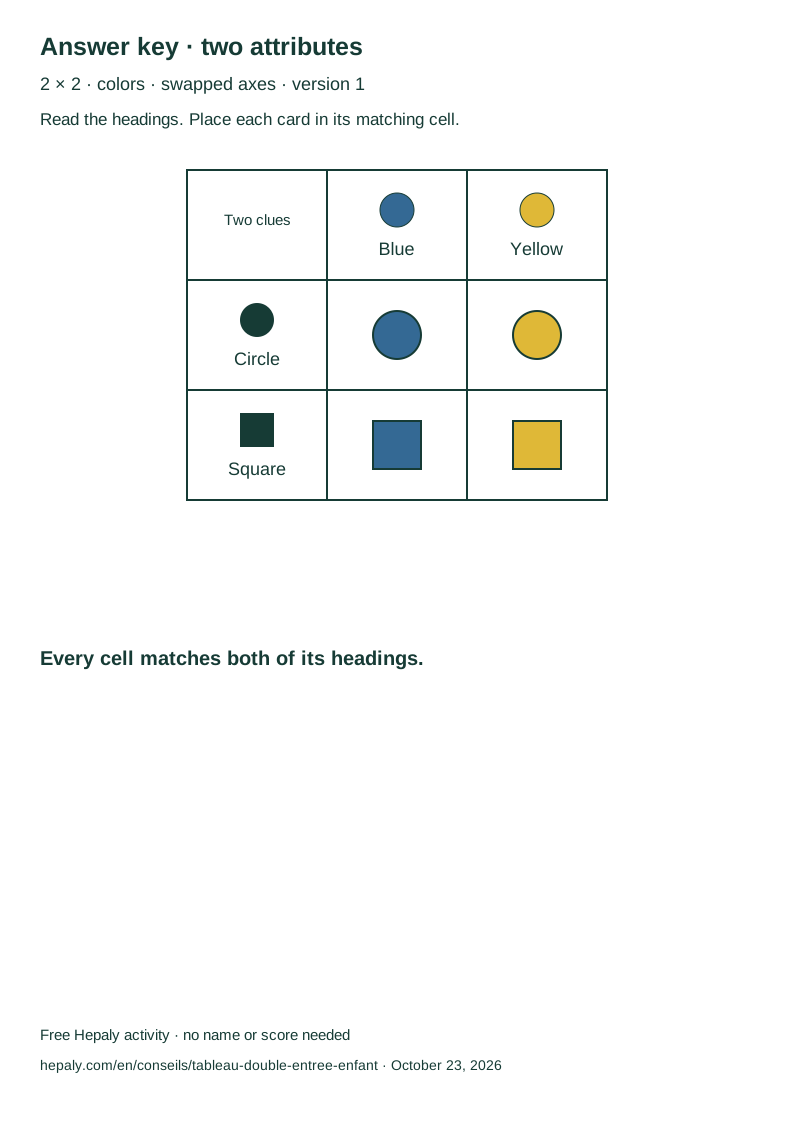
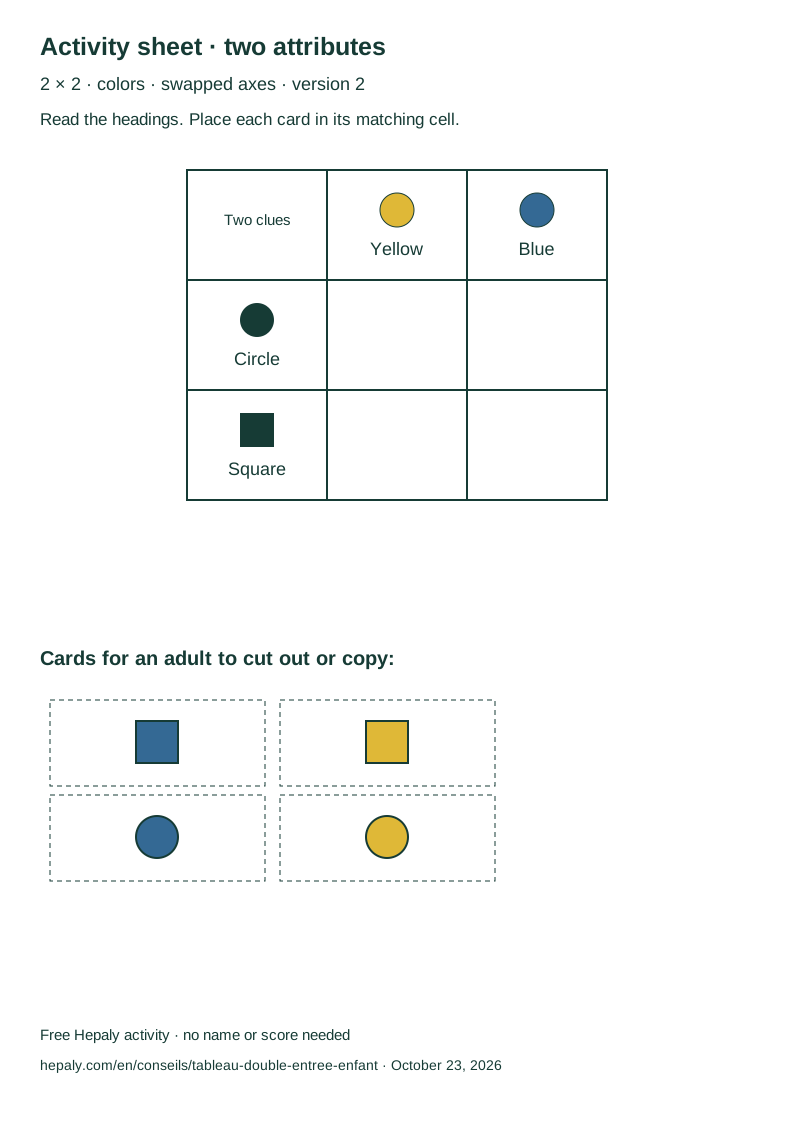
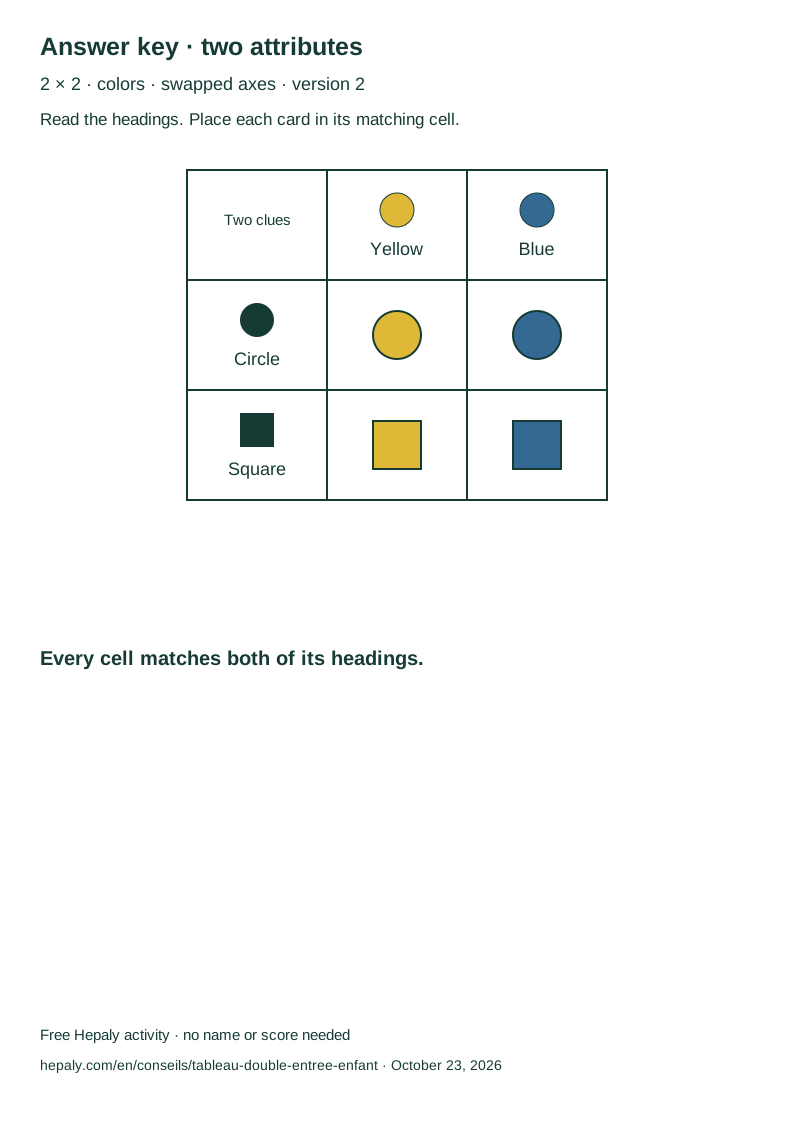
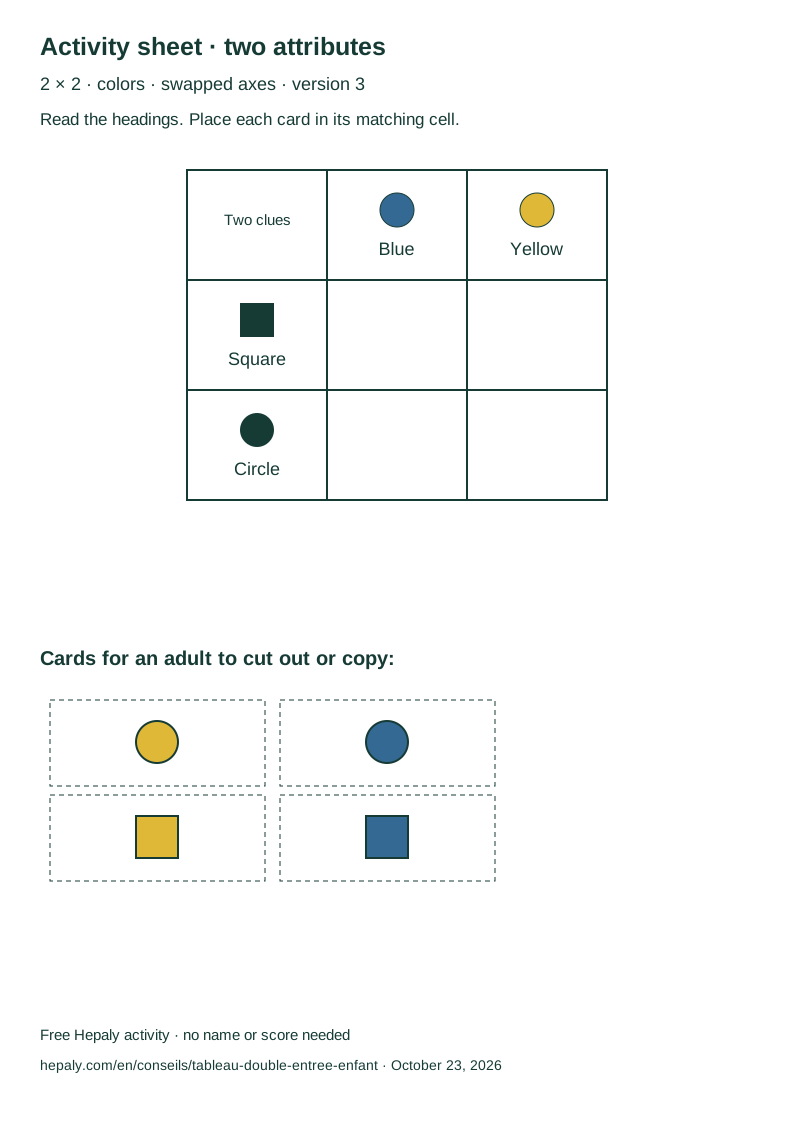
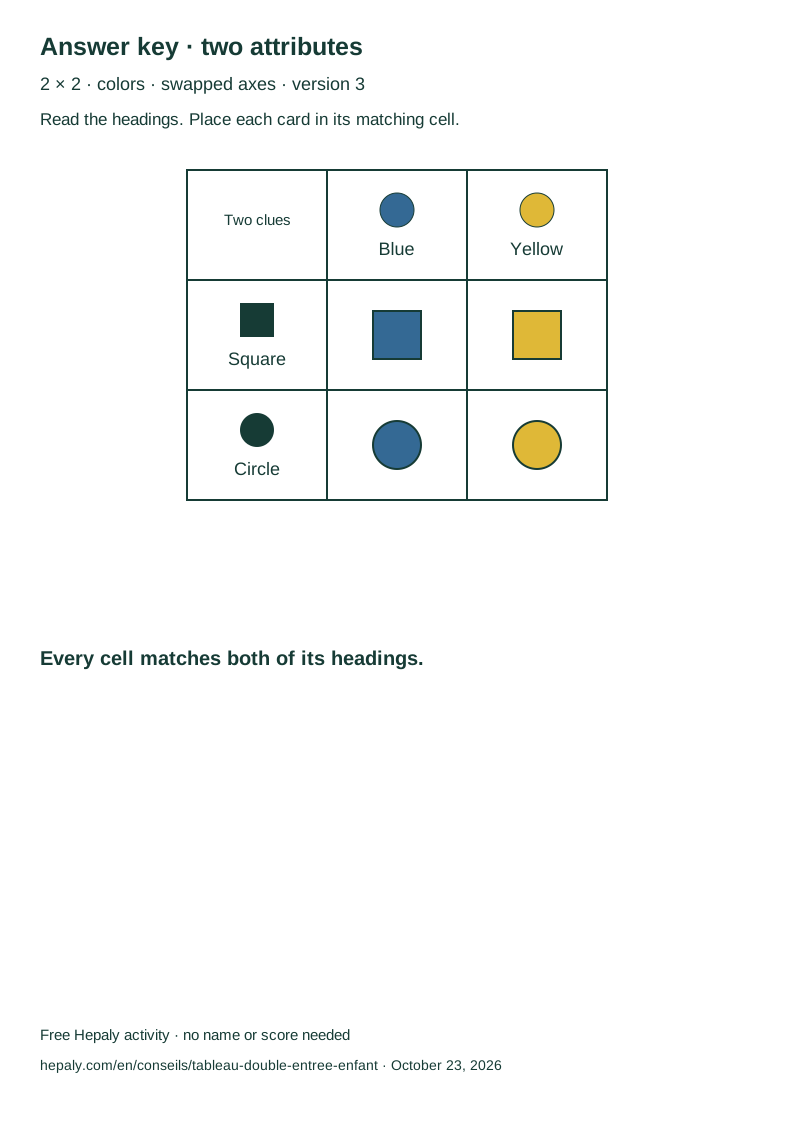
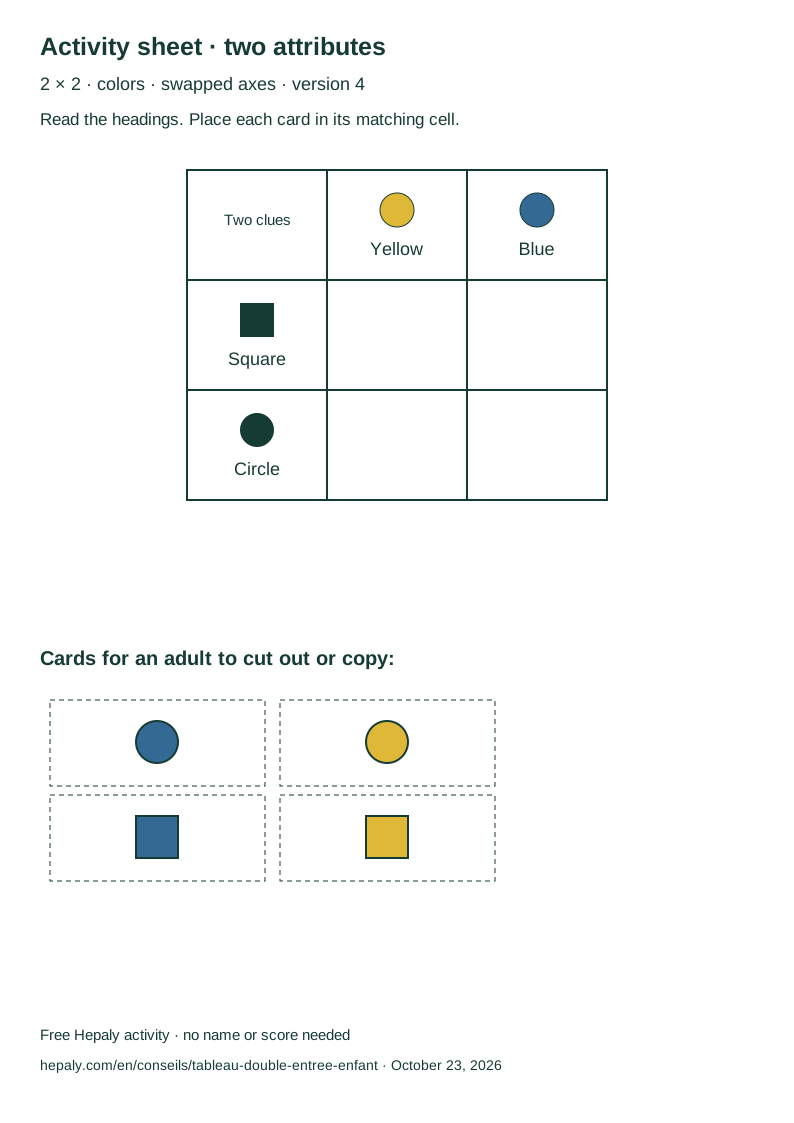
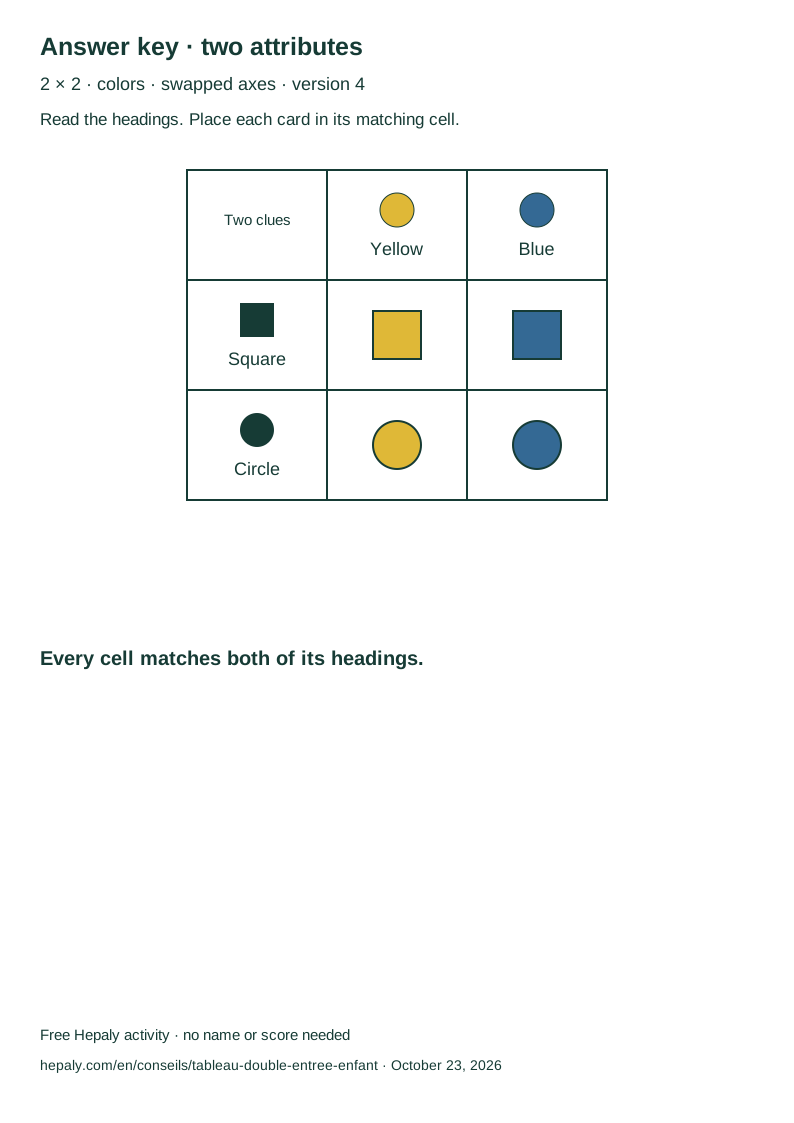
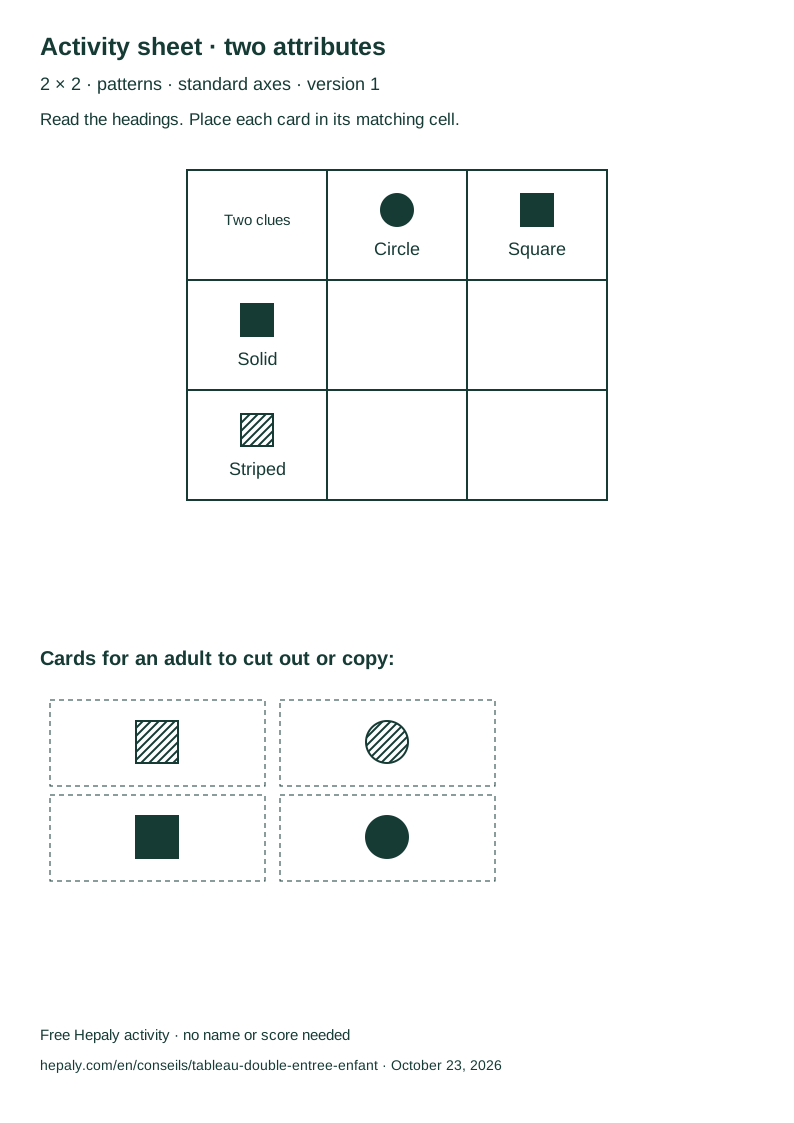
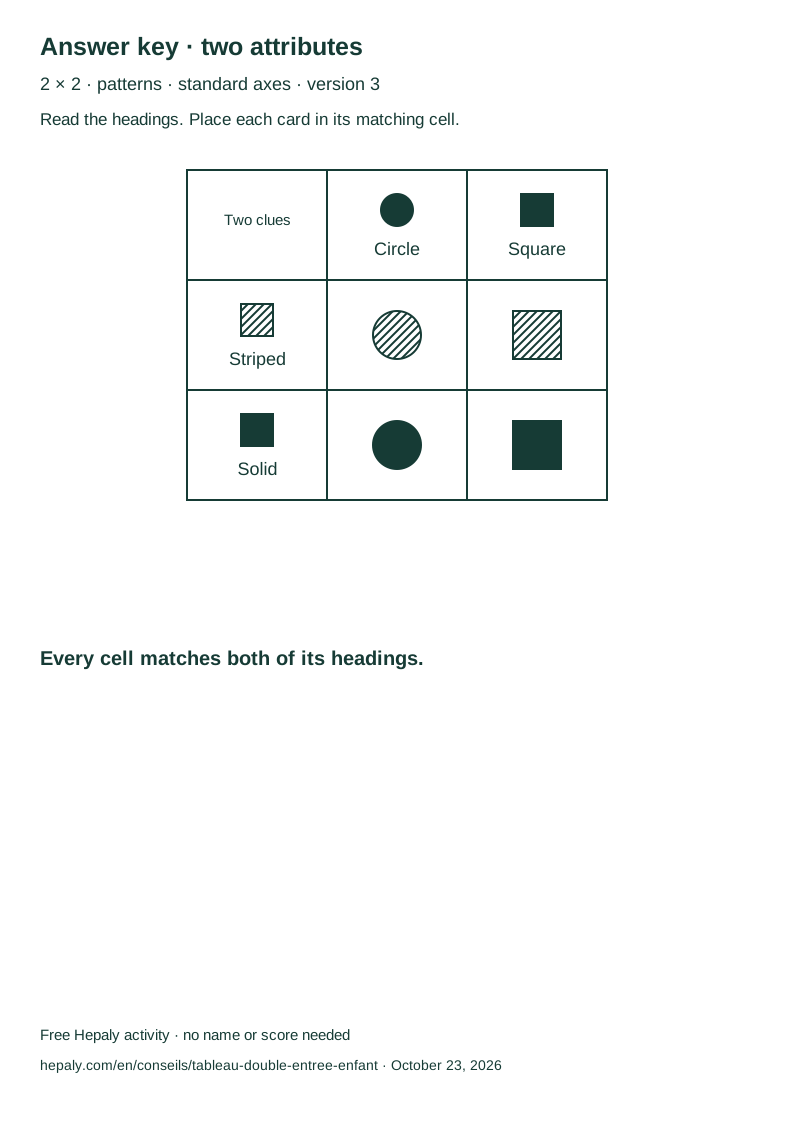
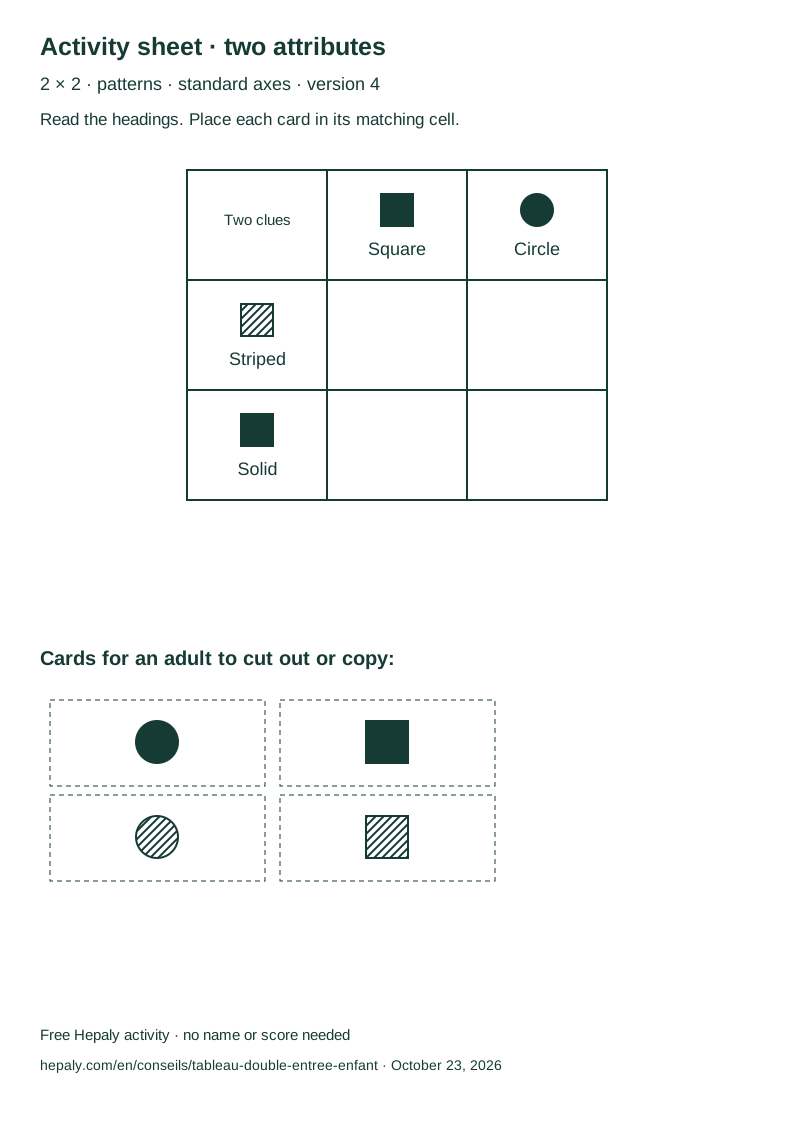
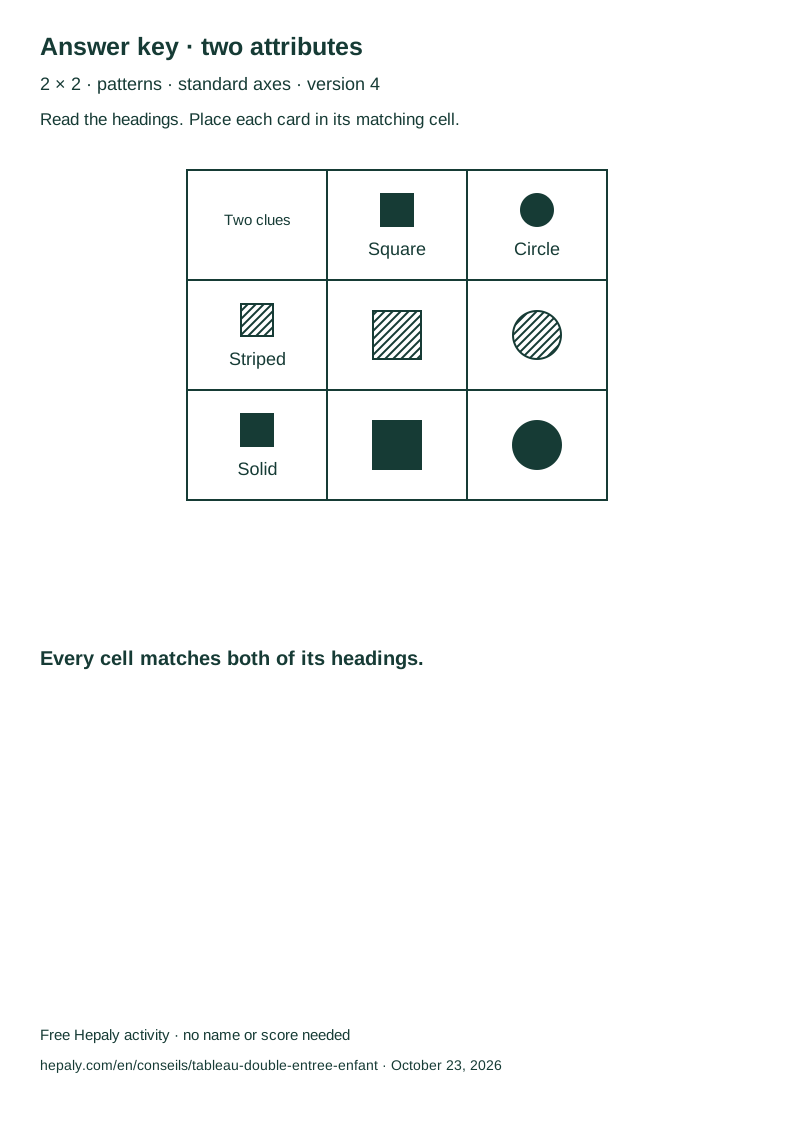
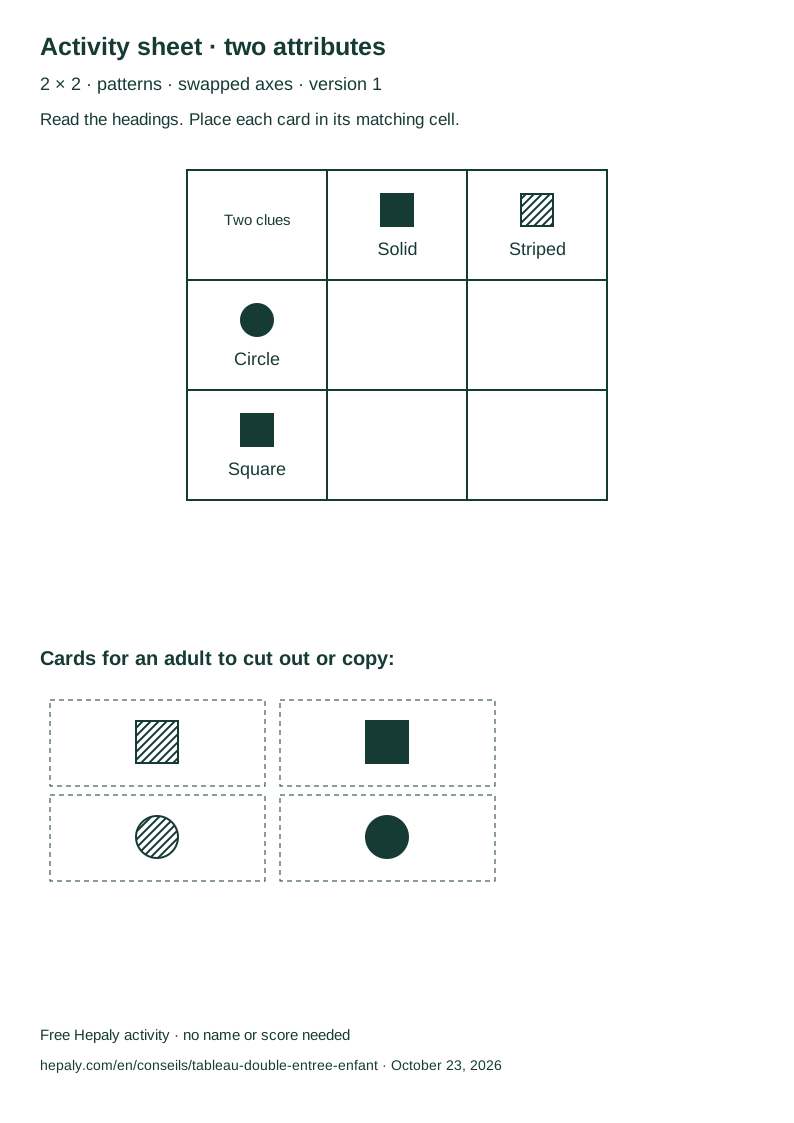
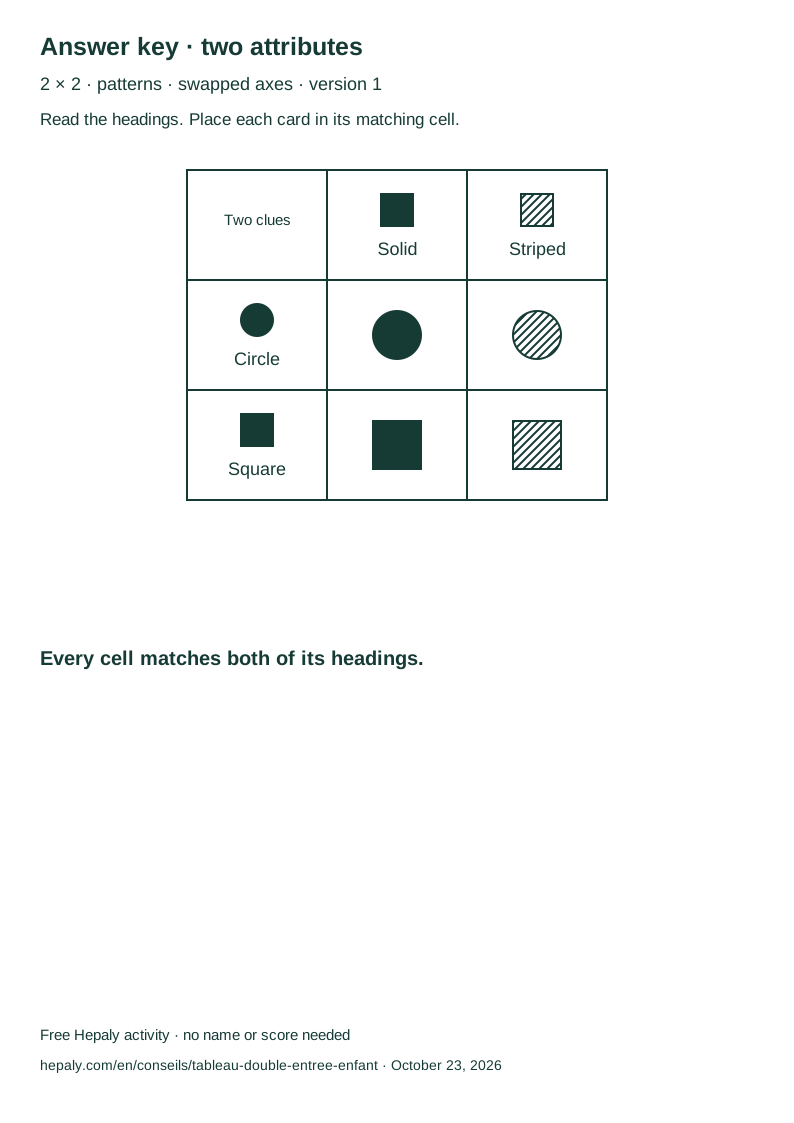
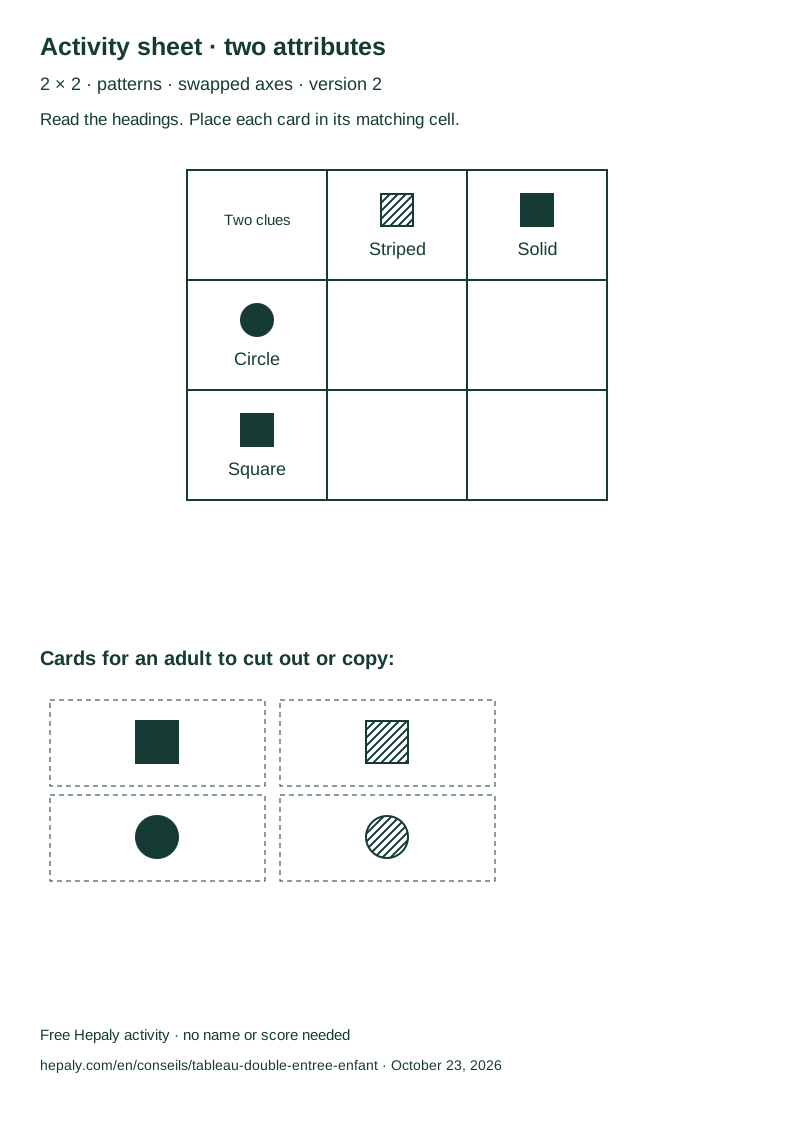
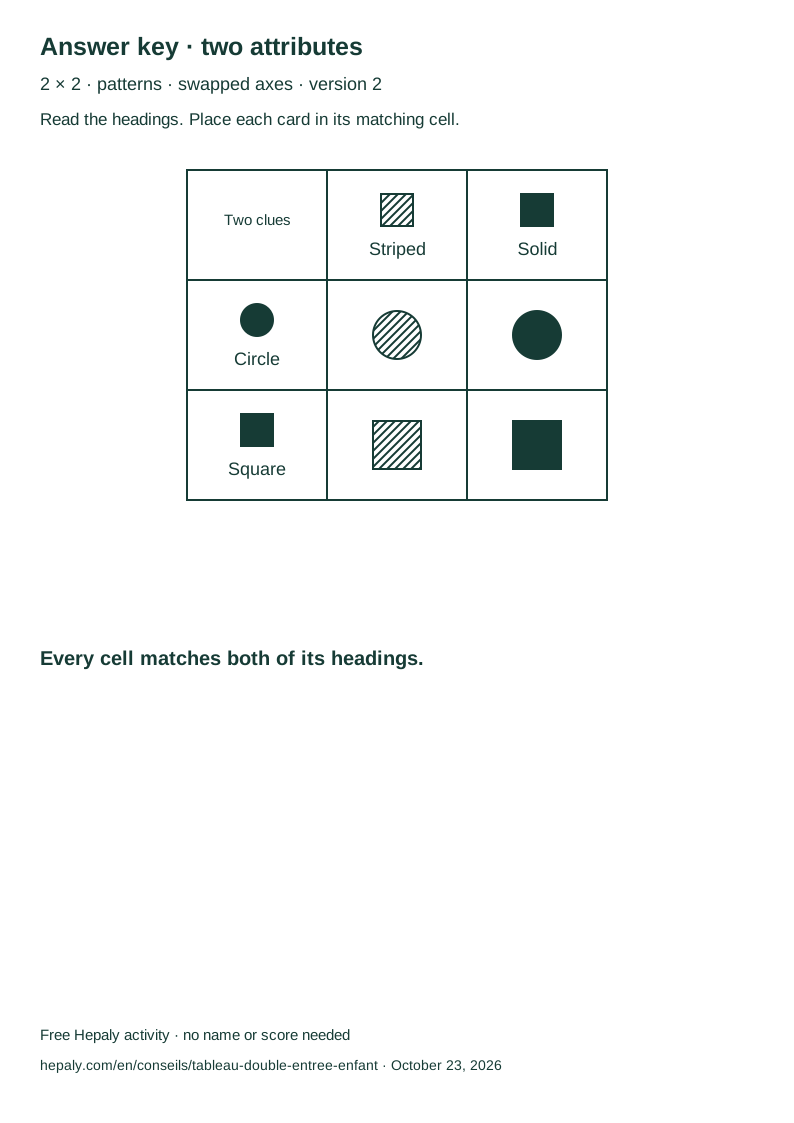
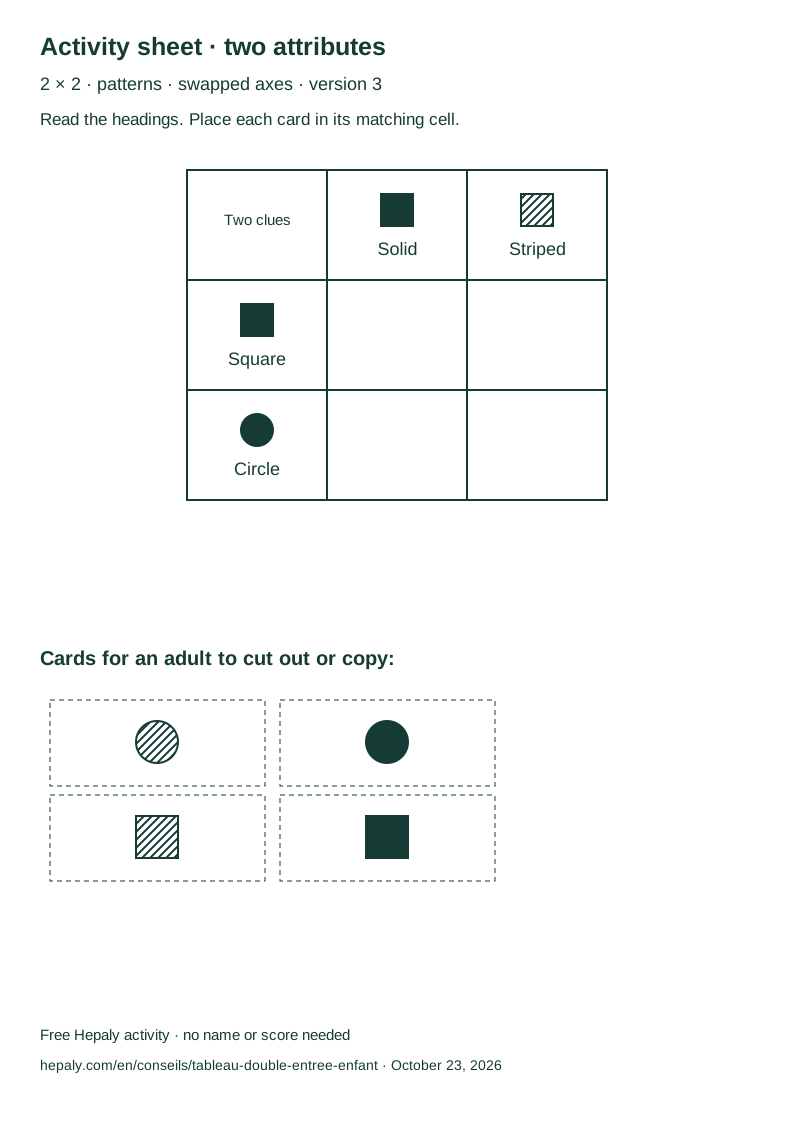
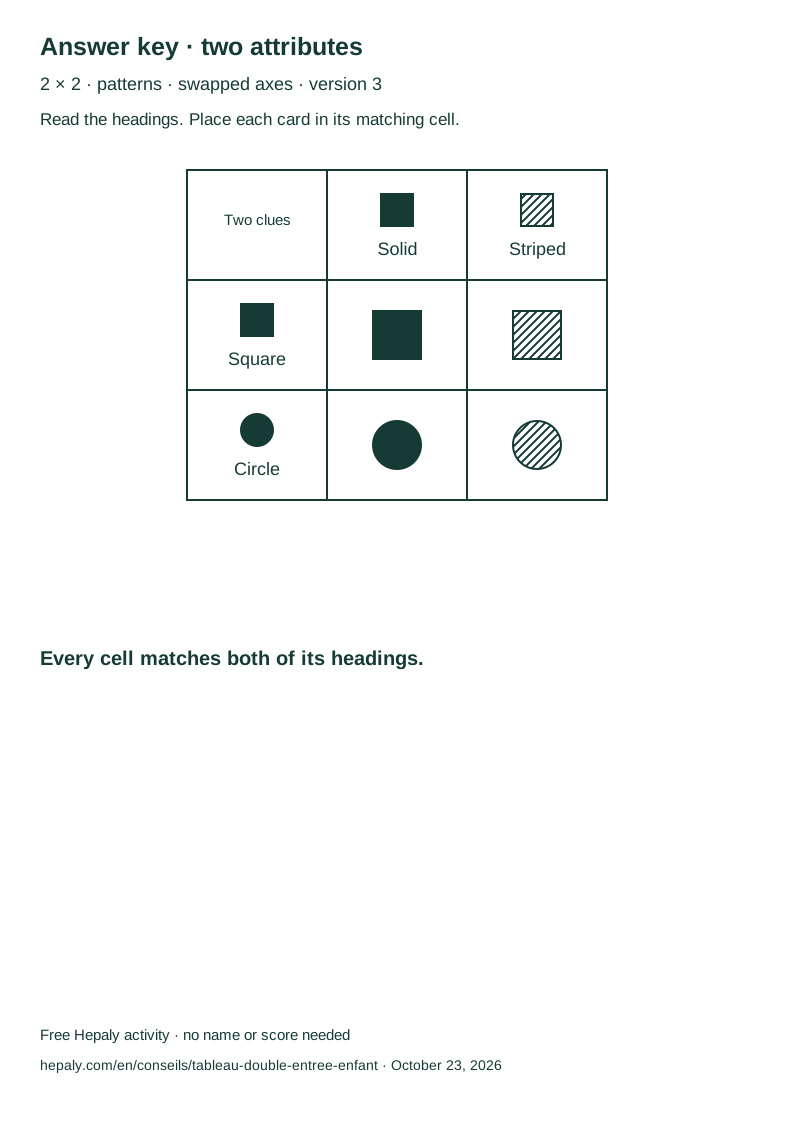
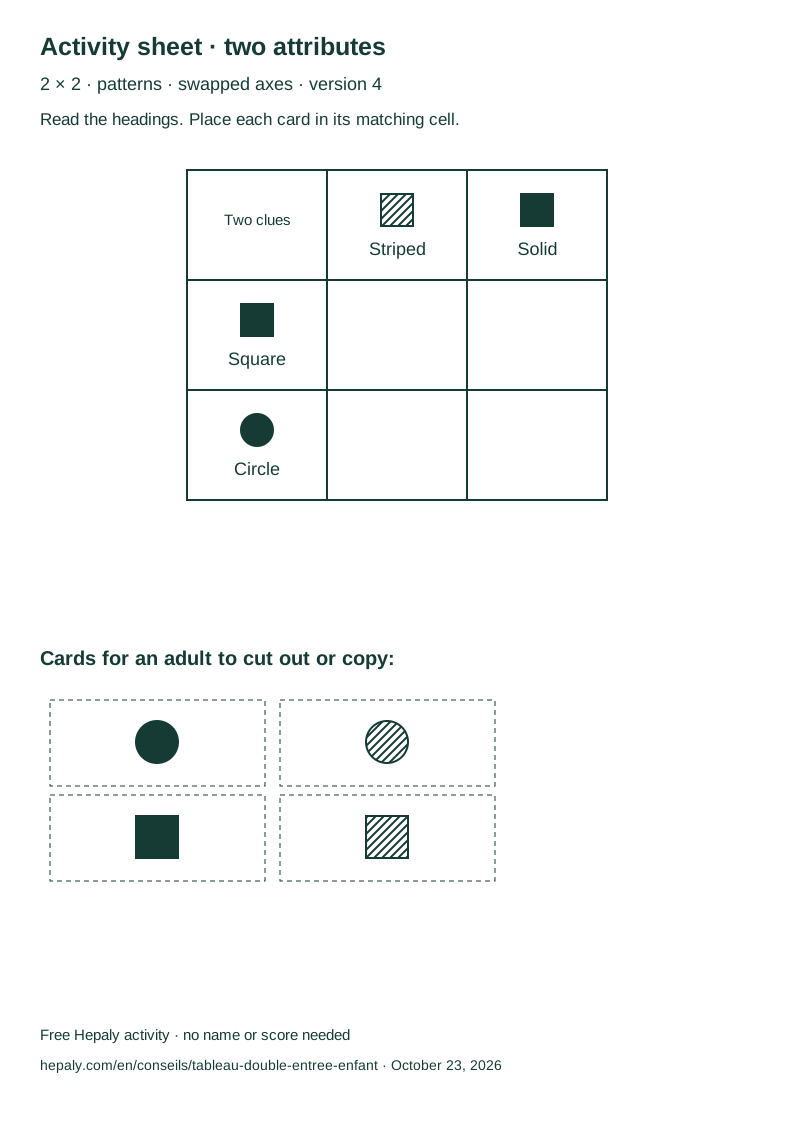
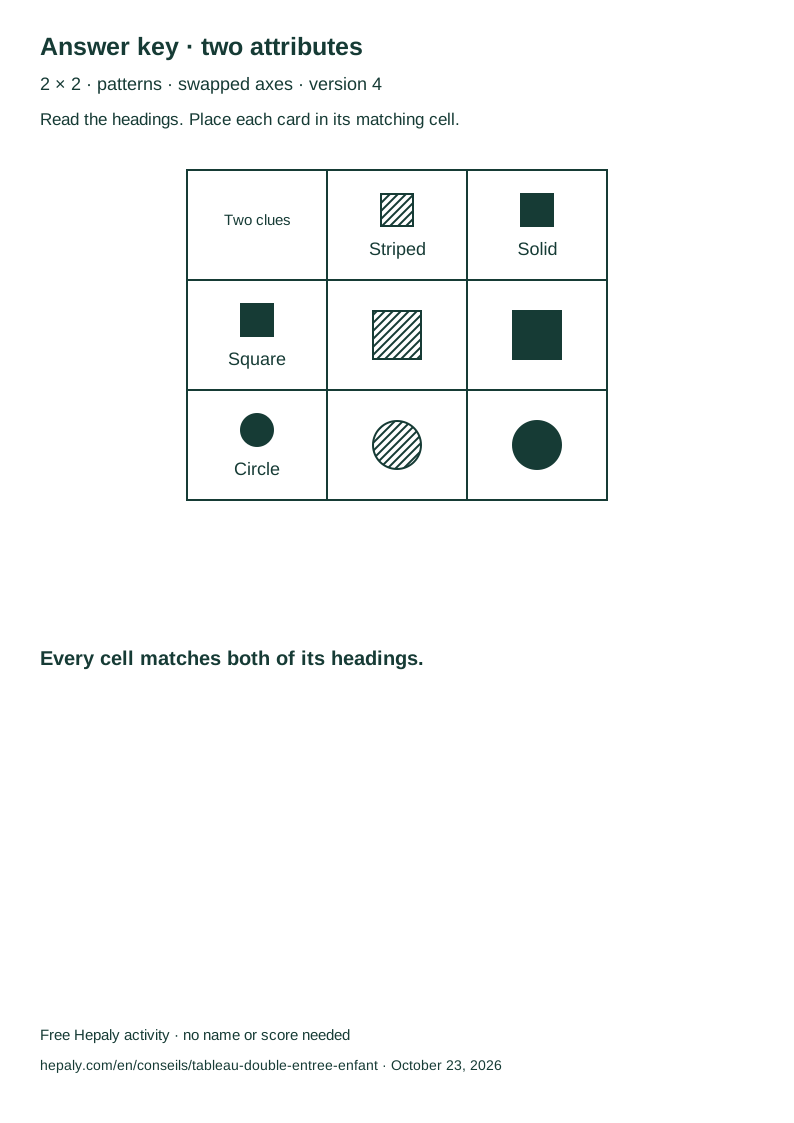
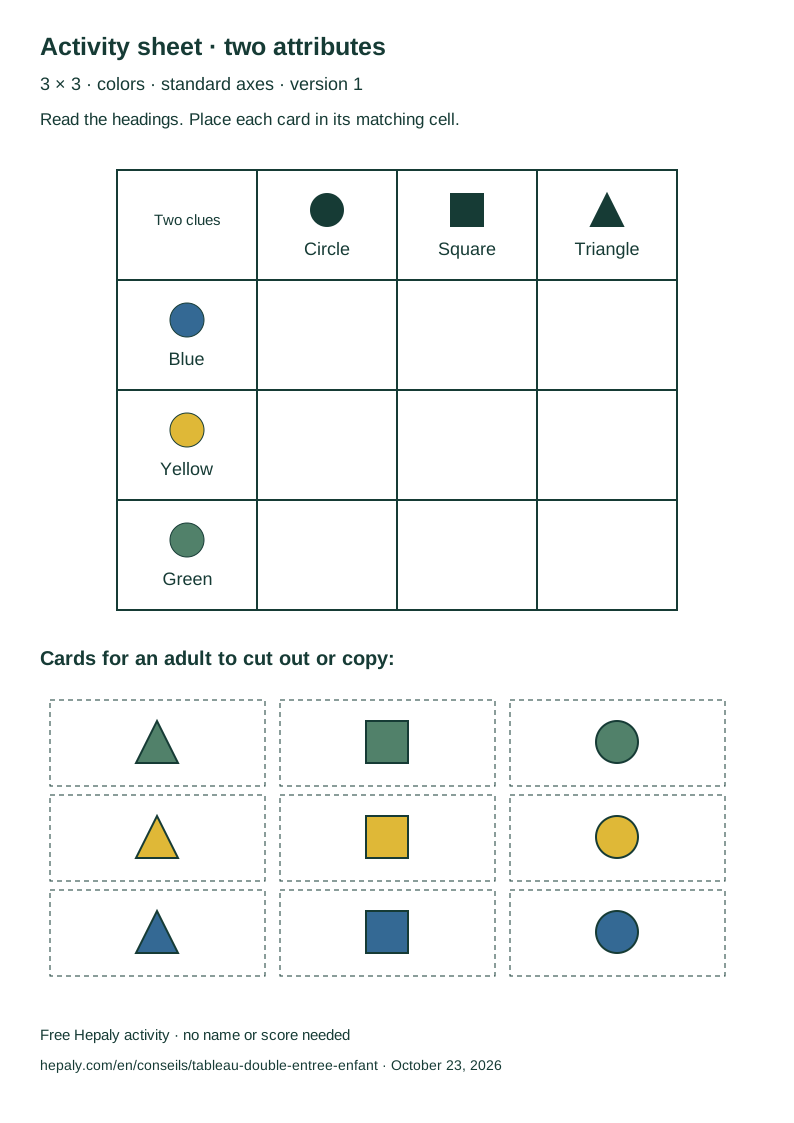
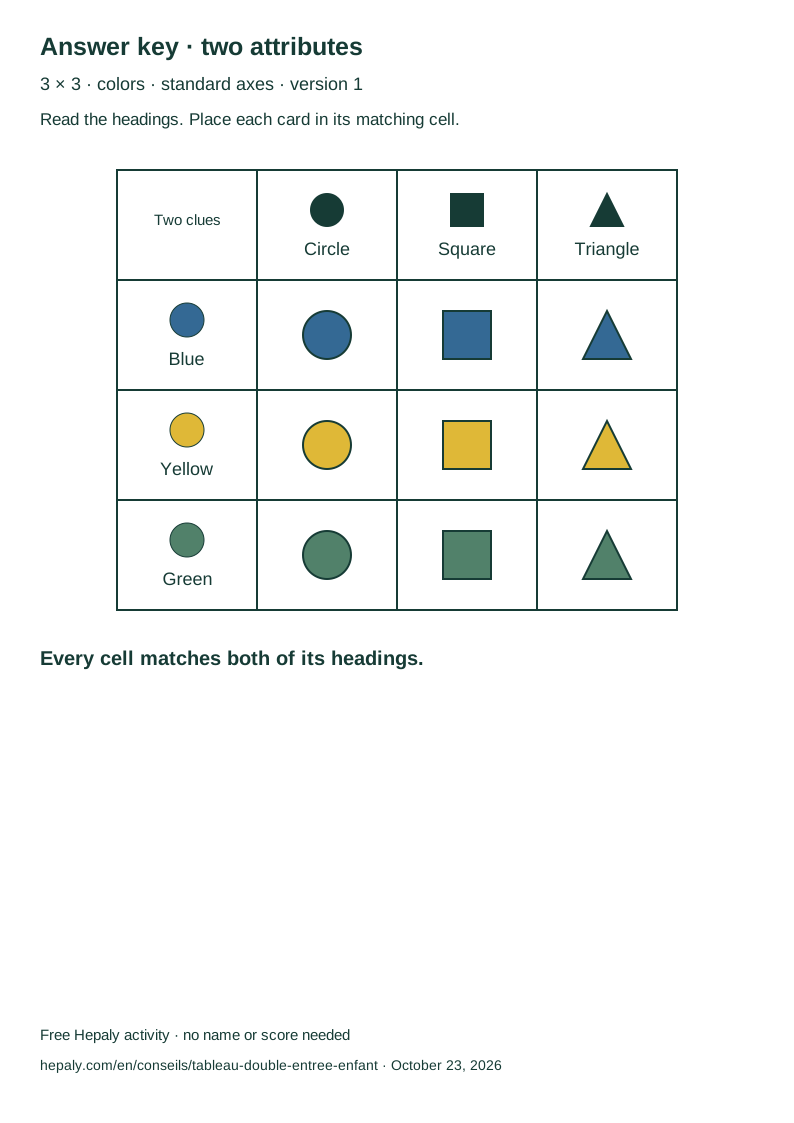
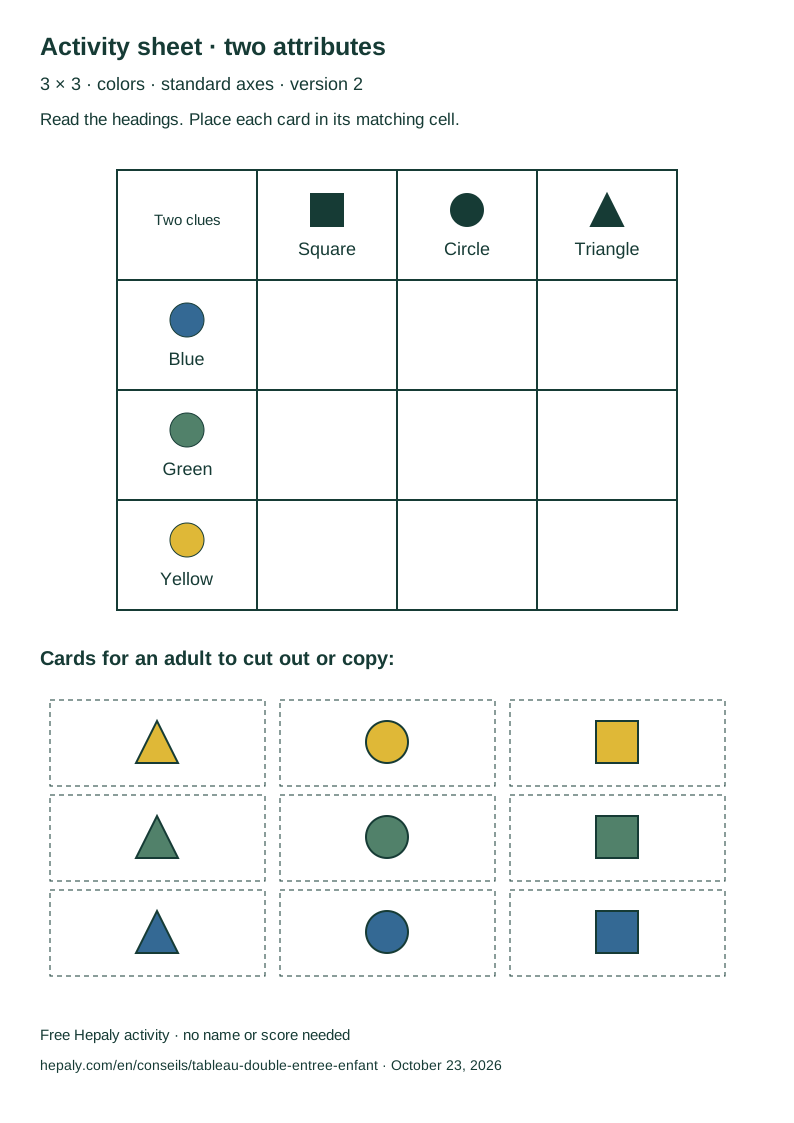
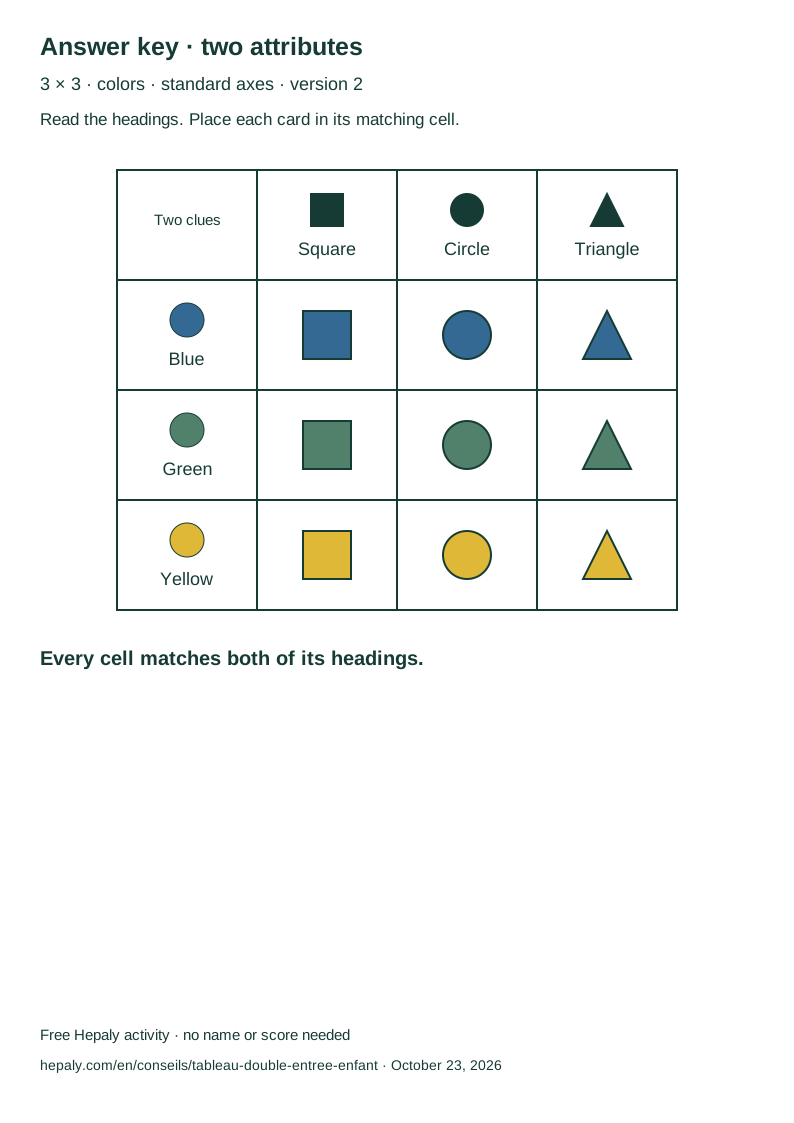
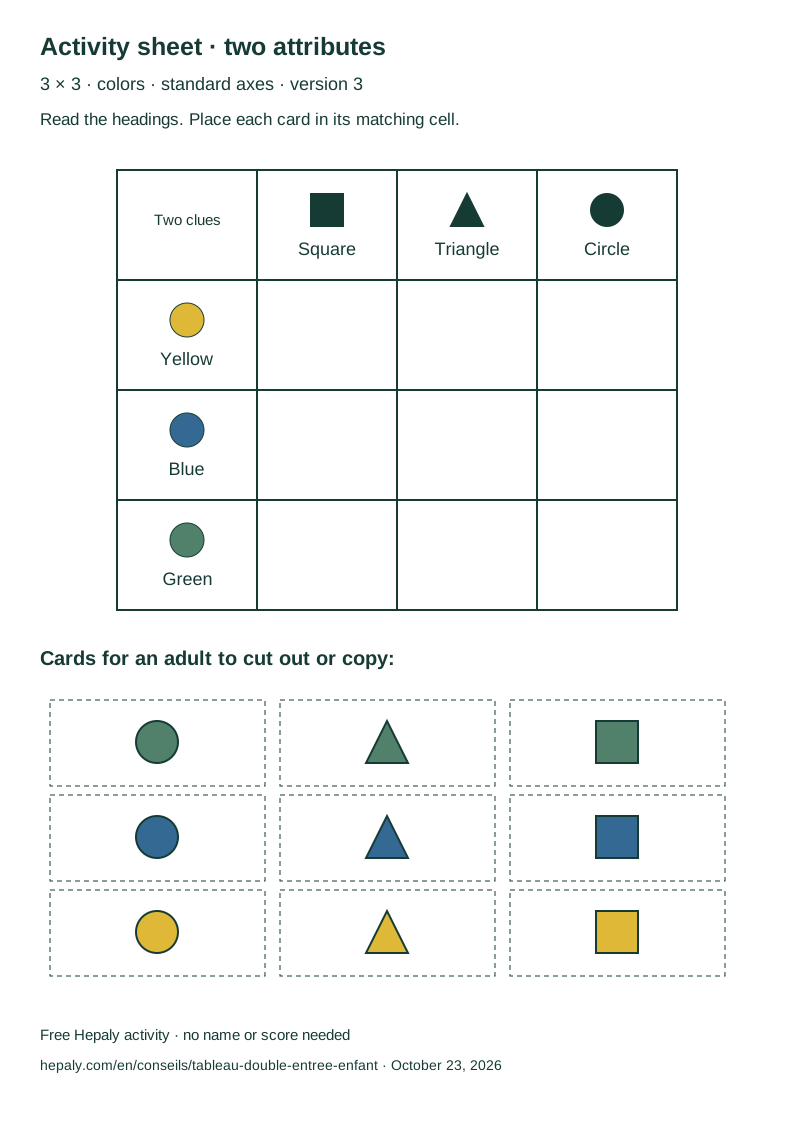
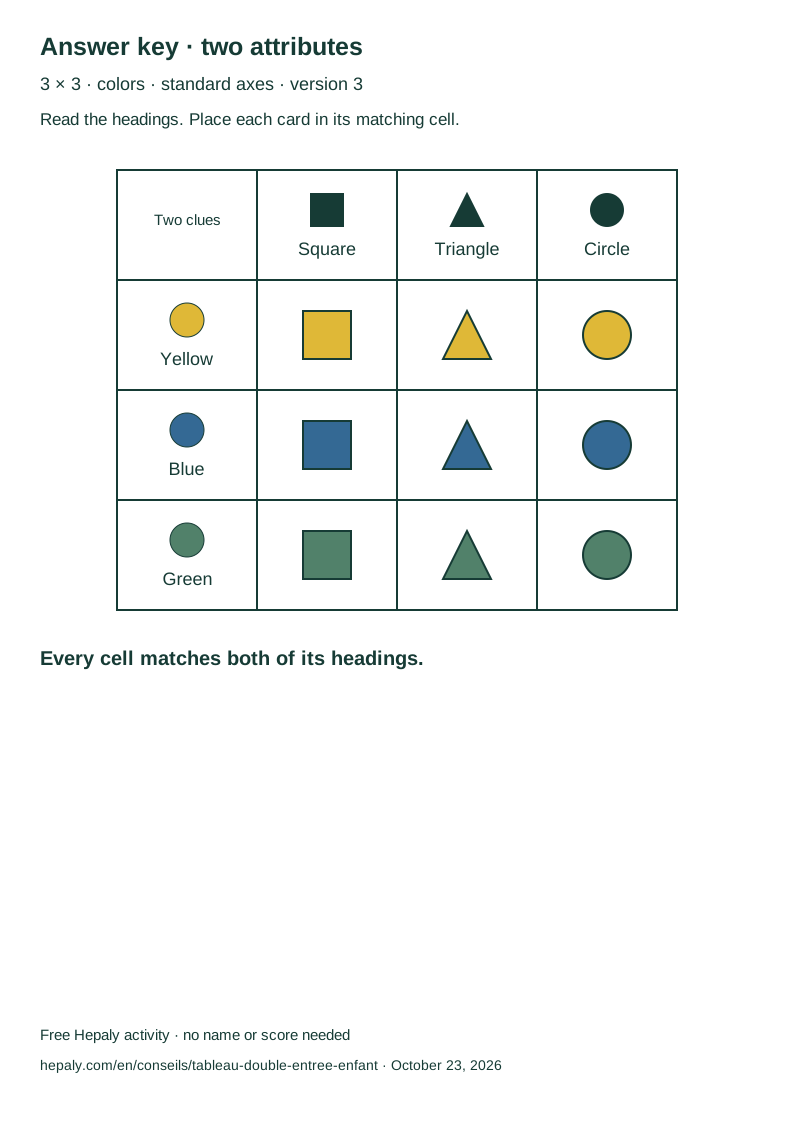
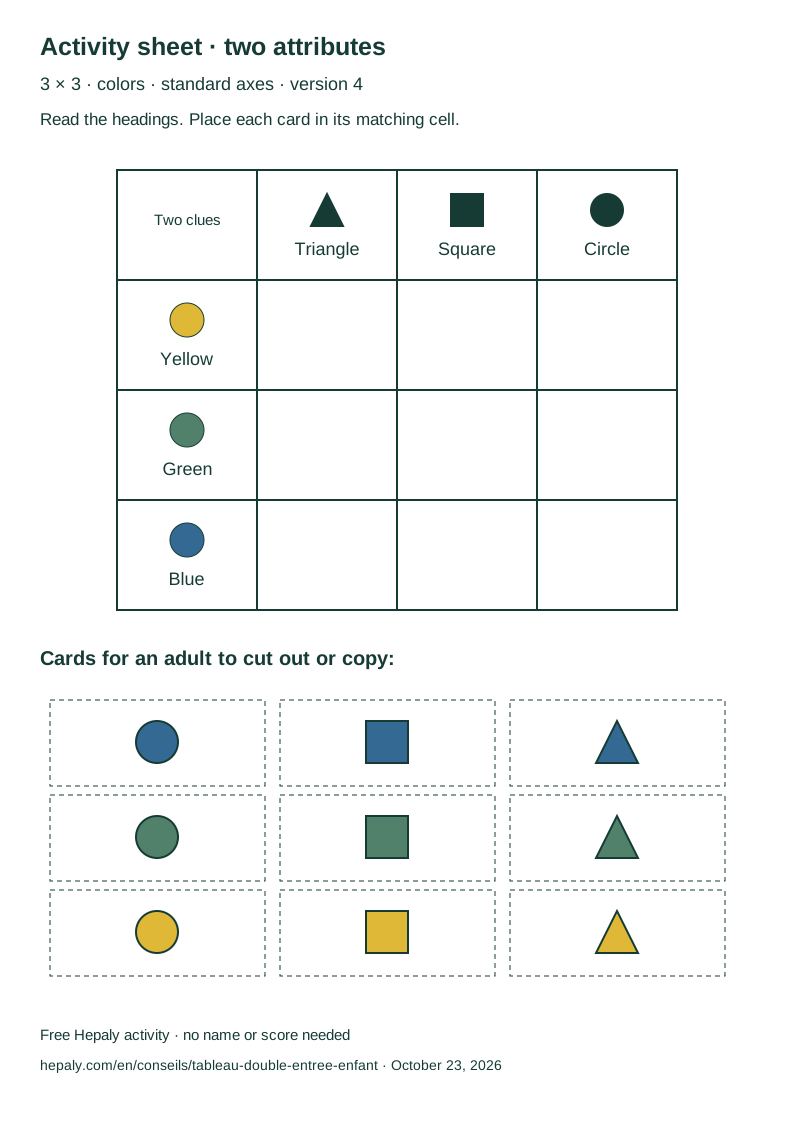
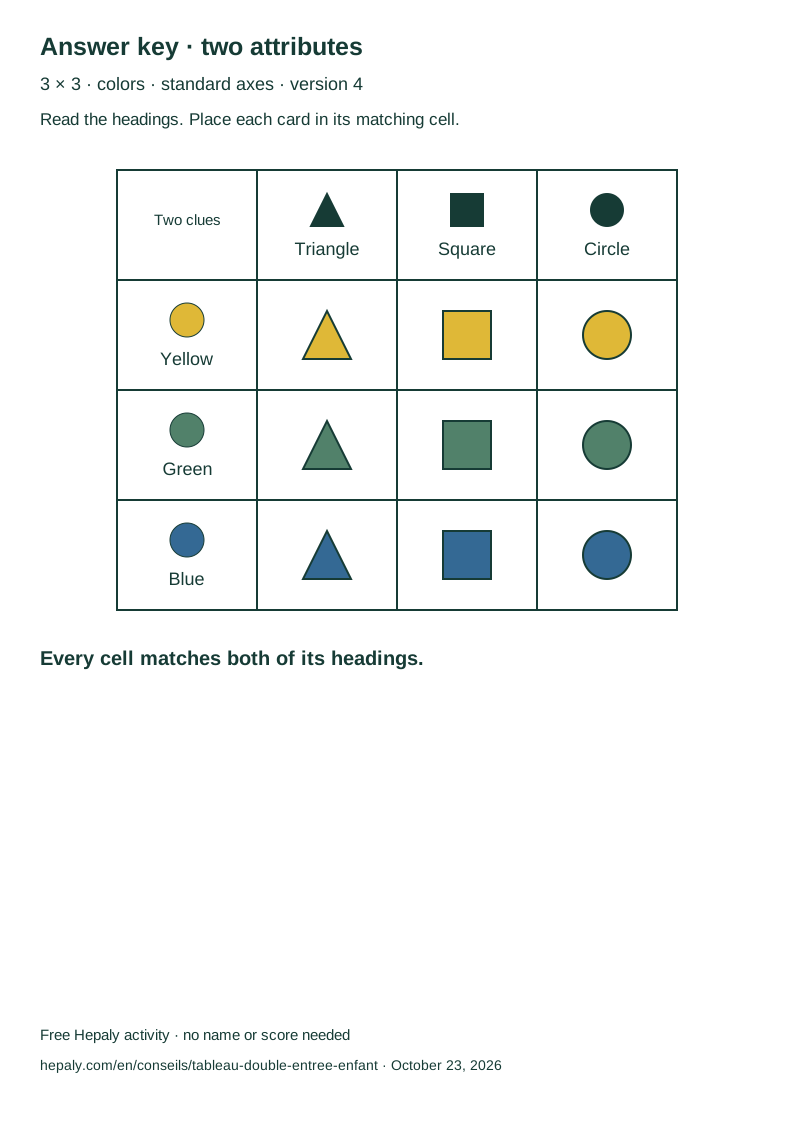
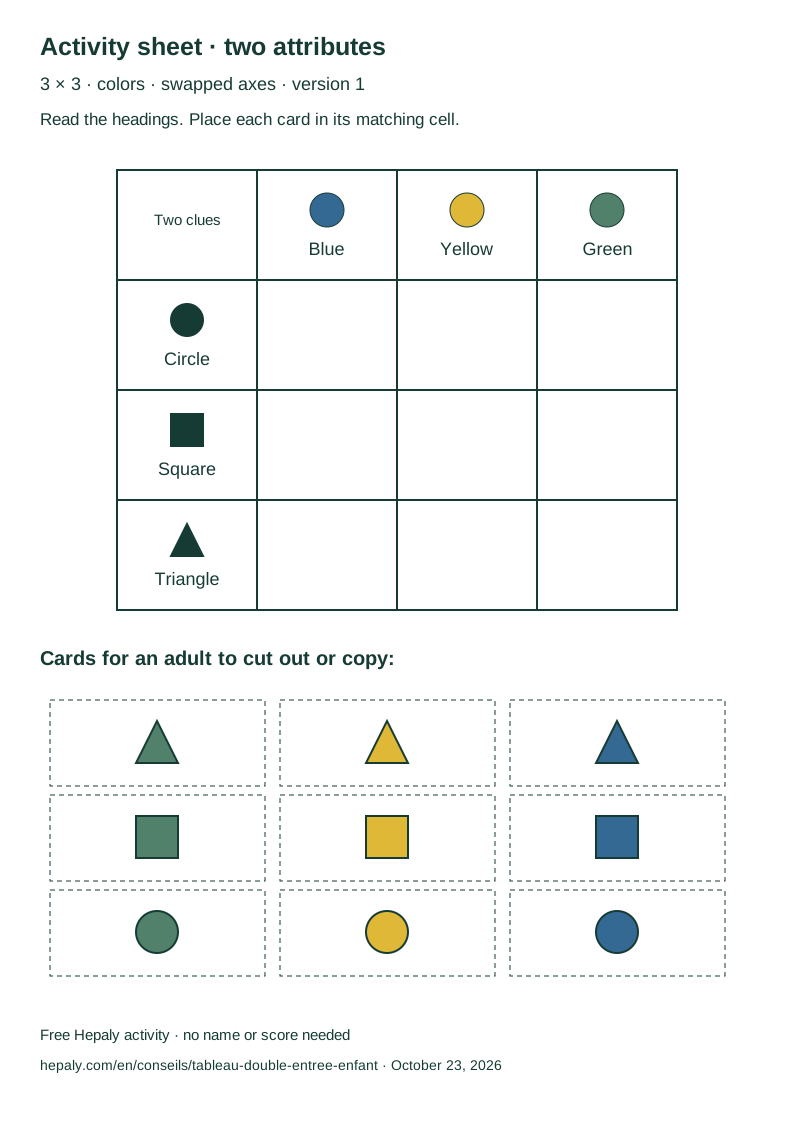
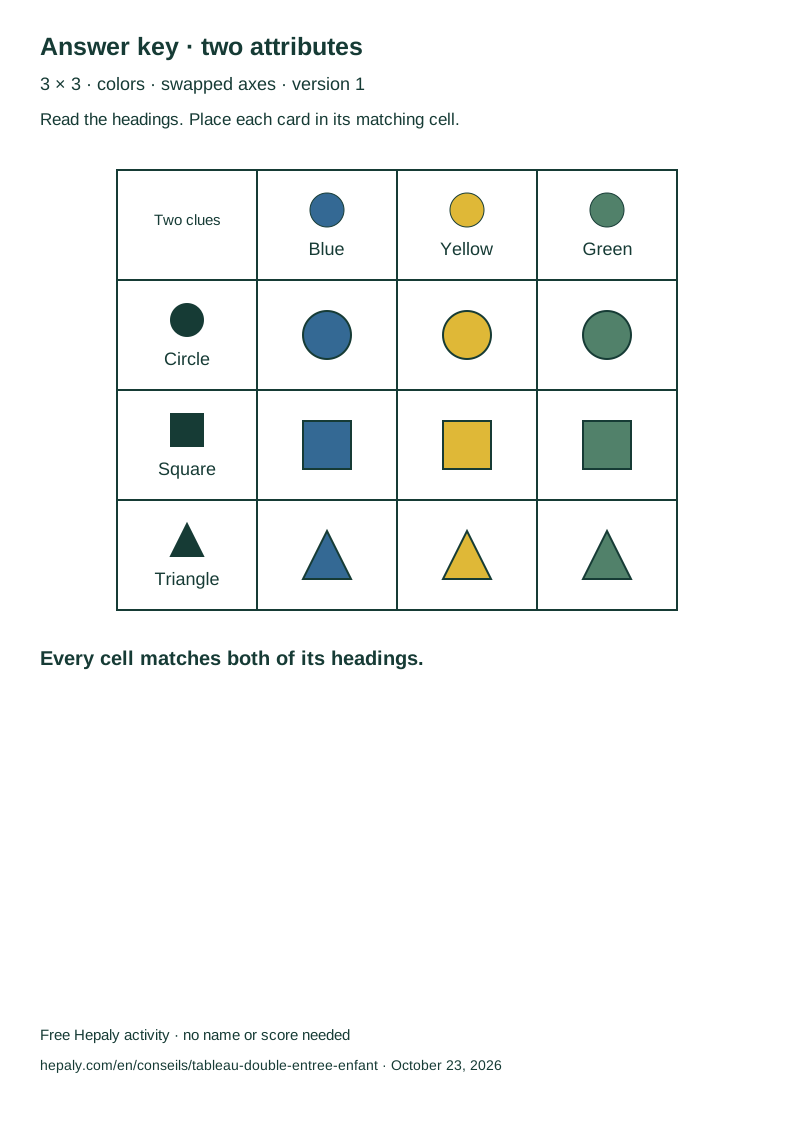
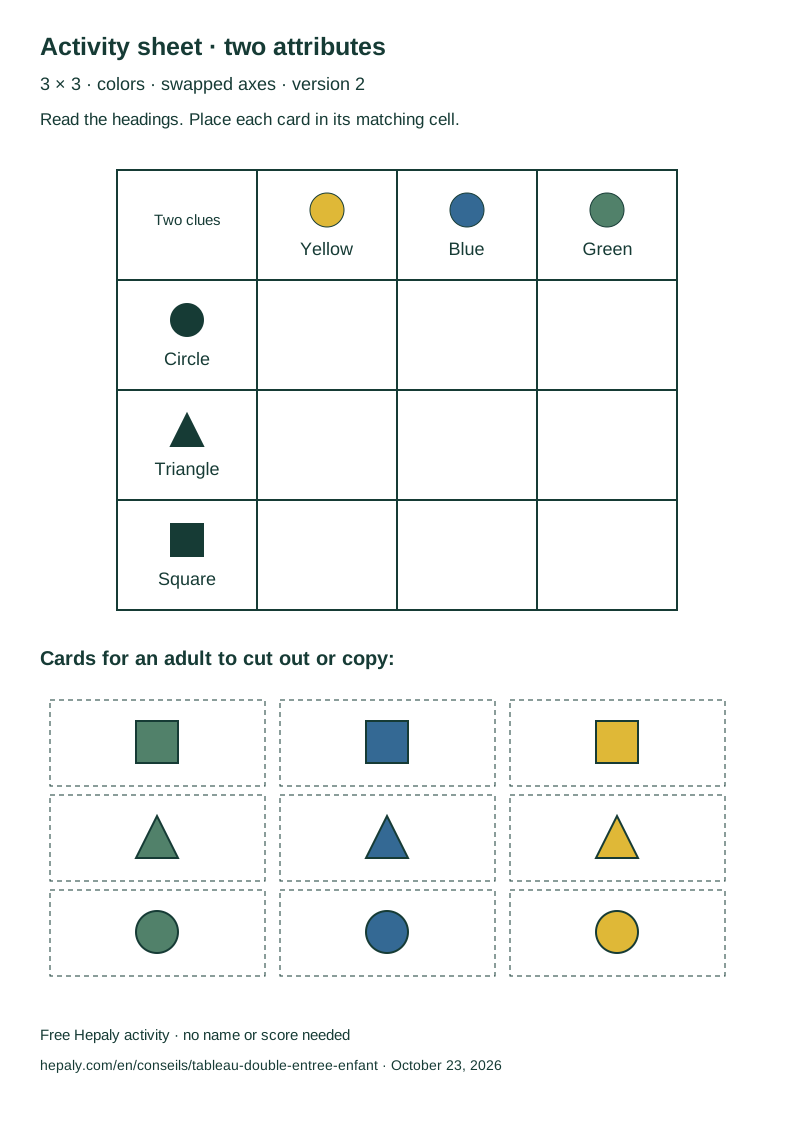
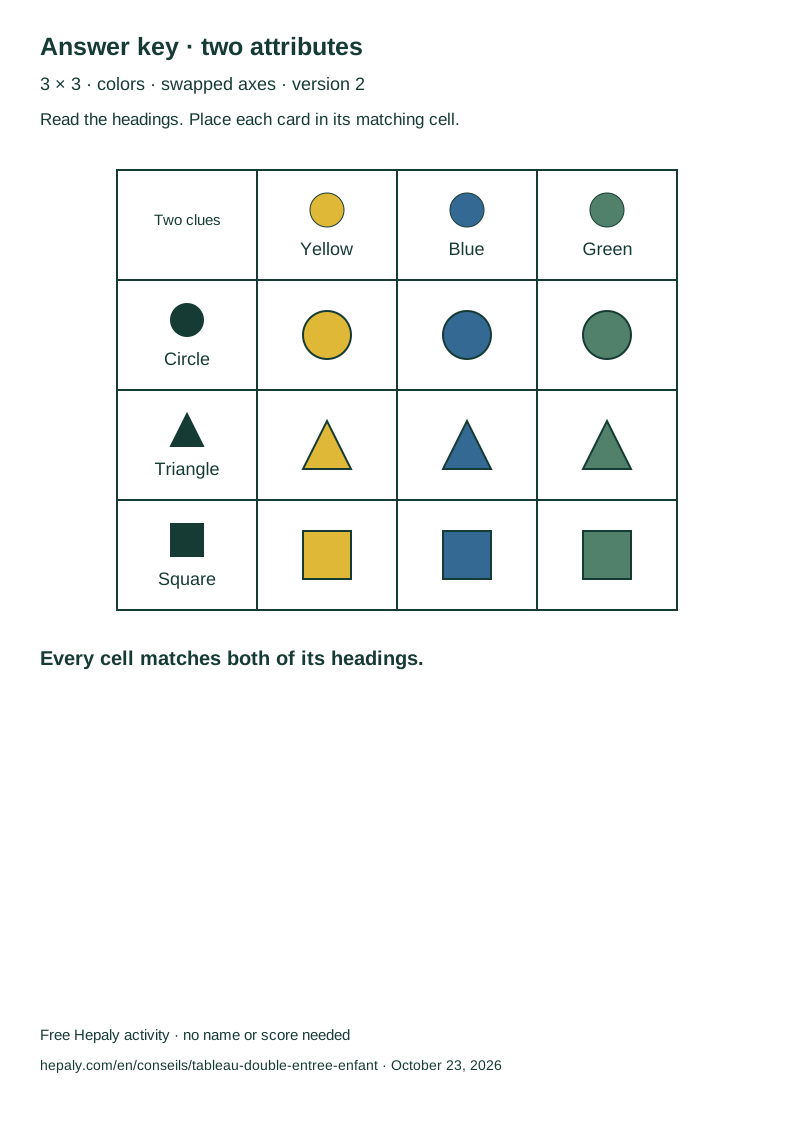
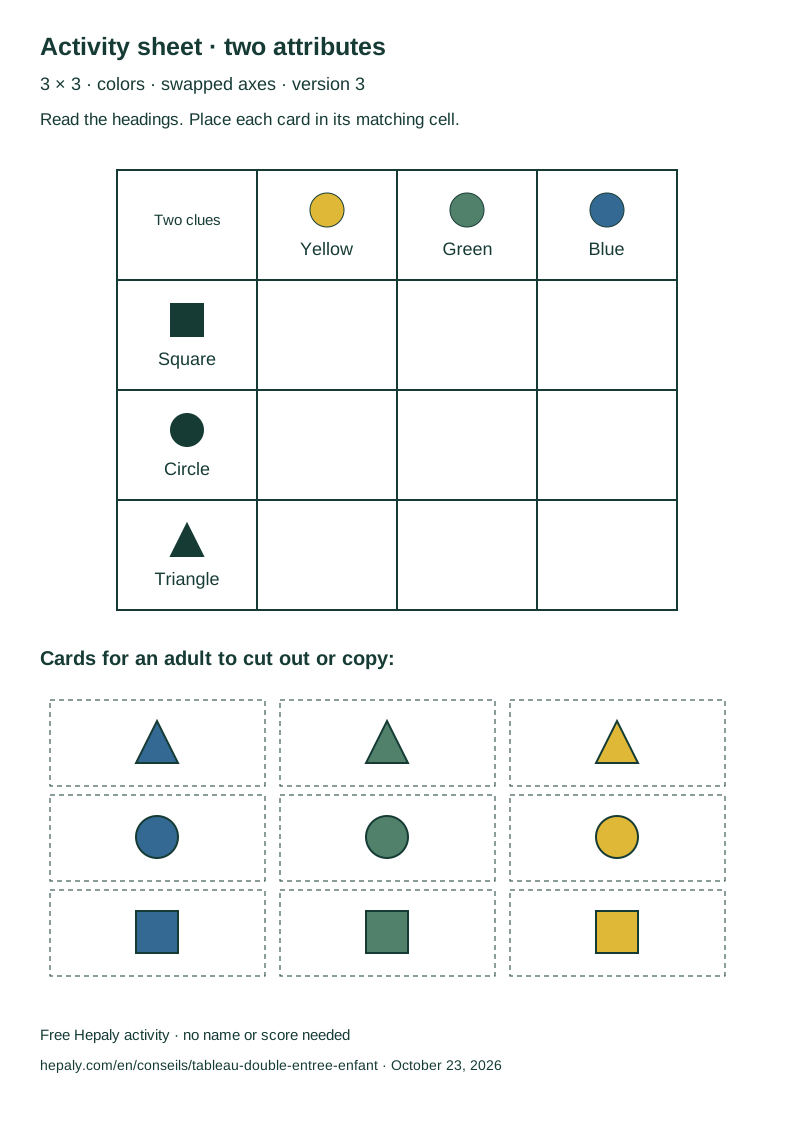
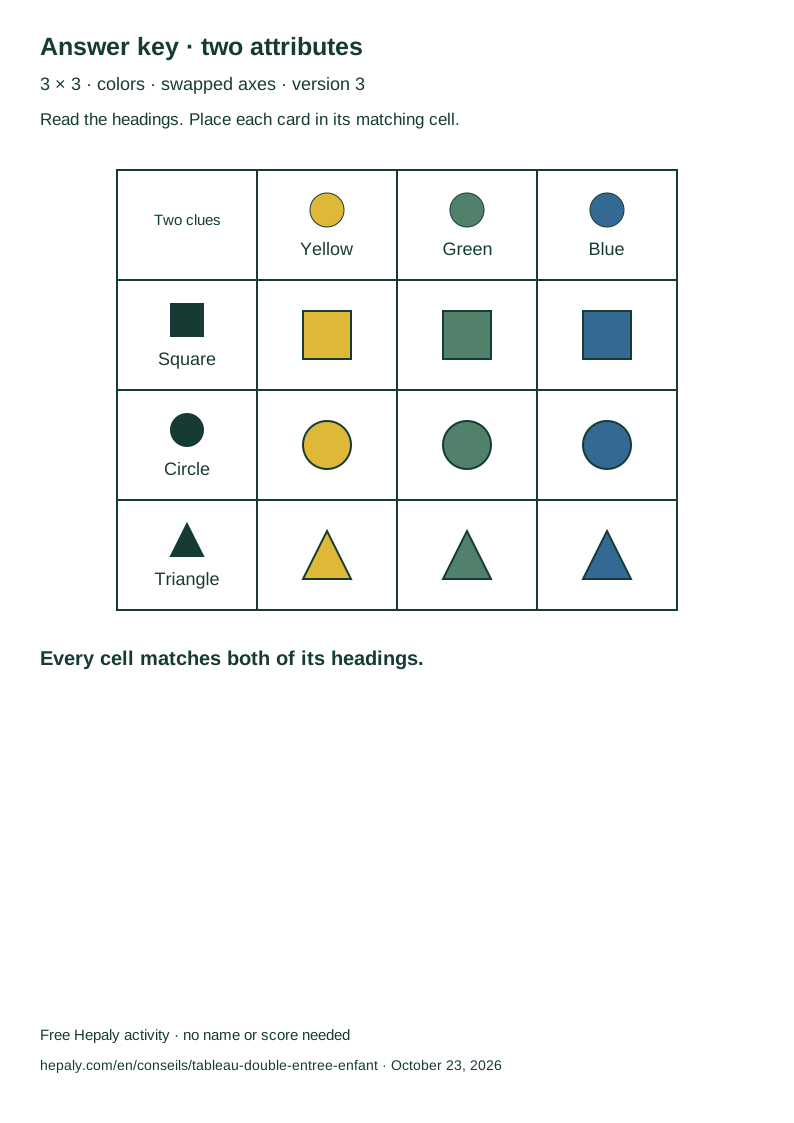
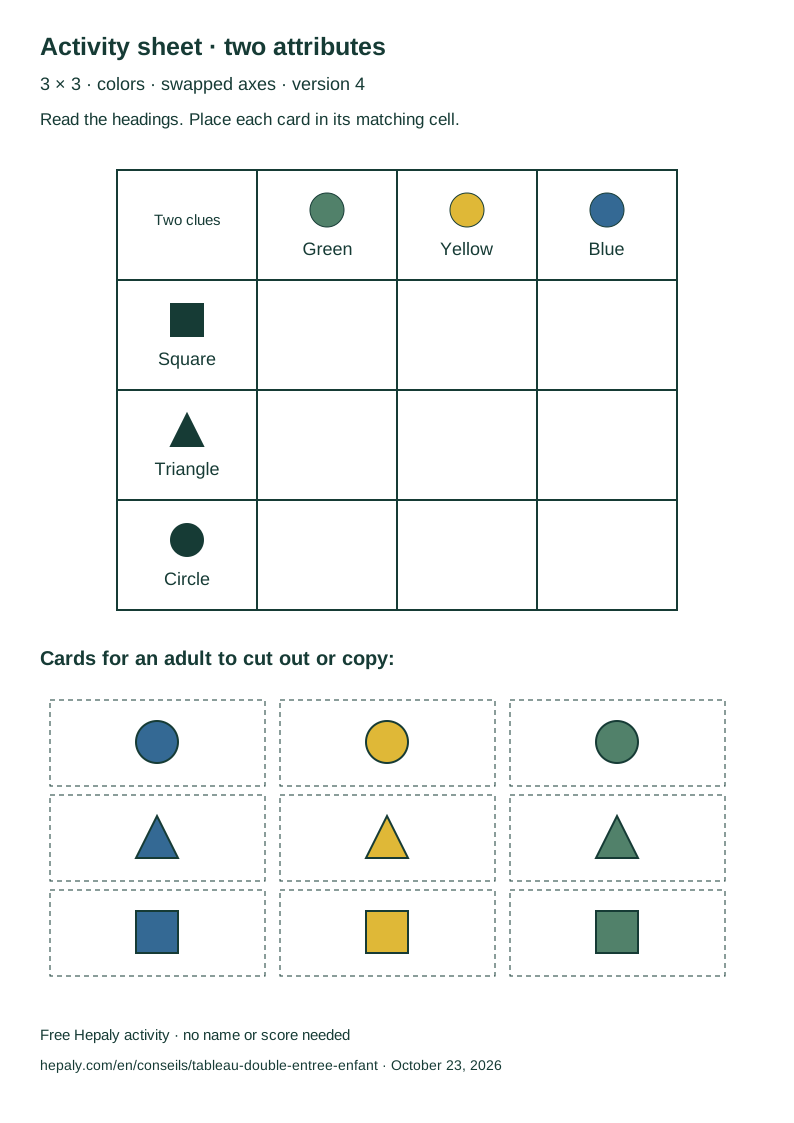
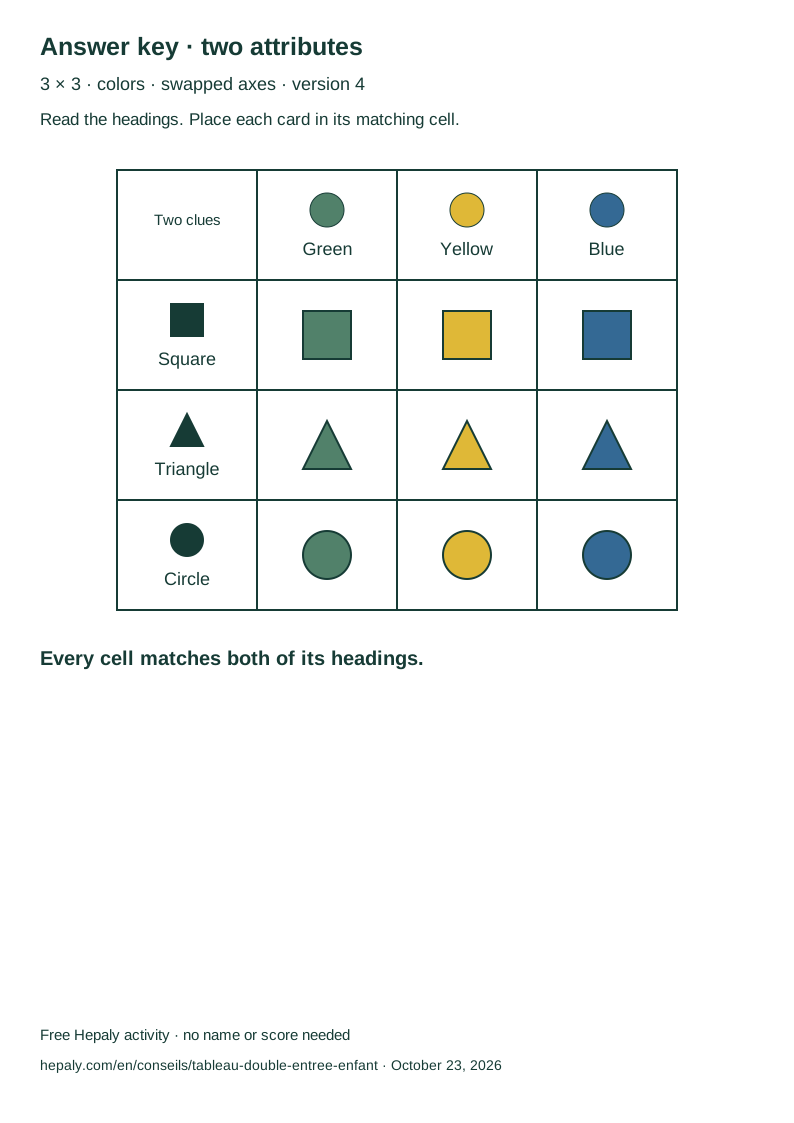
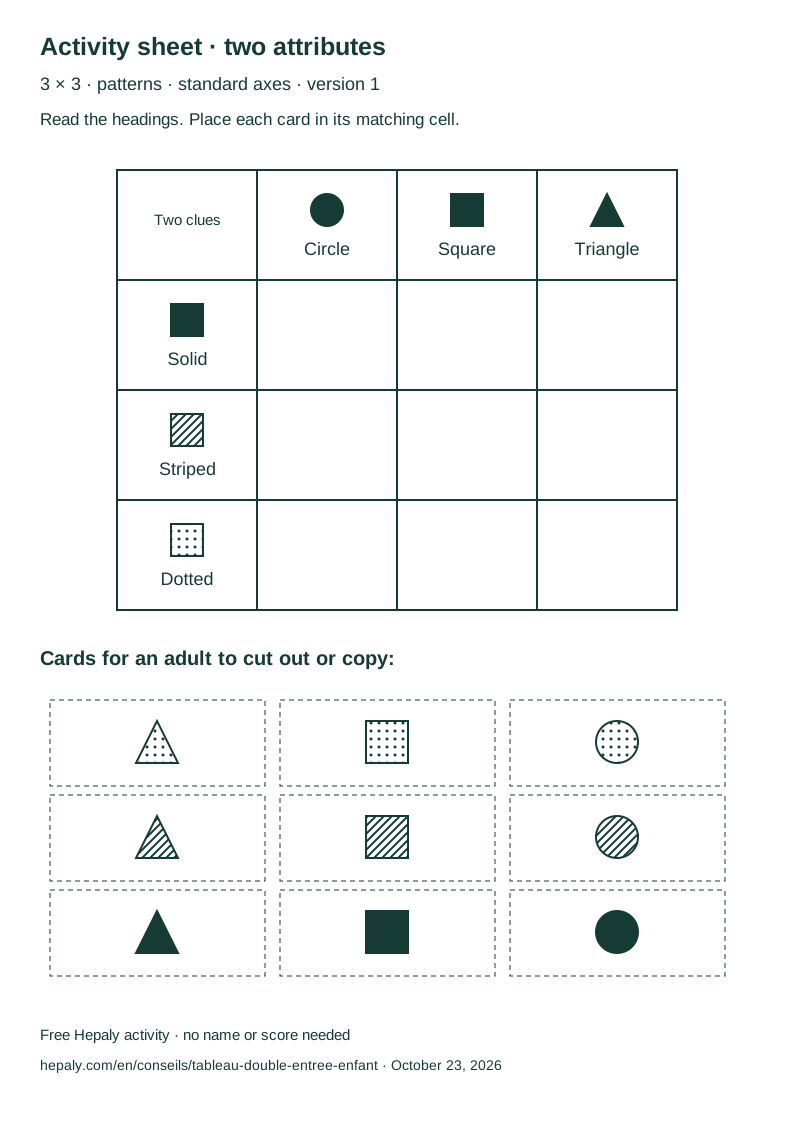
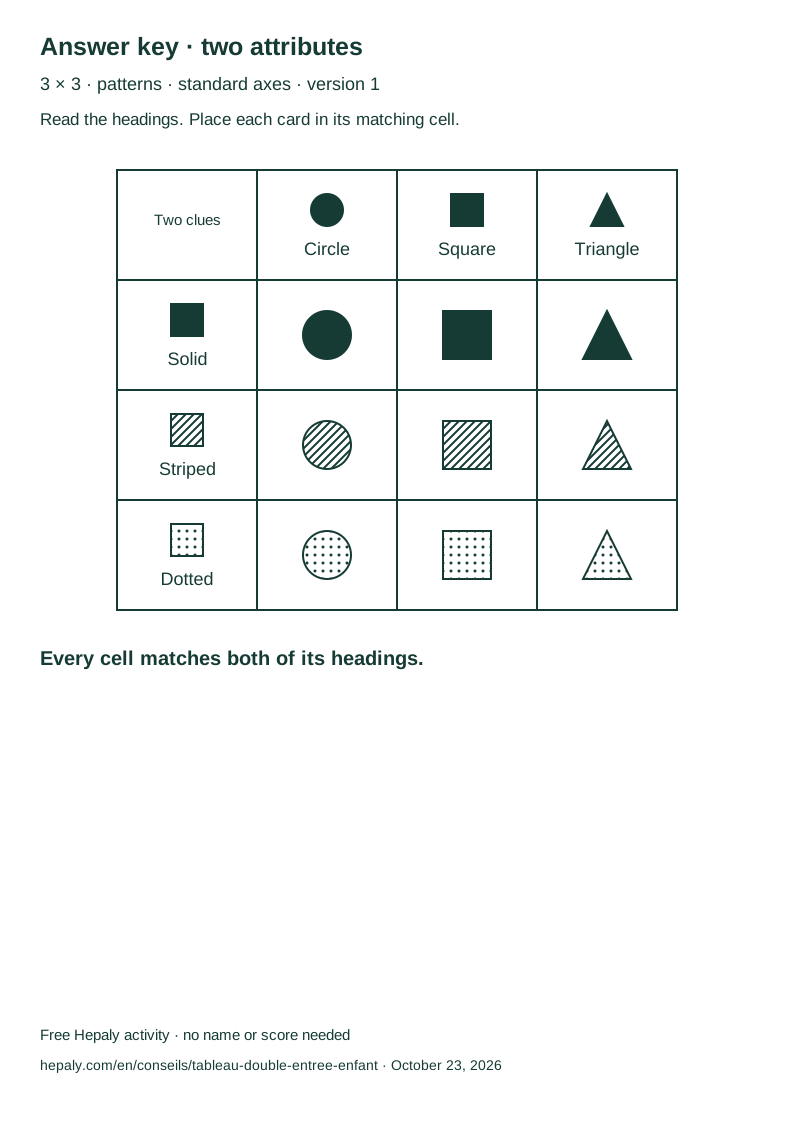
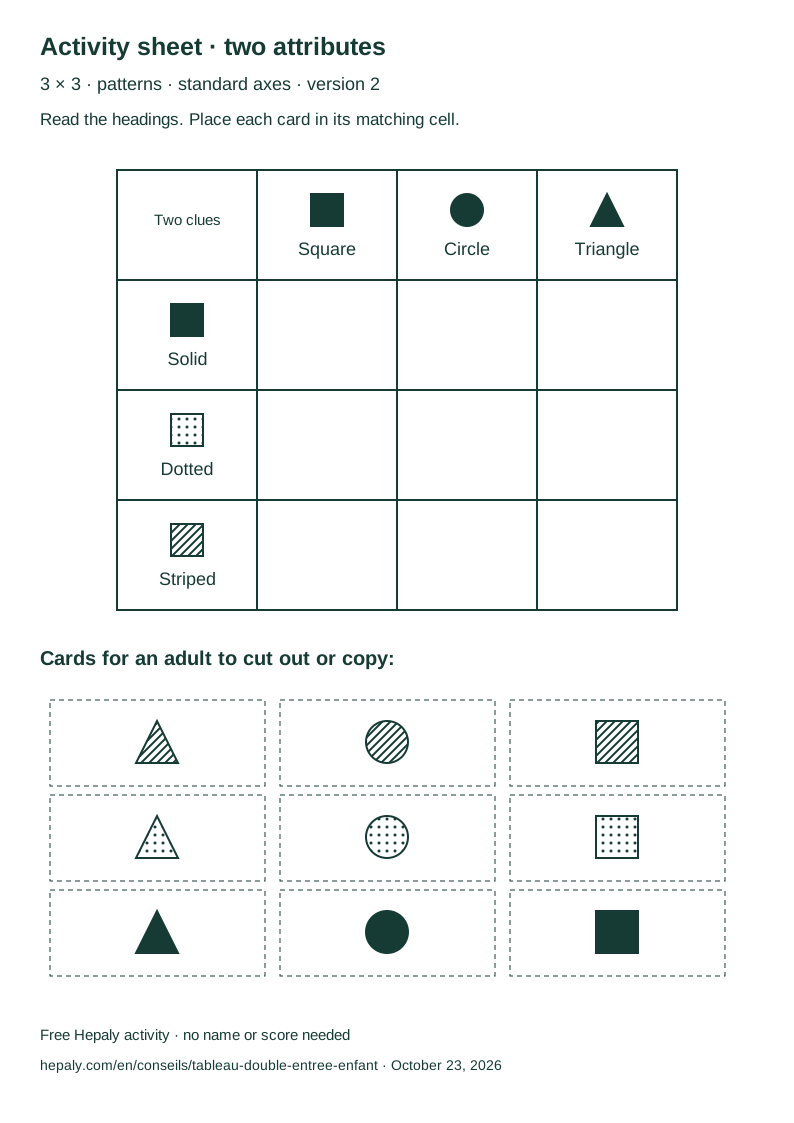
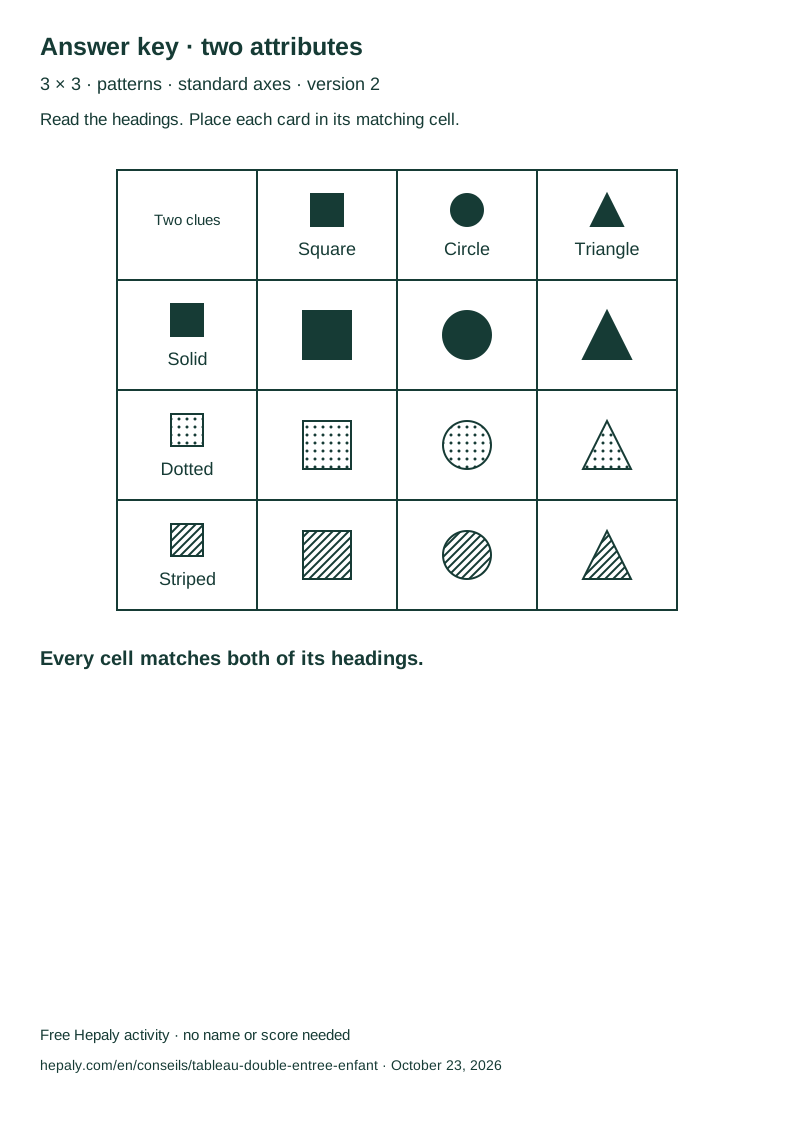
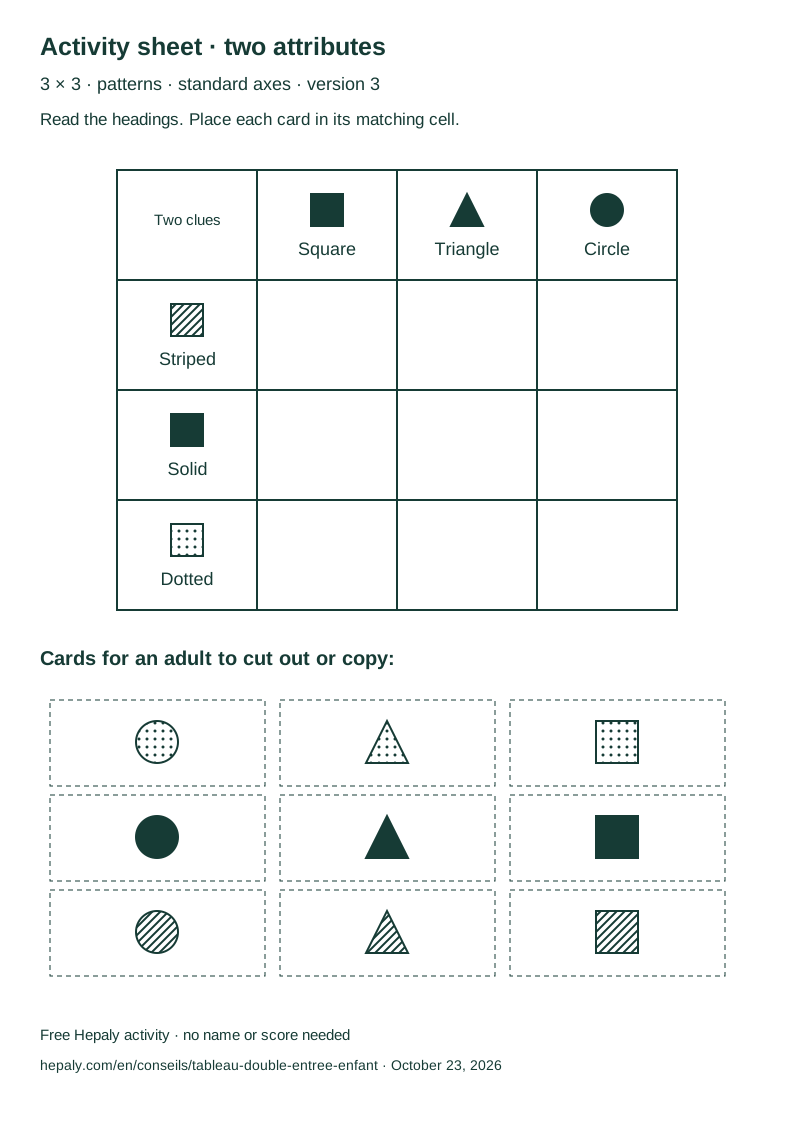
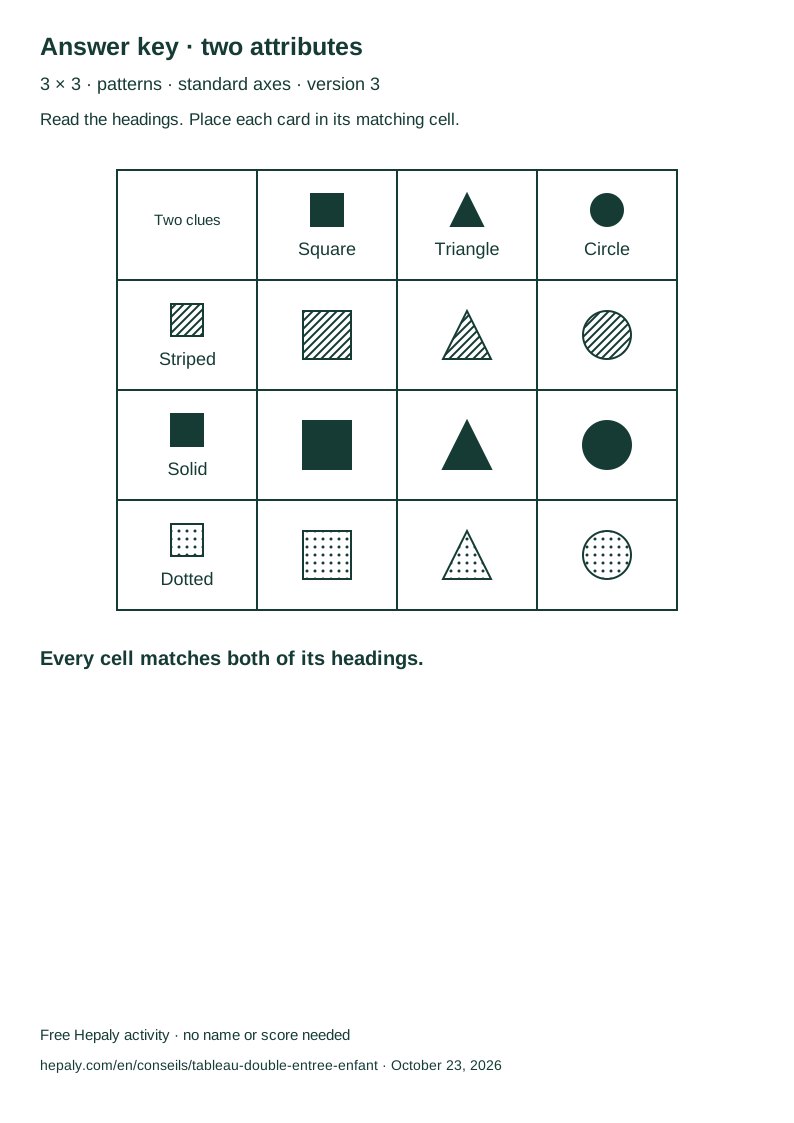
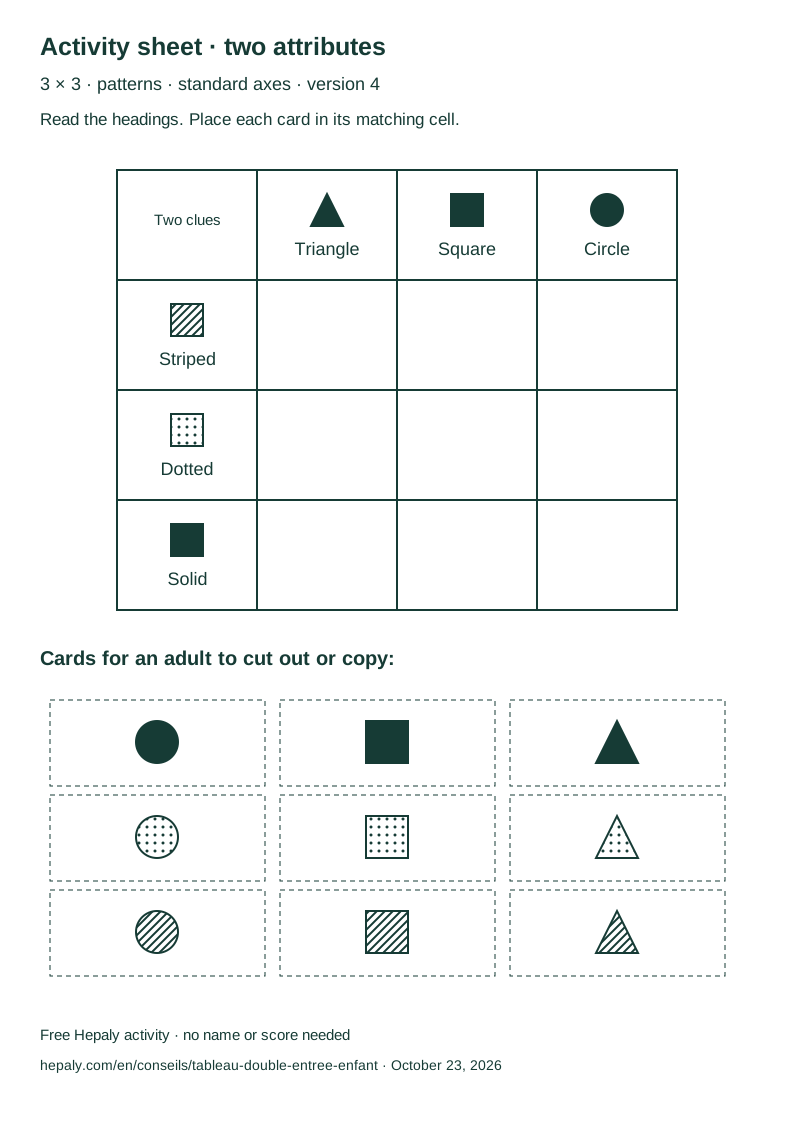
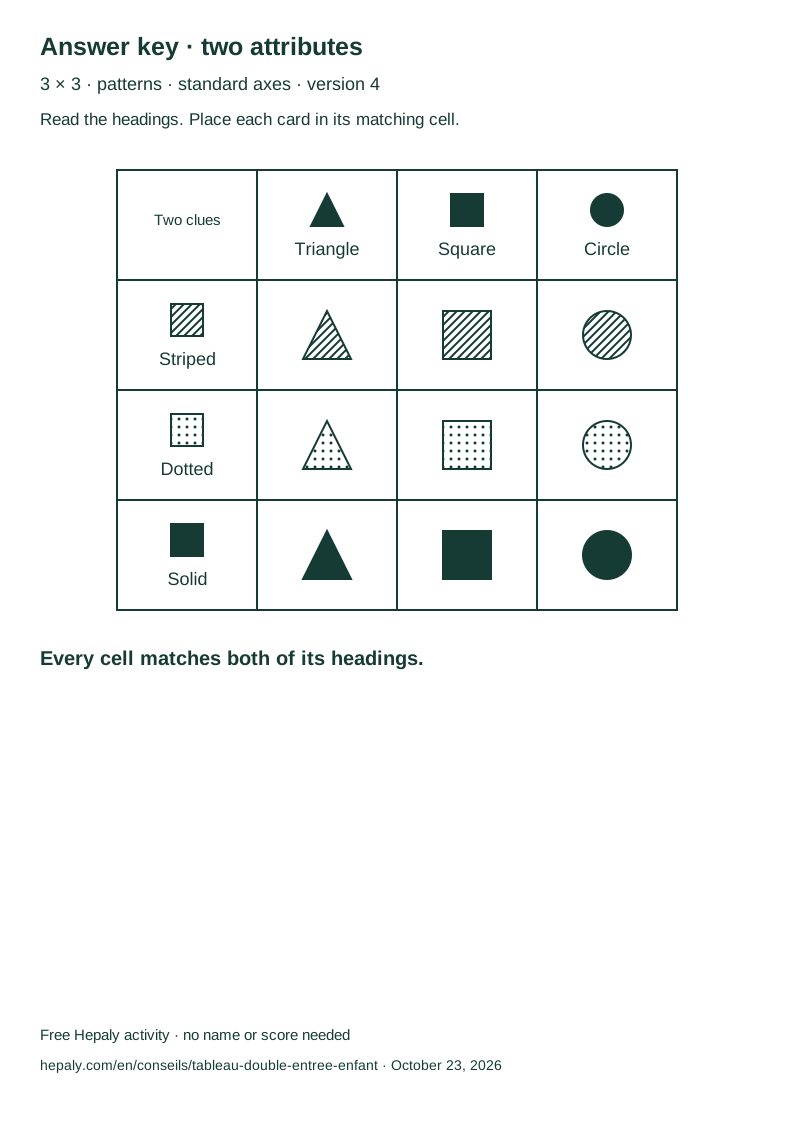
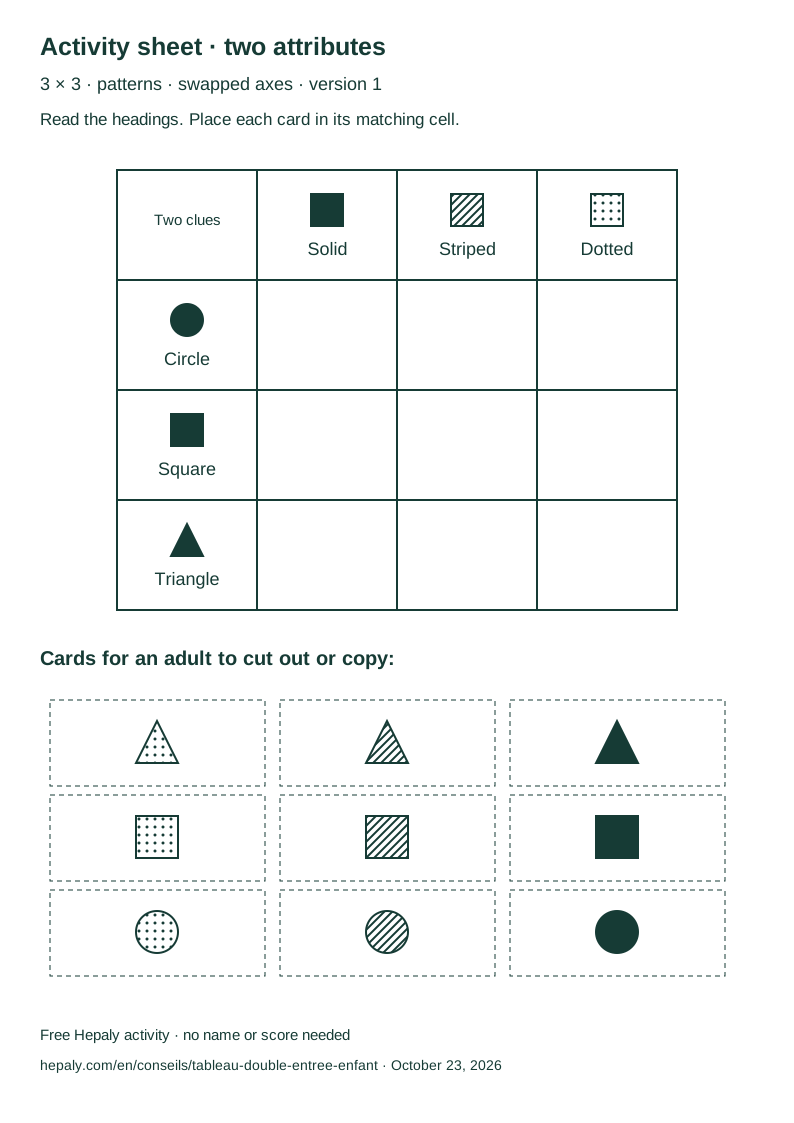
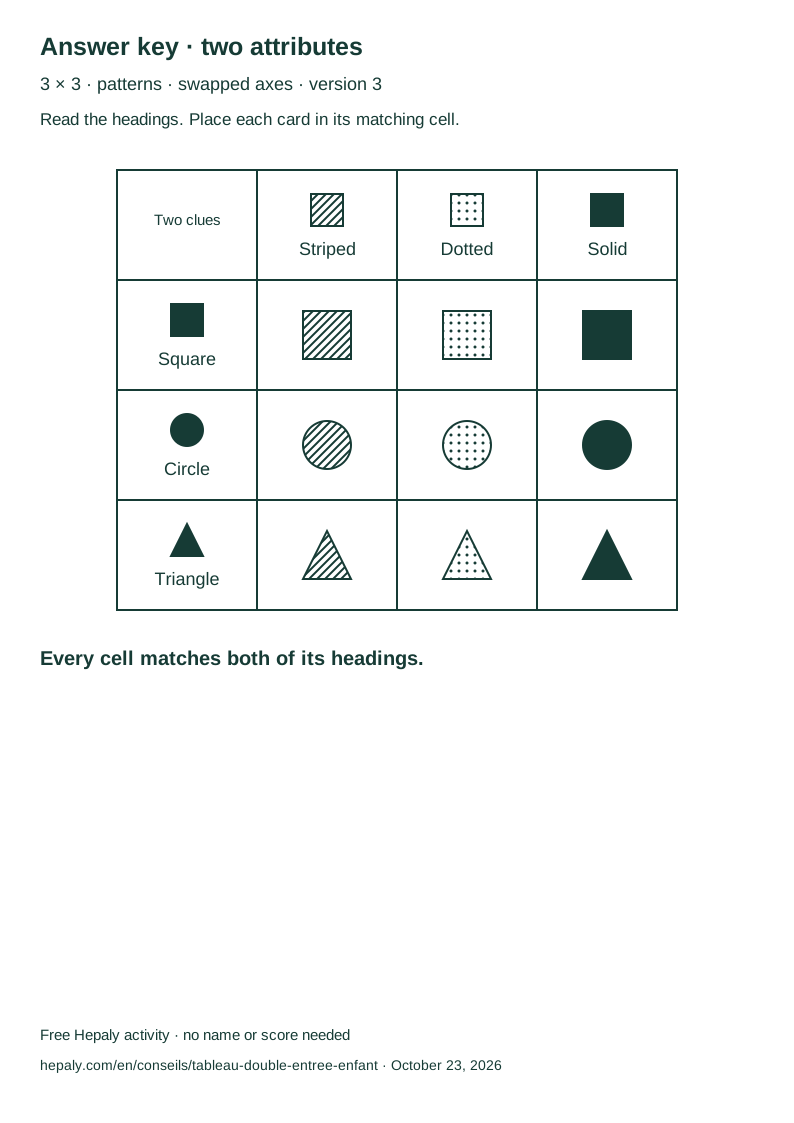
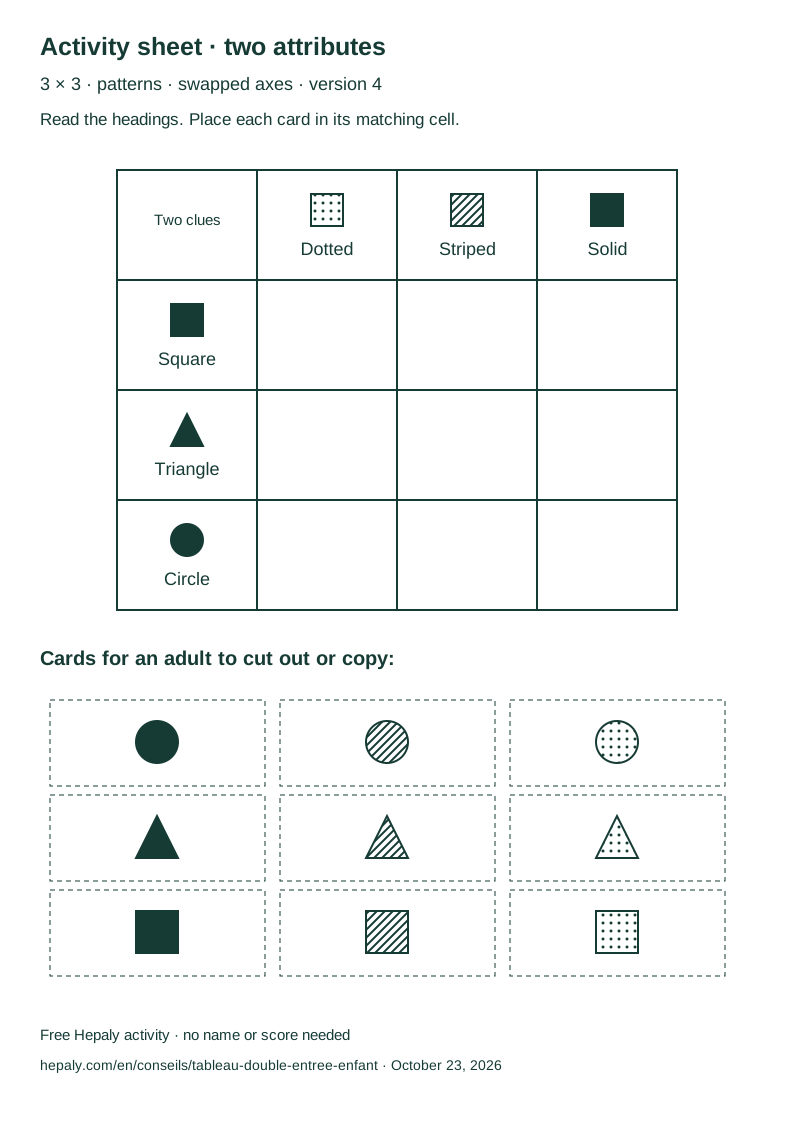
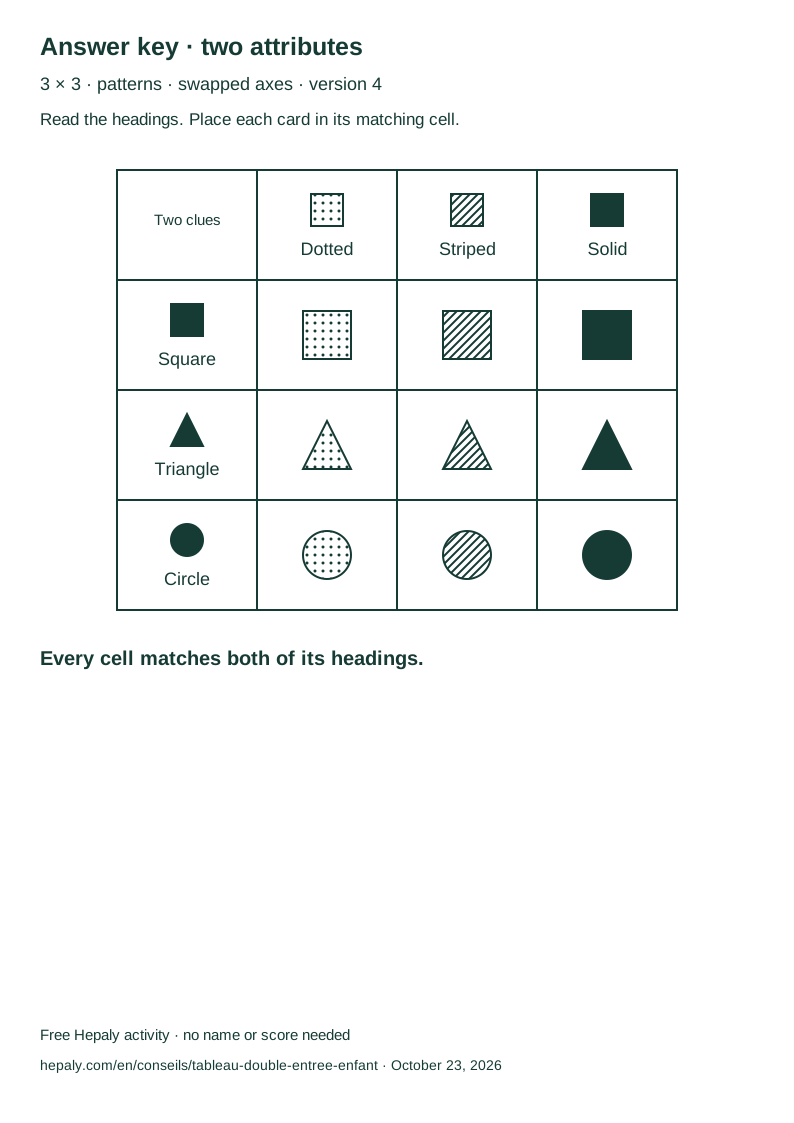
Open the downloaded SVG file, then print it from your web browser. Check for A4 format and margins; the answer key remains in a separate file.
Check the print preview on an A4 page, fitting it to the printable area. Actual margins depend on your printer. A sheet that runs off the page or a pattern that prints too light is worth another try before giving it to your child. The file contains no names, registration forms, or personal scores.
Keep the answer key face down while guiding your child, then review it together. Showing the solution after trying doesn't invalidate the hard work. Simply ask them to point out the headers that justify a given box, rather than requiring a whole new worksheet.
How to play without relying solely on colors?
Choose pattern options: solid, striped, or dotted. They come with matching words in the headers and stay clear even on black-and-white prints. This way, color isn't the only way the rule or result is communicated.
Before sorting, point out an example of each pattern. Children might use their own words to describe them, like "stripes" or "dots". You can gradually introduce the terms from the worksheet later without correcting every sentence while they search for the right spot.
The size of the shapes remains consistent across our grids, so it doesn't quietly add a third criterion. If you use your own objects, state clearly what counts—shape and pattern, for instance, even if some pieces of paper happen to be slightly larger than others.
What changes when you invert the headers?
The same pairs are still possible, but their placement changes when shapes move to rows and colors or patterns move to columns. Check the headers before relying on memorized positions. A blue circle is still a blue circle, no matter which side the word "circle" appears on.
The "inverted axes" option on the worksheets lets you practice this change once a first version is mastered. Avoid changing the size, patterns, and placements all at once. Keeping a familiar reference helps your child see what actually changed in the instructions.
This comparison is just a playful suggestion, not a mandatory step after an initial success. You can bring back the original version and let your child choose. To explore other spatial properties, our 3D shape activities distinguish 3D objects from 2D flat shapes.
How to extend the game for kids aged 7 to 10?
Cross-reference different kinds of information instead of just making the grid larger. A schedule combining two people and several days lets kids find who does what on a given date. A simple book inventory can cross-reference categories and locations, provided you define the categories together.
Clarify whether each box expects a drawing, a word, or a number. These responses aren't all checked in the same way. Reading a quantity from a grid is different from sorting a card by two criteria; explain the switch clearly so instructions don't get mixed up.
You can also let your child make a grid for you using familiar drawings. Double-check the headers before playing: every chosen card needs a designated spot based on the model. It's completely fine if you need to redraw a label or remove an ambiguous example.
When to simplify, take a break, or try something else?
Simplify when the properties themselves are hard to distinguish, or when headers stop helping in the search. Go back to sorting without a grid, using just a single row or two clear choices. Preferring a different activity isn't a sign of trouble.
In the video below, Kiffer l'école shows a teaching progression used in her classroom, complete with visual prompts before introducing the grid and tailored adaptations. This classroom experience was shared in 2022 and is not a benchmark for preschool success. Feel free to watch at your own pace, then return to paper.
The activities on this page do not assess learning conditions or grade levels. If a learning hurdle concerns you in daily activities too, speak with your child's teacher to compare notes. For a shared moment at home, observing, moving a single card, or explaining a choice are all great ways to participate.
Key takeaways to remember before putting the grid away
Focus on a rule that can be put into simple words: read both headers and find where they meet. The quiz reviews this rule along with the activity's goals. Explanations stay accessible without JavaScript so you can review without turning the end of the session into a test.
Hepaly Workshop · intersect and explain
What does it mean to cross-reference two criteria?
Store the cards together with the corresponding sheet to avoid mixing up versions. You will be able to pick it up another day with the same materials, without having to rebuild a set of results. Our printable activities and games for children offer other entries to match whatever they feel like doing.
How is a sorting table different from splitting ten?
A two-way table combines two criteria: a row can show a shape and a column a pattern. The correct cell matches both. Take a striped circle: find the circle row, then the striped column, and follow them to their intersection.
In a split of ten, the two spaces instead represent parts of the same group: six objects and four objects still make ten. The printable number 10 house helps record these splits. Comparing the activities distinguishes sorting by two properties from splitting a quantity.
Two follow-up activities address different questions: tracking counted objects to check a collection, and reading a monthly calendar date to follow a column heading.
Frequently asked questions
At what age can you introduce a double-entry grid?
Start based on observable milestones: distinguishing properties and following guided instructions. The 4–6 and 7–10 age suggestions are activity ideas, not strict milestones for mastery.
Does a child need to know how to read to use the worksheets?
Shapes and patterns provide visual cues. An adult can read the headers and instructions aloud. Printed words also serve to clarify rules without requiring independent reading.
Does a row always have to represent a color?
The headers establish the rules. One version might put colors in rows, another in columns. Always re-read them before looking for the right square.
What if my child overlooks one of the two criteria?
Check separately the property already matched and the one that is missing. Keep an example square visible and go back to two choices if the grid gets too challenging.
Can I print the worksheets in black and white?
Choose pattern mode, which features solid, striped, and dotted designs. Check the preview and legibility on your printer. Each worksheet includes a separate answer key.
Does the game save my child's answers?
The activities do not store or transmit attempts. Downloaded worksheets are activity templates without names or personal results. The YouTube player loads only after you click it.
To go further
- French Ministry of National Education — Cycle 1 mathematics curriculum (preschool / ages 3–6), decree of October 22, 2024, pages 10–11
- French Ministry of National Education — Cycle 2 mathematics curriculum (grades 1–3 / ages 6–9), decree of October 22, 2024, page 36
- DSDEN Savoie — Discovering shapes and sizes in preschool, October 7, 2022