
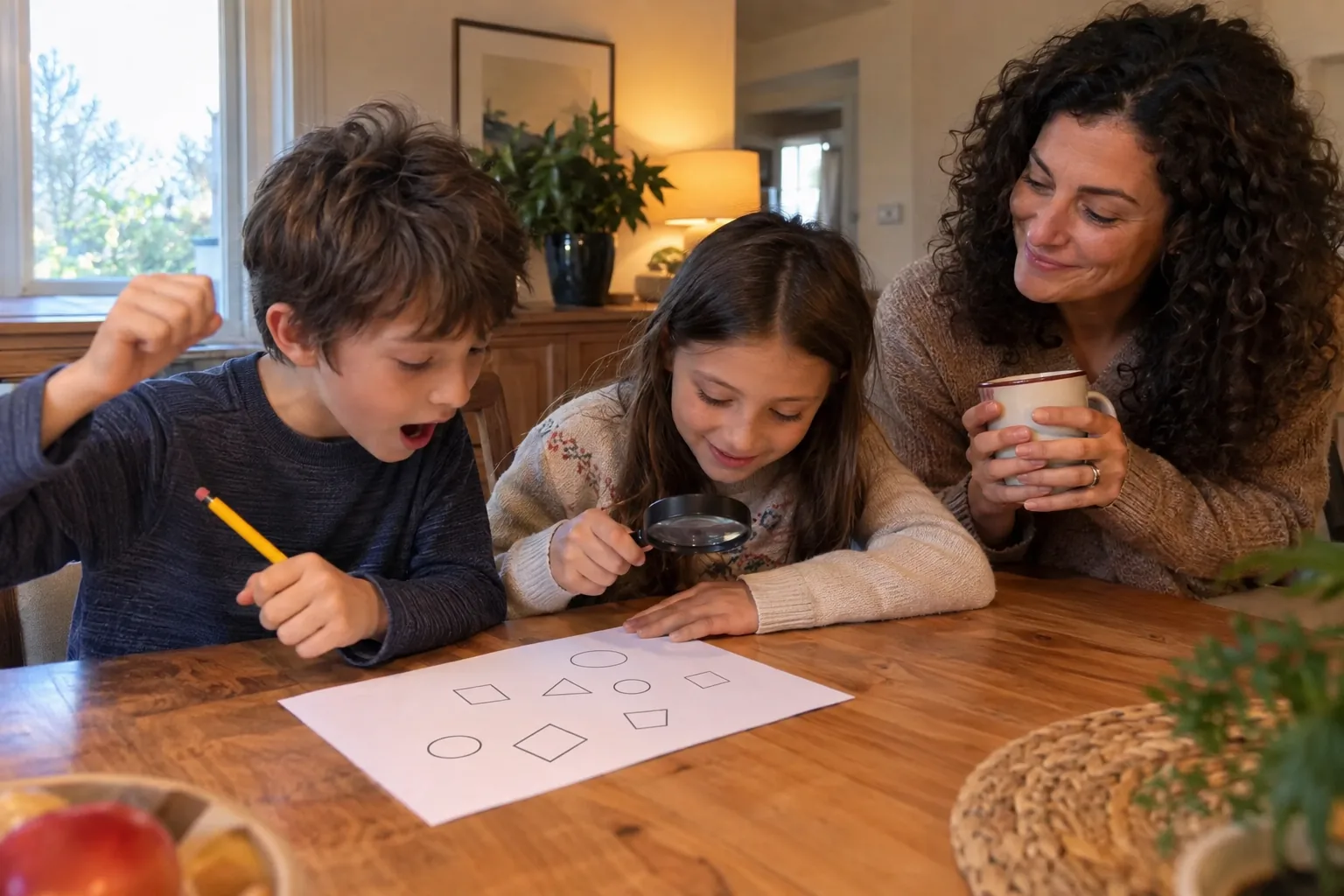
Table of Contents
What is inside the last bag?
Here is a riddle invented for this page. Three bags, A, B, and C, each contain a different fruit: an apple, a pear, or an orange. Each fruit appears only once. Bag A contains neither an apple nor an orange. Bag B does not contain an apple. What is inside bag C?
First, let your child rephrase the information. They can draw three boxes and write the fruit names on movable pieces of paper. An attempt remains useful when it shows which hint was understood. Before adding another hint, simply ask which possibility they have already ruled out and why.
First hint: where to start?
Choose the bag where two possibilities are excluded. Only one of the three options remains possible in A.
Second hint: which fruit is left for A?
A cannot contain an apple or an orange. Therefore, it contains the pear. That leaves an apple and an orange to place in B and C.
Answer: what can we conclude for C?
B does not contain an apple. Since the pear is already in A, B contains the orange. The apple remains for C. Check both hints with this arrangement.
After getting the answer, review the reasoning: which hint unlocked the search? If your child prefers moving paper slips, keep that tool. If they suggest a different arrangement, examine together which hint it respects or contradicts. The goal is to be able to explain a deduction, without a timer or comparison with another child.
A riddle for kids is a brain teaser or puzzle solved through reasoning, based on clues. To choose well, start with age: riddles about everyday objects for younger kids, sequences and deduction grids around 7 to 10 years old, then multi-step calculations. "I am full of holes, but I hold water. What am I?" Children love riddles: there is the joy of searching, the slight frustration when it resists, then the burst of laughter at the solution. Behind this game lie very serious skills: reading carefully, making hypotheses, testing them, changing tracks. Here are fifteen riddles organized by level, with clues and revealable solutions, a detective method for brain teasers, and our tips to support your child without whispering the answer.
What riddles help practice
Solving a riddle is first about understanding exactly what is being asked. Many riddles play on a misread word or a hidden obvious fact: children learn to slow down and re-read. Next comes reasoning: "If it were that, then… but no, that doesn't work." This process of trial and error is at the heart of problem solving practiced in math at school.
Riddles also develop what public health organizations call psychosocial skills, such as the ability to solve problems creatively or cope with minor frustration. Searching without finding right away, then succeeding, feeds confidence: "I can figure it out if I stick with it."
Guiding without giving the answer
An adult's knee-jerk reaction when a child gets stuck is often to whisper the solution. Yet searching for it is what builds skills. Instead, offer a ladder of hints, and let your child decide when they want to move up a step.
A few effective prompts: "Read the riddle aloud to me." "What do we know already?" "Can you draw it?" "Try an answer and see if it works." And when the solution comes, ask them to explain their reasoning: that is where learning takes root.
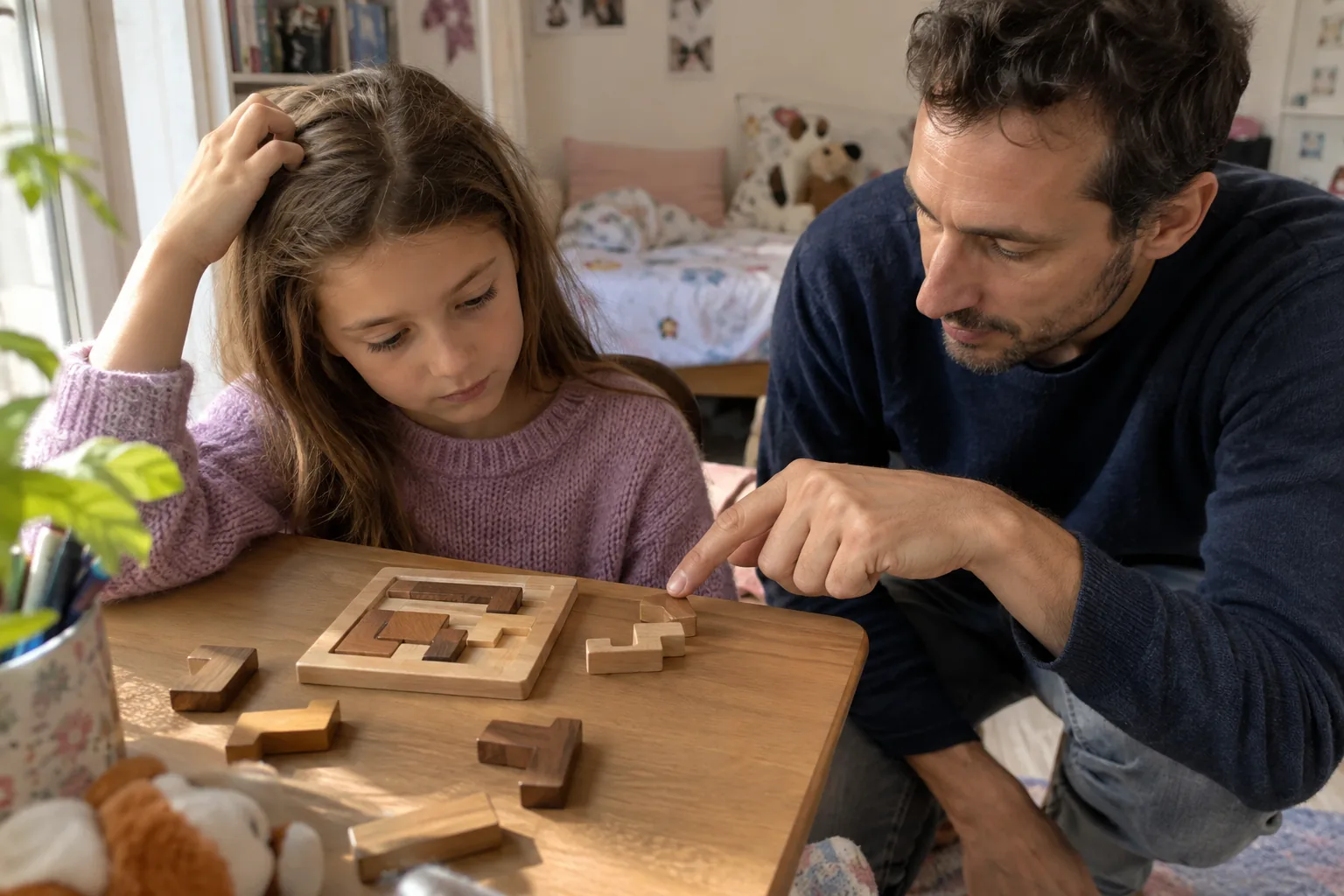
Which riddle for which age?
Riddles do not all require the same effort: a riddle about everyday objects is not solved like a deduction grid. This chart covers the age groups on this page, to be adjusted according to your child's comfort level.
| Age | Type of riddle | Example on this page |
|---|---|---|
| Ages 5–6 (K–1st grade equivalent) | Riddles about everyday objects | "I am full of holes…" |
| Ages 7–10 (2nd–5th grade equivalent) | Sequences, shapes, and one- or two-step deductions | "2, 4, 8, 16…" and "Léa, Tom, and Inès" |
| Ages 10–12 (5th–7th grade equivalent) | Simple multi-step calculations, trick riddles | "The father is four times as old as his son" |
If your child solves a riddle effortlessly, move on to the next type in the chart. If they get stuck multiple times on the same riddle, go back to the previous type: the joy of searching remains the priority.
15 riddles to solve as a family
Warm-up riddles (ages 5–6 and up)
1I am full of holes, but I hold water. What am I?
A hint
People often use me to wash dishes.
The answer
A sponge.
2I have teeth, but I never bite. What am I?
A hint
I often live in the bathroom, near the brush.
The answer
A comb.
3My first meows like a cat ("chat"), my second is the opposite of late ("tôt"), my whole is a large building with towers. What am I?
A hint
Say the two French words out loud, one after the other.
The answer
A castle (château): chat + tôt.
4The more dirt you take away from me, the bigger I get. What am I?
A hint
Think of a gardener digging.
The answer
A hole.
5Which is heavier: a pound of feathers or a pound of rocks?
A hint
Read both amounts carefully.
The answer
Neither: both weigh one pound.
6Circle, square, triangle, circle, square… Which shape comes next?
A hint
Look for the small group of shapes that repeats.
The answer
A triangle: the sequence "circle, square, triangle" starts over.
Logic brain teasers (ages 7–10)
1Léa's father has three daughters: Lili, Lola, and…?
A hint
Re-read the very beginning of the sentence.
The answer
Léa! She is the third daughter.
2During a race, you pass the person in second place. What place are you in?
A hint
You take the place of the person you pass.
The answer
Second place.
32, 4, 8, 16… Which number comes next?
A hint
Compare each number with the one before it.
The answer
32: each number is double the previous one.
4A snail is at the bottom of a 5-meter deep well. During the day, it climbs up 3 meters; at night, it slides down 2 meters. How many days will it take to get out?
A hint
Draw the well and follow the snail day by day. Pay close attention to the last day.
The answer
Three days: he is at 1 meter after the first night, 2 meters after the second, and on the third day he climbs up to 5 meters and gets out before slipping.
5How many times can you subtract 5 from 25?
A hint
Read the question very slowly.
The answer
Only once: after that, you are subtracting 5 from 20, no longer from 25.
6Léa, Tom, and Inès each have a pet: a cat, a dog, and a rabbit. The rabbit belongs to Inès. Tom does not have a cat. Who has the dog?
A hint
First rule out what is impossible, step by step.
The answer
Tom has the dog, and Léa has the cat.
Math brain teasers (ages 10–12)
These riddles require comfort with mental math. Read them out loud, write down the information before calculating, then check the answer by re-reading the question. Our mental math games prepare children well for this work.
1The father is four times as old as his son. Together, their ages add up to 60. How old is the son?
A hint
Count the shares: the son has one, the father has four.
The answer
The son is 12 years old, and the father is 48 years old: 60 ÷ 5 = 12.
2A racket and a ball cost €1.10 in total. The racket costs €1.00 more than the ball. How much does the ball cost?
A hint
If the ball cost 10 cents, would the difference with the racket really be €1.00?
The answer
5 cents: the ball costs €0.05 and the racket €1.05. Together, they add up to €1.10.
3Which number comes next: 1, 1, 2, 3, 5, 8…?
A hint
Add the two preceding numbers together.
The answer
13: each number is the sum of the two preceding ones (5 + 8 = 13).
The logic grid: a detective's tool
The last riddle is easily solved using a logic grid: children in rows, pets in columns. Each piece of information lets you check off or cross out a square. When a row has only one possible square left, you found the answer! This method tremendously helps children who get lost in details: it makes thinking visible.
Start with three characters and three items, then move to four once your child feels comfortable. Coded messages work on the same principle of deduction: our article on secret codes for kids offers several systems to decrypt.
Creating your own riddles
Children love switching roles and stumping adults. Offer them a simple prompt: "I am… (a color), I am used to… (a purpose), you can find me… (a place). What am I?" By searching for clues that are neither too easy nor too hard, your child learns to step into the solver's shoes: it is an excellent language and logic exercise.
Riddles and picture rebuses are other great playgrounds. And for a big family game, nothing beats an indoor scavenger hunt at home, where each riddle leads to the next.
Finding the right difficulty level
A good riddle sits just above what the child can already do: hard enough to make them search, accessible enough so they succeed. If three riddles in a row go unsolved, step back to a simpler level. Conversely, a child who solves everything in seconds needs multi-step brain teasers. Above all, keep it fun: a riddle is shared at dinner, in the car, or at bedtime, never as a punishment. To build memory skills alongside logic, our memory games for kids offer a great complement.
After a process-of-elimination riddle, try another type of puzzle: the Polybius square game for kids uses a grid system and row-column clues. Children can explain their path, then prepare a coded word for an adult to read.
To vary puzzle types without lengthening a riddle, try a two-way table activity. The two headers define the rule for each cell; this printable activity also helps spot forgotten properties, with an answer key to review together.
A puzzle can also begin with a short word to decode and a visible rule. The two-disc decoding wheel lets you check the key and each letter pair. Keep this step separate from the riddle that follows.
A puzzle can begin with a familiar word to find using a key. Our Morse worksheet for encoding and checking a short word separates decoding from the riddle that follows. Keep the answer aside so you can explain an error.
Frequently asked questions
At what age should you start introducing riddles to a child?
Starting at ages 5–6, using concrete riddles about everyday objects. Multi-step logic puzzles are better suited for ages 7 and up, once children read comfortably and can keep several details in mind.
My child gives up very quickly, what can I do?
Choose shorter riddles, think through them out loud together, and offer a clue at the first sign of frustration. The goal is to build successful experiences: perseverance grows with them.
Should I give the answer if they don't find it?
Yes, in the end, but by explaining it and walking through the logic together. You can also save the riddle for the next day: many children figure it out after sleeping on it.
Where can I find more suitable riddles?
Libraries offer many puzzle and riddle books, as do children's magazines. Activity workbooks that integrate riddles into a storyline often make children far more eager to solve them than isolated lists.
What kind of riddle is suitable for an 8-year-old?
Puzzles for the 7–10 age group work well, such as the sequence 2, 4, 8, 16 or the snail at the bottom of the well. Read the riddle out loud with them, ask what they already know, and offer a hint only when they hit a wall. Once solved, they can explain their reasoning to a family member: this cements the strategy.
What kind of riddle works best for a 10-year-old?
Around age 10, multi-step math riddles like the father and son's age or the racket and ball are ideal. The child needs to note down details before calculating, then verify the answer by re-reading the question. Trick questions, which seem deceptively simple, often appeal to older children, provided the hint remains accessible.
To go further
Preview before choosing
Les Grands Curieux · Ages 7–10
For children who are beginning to read instructions on their own and enjoy playing with words, numbers, and riddles. An adult can help with reading.