
Table of Contents
- Why coded messages are a great game
- Code 1: the Caesar shift cipher
- Code 2: numbers instead of letters
- Code 3: the pigpen cipher
- Code 4: Morse code, with sound and light
- Code 5: mirror writing
- Code 6: invisible lemon juice ink
- How to give progressive hints?
- Writing your first coded message, step by step
- Messages to decode as a family
- Organizing a secret agent mission at home
- Frequently asked questions
| Your child can… | Suggested activity | Helpful tool to provide |
|---|---|---|
| Find a letter in an alphabet | Number cipher A = 1 | Visible numbered alphabet |
| Follow a fixed offset | Caesar wheel | One letter shown as an example and reading direction |
| Cross a row and a column | Grid with coordinates | Same reference grid for both players |
Why coded messages are a great game
To encode a message, a child must first spell it correctly; to decode it, they must read letter by letter without guessing. Without realizing it, they practice the alphabet, count, compare, and double-check. Children who quickly grow tired of traditional worksheets often get hooked, because the goal is no longer "doing a worksheet" but "discovering the secret."
Ciphers are also a gateway to history and science: ancient generals, spies, and later computers all needed to protect their communications. Cryptography, the science of secret codes, is everywhere today, right down to online payments.
Code 1: the Caesar shift cipher
This is the most famous code of all. According to Roman historian Suetonius, Julius Caesar replaced each letter with the one three positions further in the alphabet: A becomes D, B becomes E, and so on. To decode, shift back by three letters. The wheel below does the work: pick the offset, type a message, and observe the match between the two circles.
Making your own cardboard wheel is a great activity: two discs of different sizes, a brass fastener, and the 26 letters evenly spaced on each disc. Your child can then change the key every week: the shift becomes the "password" that only club members know. To review the order of the letters before coding, our games to learn the alphabet are a great starting point.
Code 2: numbers instead of letters
A is 1, B is 2, up to Z which is 26. The name MILO becomes 13 – 9 – 12 – 15. This code is ideal for children who know the alphabet but still read slowly, as it relies on a grid they can keep in front of them. To make the game more challenging, add a secret number to each letter: with + 2, A is 3, B is 4… You review mental math along the way.
Code 3: the pigpen cipher
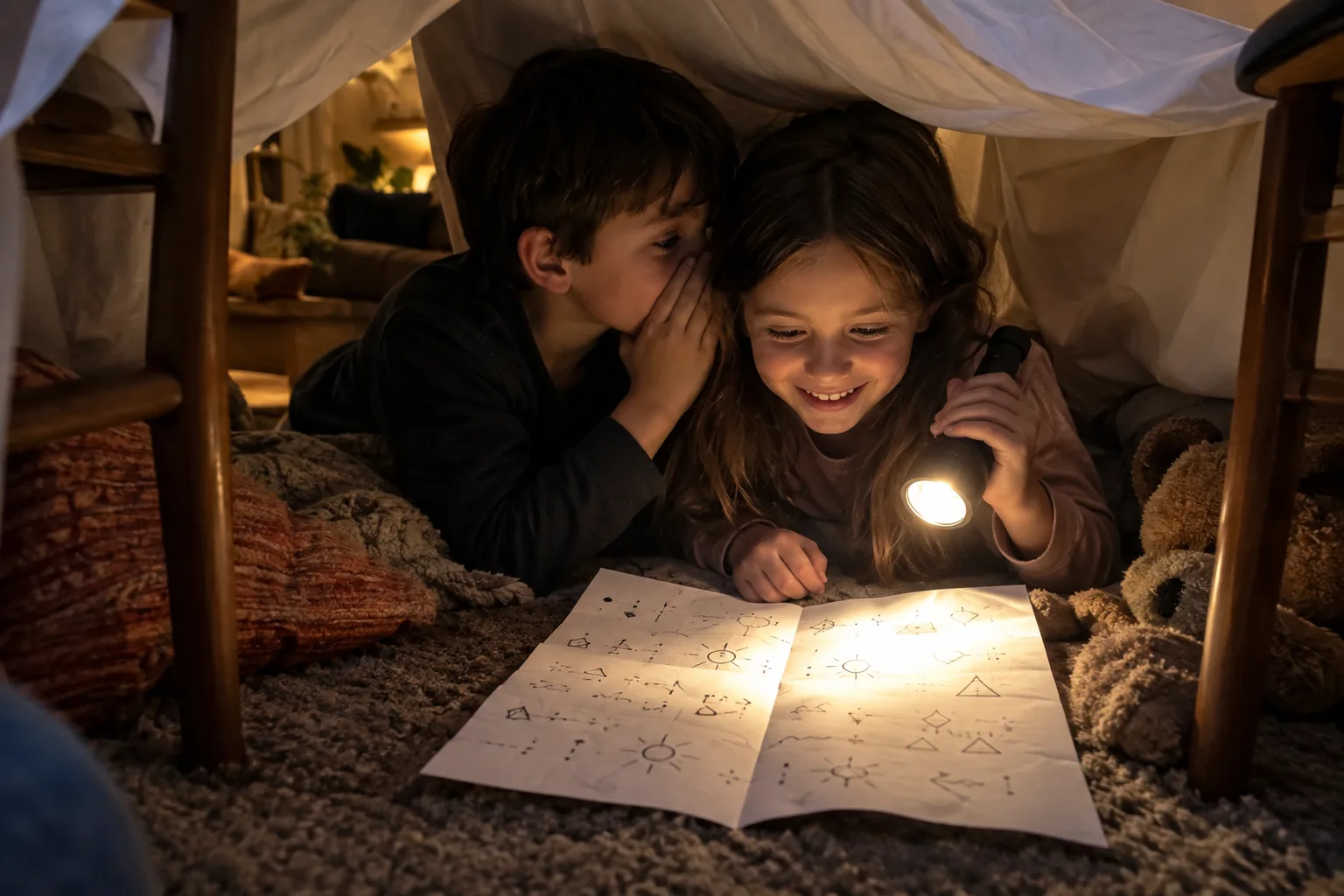
This symbol code replaces letters with the shape of the cell containing them in two tic-tac-toe grids and two crosses. A dot distinguishes the second grid from the first. The result looks like a mysterious script, loved by 6–8-year-olds.
Code 4: Morse code, with sounds and light
A coded message for a child must keep the intended separators. In Morse on paper, a space between groups distinguishes two letters. A slash can mark a word break if that convention is explained to both players.
| What appears | What it can mean | What to check |
|---|---|---|
| ... in one group | The letter S | Was the intended message a single letter? |
| . . . in three groups | Three letters E | Are the spaces still visible on the card? |
| A slash between two groups | A word break in our worksheet | Are both players using the same convention? |
These examples are calculated from the same table. They show why joining dots can change the reading. A decoder can accept a valid group without recovering the player's intended word. Keep the original word on the answer card and compare both cards before changing the symbols.
Check one group, then its space before the next. If the code matches no letter, review that group's symbols. If it produces a different valid letter, compare it with the intended letter. This check concerns the prepared message, not an assumed ability or fault in the child.
Invented in the 19th century for the telegraph, Morse code encodes each letter using dots (short signals) and dashes (long signals). It can be transmitted in writing, but also with a flashlight, by tapping on a table, or by whistling. The best-known signal, SOS, is written as three dots, three dashes, three dots.
A simple game: each person chooses a three-letter word, transmits it with a flashlight in a dark room, and the other person notes it down then decodes it using the chart.
Code 5: mirror writing
Writing backward, from right to left and with flipped letters, then reading the message in a mirror: this code requires a lot of concentration. Leonardo da Vinci filled his notebooks with this reversed writing. For children who still confuse b and d, save this game for later: introduce it around age 8–9 instead.
Code 6: lemon invisible ink
Time for chemistry! Squeeze half a lemon into a bowl, dip a cotton swab in it, and write on a sheet of white paper. As it dries, the message disappears. To reveal it, an adult gently warms the sheet, for example with a dry iron or a hair dryer on warm: the lemon juice turns brown faster than the paper and the text appears.
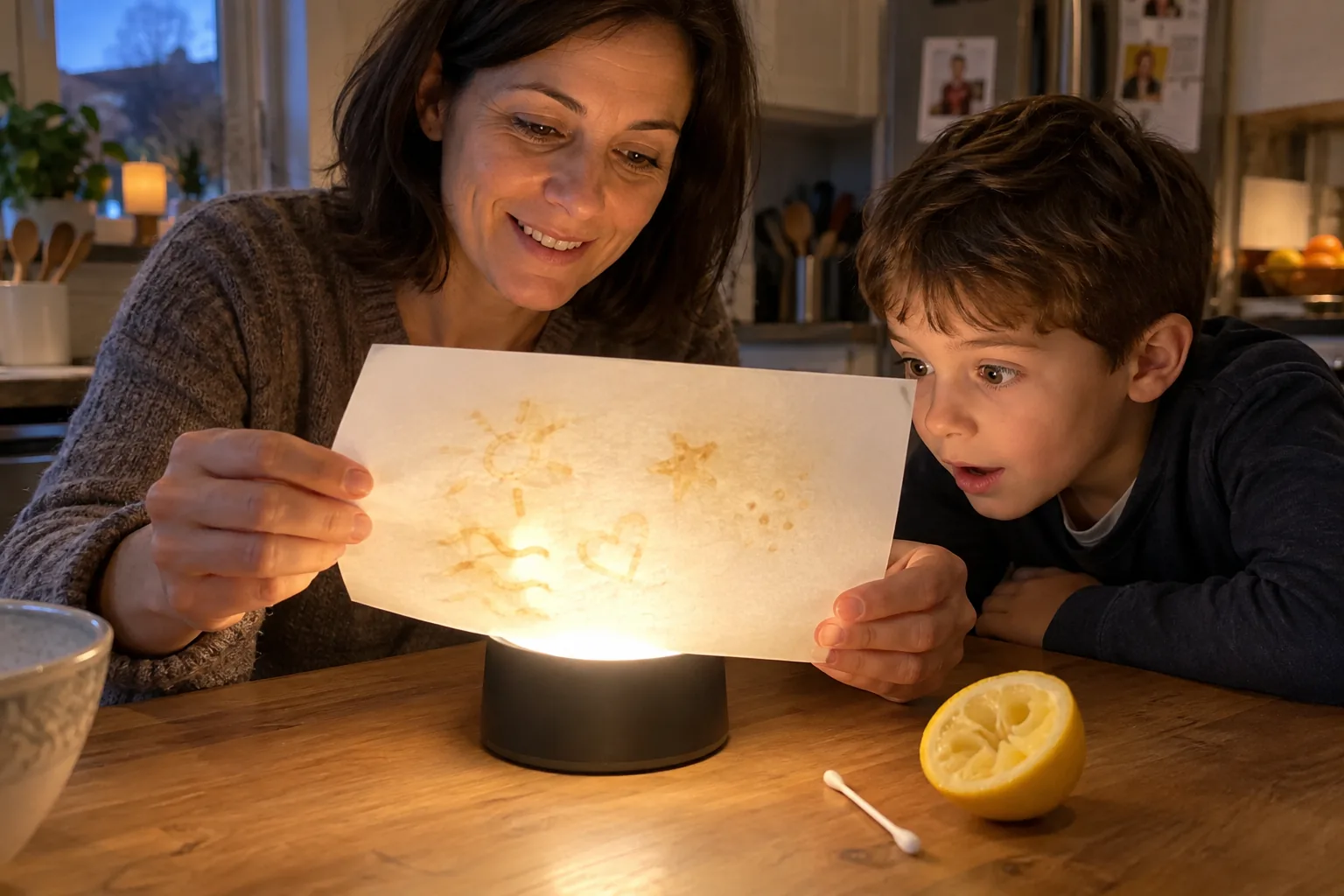
Older children might be interested in the explanation: lemon juice contains sugars and acids that weaken the paper and darken with heat. For similar experiments, our article on easy science experiments offers plenty of ideas.
How to help decode without giving away the whole message?
Give a clue about the rule, then let the child try one letter. If that is enough, do not add more clues. The goal of the game is to understand a repeatable transformation, not to guess what the adult has in mind. The table offers step-by-step help for a fictional example.
| Step | Clue to give | What the child can check |
|---|---|---|
| First try | Each letter was shifted forward by the same number of places. | The rule stays the same from start to finish. |
| Second clue | To read, go back three places in the alphabet. | O goes back to L, without changing direction after that. |
| Verification | The decoded word is LUNE. | Shifting L, U, N, and E forward three places gives O, X, Q, and H. |
What if the wheel and the message seem to contradict each other?
Check the key, reading direction, and disc stability separately. Our diagnostic uses four known attempts: it does not search for an unknown key or turn a confusing message into a judgment about your child.
Which code can a beginning first-grade reader try?
For a beginning reader, use a familiar word and keep the table visible. An adult can read the instructions, hold the wheel's centers, and let the child find one pair. CP is the name of a French school grade, not a guarantee that this game suits every child in that grade.
If the setting is wrong, a shorter word will not fix it: check the key pair first. If recognizing letters is difficult, simplify the reading before adding a shift. To prepare the paper game, separate the key card, message, and answer sheet, then check the reading path with the actual wheel.
How to change difficulty without making the text longer?
Keep the same word and only change the available help: full alphabet, first letter shown, then key alone. Your child can then prepare a message for you and check your response. If the letters or reading direction cause fatigue, return to the visible model or stop playing. Successfully solving a puzzle measures neither developmental age nor academic level.
Writing your first coded message, step by step
Start with the number code or the Caesar cipher, with its shift of 3. Then write your message in capital letters, without accents, and encode it letter by letter on scrap paper. For a first try, a short word is enough: LUNE, POMME, or BISOU.
- Keep the key to yourself: the shift or number chart is only given to the recipient.
- Read out loud: by decoding their own message, the child quickly spots a skipped letter.
- Test before sending: decode the message once coded to check the result.
Once the principle is understood, the message can be slipped into an envelope or left on the breakfast table: the recipient must decode it before discovering what it says.
Messages to decode as a family
Here are four messages to decode. Try them on your own first, then reveal the solution if needed.
1What word is hidden behind 3-8-1-20 using the number code?
A hint
Each number corresponds to the letter at the same position in the alphabet: 1 = A, 2 = B…
The answer
CHAT.
2What word is hidden behind 8-9-2-15-21 using the number code?
A hint
Start with the first number: 8 corresponds to the eighth letter.
The answer
HIBOU.
3What word is hidden behind 19-15-12-5-9-12 using the number code?
A hint
Count the letters one by one starting from A if you are not sure.
The answer
SOLEIL.
4What word is hidden behind FDPMF, encoded with a shift of 1?
A hint
Go back one spot in the alphabet for each letter: F becomes E.
The answer
ECOLE.
Organizing a spy mission at home
A secret code makes full sense when it serves a purpose. Imagine a mission: a coded message hidden under a cushion shows where to find the next one, all the way to a small treasure. Each step can use a different code, and your child can note down their discoveries in an "agent notepad." To take it further, our guide on organizing a treasure hunt offers a complete walkthrough, and our riddles for kids provide plenty to spice up the steps.

You can also switch roles: your child codes a message for you. They will check your work very seriously... and discover that a code must be clear to be decipherable.
To try a different rule without shifting the alphabet, our Polybius square with printable worksheets lets kids find a letter at the intersection of a row and a column. Both players keep the same grid; the answer key is downloaded separately.
Before reading a coded grid, you can try another type of grid reading. The double-entry table game combines two visible properties. Point out the difference: this classification does not determine the order of two digits in a code.
To work on assembly and the key without switching methods, use our printable Caesar wheel and setup guide. Two discs, a key card, and a separate answer sheet take the online activity onto paper.
To practice separators without changing a key, try our Morse code on paper with a separate answer sheet. Each letter becomes a group of symbols; keep the spaces in the message visible.
Frequently asked questions
Which code can you offer a first grader who is still reading slowly?
Choose a familiar word, show one letter pair, and keep the table visible. An adult can read the instructions and hold the wheel. This is not a required French first-grade skill; simplify if reading already takes all your child's attention.
Which code should you choose to start with?
Start from what the child can follow: letter and number with A = 1, shifting with Caesar, row and column with a grid. Show an example and keep its model visible.
Is lemon invisible ink dangerous?
Revealing the message involves heat and carries a risk of burns or fire. Leave this step to an adult, without using open flames, and out of reach of children. Choose a paper-based game without heat if you are unsure.
How can you make a code more difficult?
Remove one piece of help at a time: first letter shown, full alphabet, then rule alone. Keep messages short so you can easily verify the path. Go back to the model if solving becomes tiring.
Can you decode a Caesar cipher without the key?
Shifting a 26-letter alphabet offers no modern security. All possible shifts can be tried. To play, provide a clue about the direction or the key without asking them to handle actual private information.
What coded message should you write for a beginner?
Choose a familiar word, such as LUNE or POMME, and show the first letter. Re-read the code before handing it over. Save full sentences until the rule is understood; sentence length does not measure academic level.
To go further
Preview before choosing
Les Grands Curieux · Ages 7–10
For children who are beginning to read instructions on their own and enjoy playing with words, numbers, and riddles. An adult can help with reading.