
Table of Contents
Everyday supplies are enough to get started
A creative activity doesn't always require a complete craft kit. A sheet of paper, a few crayons, or a clean cardboard box can spark play. Before bringing out more items, ask your child what they would like to invent. They can draw a character, transform a box into a house, or make up an adventure around an everyday object.
Choose age-appropriate supplies and stay close to younger children when they use items that require supervision. Scissors, small parts, and materials unsuitable for the child should remain under adult control. A short and safe activity is better than a lot of supplies that are hard to clean up.
Let your child decide what the object becomes
A cardboard tube can become a telescope, a magic wand, or a dragon's snout. There's no need to give an idea before your child does. You can ask: "What could we build with this?" If they don't know, offer two ideas and let them transform them. Play often grows out of very simple suggestions.
Try not to correct their drawing or construction to make it look more realistic. A leaning tower can become a house in the wind. A randomly chosen color might be exactly what your child intended. If the activity becomes frustrating, suggest swapping roles: the adult holds the cardboard while the child decides where to place it.
Six easy-to-adapt ideas
To start, each person draws a line and the other turns it into a picture. You can also create a character using three shapes, invent a name for a plant, build a paper bridge, draw an imaginary treasure map, or guess an object from its shadow. Each idea adapts to multiple skill levels: an adult can draw with a young child, while an older child invents the rules.
No activity needs to result in something display-worthy. Children can dismantle their structure, start over, or change subjects mid-game. If you want to keep something, ask if they would like a photo or a spot on the refrigerator. Saving the creation remains their choice.
To go further: Set up a screen-free routine without turning the evening into a rigid schedule.
Creating with two children of different ages
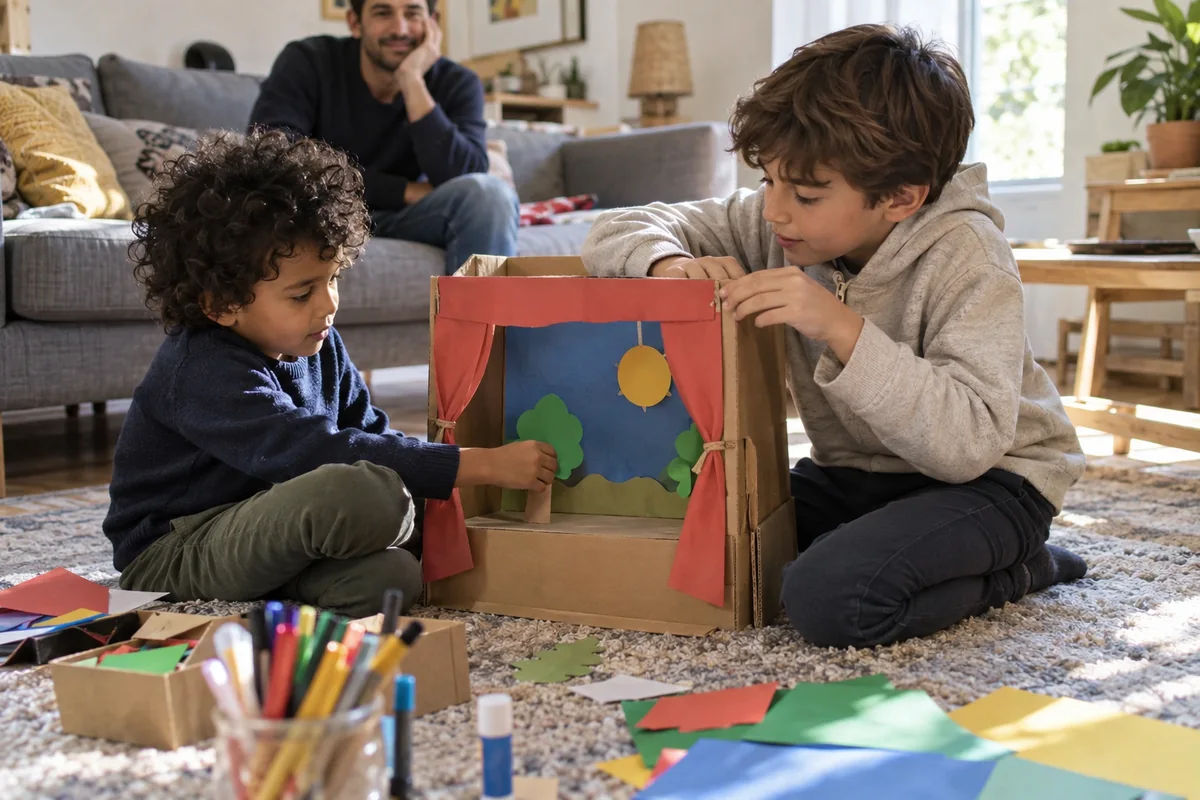
Give everyone a way to participate. The younger child selects colors while the older one cuts cardboard under supervision; roles can then be swapped depending on the activity and everyone's abilities. For a drawn story, one child invents the character and the other creates the scenery. You can also place two sheets of paper side by side and connect them with an imaginary road.
Avoid putting the older child in charge of the younger one's work. Each child creates their own part and can ask the adult for help. If the children don't want to do the same thing, share a common table while allowing two different activities. Shared creation doesn't require everyone to agree on the final result.
Use music or movement as a trigger
An action song can make children want to move their hands before drawing or building. The Titounis nursery rhyme featured below is suitable for young children; you can watch it together, then close the media player and repeat the gestures screen-free. It is optional: making up your own rhythm works just as well.
After moving around, invite your child to draw the shape they imagined or create a dancing character. The transition from movement to creation should be free and open. If your child prefers to keep dancing or stop altogether, follow their lead rather than insisting on a finished craft.
The idea box game
Write or draw three prompt ideas on slips of paper: invent an animal, build a fort, or draw a map. Your child can pick one, change it, or pick another. Save the box for another day, or empty it after playing.
Make room for breaks and new ideas
UNICEF describes play as a way for children to explore and learn. In everyday life, it can be as simple as trying out a shape, building something, and starting over. You don't have to turn every bit of free time into an educational exercise. Play can remain pressure-free, light, and open-ended.
When interest fades, put the supplies away and try again another day. You can flip through illustrated activity books for new ideas, but home creations don't require any workbook. A Hepaly preview sample is available for families who wish to view the pages before choosing a book.