
Table of Contents
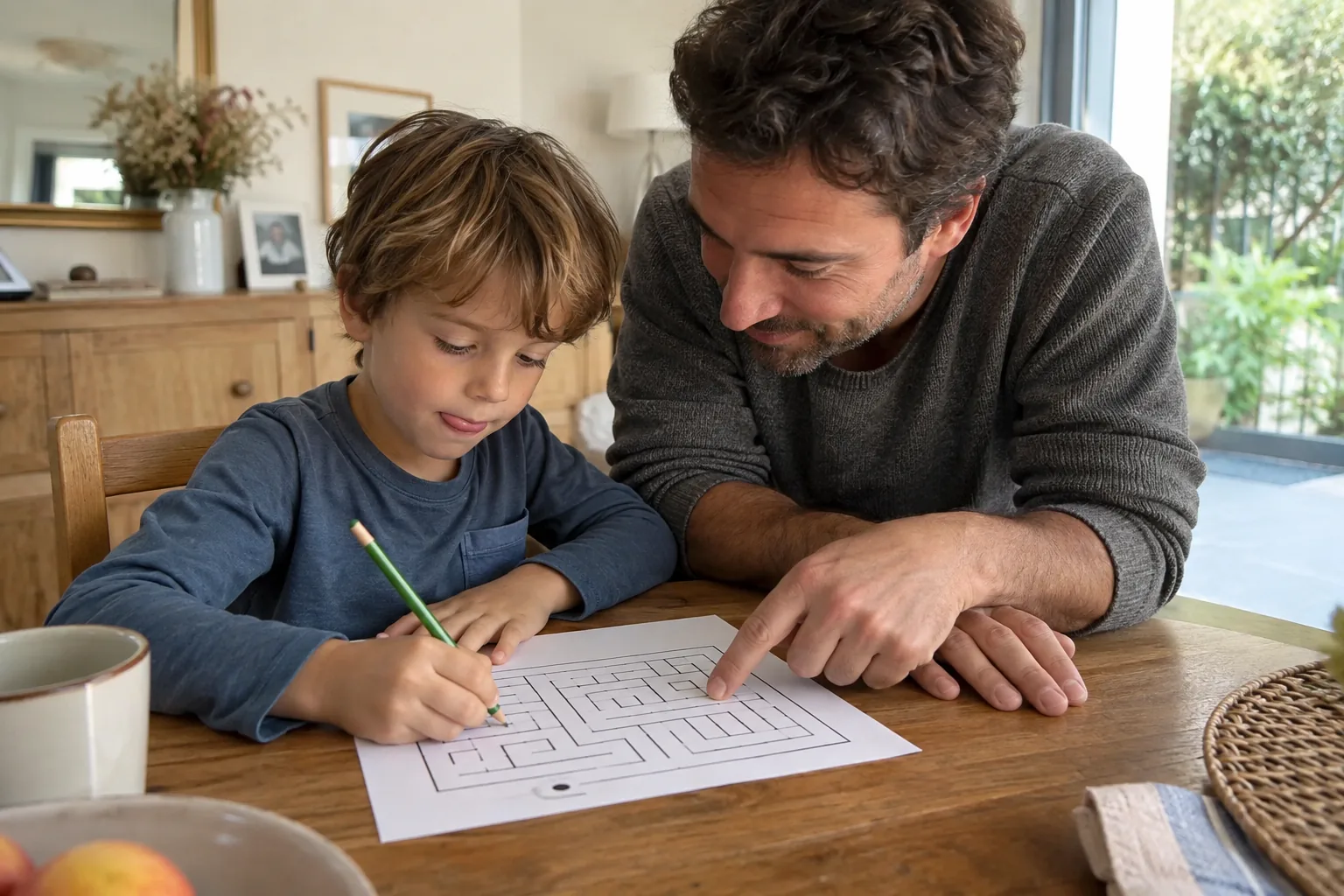
To prepare a paper activity, create a set of printable mazes with answer keys.
A child's maze is a path to trace from start to finish. A green circle at the start, a star at the exit, with corridors, turns, and dead ends in between. Mazes are among the favorite activities for children aged 4 to 10, and for good reason: they offer a clear challenge, visible success, and the satisfaction of solving a puzzle independently. Behind this game lie real learning milestones: planning ahead, spatial orientation, and fine pencil control. Here is what mazes help develop, how to pick the right level for your child's age, strategies to guide them without giving away the answer, plus an interactive maze to solve together.
Skills that mazes build
When solving a maze, children must plan ahead: looking further down the page than the tip of their pencil, identifying intersections, and visualizing where each corridor leads. They also learn to abandon a wrong turn: when facing a dead end, they need to backtrack—a real effort for younger kids who tend to rush ahead.
Mazes also strengthen spatial orientation. Preschool learning guidelines specify that students should learn to navigate a path based on a visual plan or key inside the school or playground—which is exactly what a paper maze asks them to do. Finally, staying inside a corridor without hitting the walls builds fine motor precision, great preparation for handwriting. For details on pencil grip, which impacts this control, our holding a pencil properly guide offers age-by-age benchmarks.
Choosing the right level
An overly easy maze gets boring, while an overly hard one creates frustration. Two settings shift the challenge: corridor width, which sets the physical control needed, and the number of turns and dead ends, which challenges reasoning.
| Age | Maze type | How to complete it |
|---|---|---|
| 3–4 years old | Very wide corridors, one or two intersections | With a finger first, then with a thick crayon |
| Ages 5–6 (K–1st grade equivalent) | Medium corridors, a few dead ends | With a pencil, pausing at intersections |
| Ages 7–8 | Numerous dead ends, varied shapes | With a regular pencil and an eraser |
| Ages 9–10 | Multi-level mazes, bridges, rules to follow | Independently, timing themselves for fun |
Simple mazes for beginners
A beginner maze is defined by visual clarity rather than total size. Before offering one, check four details: wide enough paths so the pencil doesn't bump the borders, clearly marked start and exit points, very few turns, and short dead ends. A first maze should be tried with a finger, then a pencil. If your child completes it effortlessly, step up the difficulty in small increments: first add more turns, then include a few dead ends.
For kids in kindergarten through 2nd grade (equivalent to French GS, CP, and CE1), the same core principle applies: pick a maze based on motor control and reading ability rather than exact grade levels. For early elementary ages, written instructions can be added, like "find the path that goes through the key." For learning to write their name, which relies on similar hand control, our article on writing your name in preschool takes over.
Helping without giving away the answer
When your child gets stuck, resist the urge to draw the solution. Here are a few prompts to guide them independently:
- Finger first: explore the path using a finger, picking up the pencil only once the route is found.
- Pause at intersections: stop at every split in the path and look down each option before making a choice.
- Work backward: starting from the star and working back toward the beginning is often easier, as there are fewer paths near the exit.
- Mark off dead ends: drawing a small line across blocked paths closes them off, like a detective ruling out leads.
If frustration sets in, switch to an easier maze: a quick win rebuilds motivation for trickier challenges. Our logic riddles for kids nurture the same sense of persistence.
Milo's maze
This maze is randomly generated every round. Select a size, then help the green circle reach the star using your keyboard's arrow keys or on-screen buttons. The "Show solution" button draws the route.
Making your own mazes
Homemade mazes have a wonderful charm, and children love designing them for others:
- On grid paper, color a path, then add dead ends all around. For older kids, it is a real puzzle to design.
- On the floor, with masking tape, draw a large maze in the living room or hallway, to go through on all fours or with a toy car.
- With chalk in the yard, draw a giant maze to explore on foot.
- Out of cardboard with a marble, glue cardboard strips inside the lid of a shoebox, and guide the marble by tilting the box.
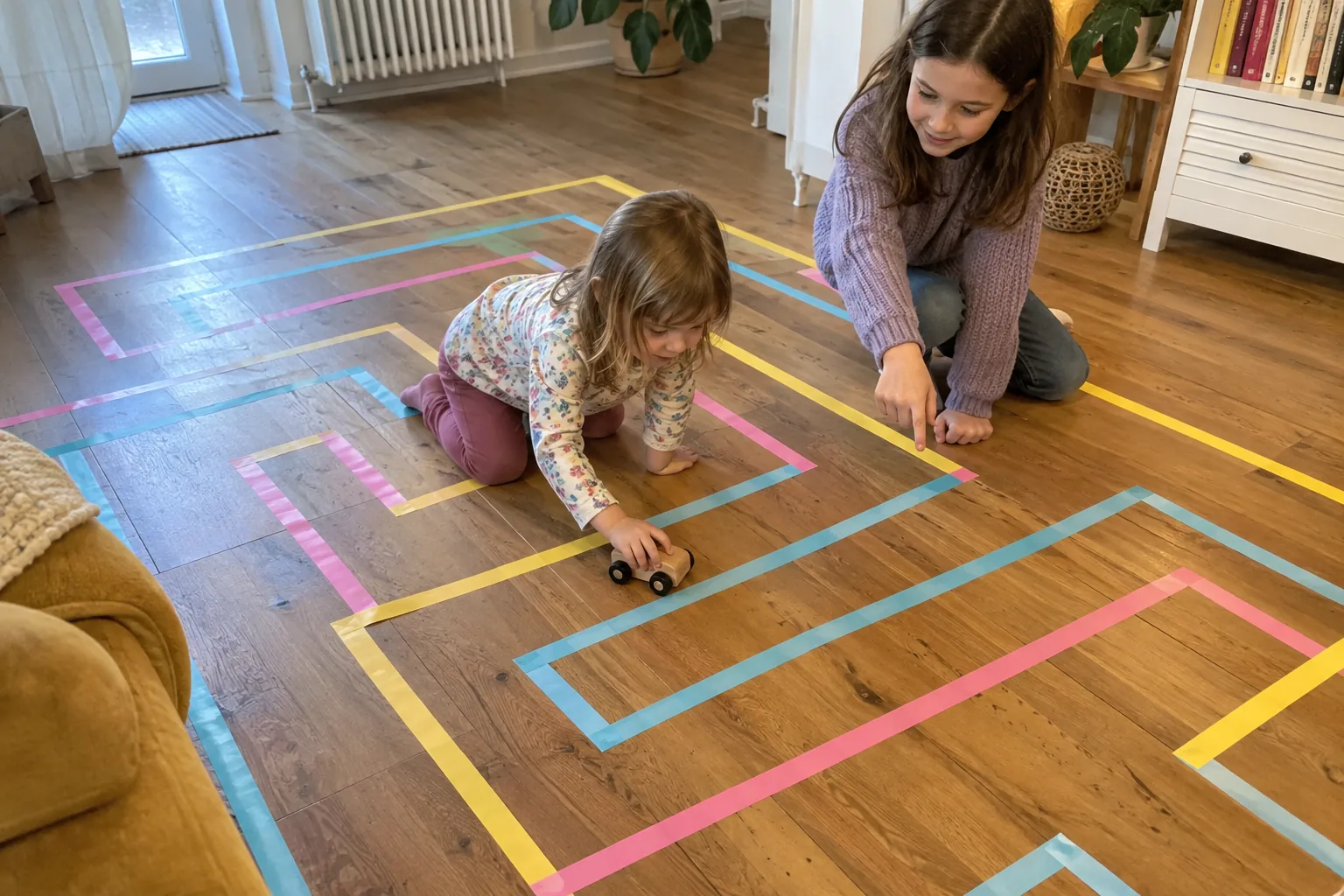
From maze to map
The maze is a first introduction to maps and floor plans. Extend the fun by drawing a map of the bedroom or the route to school together, then following a path on a map during a walk. And to turn the whole house into a playground, nothing beats a treasure hunt with a hand-drawn map.

Mazes are also great training for hand movement. For other games that prepare the hand for writing, check out our fine motor skills mini-games.
A maze’s walls and its route serve different roles. The open and closed line examples help name a passage or boundary before adding a route.
Frequently asked questions
At what age should you introduce mazes?
Starting as early as age 3, with very simple mazes with wide paths to follow with a finger. The difficulty then increases gradually with age and the child's skill level.
My child draws right through the walls with their pencil, what should I do?
This is common at first, out of impatience or because the paths are too narrow. Offer wider mazes, have them trace with a finger first, and remind them of the rule while playing: "The walls are made of lava!"
Do digital mazes on screens offer the same benefits?
They train anticipation and spatial awareness, but not pencil control. Alternate screen mazes with paper mazes and life-sized ones that also get the body moving.
My child gets upset when taking a wrong turn, how can I help?
Frame dead ends as normal: "Explorers take wrong turns too." Offer a shorter maze, praise their perseverance, and show them the trick of working backward from the finish line.
Which maze is right for a 5-year-old?
For a 5-year-old, choose medium-width paths with a few dead ends and few intersections, as shown in the table on this page. Start with a finger, then use a lead pencil, stopping at each intersection so they can see where the paths lead. If the maze is too difficult, stepping back a level is normal progress, not a failure.
How can I help a 1st grader succeed at a maze?
In 1st grade (around 6 years old), a maze with medium paths and a few dead ends works well, solved with a lead pencil. First, ask them to locate the finish line, then trace the paths with a finger before drawing. At each dead end, draw a small line across the path, and have the child resume from the last intersection. If the path remains elusive, try starting from the finish line, which is often easier to follow.
To go further
Preview before choosing
Les Petits Explorateurs · Ages 4–6
For preschool and early elementary children discovering shapes, numbers, and the fun of drawing lines. An adult reads the instructions.