
Table of Contents
- What does having the same number mean?
- What materials work for matching without counting?
- How do you check with one-to-one matching?
- How do you explain which group has more or fewer?
- Does a longer row always contain more objects?
- When is counting both groups useful?
- How can you keep the worksheet separate from its answers?
- What if the comparison is still unclear?
- Which activity makes sense after comparing groups?
- Frequently asked questions
Compare two groups by matching one object from each group. Each pair uses one item on each side. With nothing left over, both groups have the same number. Leftover objects show which group has more. The space a row takes up cannot prove its number of objects.
What does having the same number mean?
Two groups have the same number when every object can have one partner in the other group, with none left over. Their objects can be different sizes. Three large paper cards can match three small cards without covering the same area.
Try this with a child who is comfortable moving or pointing to objects alongside you. Reading an addition sentence is optional. For counting just one group, start with keeping track of every object. Comparing two groups answers a different question: does every object have a partner?
What materials work for matching without counting?
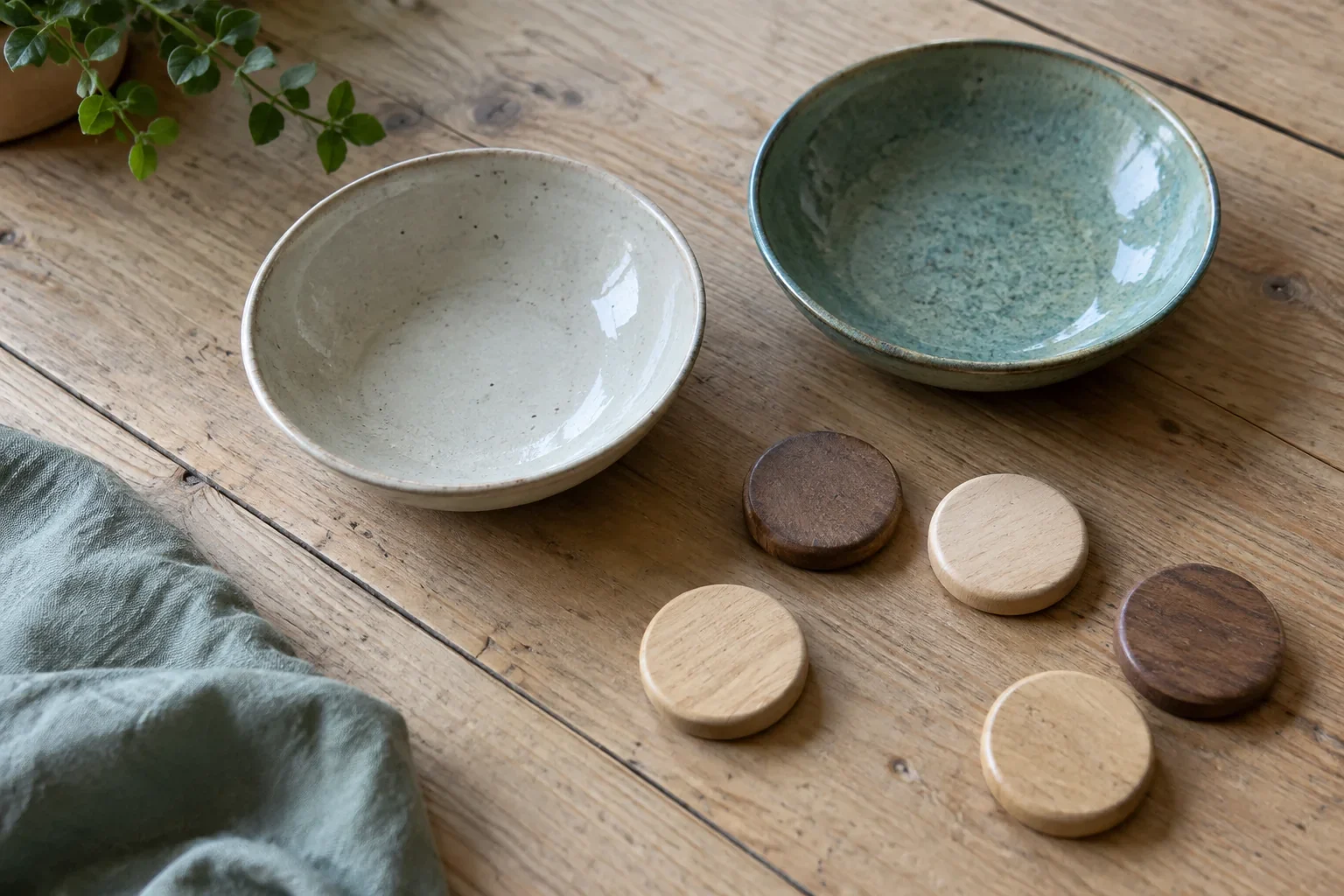
Use two spaces and large paper cards. Draw a circle on one set and a triangle on the other so color is not the only way to tell them apart. Choose a small group your child can comfortably handle rather than a number prescribed by age.
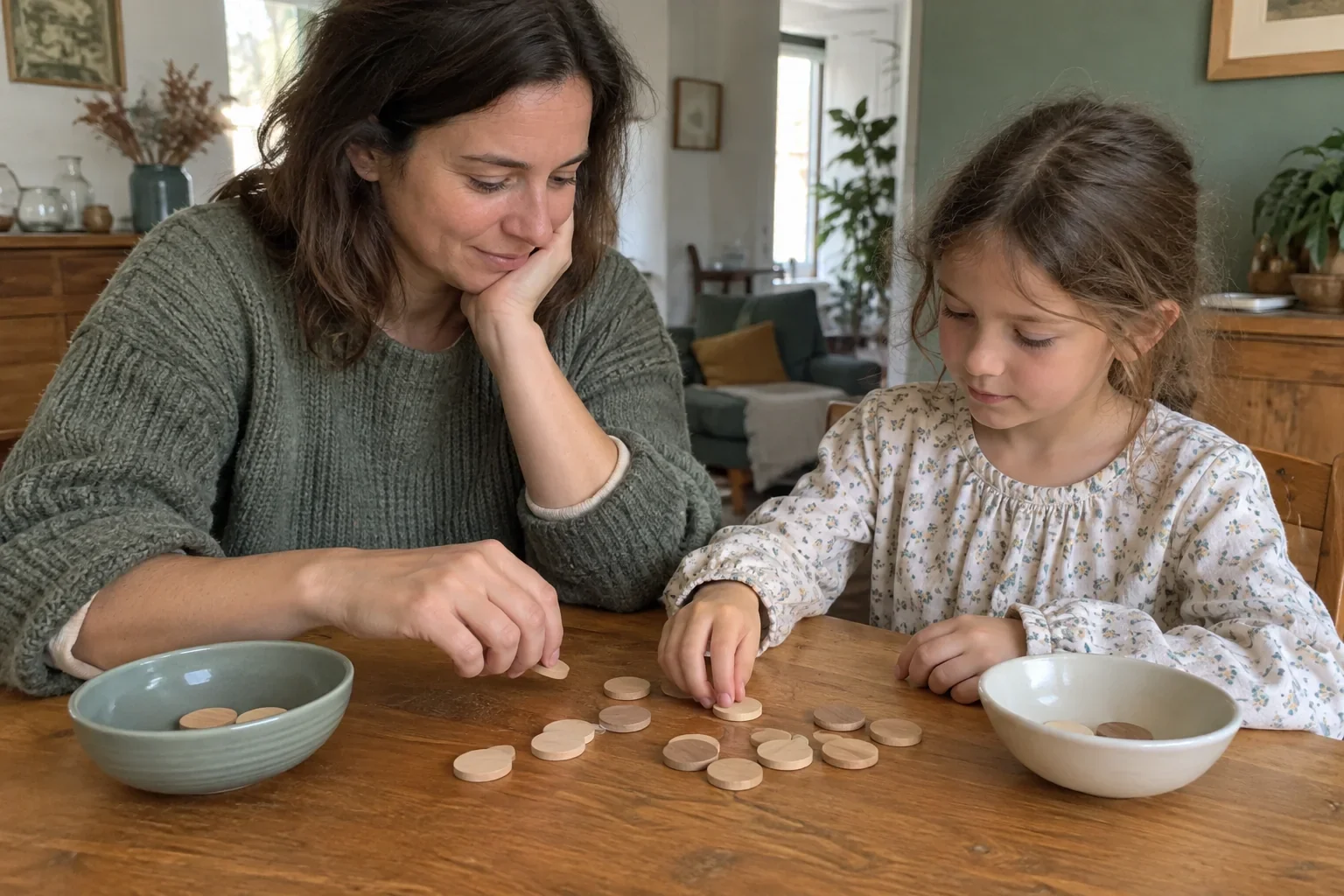
Stay nearby and choose materials suitable for your child. Avoid small loose parts if your child still mouths objects. The generated illustrations on this page show a possible setting; their objects are not an answer key.
How do you check with one-to-one matching?
Place one card from each group side by side. Make another pair with two unused cards. Keep completed pairs together so a card cannot quietly become a partner twice. Look at the objects still waiting, not only at the pairs already made.
France’s cycle1 mathematics program includes this way of comparing quantities. The ministry’s number guide also illustrates comparison without requiring a child to name the total first. These are teaching references, not an age-based deadline for your family.
Match the objects in pairs
Choose both quantities, then check pairs and leftovers. Changing a choice clears the previous result.
Check the result for the current choices.
Pairs: {p}. Unmatched circles: {a}. Unmatched triangles: {b}.How do you explain which group has more or fewer?
Name both groups. If there are more circles than triangles, there are fewer triangles than circles. Reversing the sentence does not change the objects. It only changes which group you are describing.
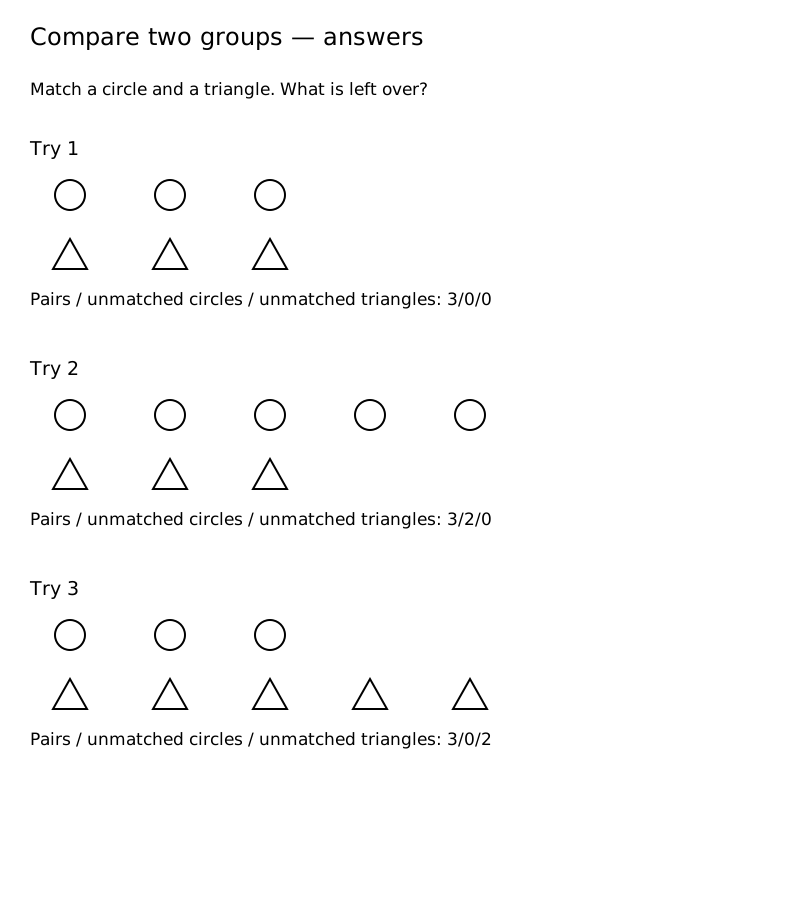
The examples below are constructed for this activity. Their pairs and leftovers are calculated, not a set of results every child must achieve. Ask your child to point to an unmatched object before focusing on the words. Saying only “more” can hide a different idea about which group is being compared.
| Circles | Triangles | Pairs | Unmatched circles | Unmatched triangles |
|---|---|---|---|---|
| 3 | 3 | 3 | 0 | 0 |
| 5 | 3 | 3 | 2 | 0 |
| 3 | 5 | 3 | 0 | 2 |
| 4 | 4 | 4 | 0 | 0 |
| 0 | 3 | 0 | 0 | 3 |
| 3 | 0 | 0 | 3 | 0 |
Does a longer row always contain more objects?
Spreading objects apart makes a row longer without adding anything. Begin with two equal groups, then spread out just one group. Match them again to check what changed: the gaps changed, while the number of objects stayed the same.
The spacing button in the activity changes the display only. Selected quantities remain visible. If your child gives a different answer after a rearrangement, check together. One uncertain answer does not establish an ongoing learning difficulty.
Which evidence would you choose?
The answer matches the pairs.Look at the unmatched objects, then try again.When is counting both groups useful?
Counting helps when objects cannot be moved or the groups are far apart. Record each total before comparing the numbers. Matching and counting are both ways to check a comparison; your child does not need to abandon one as soon as another becomes possible.
For an empty group, describe what you can see: no circle is available to match a triangle. Writing the numeral zero need not be a condition for playing. An observed empty group is different from a group nobody has checked yet.
How can you keep the worksheet separate from its answers?
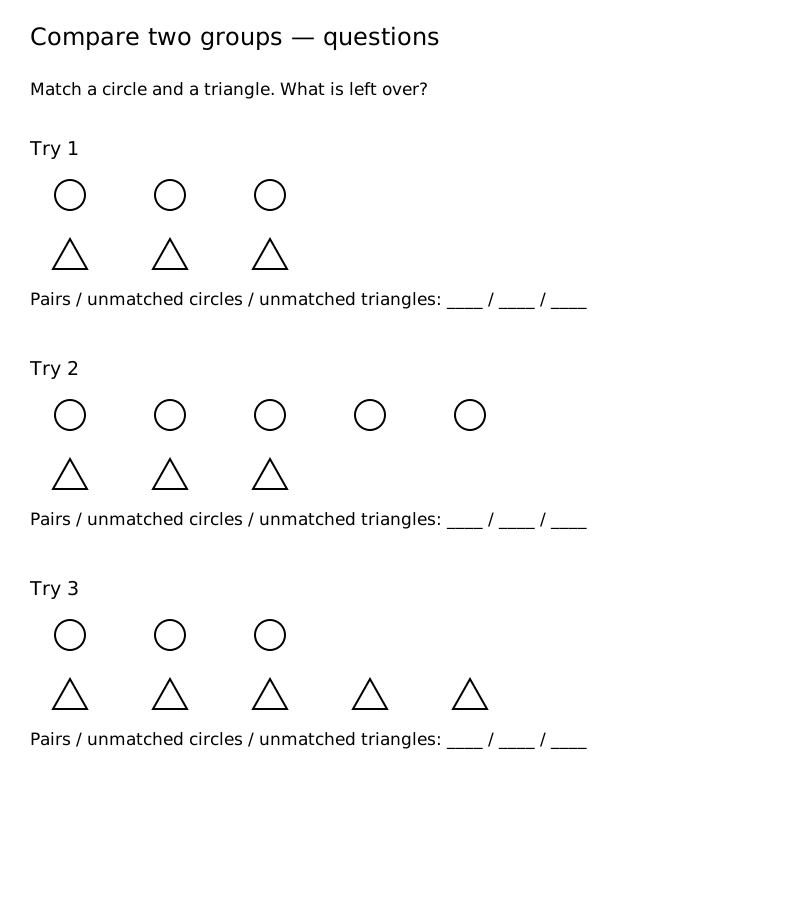
Open the question sheet first and keep the answer sheet out of sight. The files have different names. Your child can draw connecting lines or place large paper cards on the sheet; handwriting is not the goal of the comparison.
Both files use the same examples. A response can be shown with pairs, explained aloud or written with adult help. Check your printer preview before printing. Keeping an answer sheet separate gives time to work out a method rather than copying a number.
Open the separate answer sheet
What if the comparison is still unclear?
Check the question and the materials first. A card used twice, an object hidden under a sheet or a piece moved into the other group can explain an unexpected answer. Restore the setup before asking your child to try again.
Give a concrete invitation: “Show me the cards still waiting for a partner.” You can demonstrate one turn and describe what your hands are doing. Use fewer objects or stop if your child wants a break. There is no timer and no required streak of correct answers.
Prepare a clear comparison
Checked items: 0 of 5.
Checked items: {n} of 5.Which activity makes sense after comparing groups?
Follow your child’s next question. The number ten house splits one fixed collection between two spaces. A two-way sorting table sorts objects using two features. Those tasks require different checks, even if both use two areas on paper.
Browse the free activities for another format. Hepaly’s downloadable activity books provide more paper activities; the six commercial books remain in French. Buying one is not necessary to use this comparison activity.
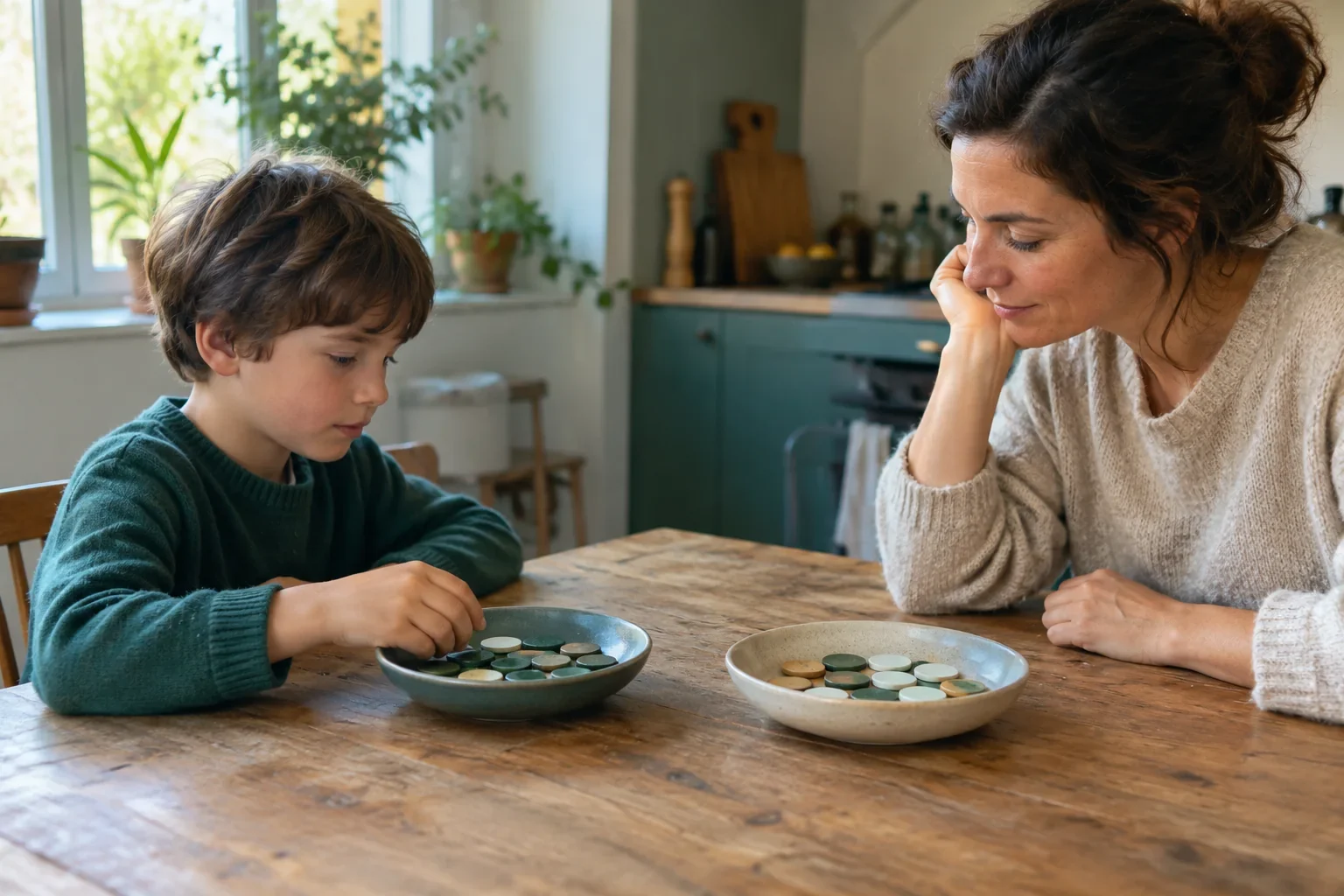
The English video offers another hands-on approach to one-to-one correspondence. Its materials and instructions differ from our sheets. Keep the cards nearby if you choose to watch and try a matching activity together.
Frequently asked questions
Does a child need to count first?
Matching can show equal groups or leftovers without naming both totals. Counting offers another check when the objects cannot be brought together.
Can the objects have different sizes?
Yes, when comparing the number of objects. A large card and a small card each count as one card. The area they cover is a different measure.
What if one card has two partners?
Separate that match and rebuild pairs with one card from each group. Keep finished pairs apart so you can see which cards are still available.
Are the greater-than and less-than signs required?
Words and objects are enough for this activity. Add symbols if they fit what your child is working on, without making them a requirement for playing.
Does a spread-out row have more cards?
Not if no cards were added. Bring them closer or match them with the other group to check the number independently of the spacing.
Can we use the sheets without JavaScript?
The question and answer files remain available. Read the examples and explanations, then use physical cards in place of the simulation.