
Table of Contents
- Which fall activity to pick today?
- Why do leaves change color?
- Why do daylight hours get shorter?
- Which leaf shapes can you observe?
- What should be avoided with horse chestnuts?
- How to plan a fall walk?
- What ideas to try outdoors and at home?
- How to adapt crafts to your child's age and stage?
- What supplies to keep on hand?
- Which activity to choose when it rains?
- Frequently asked questions
Which fall activity to choose today?
Start from your current setting and an action your child can try with you. The chart helps you choose a single activity, rather than a whole program to complete.
| Your situation | Simple idea | Adult's role |
|---|---|---|
| Paper at home | Tearing and assembling autumn foliage | Prepare a large enough backing sheet |
| Clean and dry leaves | Observe a crayon leaf rubbing | Hold the sheet in place if needed |
| An allowed walk outside | Look for colors without gathering items | Choose the location and guide the outing |
| Time in the kitchen | Wash familiar apples | Handle difficult cutting and heat sources |
Hepaly Workshop · choose
Which idea fits today's setting?
Ages are general guides: adapt to your child's current fine motor skills. Your choices are not saved.
All ideas, with or without JavaScript
Ages 4-6 · Create a paper leaf composition
Tear large pieces of paper and glue them onto a freeform outline. The adult sets up the glue and a large sheet of paper; the child chooses the colors. Continue this activity.
Ages 7-10 · Create a tree silhouette
Draw a trunk, then create two foliage arrangements using the same paper pieces. Compare what changes without asking for a realistic drawing. Continue this activity.
Ages 4-6 · Reveal a leaf vein
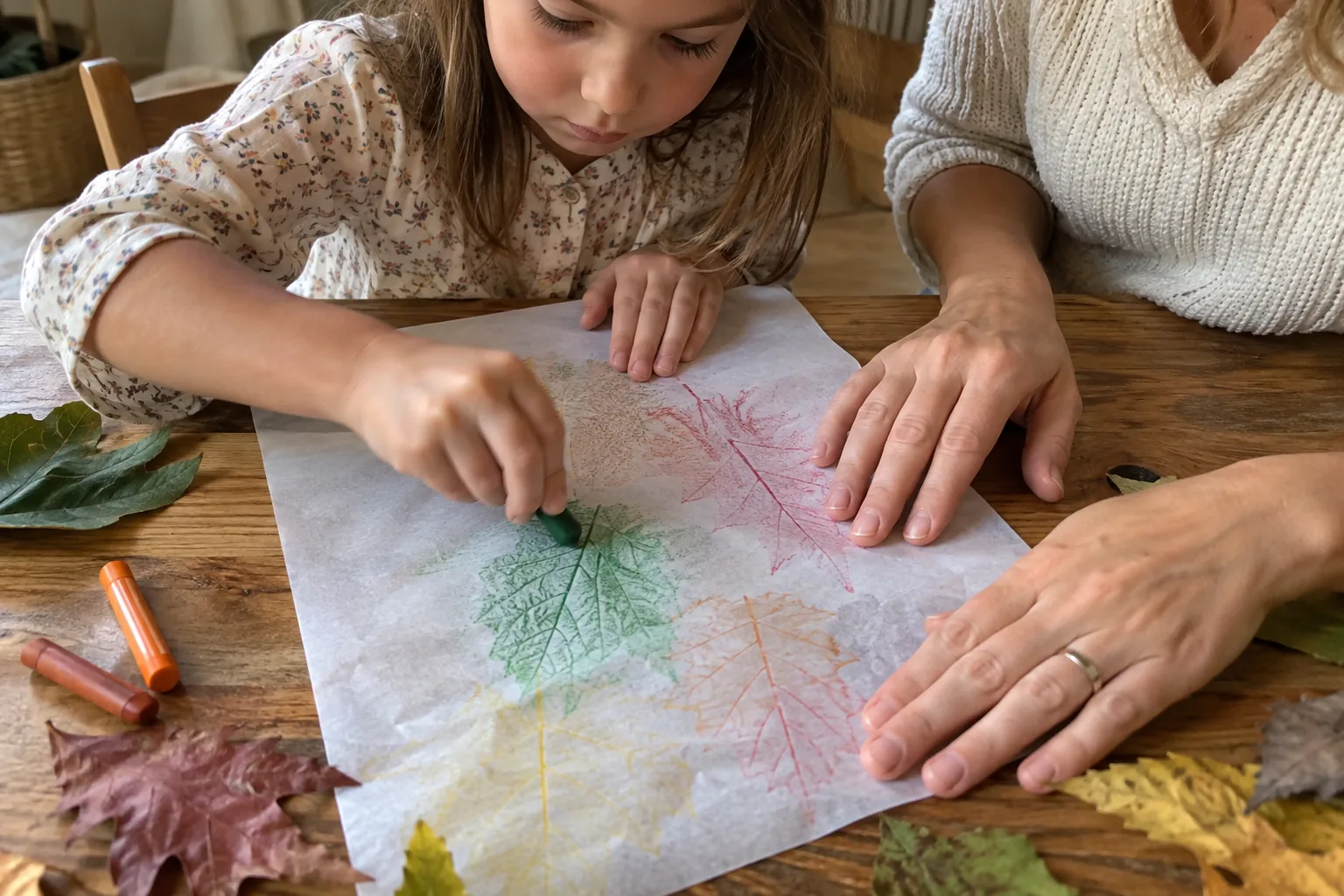
Place a clean, dry leaf under the paper. The adult holds it if it slips; the child tries rubbing with a crayon held flat. Continue this activity.
Ages 7-10 · Compare two leaf rubbings
Make rubbings of two different leaves, then describe the markings. Comparing shapes is enough; drawings cannot be used to identify edible plants. Continue this activity.
Ages 4-6 · Look for two colors to observe
Choose an allowed, clear route together. Point out colors on the trees or on the ground; there is no need to pick or bring home small fruits. Continue this activity.
Ages 7-10 · Find the same tree again
Observe an accessible tree from the same spot and note a few changes. Stay on the designated path; a photo or a drawing can take the place of collecting items. Continue this activity.
Ages 4-6 · Prepare apples with an adult
Your child can wash the apples and move the pre-cut pieces. The adult handles difficult cutting and hot utensils. Use familiar store-bought food, not items collected in the park. Continue this activity.
Ages 7-10 · Observe making applesauce
Divide tasks according to actual skill levels: washing, comparing pieces, or stirring away from heat. The adult remains responsible for tools and cooking. Continue this activity.
Hepaly Workshop · review
Which safety guidelines should you prepare before the activity?
This checklist helps review your choices; it does not guarantee safety in every situation.
0 / 5
Checklist reviewed. Stay attentive to the situation and your child's reactions.
Why do leaves change color?
In spring and summer, leaves are filled with chlorophyll, the green pigment that allows trees to make food using sunlight. In fall, the days grow shorter, and chlorophyll is no longer renewed. The green color gradually disappears, revealing other pigments that were hidden: carotenoids, which are yellow and orange, the same ones found in carrots. Red and purple colors come from different pigments, anthocyanins, which certain trees produce at the end of summer. This explanation comes from the French National Museum of Natural History.
Why do days get shorter?
In mainland France, days shorten during fall. The 2026 equinox occurs on September 23, according to IMCCE ephemerides; the chart begins the day before and displays calculated estimates for Paris, not local sunset times.
Estimates rounded to the nearest minute, theoretical horizon, and standard refraction; terrain and weather are not modeled. Daylight saving time changes affect local clock time, not this astronomical duration.
Source: Hepaly calculation, approximate NOAA solar equations; latitude 48.8566° N, zenith 90.833°.
View chart data
| Date | Day length |
|---|---|
| Sept. 22 | 12 h 16 min |
| Sept. 29 | 11 h 51 min |
| Oct. 6 | 11 h 26 min |
| Oct. 13 | 11 h 01 min |
| Oct. 20 | 10 h 37 min |
| Oct. 27 | 10 h 13 min |
| Nov. 3 | 9 h 50 min |
| Nov. 10 | 9 h 28 min |
| Nov. 17 | 9 h 08 min |
| Nov. 24 | 8 h 50 min |
| Dec. 1 | 8 h 36 min |
| Dec. 8 | 8 h 24 min |
| Dec. 15 | 8 h 17 min |
For a shared observation activity, record what you see from the same spot on several different dates. Do not confuse nightfall, sunset, and day length: they are not the same measurement.
Which leaf shapes can you observe?
When you return from a walk, spread your harvest on the table and play detective. Here are six easy-to-identify leaves commonly found in parks and forests.
What safety precautions should you take with horse chestnuts?
Horse chestnuts are toxic if ingested. Mistakes confusing them with edible sweet chestnuts are documented by ANSES (the French National Agency for Food, Environmental and Occupational Health Safety). The silhouettes and descriptions on this page cannot be used to determine if a collected item is edible: use known food products for cooking. If your child puts objects in their mouth, choose large paper cards instead. If a horse chestnut is ingested, contact a poison control center immediately.
How to prepare for an autumn walk?
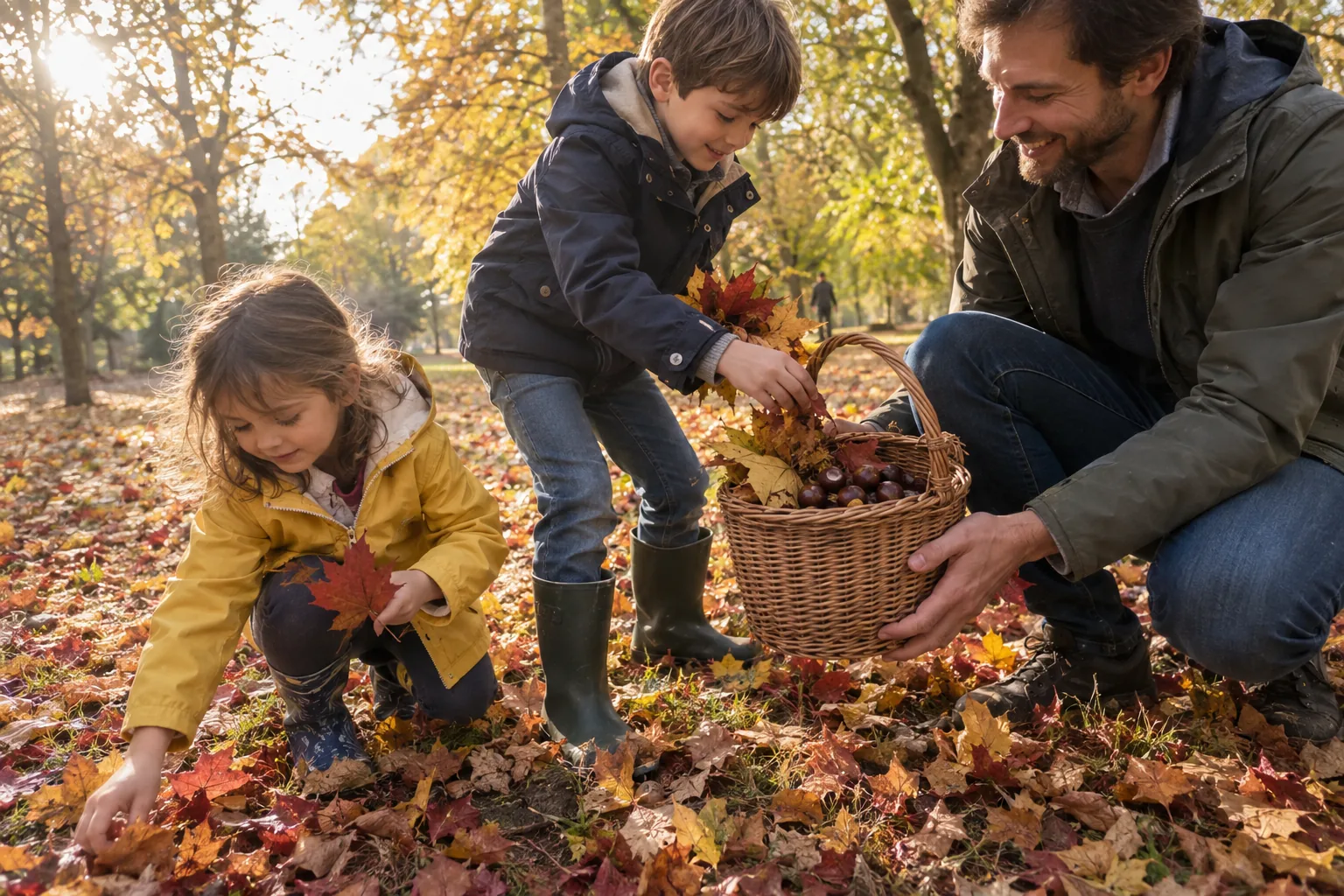
Choose an authorized trail and a question to observe. Before, pick a park or woods, bring a basket and a question of the day, such as: how many different colors will you find? During, collect only what has fallen on the ground, and keep horse chestnuts far away from the mouths of little ones. A list of items to find (a red leaf, a pinecone, an acorn) turns the walk into a treasure hunt. When you get back, spread the harvest out on a table and sort it by color or shape, using the six activity sheets in this article. In the evening, pick just one activity, like leaf rubbing or a herbarium, so that it remains fun.
Which ideas to try outdoors and at home?
- The color hunt: find a leaf of each color, from green to red, and arrange them in a gradient.
- Leaf rubbing: a tree leaf under a sheet of paper, a crayon flat on its side, and the veins appear.
- The herbarium: dry the prettiest leaves between two sheets of newspaper, under heavy books, until dry, checking the leaves and paper regularly.
- The autumn wreath: leaves glued onto a cardboard ring to decorate the front door.
- The hedgehog: a pinecone, paper eyes, and a small playdough snout.
- The leaf mandala: arrange leaves, acorns, and horse chestnuts in circles, outside or on a large sheet of paper.
- Salt dough prints: press a leaf into the dough to capture its veins; see our salt dough recipe.
- The observation walk: observe shapes and colors from a clear walkway.
- The acorn race: roll them down an inclined board; which one will go the farthest?
- Land art: create a face, an animal, or a sun using ground finds, then take a photo.
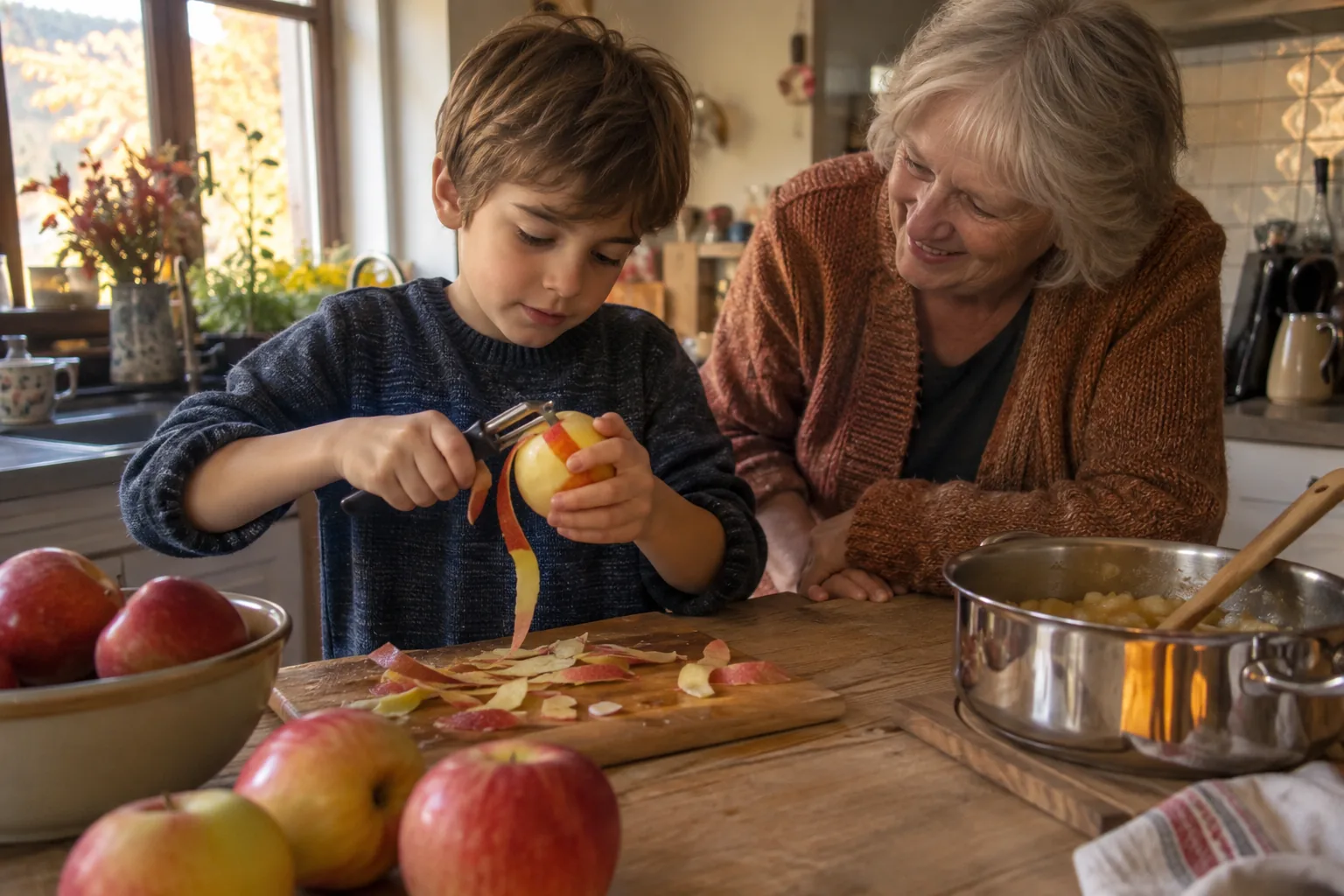
- Applesauce: wash the fruit and move the prepared pieces; the adult handles the chopping and hot utensils.
- Pumpkin soup: wash, stir, taste; chopping the pumpkin remains a task for adults.
- Tree journal: pick a tree and photograph it every week to watch its leaves change.
- The lantern: a jar decorated with glued leaves and an LED candle inside.
- Counting cards: opt for large paper cards if small objects might be put in the mouth.
To extend your outings, our article on turning a nature walk into an observation game offers more ideas, and our guide on cooking with children details age-appropriate steps.
How to adapt crafting to your child's milestones?
Adapt instructions based on the movements you observe. One child might prefer tearing paper while another wants to compare leaf prints; age alone doesn't determine what they can do. Start with a single step, show the materials, and allow them to just watch without joining in. For multi-step activities, prepare materials ahead of time and introduce one step at a time. Naming a tree or writing in a journal remains an optional guided activity, not a requirement to enjoy the outing.
What supplies should you keep on hand?
To enjoy autumn without running to the store, keep a few essentials near the door: a basket, paper bags, rain boots, a raincoat, a magnifying glass to look at leaf veins, and a notebook to write down discoveries. At home, keep newspaper for the herbarium, crayons for leaf rubbing, glue, blunt-tip scissors, and a large sheet of white paper for collages. Keep small nature finds out of reach of young children who put objects in their mouth; a pouch of large paper shapes offers a safe alternative.
Which activity should you pick when it rains?
Rain shouldn't stop you from enjoying autumn: with good rain boots and a raincoat, jumping in puddles is a full-fledged activity. And at home, yesterday's haul becomes today's craft supply: herbarium, rubbings, or treasure sorting. Collected leaves are also great for a memory game: show a few, hide them, and let your child find which ones disappeared. Early nightfalls also offer a wonderful opportunity to stargaze with children before bedtime. And in late October, make way for kid-friendly, non-scary Halloween activities.
To sort two traits with clearer rules than natural, variable leaves, use large illustrated cards. Our double-entry grid for children pairs shapes and colors or patterns, complete with activity sheets and separate answer keys.
To add a written clue to a fall scavenger hunt, use a paper card rather than writing on a fragile leaf. Our free Caesar wheel template gives both players the same key and provides a separate answer sheet.
For a small fall activity at home, hand over a card on a table rather than hiding it somewhere difficult to reach. Our printable Morse guide with an accessible key uses a short word and separate answer sheet, without lights or sound equipment.
Frequently asked questions
Which autumn activities should I pick for a 4- to 6-year-old?
Keep the idea short: observe two colors, make paper foliage, or try a crayon rubbing. Adapt steps and materials to your child; age doesn't set a fixed target for success.
What can I offer a 7- to 10-year-old?
They can compare two leaf rubbings, track changes in a tree, or invent a sorting system. Change one rule at a time and leave room for personal choices.
How do you make a herbarium with a child?
Place clean leaves between absorbent paper towels under a heavy, stable object. Check that they are fully dry before mounting them. Moldy leaves shouldn't be kept for crafts.
Are horse chestnuts safe for games?
They are toxic if ingested and unsuitable for children who put items in their mouth. Large paper cards can replace small collected items. In case of ingestion, contact a poison control center immediately.
Do we have to go out in the rain to do an autumn activity?
Going outside is not mandatory. Paper, drawing tools, and previously dried finds allow you to pick an indoor activity. Decide on outdoor trips based on real conditions and location.
Can you identify edible plants using leaf drawings?
The leaf outlines on this page are for observing differences; they are not sufficient for identifying edible plants. Never taste an unknown plant based on an illustration.
To go further
Preview before choosing
Les Petits Explorateurs · Ages 4–6
For preschool and early elementary children discovering shapes, numbers, and the fun of drawing lines. An adult reads the instructions.